

Short answer: 12C27 is the easier steel to live with — a fine-grained Swedish stainless that shrugs off rust and sharpens in a few minutes — while D2 holds a working edge longer in abrasive material like cardboard and rope. Pick 12C27 for a knife that rides in a sweaty pocket or gets used around food; pick D2 when cutting volume matters more than upkeep.
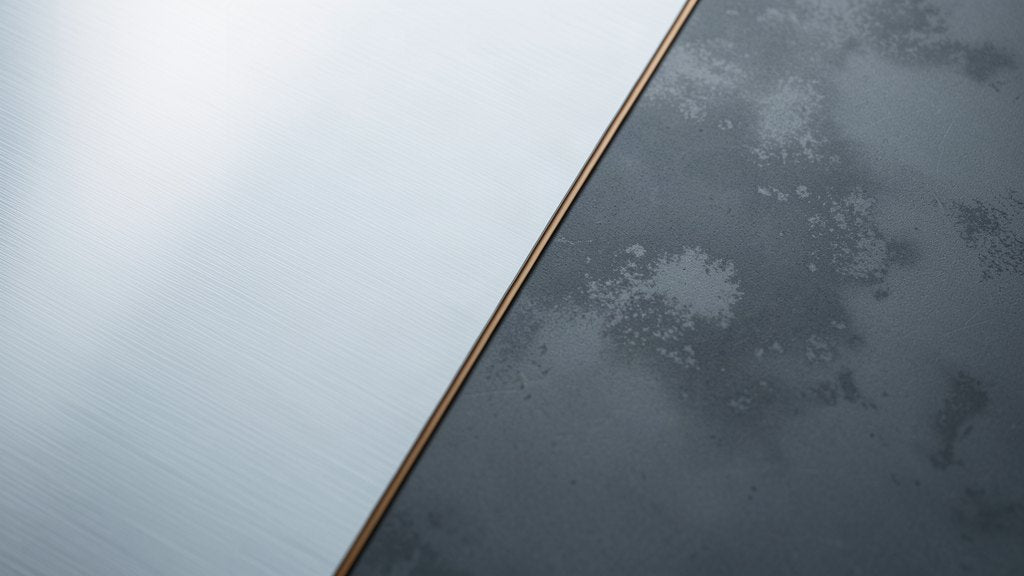
Fine carbides versus coarse: the structural difference behind most of the practical gaps between these two steels.
Both are budget-friendly standards, which is exactly why they end up compared so often. They are not close cousins, though. One is a low-carbon stainless built around fine carbides, the other a high-carbon tool steel built around wear resistance. Understanding that split tells you almost everything about how each one behaves on your belt.
What 12C27 actually is
12C27 is a Sandvik steel from Sweden: roughly 0.6% carbon and about 14% chromium, made as a very pure strip product. Knife Steel Nerds describes it as close in behaviour to AEB-L and 13C26, two fine-carbide stainless steels known for sharpness and stability rather than raw abrasion resistance.
The low carbon content is the part people skip past. More carbon means more carbide, and more carbide means a coarser structure. 12C27 stays fine, which is why a thin edge on this steel does not crumble the moment it meets a staple or a hard plastic band. It was used in production knives in Europe for decades partly because the strip stamps cleanly, which keeps manufacturing affordable — the same reason it turns up in sensible, everyday knives rather than showpieces.
What D2 actually is
D2 is a tool steel from the D series, the family used for dies and wear parts. Its published composition sits around 1.5% carbon, 11–13% chromium, about 1% vanadium, 0.9% molybdenum, 0.45% manganese and 0.30% silicon. Wikipedia's tool steel entry sums up the character neatly: very wear resistant, but not as tough as lower-alloyed steels, and very sensitive to heat treatment.
That last point matters more than most shoppers realise. A well-treated D2 and a rushed D2 can behave like two different alloys, so maker reputation counts for more with this steel than with a forgiving stainless.
Side-by-side comparison
| Property | 12C27 | D2 |
|---|---|---|
| Carbon | ~0.6% | ~1.5% |
| Chromium | ~14% | 11–13% |
| Carbide structure | Very fine, low volume | Large, high volume |
| Edge retention (abrasive work) | Moderate | High |
| Toughness / edge stability | High for its hardness | Lower — chips sooner at thin angles |
| Corrosion resistance | Good | Fair — marketed as semi-stainless |
| Sharpening effort | Low | Moderate to high |
| Heat treatment sensitivity | Forgiving | High |
Edge retention: D2's home turf
D2 was designed to survive abrasion in a stamping die, and that is exactly what a knife edge does when it slices through corrugated board, cable insulation, rubber hose or rope. The vanadium carbides in the structure are harder than the abrasive grit in paper and cardboard, so the apex wears away more slowly. In a warehouse or a workshop, that translates into fewer touch-ups per week.
12C27 does not try to compete here. It holds an edge well enough for everyday cutting, and it wears evenly rather than chipping out, but push it through a few hundred feet of double-wall cardboard and you will notice the difference. If edge holding is your single priority, D2 is the honest answer.
Toughness and edge stability: 12C27's side
A steel full of large carbides has planes where a crack can start. That is why tool steels like D2 are described as less tough than lower-alloyed grades: sharp impacts and sideways loads find the weak spots. In practice, a thin D2 edge used to pry a paint lid or carve through a knot can chip, and a chipped edge is a longer repair than a dull one.
12C27's very fine carbides give it excellent edge stability at thin geometry, which is the quiet advantage of the Sandvik family. You can run a keener angle, the edge resists micro-chipping, and the blade feels crisp on soft material like fruit, packaging tape and twine. For a pocket knife that gets used carelessly rather than deliberately, that forgiveness is worth more than a wear-resistance score.
Rust: the biggest practical difference
D2 is often marketed as semi-stainless because 11–13% chromium sits right around the fuzzy threshold where steel starts forming a protective oxide layer. Knife Steel Nerds points out the flaw in that shorthand: with 1.5% carbon, a large share of the chromium is tied up in carbides instead of sitting in the matrix where it can build the passive film. The label promises more corrosion resistance than the structure delivers.
12C27 has the opposite arrangement — more chromium, far less carbon to consume it — so more of that chromium stays in solution and does its job. Leave a 12C27 blade damp in a pocket overnight and you will usually find it unchanged in the morning. Do the same with D2 and you may find speckling by the weekend, especially in humid weather or near salt water.
Sharpening: speed versus patience
12C27 is one of the friendlier stainless steels on a stone. The carbides are small, the alloy resists clogging, and a burr forms quickly. A simple two-stone setup and five minutes gets you a clean, aggressive edge, and the steel is happy to be refined further on a fine ceramic or a strop.
D2 asks for more. Its vanadium carbides respond best to diamond or good quality ceramic abrasive, and the steel rewards light, consistent passes instead of heavy pressure. Because the alloy is heat-treatment sensitive, aggressive power sharpeners that build heat are a genuine risk. Both steels take a fine edge; 12C27 simply arrives there with less fuss.
Which one fits your week
- Office or city carry, humid climate: 12C27. Low maintenance, no rust anxiety, sharpens on a coffee break.
- Food, fruit and picnic duty: 12C27. Acids and wet hands are its normal environment.
- Warehouse, farm or workshop cutting: D2. Cardboard, hose and abrasive stock reward the wear resistance.
- Coastal or boat use: neither is ideal, but 12C27 is the safer bet; rinse and dry either way.
- First serious folder: 12C27. It teaches sharpening without punishing small mistakes.
Care routines that actually differ
For 12C27, maintenance is close to a formality: wipe the blade after use, add a thin film of oil every few weeks, and keep the pivot clean. It does not need to be babied, which is the point of buying a stainless in the first place.
D2 needs a habit, not a ritual. Dry the blade before it goes back in the pocket, keep a light oil film on it, and check under the scales now and then, since moisture hides there. A little discolouration is normal on a tool steel and not a defect; red rust is the signal to change something about your routine.
Where each steel shows up in a lineup
Both alloys are common across budget and mid-range folders, which makes comparison shopping easy. If you want to see how 12C27 is used in practice, the 12C27 collection covers the stainless side of the range; the D2 collection shows the tool-steel option, often at slightly lower prices for the same pattern. For a wider look at blade materials across the catalogue, the knife types index is a useful starting point, and the folding knives section is where most of these steels land.
Geometry matters as much as the alloy
Steel choice gets the attention, but grind and edge angle decide most of what you feel in use. A thin, high grind in 12C27 will out-slice a thick, low grind in D2 on soft material, simply because there is less material to push through the cut. Conversely, a thick D2 blade with a conservative angle will survive work that would roll a thin stainless edge.
This is why the comparison is never purely about steel. If a maker runs 12C27 thin and hard, it behaves like a precision cutter with modest wear resistance. If the same maker runs D2 thick with a sturdy bevel, you get a working blade that needs less maintenance but feels less nimble. Check the stock thickness and grind before you assume the steel name tells the full story.
A quick buying checklist
- Look at the use case first. Cutting volume versus maintenance tolerance is the real decision.
- Ask who heat treats it. With D2 especially, the maker's process does much of the work.
- Check the grind. Full flat and thin stock suit 12C27; saber or scandi grinds pair well with a tougher, thicker blade.
- Budget for upkeep. D2 is not expensive to own, but it does require a cloth, a light oil and a habit.
- Ignore the "semi-stainless" label. Treat D2 as a steel that rusts slowly, not as one that does not rust.
Bottom line
12C27 is the better everyday steel for most people: it resists corrosion, sharpens quickly, and tolerates a thin edge without drama. D2 is the better working steel for anyone who genuinely wears out edges on abrasive material and does not mind drying and oiling the blade. Neither is a compromise — they are simply tuned for different jobs, and knowing which job you actually have is the whole decision.
For background on the metallurgy, Knife Steel Nerds has a detailed write-up on AEB-L and the Sandvik fine-carbide family and a separate piece on how much chromium D2 really has in solution.

Leave a comment
This site is protected by hCaptcha and the hCaptcha Privacy Policy and Terms of Service apply.