

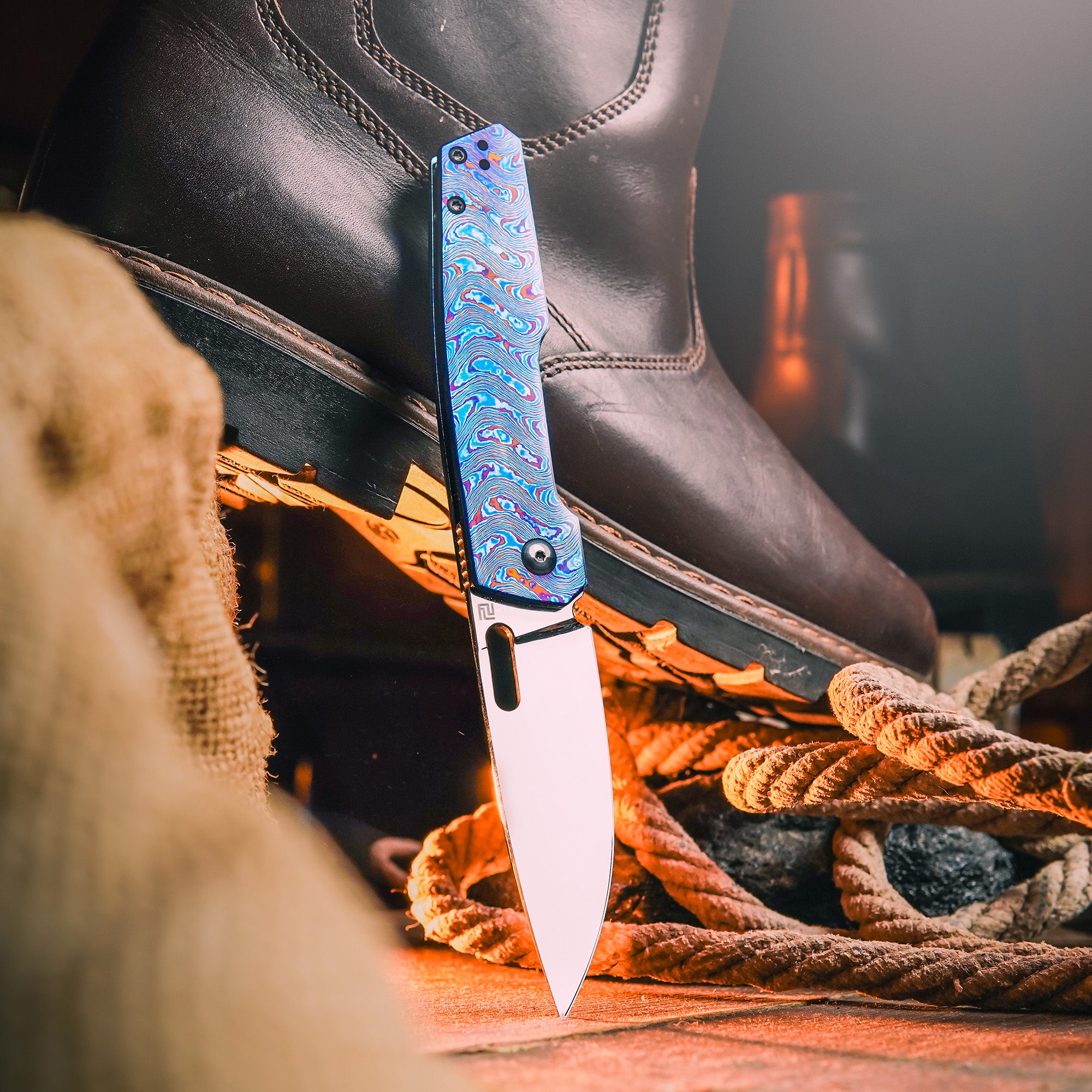
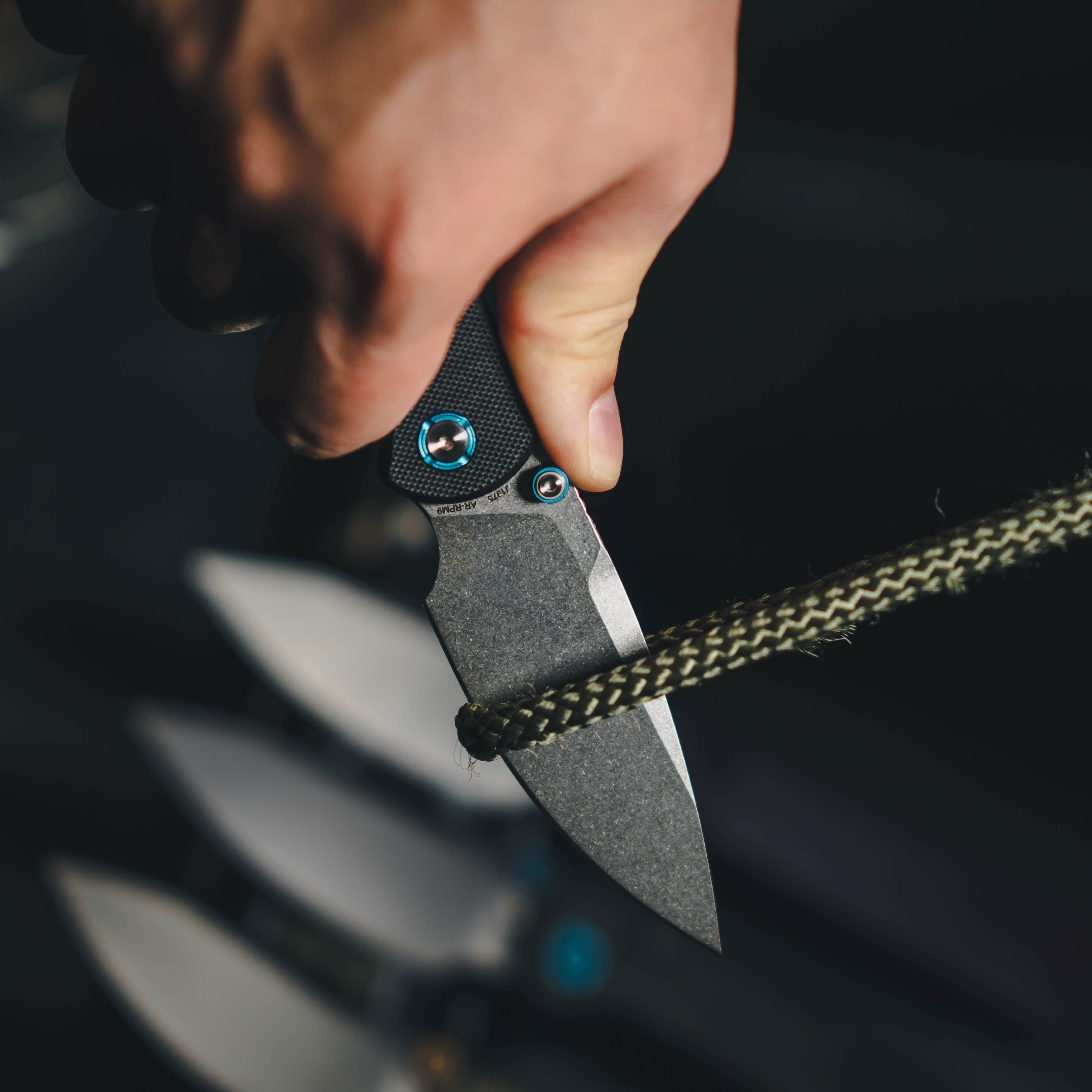

Artisan Cutlery's premium tier is built around titanium frame locks with high-hardness powder steels, and two of the most interesting models in that group are the Fragarach 1879G and the Tomahawk 1815G. Both are full-size folders, both use a ceramic ball bearing pivot, and both are heat treated to HRC 60-62. The differences that actually matter are in the blade stock, the blade steel, and the handle package. This comparison walks through the published specifications side by side so you can decide which one belongs in your pocket.
Two premium powder steels, one frame lock platform: the choice comes down to blade stock and edge retention.
Fragarach vs Tomahawk at a Glance
| Specification | Fragarach ATZ-1879G | Tomahawk ATZ-1815G |
|---|---|---|
| Blade material | CPM S90V | M390 |
| Blade hardness | HRC 60-62 | HRC 60-62 |
| Blade length | 3.72 in (94.5 mm) | 3.94 in (100 mm) |
| Blade thickness | 0.13 in (3.2 mm) | 0.16 in (3.98 mm) |
| Blade style / grind | Drop point, flat grind | Drop point, flat grind |
| Blade finish | Black PVD coating / sand polish | Satin |
| Handle material | Titanium + Fat Carbon | Titanium |
| Lock type | Frame lock | Frame lock |
| Pivot | Ceramic ball bearing | Ceramic ball bearing |
| Overall length | 8.56 in (217.5 mm) | 8.98 in (228 mm) |
| Closed length | 4.84 in (123 mm) | 5.04 in (128 mm) |
| Weight | 150 g (5.29 oz) | 145 g (5.11 oz) |
| Designer | Wayne Walter | Artisan Cutlery |
Blade Geometry: A 100 mm Blade or a 94.5 mm Blade?
The Tomahawk carries the longer blade at 3.94 in (100 mm) against the Fragarach's 3.72 in (94.5 mm). More important for cutting feel is the stock thickness. The Tomahawk runs a substantial 0.16 in (3.98 mm) blade, while the Fragarach is noticeably thinner at 0.13 in (3.2 mm).
- Tomahawk: a thicker flat-ground drop point that takes more lateral abuse and holds up to harder use without feeling fragile behind the edge. The trade-off is a blade that wedges more in dense material.
- Fragarach: thinner stock behind the same flat grind, so it separates material more easily and feels quicker through cardboard, rope and packaging. Less steel also means a lighter, more portable feel in the hand.
Both are drop points with a flat grind, so neither is a specialised slicer or a dedicated piercer. The Tomahawk is the more substantial tool, the Fragarach the more refined one.
Steel: M390 vs CPM S90V
This is the real decision point, because both steels are powder metallurgy products with a reputation for holding an edge far longer than conventional stainless.
M390 is a Böhler-Uddeholm martensitic chromium steel made with the company's third-generation powder metallurgy process. It is described as a fine-grained alloy with very high wear and corrosion resistance, popular for high-end folders, with a working hardness up to 62 HRC. Artisan hardens the Tomahawk's M390 to HRC 60-62, which is the top of that range.
CPM S90V comes from Crucible and was first introduced in 1999. It is a Crucible Particle Metallurgy steel based on the AISI 420 family with a very large vanadium addition, which is what gives it its extreme wear resistance and strong stain resistance. In practice S90V is the more wear-resistant of the two and the more abrasive-resistant in slicing, while M390 is generally regarded as the more corrosion-resistant and the friendlier of the two to sharpen.
Neither steel is easy to sharpen at home. Both reward a diamond or ceramic system, and both will hold a working edge through weeks of cardboard and tape rather than days.
For deeper reading, the Knife Steel Nerds analysis of S90V and S125V and the zknives M390 composition overview both cover the metallurgy in detail, and Wikipedia's article on powder metallurgy explains the manufacturing step both steels share.
Handles, Weight and Carry
The Tomahawk uses a titanium handle with a titanium clip, and it weighs 145 g (5.11 oz). The Fragarach pairs a titanium frame with Fat Carbon inlays and a titanium clip at 150 g (5.29 oz). Fat Carbon is a layered carbon fibre composite, so the Fragarach's handle mixes the strength of a titanium frame with a lighter, warmer and more visually layered scale material.
On paper the Tomahawk is the slightly lighter knife despite being the longer one, and it is also the slimmer carry at 5.04 in (128 mm) closed against the Fragarach's 4.84 in (123 mm) - the Fragarach is the shorter package, the Tomahawk the thinner one.
Both use a frame lock, which means the lock bar is formed from the handle itself: there is no separate liner to add play, and the interface wears in rather than out. Both also run a ceramic ball bearing pivot, which is the reason the action on this tier of Artisan knives feels different from a washer-based budget folder.
Price and Model Position
At retail the Fragarach 1879G lists at $199.99 and the Tomahawk 1815G M390 lists at $224.99. Both belong to model families that reach well below their flagship pricing:
- The Tomahawk name also covers D2 liner lock versions with G10 or Micarta handles from around $45-$60, a D2 fixed blade, and Damascus and titanium versions, so the Tomahawk buyer can choose a price point rather than a single knife.
- The Fragarach is a tighter line built around S90V, including prototype runs, which makes it the more collectible of the two.
Which One Should You Carry?
Choose the Tomahawk ATZ-1815G if:
- You want the longer blade and heavier stock for harder, more varied work.
- You prefer a satin finish over a coated blade.
- You want M390's balance of corrosion resistance and wear resistance.
- You want to stay within a model family that also offers budget D2 builds.
Choose the Fragarach ATZ-1879G if:
- You want maximum edge retention from CPM S90V.
- You prefer thinner blade stock that slices more freely.
- You like the titanium and Fat Carbon handle package, and the thumb hole opener documented on the 1879G.
- You want a Wayne Walter design with a smaller closed footprint.
The Shared Platform: Frame Lock and Ceramic Bearings
Strip away the steel and the scale material and the Fragarach and the Tomahawk are the same class of knife mechanically. Both are frame locks, which means the lock bar is cut from the handle slab itself rather than from a separate liner. The user-facing consequences are worth knowing before you buy either one:
- Fewer parts, less play. A frame lock has no liner to move against the scale, so there is one less interface that can develop rattle over years of use.
- Lock-up wears in, not out. The lock face mates with the blade tang progressively as the knife is opened, which is why a new frame lock often feels slightly stiff in the first week.
- Grip matters. Because your fingers wrap the lock bar, how you hold the knife influences how firmly it locks - which is why frame locks are usually paired with a choil or a thumb ramp.
Both knives also run a ceramic ball bearing pivot, and that is the single biggest reason this tier of Artisan Cutlery folder feels different from a washer-based budget knife. Ceramic bearings do not corrode, they are not sensitive to the light oiling that steel bearings require, and they tolerate the fine grit that finds its way into a working knife.
Maintenance Expectations
Neither knife needs a routine. A titanium frame lock with a powder-steel blade, a titanium clip and a coated or satin finish is a wipe-down-and-carry object: blow out the pivot when it picks up grit, add a drop of oil if the action slows, and keep the edge touched up rather than waiting for it to go completely dull. The only two things worth planning for are the ones the specifications imply.
First, both steels are hard. M390 at HRC 60-62 and S90V at HRC 60-62 will resist a pull-through sharpener and will reward a diamond or guided system instead; expect to spend real time on the first full sharpening and very little time on each subsequent touch-up. Second, if you choose a PVD-coated Fragarach variant, remember that the coating sits on top of the steel - normal cutting wear on a coated blade is cosmetic, not structural, and it should not be sanded or polished away.
The Bottom Line
These two Artisan Cutlery folders are not direct substitutes. The Tomahawk is the bigger, thicker, more utilitarian titanium frame lock, and the Fragarach is the thinner, more wear-resistant, more collected one. If you value steel performance above all, S90V is the stronger claim; if you value a blade that can take rougher use with extra stock behind the edge, the Tomahawk earns its place. Either way you are buying the same foundation: a titanium frame lock, a ceramic bearing pivot, a titanium clip, and a hardness of HRC 60-62.
Explore the full range of Artisan Cutlery folding knives, browse every CPM S90V model, or see the complete catalogue in the all products collection for premium everyday carry.

Leave a comment
This site is protected by hCaptcha and the hCaptcha Privacy Policy and Terms of Service apply.