

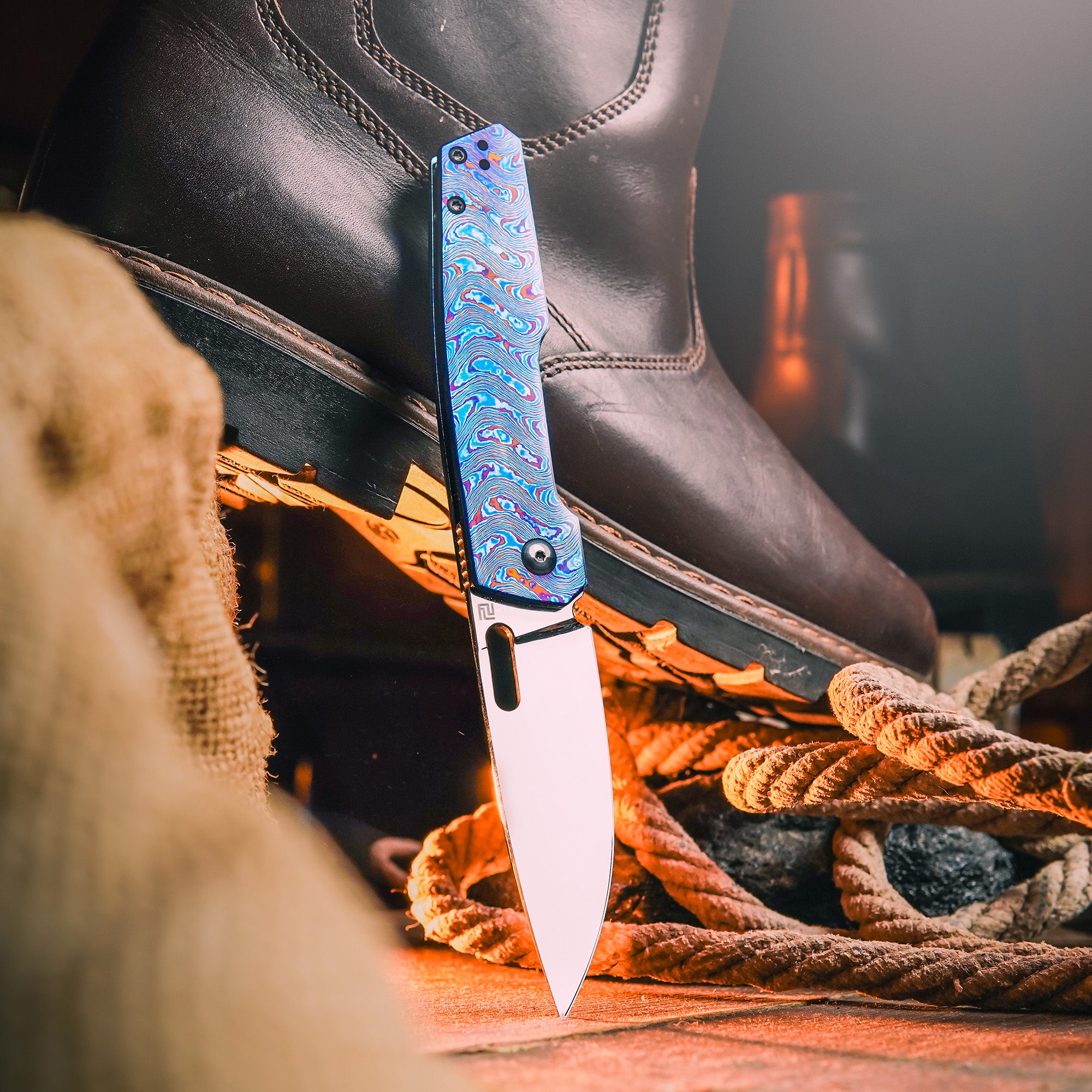
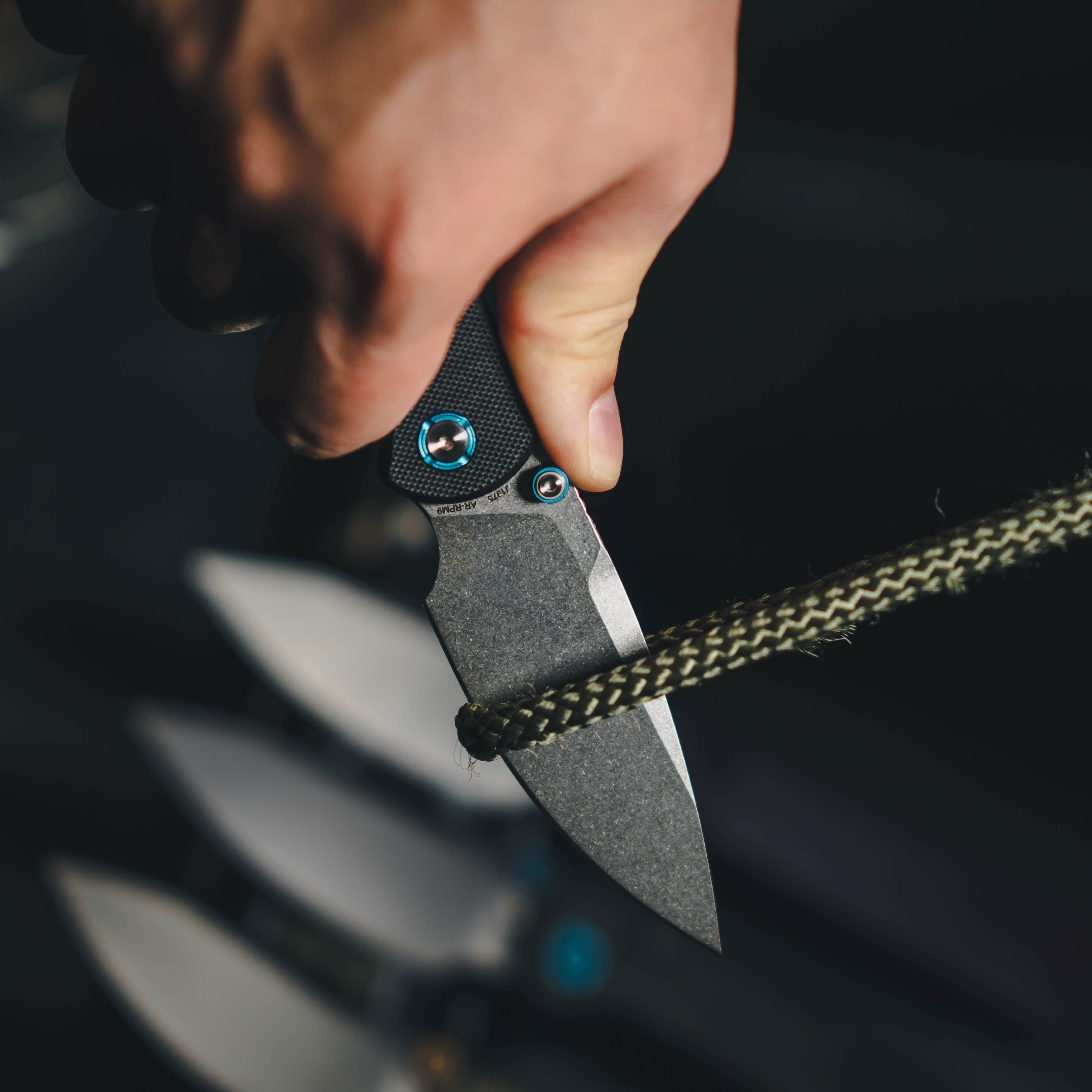

The Artisan Cutlery Kakapo (ATZ-1898G) is one of the most distinctive pieces in the brand's 2026 prototype run. Designed by Dustin Rhodes — the same hand behind the popular Mousebird — the Kakapo is a compact titanium frame lock that trades spectacle for restraint. As Artisan describes it, the design 'brings all the wildness and flair of previous designs, but delivers that in a more tame package.' This review breaks down the Kakapo's verified specifications, its materials, and why limited prototype pieces like this matter to collectors.
The Kakapo pairs a 3-inch S35VN sheepsfoot with a titanium frame lock at just 98 grams.
Artisan Cutlery Kakapo at a glance
Everything below comes from the official product listing, so the numbers are exactly what Artisan publishes for this prototype model.
| Specification | Kakapo ATZ-1898G |
|---|---|
| Designer | Dustin Rhodes |
| Blade steel | S35VN, HRC 60–62 |
| Blade length | 3" (76 mm) |
| Blade thickness | 0.13" (3.2 mm) |
| Blade style | Sheepsfoot, flat grind |
| Blade finish | Stonewash or black PVD coating |
| Overall length | 6.85" (174 mm) |
| Closed length | 3.86" (98 mm) |
| Handle material | Titanium or crystal titanium |
| Clip material | Titanium |
| Pivot | Ceramic ball bearing |
| Lock type | Frame lock |
| Weight | 98 g / 3.46 oz |
| Availability | Limited prototype run |
Dustin Rhodes and the Kakapo design philosophy
Dustin Rhodes is one of the most recognizable names in the designer-collaboration side of the knife world. His Mousebird — a thumb-hole, top liner lock folder — established his reputation for compact, characterful designs with a clear point of view. The Kakapo takes that same personality and wraps it in a more practical package: a 3-inch sheepsfoot blade, a slim titanium handle, and a frame lock that keeps the carry profile minimal.
The name is a nod to the flightless New Zealand parrot, and the design follows the same logic — grounded, sturdy, and built for real-world use rather than show. Where some prototype releases push exaggerated shapes, the Kakapo's appeal is its restraint: clean lines, a neutral blade shape, and premium materials doing the talking.
S35VN blade: a proven super steel
At the heart of the Kakapo is CPM S35VN, a powder-metallurgy stainless steel made by Crucible Industries. It is one of the most widely used premium steels in production folding knives because it balances edge retention, toughness, and corrosion resistance without demanding a specialist's sharpening routine. Artisan specifies a hardness of HRC 60–62, right in the sweet spot where the steel holds an edge well while staying practical to touch up.
The blade is a sheepsfoot with a full flat grind — a combination that makes the Kakapo a natural choice for utility work: controlled cuts, slicing, and detail tasks where a pointed tip would be a liability. The 0.13-inch stock keeps it thin enough to slice well while remaining plenty rigid at this blade length. Two finishes are offered: a low-maintenance stonewash and a black PVD coating for a more stealthy look. For a deeper dive into how S35VN behaves, Knife Steel Nerds' S35VN analysis is the definitive read.
Titanium and crystal titanium handles
The Kakapo's handle is machined titanium, which keeps the whole knife at a remarkably light 98 grams despite a 3-inch blade and a full frame lock. Titanium offers the classic premium combo — stiff, corrosion-proof, and featherweight — and it allows the frame lock to be integrated directly into the handle scale, eliminating extra lock hardware. The pocket clip is titanium as well, which means the entire external hardware package matches.
For collectors, the highlight of the run is the crystal titanium variant. Crystal titanium is a decorative heat-treated finish that grows iridescent, shifting color patterns across the surface of the metal — each piece ends up unique. At $399.99, the crystal version is the flagship of the Kakapo line, while the standard stonewash and black PVD titanium versions sit at $266.65.
Why prototype runs matter to collectors
Artisan's prototype releases are small-batch pieces that preview what the brand is developing, and they have become a reliable source of collector interest. Because production numbers are limited and the designs often never return in exactly the same form, prototypes frequently become the most sought-after models in a maker's catalog. The Kakapo is a textbook example: it pairs an established designer name with a first-run finish option (crystal titanium) that is unlikely to be repeated at the same price. For anyone who follows knife collecting, picking up a prototype at release is one of the few ways to own a genuinely scarce piece without paying a secondary-market premium later.
How the Kakapo fits into Artisan's lineup
The natural comparison is the Mousebird, Dustin Rhodes' earlier Artisan folder. The Mousebird is a thumb-hole design with a top liner lock and a smaller footprint; the Kakapo steps up to a 3-inch blade, a more conventional frame lock, and a ceramic ball bearing pivot for smoother action. Both are EDC-sized, but the Kakapo's sheepsfoot blade and stronger lock make it the more utility-oriented of the two. If you already carry a Mousebird and want the same designer's take on a sturdier workhorse, the Kakapo is the direct upgrade path.
Sharpening and upkeep
S35VN at HRC 60–62 responds well to a standard progression of stones: a coarse stone for reprofiling, a medium stone for routine sharpening, and a strop for finishing. Because it is a stainless steel, the Kakapo needs almost no corrosion care — wipe it down after use and keep the pivot clean. If you opt for the black PVD blade, avoid aggressive abrasive cleaners on the coating and sharpen only the exposed bevel edge. A light application of a good knife lubricant on the pivot keeps the ceramic bearings spinning smoothly.
Who should buy the Kakapo?
The Kakapo is for three kinds of people: collectors who follow Dustin Rhodes' designs, EDC users who want a premium 3-inch sheepsfoot in a featherweight titanium frame lock, and anyone who appreciates the one-of-one appeal of crystal titanium. It is not the cheapest way into an Artisan folder — the standard versions run $266.65 and the crystal variant $399.99 — but for a limited prototype with this designer pedigree, the pricing is in line with comparable small-batch releases.
In the hand: ergonomics and carry profile
With a closed length of just 3.86 inches and a weight of 98 grams, the Kakapo disappears into a pocket in a way its blade length might not suggest. The titanium handle is slim and smooth-edged, and the short blade-to-handle ratio keeps the knife compact when closed while still offering a full three inches of cutting edge when open. The 6.85-inch overall length gives a comfortable four-finger grip for most hand sizes, and the sheepsfoot profile means the working edge stays close to the handle — a configuration that makes controlled, precise cuts easier than with a longer, more swept blade.
Carrying the Kakapo is as fuss-free as a titanium knife gets: the material is impervious to sweat and moisture, so the handle and clip will not develop rust or patina even in humid climates or after a day of hard use. The frame lock means there is no liner to snag on pocket fabric, and at under 3.5 ounces the knife is light enough that you will forget it is there — until you need it.
The crystal titanium finish explained
Crystal titanium is worth a closer look because it is the feature that makes the Kakapo stand out in a crowded field of titanium folders. The finish is produced by a controlled heat treatment that grows an oxide layer on the titanium surface; depending on the exact temperature and timing, the oxide layer interferes with light to produce shifting colors — blues, golds, greens, and purples that change as the angle of the light changes. Because the result depends on precise conditions rather than a printed pattern, no two crystal titanium pieces come out exactly alike. That inherent uniqueness is a large part of why the $399.99 crystal Kakapo is the variant collectors are watching most closely. The standard stonewash and black PVD titanium versions share the same build and action at $266.65, so the crystal finish is purely a premium aesthetic choice.
The Kakapo among Artisan's 2026 prototypes
The Kakapo is part of a notable 2026 prototype wave from Artisan, which also includes the Henning Marxen-designed Marlin, the Mike Gavac-designed Baskin, and the ultra-light M14-V1. All of them share the same formula — premium steel in a titanium frame lock, released in limited numbers — but they are aimed at different hands. The Marlin is a heavier 143-gram, 3.47-inch drop point for users who want a bigger blade; the M14-V1 is an even lighter 73-gram wharncliffe; and the Kakapo splits the difference at 98 grams with a 3-inch sheepsfoot. If you want the most versatile blade shape of the batch, the Kakapo's sheepsfoot is the strongest argument — it is the safest, most utility-focused profile of the group, and it pairs with the mid-weight carry that most EDC users will find easiest to live with.
Maintenance and the titanium finish
Routine care for the Kakapo is minimal. The S35VN blade is stainless, so rust is not a practical concern; a wipe with a dry cloth after use and an occasional light oil on the pivot is all the regular maintenance the knife asks for. On the black PVD variant, keep abrasive cleaners away from the coated flats and sharpen only the bevel edge. On the crystal titanium variant, treat the handle finish gently — aggressive polishing compounds could strip the oxide layer that creates the color play, so stick to mild soap and water for cleaning. The ceramic ball bearing pivot needs little attention: bearings run clean and smooth for long stretches, and a single drop of thin lubricant every few months keeps the action glassy.
Find your ideal everyday carry configuration — explore the Artisan Cutlery folding knife collection for premium EDC folders built for reliable everyday carry.

Leave a comment
This site is protected by hCaptcha and the hCaptcha Privacy Policy and Terms of Service apply.