




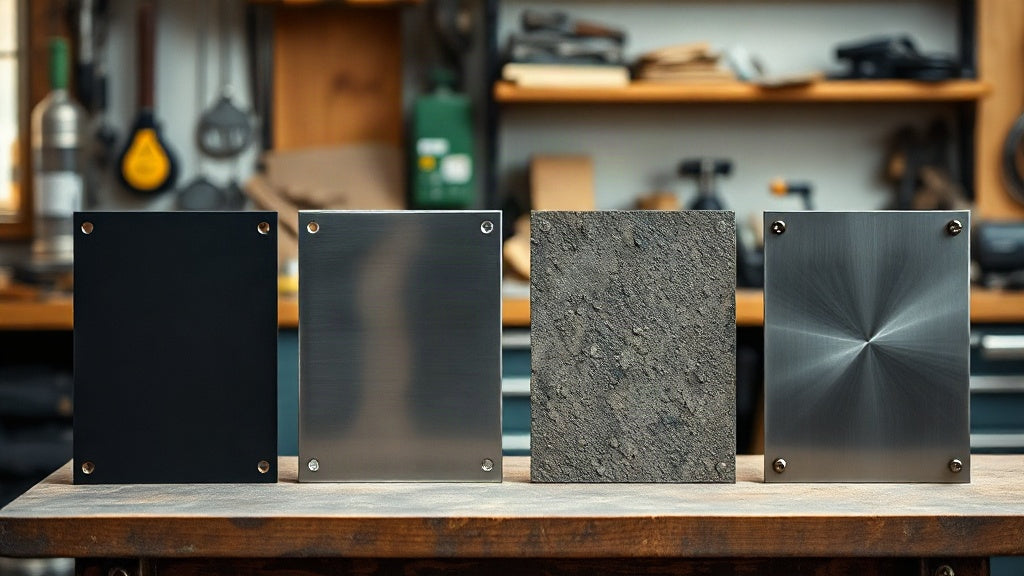
Blade finish is a price-band decision and a returns decision before it is an aesthetic one. In our own catalog of 452 folding knives that carry a stated blade finish, satin is almost never a budget option — 21 of 26 satin SKUs sit at $120 or above — while stonewash combined with black PVD clusters at the bottom, with 57 of 81 SKUs under $60. If you are building a price ladder for a store or a private-label run, the finish tells you where a knife is meant to sit on the shelf.
This guide is written for buyers, store owners and brand managers who have to defend a sourcing decision to a spreadsheet. It covers the finishes you will actually be quoted, what each one costs you in complaints and rework, and the questions that separate a controlled coating run from a batch you will regret in month three.
Why the finish is a margin decision
A blade finish changes three numbers in your model, and only one of them is the unit cost on the invoice.
Return rate. Coatings and polishes fail in predictable ways, and the failure shows up in the first weeks of use, not at unboxing. A customer who buys a black blade and finds the black worn to bright steel along the sharpened bevel will call it a defect even when it is normal wear. A retailer who buys a polished blade and finds fingerprints and hairline scratches on every piece after a weekend of handling will mark them down or write them off.
Handling cost at the store. Polished and satin surfaces require bagging, gloves or both during display. Stonewashed and coated surfaces absorb handling. That difference is paid in staff time on every restock, not on the purchase order.
Perceived tier. Buyers read finish as a signal before they read the steel. Getting the finish wrong for the price band makes a good knife look cheap, or a cheap knife look like it is overpriced.
What buyers actually get quoted
Five finish families cover almost everything in a folding knife program: stonewash, black PVD, stonewash with black PVD over it, sand polish, and satin. Acid etch is the sixth and, in practice, it belongs to Damascus blades rather than to a volume stainless program.
The table below is pulled from our own live catalog, using the blade finish and retail price recorded on each product's specification sheet. The retail band is public information you can check on any product page; it is here to show how finish correlates with positioning across a real assortment rather than to quote anyone a price.
| Finish | What it is | SKUs in catalog | Retail band observed |
|---|---|---|---|
| Stonewash | Tumbled with abrasive media until the surface is uniformly matte and slightly irregular | 142 | $29.99 – $299.99 (median $59.99) |
| Stonewash + black PVD | Stonewash texture underneath, thin black coating deposited over it | 81 | $29.99 – $266.65 (median $49.99) |
| Black PVD | Vacuum-deposited thin film, usually over a finer substrate finish | 97 | $29.99 – $452.00 (median $59.99) |
| Sand polish | Fine abrasive polish, low sheen, flat reflection rather than a mirror | 79 | $32.98 – $609.00 (median $89.99) |
| Satin | Unidirectional belt-finished lines, the classic premium hand finish | 26 | $39.49 – $236.99 (median $198.76) |
| Acid etch | Chemically darkened surface, in this catalog used on Damascus only | 7 | $69.99 – $208.32 |
Two readings matter here. First, a finish is not a price tier by itself — stonewash spans almost the entire range, from a $89.99 stonewash S35VN liner lock to titanium frame locks at $299.99. Second, the finish mix at a given price is a design choice by the brand, and it is one you can negotiate around when you specify an exclusive or a private label.
PVD versus DLC: what the upcharge actually buys
Both are deposited in a vacuum chamber, which is why suppliers quote them together, but they are not interchangeable.
PVD is a family of processes that deposits a metal-bearing film a few microns thick. It takes color well — black, grey, bronze, gold tones — and it is the standard choice when a range needs to look coordinated across models. Its weakness is that it is thin: wear appears as the film thinning at contact points, and on a black blade that reads as a lighter burnished line along the edge bevel and the spine.
DLC is a carbon film with diamond-like bonding: harder than PVD, with a lower coefficient of friction, and effectively limited to dark grey and black. It resists abrasion better, costs more per blade, and — importantly for a program — it is less forgiving of a poorly prepared substrate. A DLC run on a blade that has not been cleaned and prepped properly will delaminate in patches, and that is a batch-level loss, not a single-unit return.
Three practical consequences for a buyer:
- Ask which film and which thickness. "Black coating" is not a specification. You want the process named and a thickness range in microns.
- Ask whether the edge is masked or coated. Coating applied over a finished edge changes the edge geometry slightly and wears off immediately in use, which looks like a defect. A masked edge (bare steel at the bevel) is the cleaner story at retail even though it requires an extra step.
- Ask for a batch color sample, then hold the rest of the run to it. Chamber runs vary. Two shipments three months apart can arrive visibly different under store lighting, and the customer will notice before you do.
Stonewash is the retail-safe default
Stonewash is the cheapest finish to produce well and the most forgiving once the knife leaves the factory. The irregular matte surface hides fingerprints, handling marks and the light scratches a display knife collects. It also hides the small finishing inconsistencies that a polished surface would advertise.
That is why stonewash dominates the entry and mid bands in every catalog I have audited, including ours: 72 of 142 stonewash SKUs sit under $60. It is not a compromise — it is the correct choice when the buyer cannot control how the knife will be handled after delivery.
Stonewash plus black PVD is the hardest-working combination in that band and the one with the most SKUs under $60 in this catalog (57 of 81). The texture underneath the film means that when the coating does wear at the edges, the wear is less visually stark than on a smooth black blade. If a store is buying a black tactical-looking assortment at a price that has to hold, this is the specification to ask for.
Where satin and polish earn their price
Satin is a directional belt finish. It produces clean parallel lines, reflects light in a controlled way, and looks like hand work because it largely is. Sand polish is flatter and slightly softer in appearance.
In this catalog satin behaves like a premium marker rather than a cost saver: 21 of 26 satin SKUs are $120 or above, and 24 of the 26 are paired with a powder-metallurgy stainless rather than a budget steel. Compare that with the two stonewash families, where the majority sits under $60. A satin M390 titanium frame lock at $209.99 and a satin and sand-polished M390 frame lock at $236.99 are telling the same story: the finish is being used to justify the tier.
The cost of that story is handling discipline. If you put satin in a blister pack on a pegboard and let customers open and close the knife, you will mark the blade. That is not a quality problem, it is a merchandising problem, and it argues for a boxed or bagged presentation and a staff-handled display for anything above roughly $120.
The five questions that separate a good coating run from a bad one
Whether you are buying a stock program or specifying a private label, these are the questions that determine whether the finish survives contact with customers.
- Adhesion test data. Ask for cross-hatch and tape-pull results, or a salt-spray hour count, on the specific steel you are coating. Not every steel takes a film equally well, and the answer changes with substrate preparation.
- Substrate before coating. A film over a rough grind looks rough. Ask what grit or finish the blade is taken to before deposition.
- Edge treatment. Masked edge or coated edge, as above. Get it in writing, because it is the single most common source of "the coating is coming off" complaints.
- Batch consistency. Ask how the factory controls color and gloss between runs, and request a retained sample from the first run to compare against later shipments.
- Sharpening instructions. Coated blades need guidance. If you are going to publish care instructions, ask what the factory recommends so your copy matches the product.
Matching finish to price band: a buying sequence
The workable order of operations for a new assortment is:
- Set the bands first. Decide your opening price point, your volume band and your flagship band, then work out how many SKUs each will carry.
- Assign finish by band, not by taste. Stonewash and stonewash-plus-PVD for the volume bands; one or two coated heroes in the mid band for visual pull; satin or a polished finish reserved for the flagship band where the presentation can carry it.
- Budget the handling cost. Anything polished needs bags, and probably staff handling. Add that to the landed cost comparison before you commit.
- Order a batch sample of the exact finish, not just the exact model. A sample in a different finish will not tell you how the color reads in your store lighting.
- Write the specification into the purchase order — process, thickness, edge treatment, color reference.
For a comparison across price tiers with real specification sheets attached, the $75.99 black PVD copper-handle knife and the $199.99 stonewash and black PVD titanium frame lock show the same finish family doing two different jobs across a $124 spread. That is the kind of pair worth putting in front of a buying committee — same visual language, two price points, one decision about which tier gets the volume.
Buying finishes at program level
Artisan Cutlery supplies folding knives to dealers, retailers and private-label brands, with stock programs and specified builds across stainless and powder-metallurgy steels. If you want to see how a finish family runs across our price ladder — or want a finish specified against a steel grade for your own line — the next step is the dealer application.
Wholesale pricing, MOQ and lead time are quoted per program. Every specification in this article — finish name, steel, blade length and retail price — is taken from the published specification sheet on our product pages, so you can check any claim against the source before it goes into your buying plan.



Leave a comment
This site is protected by hCaptcha and the hCaptcha Privacy Policy and Terms of Service apply.