

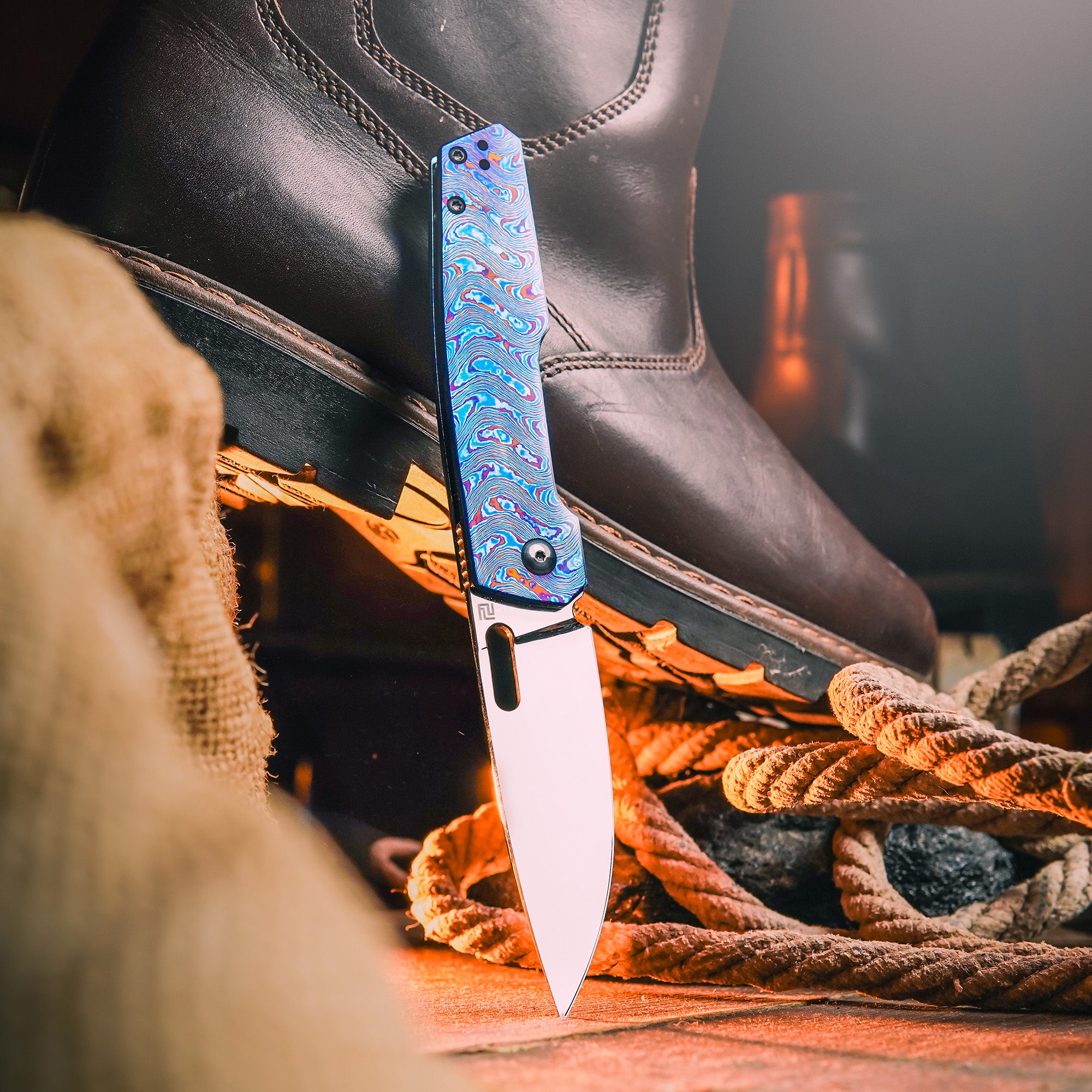
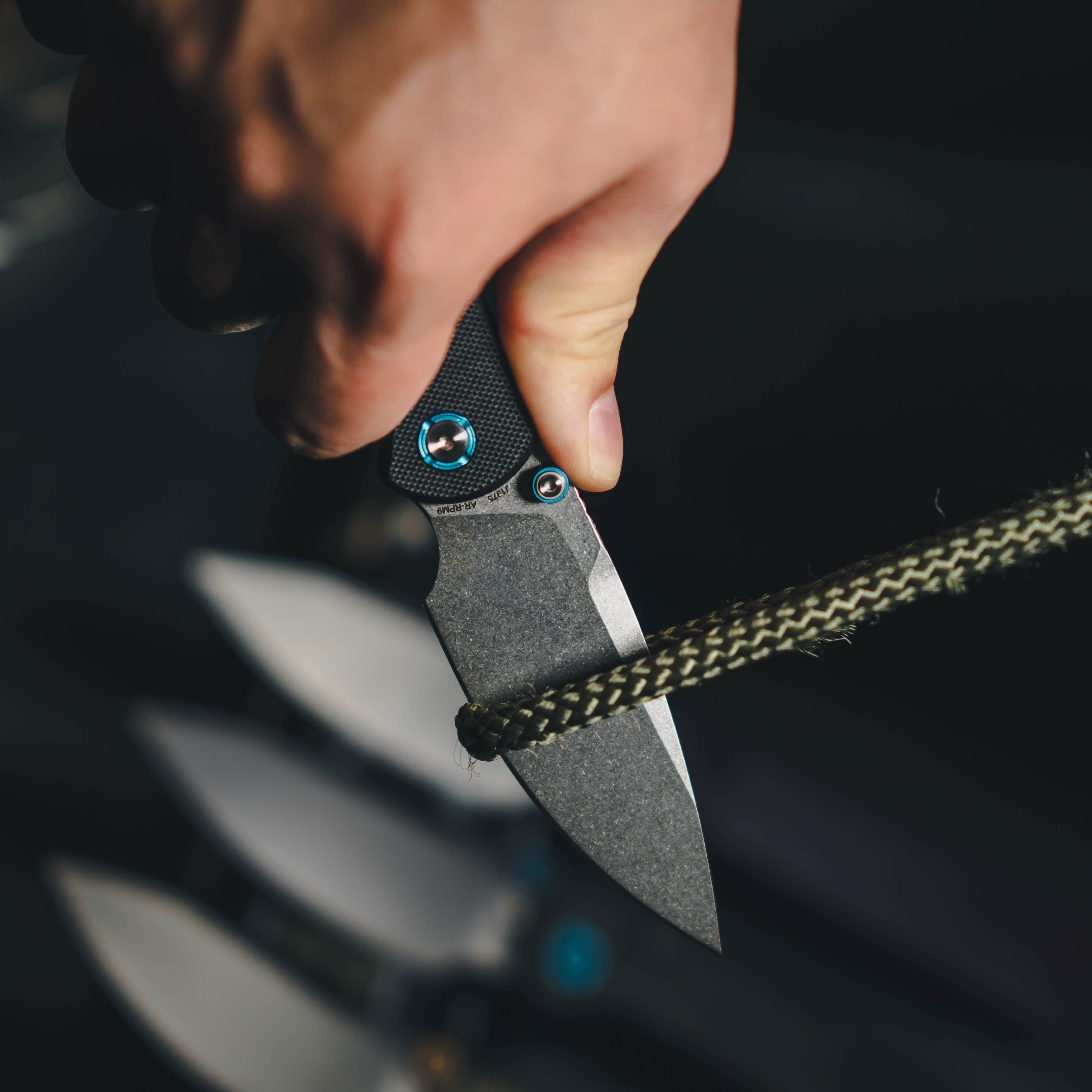
The CJRB Scoria J1920 is described in its own listing copy as “our most advanced model to date,” and the details back that up: a 3.48 in drop-point blade in AR-RPM9, a 0.11 in flat grind, and the first CJRB to ship with a standard milled titanium clip, titanium thumb studs, and a titanium pivot collar. It is in stock in two handle materials — black G10 at $59.49 and Double Coral Micarta at $67.99.
Titanium hardware, milled liners, and thin 0.11 in stock are what keep the Scoria at 100 g.
Scoria J1920 at a Glance
| Blade length | 3.48 in (88.28 mm) |
| Blade thickness | 0.11 in (2.7 mm) |
| Blade material | AR-RPM9 |
| Blade hardness | HRC 59-61 |
| Blade style | Drop point |
| Blade finish | Black PVD coated |
| Blade grind | Flat |
| Overall length | 8.01 in (203.44 mm) |
| Closed length | 4.53 in (115.16 mm) |
| Weight | 100 g (3.53 oz) |
| Clip material | Titanium, reversible, milled |
| Pivot assembly | Caged ceramic ball bearing |
| Lock type | Liner lock |
Both listings publish the same blade dimensions, the same 8.01 in overall and 4.53 in closed lengths, and the same 100 g (3.53 oz) weight, so the two tiers are dimensionally identical knives with different scales.
Two Configurations, Two Handle Materials
| Tier | Handle | SKU | Price | Stock |
|---|---|---|---|---|
| Black PVD blade, black G10 handle | Contoured G10 with milled liners | J1920-BBK | $59.49 | In stock |
| Black PVD blade, Double Coral Micarta handle | Double Coral Micarta | J1920-BDRC | $67.99 | In stock |
Listing note for the shop owner: the black G10 listing’s specification table still lists “Double Coral Micarta” under Handle Material even though its title and description both specify contoured G10 scales with milled liners — a copy-paste artifact from the micarta listing. Its prose also describes “hyper-thin 0.10” blade stock while the specification table on both listings reads 0.11 in (2.7 mm); the specification figure is used above. One micarta listing feature block also quotes 58-60 HRC against its own HRC 59-61 spec row.
The Titanium Hardware Trio
Most of what separates the Scoria from a $50 CJRB folder lives in three small parts. The listing is explicit that the Scoria “is the first to include a standard milled titanium clip, titanium thumb studs, and a titanium pivot collar for an added touch of class.” In practice that means:
- A milled titanium clip that is reversible and blind-screwed into the reverse side of the scale, so the outside of the handle stays smooth and pocket retention stays consistent.
- Titanium thumb studs, which pair with the flipper to give the knife more than one deployment method.
- A titanium pivot collar, a small detail that keeps the pivot area looking finished rather than purely functional.
Titanium is used here for hardware rather than for the scales, which is the pragmatic choice on a knife that has to hit a $59.49 entry price: you get the wear and corrosion behaviour of titanium where it matters, and the cost stays in the blade and the pivot.
Thin Stock and a Tall Blade Shape
The Scoria’s 0.11 in (2.7 mm) blade stock is paired with a tall blade and a flat grind. The listing describes the goal as making the knife “cut like a laser”: thin stock lowers the force needed to push the blade through material, and a tall flat grind gives you a shallow edge angle with enough mass behind it to stay stable.
The handle geometry matters just as much. Milled liners and “super thin contoured G10 scales” are what keep a knife with an 8.01 in overall length down to 100 g, and the enlarged front choil adds a second grip position for anyone who chokes up for detail work. Smoothly contoured G10, rather than aggressive texturing, is the deliberate choice here.
Deployment and Action
Two details make the Scoria feel faster than its price bracket. First, multiple deployment methods — thumb studs and a flipper — so the knife is fidget-friendly and works in either hand without thinking about it. Second, a caged ceramic ball-bearing pivot. The listing describes the behaviour directly: the bearings “ensure that the Scoria will snap open with authority with just a little pressure on the thumbstuds or the flipper,” and closing is equally fluid — “simply disengage the liner and the blade will smoothly fall shut into the handle.”
A drop-shut action is convenient, but it is also a habit worth controlling: keep fingers clear of the blade path while the liner is disengaged, and remember that a liner lock relies on clean, consistent engagement between the lock face and the blade tang.
How the Scoria Compares Around $60
All rows below are in stock and taken from live listings; this band is crowded, so the differentiators are lock type, blade length, and weight.
| Model | Blade | Lock | Weight | Price |
|---|---|---|---|---|
| Scoria J1920 (G10) | 3.48 in (88.28 mm) drop point | Liner lock | 100 g (3.53 oz) | $59.49 |
| Scoria J1920 (Micarta) | 3.48 in (88.28 mm) drop point | Liner lock | 100 g (3.53 oz) | $67.99 |
| Resource J1932 | 4.18 in (106.04 mm) drop point | Liner lock | 170 g (6 oz) | $55.99–$59.49 |
| Prado J1936 (G10 or wood) | 3.76 in (95.46 mm) clip point | Crossbar lock | 90 g (3.17 oz) in wood | $57.00 |
| Frack J1931 (frag steel handle) | 3.9 in (99 mm) drop point | Button lock | 143 g (5.04 oz) | $59.80 |
| Caldera J1923 | 3.5 in cleaver | Liner lock | 4.94 oz | $59.99 |
| Kestrel J1962 | 3.31 in (84 mm) Wharncliffe | Liner lock | 106 g (3.74 oz) | $49.99 |
The pattern is straightforward. If you want the largest blade for the money, the Resource J1932 gives you 4.18 in for $55.99, at the cost of 170 g. If lock type is your priority, the Prado J1936 offers a crossbar lock with a longer blade for $57.00. The Scoria’s argument is different: it is the tier where CJRB put titanium hardware and a thin, tall, laser-oriented blade on a 100 g frame, and it does that while staying under $60 in G10.
What the Numbers Say About Carry
- Pocket footprint. A 4.53 in closed length is a mid-size folder; it fits standard front pockets without dominating them, and the reversible milled clip keeps the handle profile clean.
- Weight. 100 g (3.53 oz) is right at the point where a knife is noticeable enough to deploy quickly but light enough to forget. Milled liners are doing the work here.
- Lanyard. The listing notes a generous lanyard hole that fits 550 paracord or leather cordage, which is a useful option for wet or cold-weather carry.
- Steel. AR-RPM9 is CJRB’s proprietary powder-metallurgy stainless, described in the listing as blending edge retention, corrosion resistance, and ease of sharpening. It is a stainless knife steel, so wipe it dry after wet use and keep the pivot lightly oiled.
- Blade coating. The black PVD coated blade resists scuffing better than a bare satin finish, and it is a coating rather than a treatment, so sharpen through it only as needed and expect a bright line along the apex over time.
Frequently Asked Questions
What does the J1920 code mean?
It is the CJRB model number for the Scoria. Suffixes identify the tier: BBK denotes the black PVD blade on black G10, and BDRC denotes the black blade on Double Coral Micarta. More of the numbering system is visible on the CJRB all-model page.
Is the micarta tier worth the extra $8.50?
It is a materials choice, not a performance upgrade — the blade steel, blade length, lock, pivot, and weight are the same in both listings. Micarta develops a patina with handling; G10 stays effectively unchanged.
Is the titanium clip durable?
Titanium is chosen for its strength-to-weight ratio and corrosion resistance, and the milled clip is fastened to the reverse side of the scale with blind screws. Treat it as a retention and finish upgrade rather than an interchangeable aftermarket part.
Does the Scoria come in a non-coated blade?
The two listings currently published both specify a black PVD coated blade. Check the Scoria collection for the latest finishes.
If you have been waiting for CJRB to move its premium hardware down into a sub-$70 price point, the Scoria is that move: AR-RPM9 steel, a titanium clip, thumb studs and pivot collar, and a 100 g frame carrying a 3.48 in blade. See the Scoria collection for both tiers, or browse the AR-RPM9 collection to compare how the steel behaves across the line-up.

Leave a comment
This site is protected by hCaptcha and the hCaptcha Privacy Policy and Terms of Service apply.