
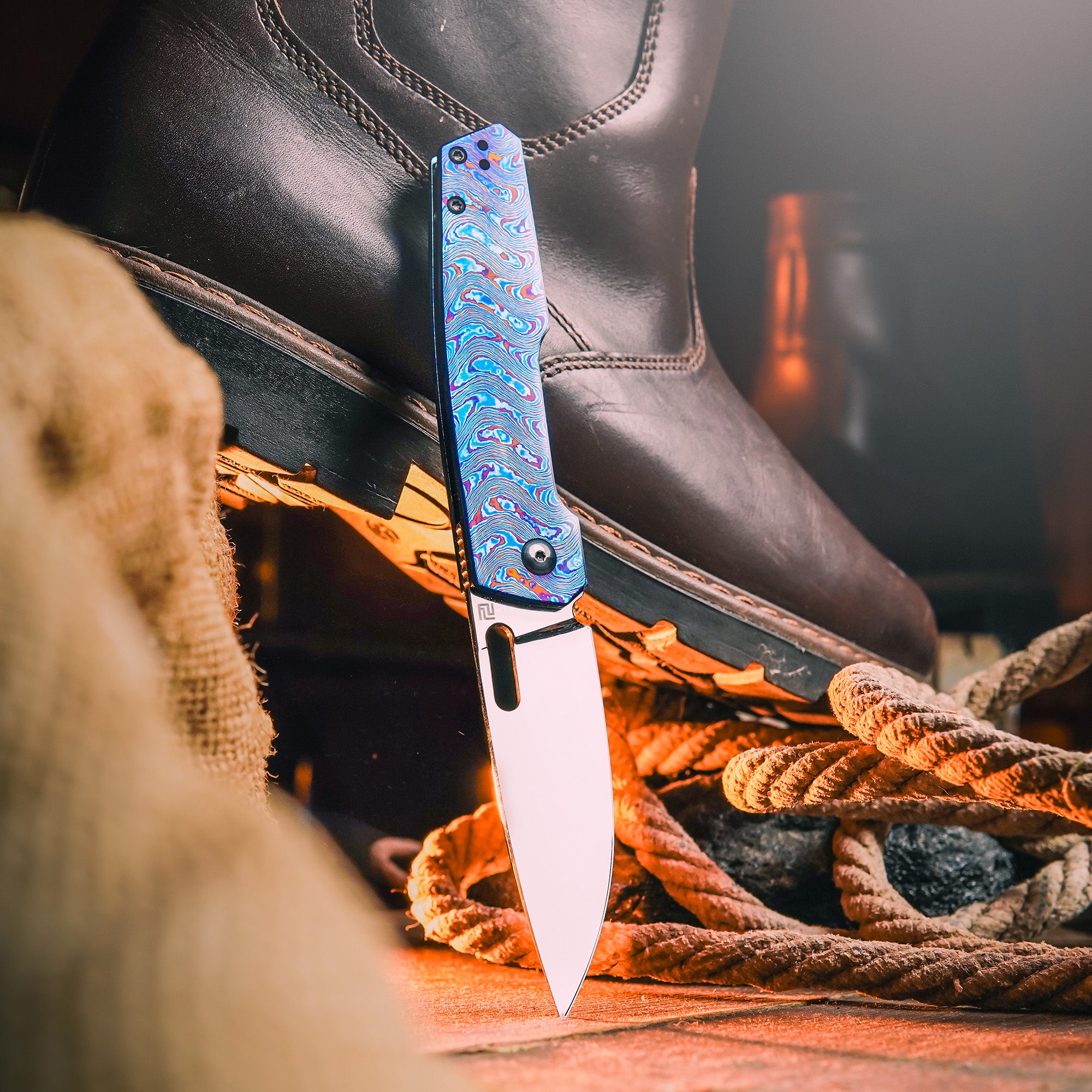
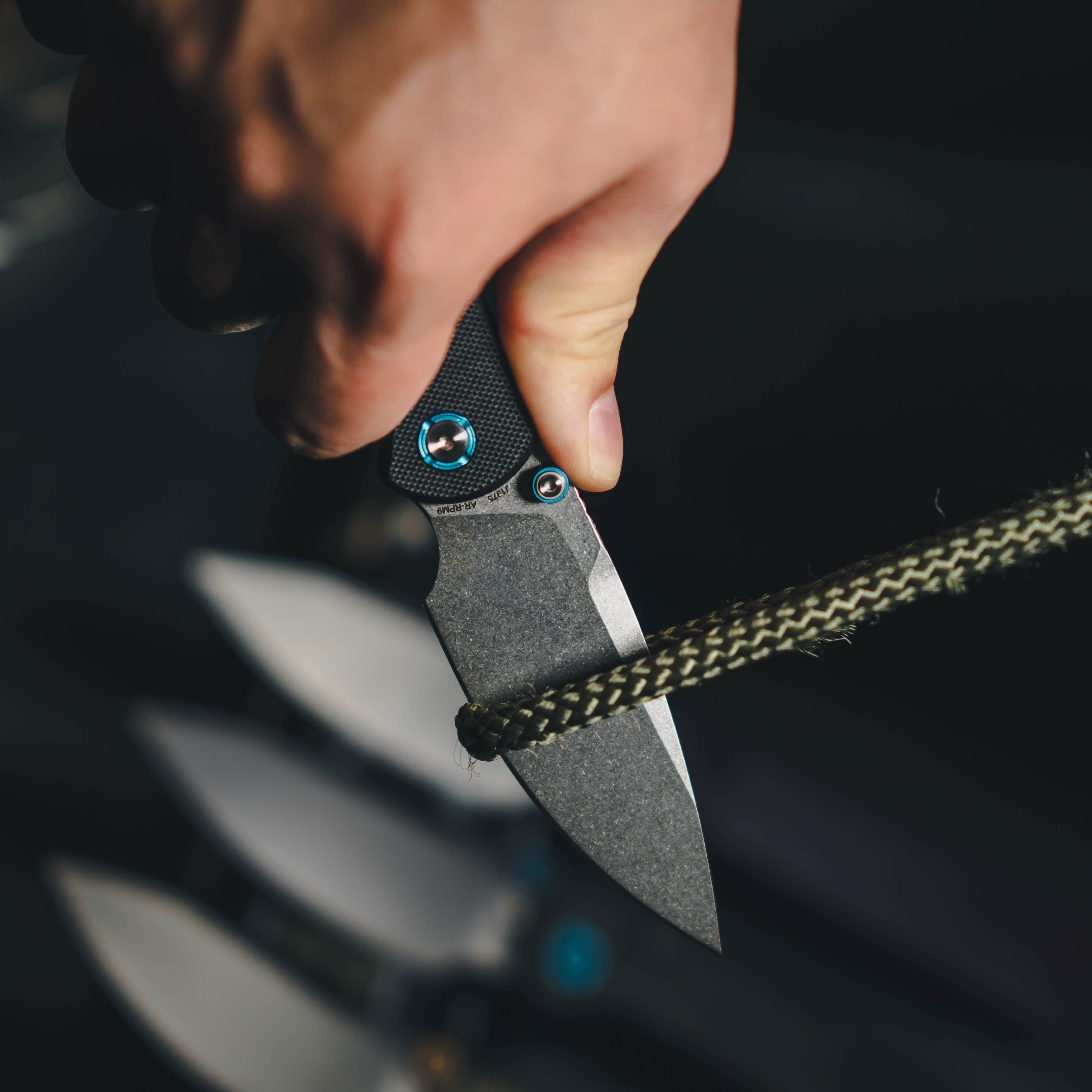
Most $50 folding knives ask you to choose between a smooth opener and a strong lock. The CJRB Shale J1943 is built to skip that choice: an 80 mm recurve drop-point blade in AR-RPM9 steel, a crossbar lock you can work one-handed, and a dual-tone G10 handle that keeps the whole knife at 80 grams. If you have been searching for a specific CJRB Shale review rather than another generic list of budget folders, this guide covers the actual model — its published specifications, its three factory colourways, and how it stacks up against the rest of the CJRB crossbar family sitting near the same price.
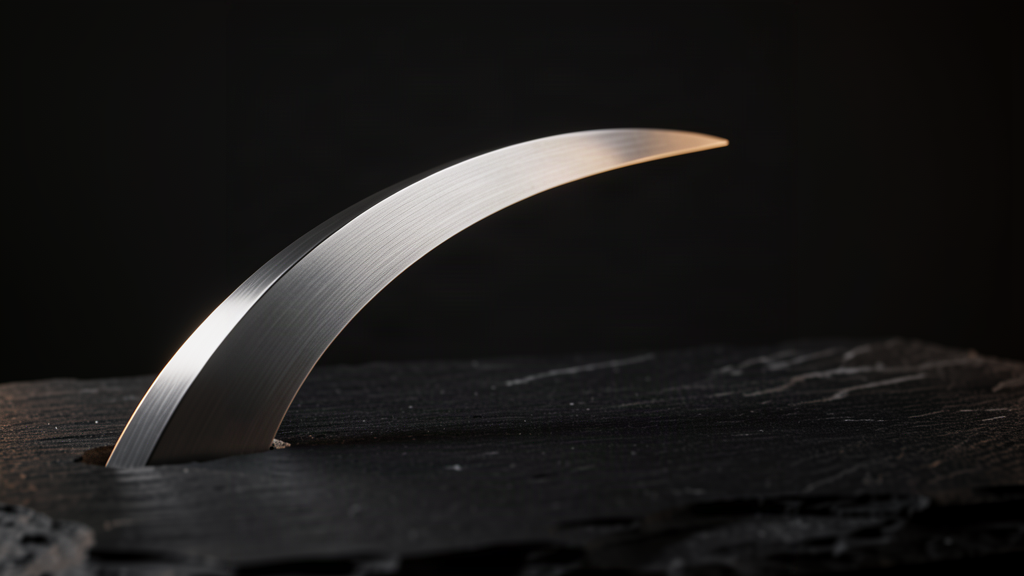
The Shale J1943 pairs a recurve drop point with a crossbar lock and dual-tone G10 scales.
CJRB Shale J1943: Published Specifications
| Specification | CJRB Shale J1943 |
|---|---|
| Model code | J1943 |
| Blade length | 3.15 in (80 mm) |
| Blade thickness | 0.11 in (2.7 mm) |
| Blade style | Recurve drop point |
| Blade grind | Flat |
| Blade steel | AR-RPM9, HRC 59-61 |
| Blade finish | Stone wash or black PVD coating, by colourway |
| Handle material | Dual-tone G10 |
| Lock type | Crossbar lock |
| Pivot assembly | Ceramic ball bearing |
| Overall length | 7.3 in (185.5 mm) |
| Closed length | 4.15 in (105.5 mm) |
| Weight | 80 g / 2.82 oz |
| Clip | Steel, reversible |
| Street price | $49.99 |
Those numbers describe a mid-size everyday folder: 3.15 inches of blade is the mainstream sweet spot for a knife that has to open mail, break down boxes, and still sit flat in a front pocket. The 80 mm blade lives inside a 105.5 mm closed handle, so roughly a fifth of the overall 185.5 mm length is the handle you actually grip.
What a Recurve Drop Point Does for You
Look at the spine of the Shale and you will see a subtle S-curve rather than a straight line: the profile rises toward the tip, dips in the middle of the belly, then sweeps up again. That is the recurve, the same concave-then-convex geometry that recurve designs use elsewhere for stored energy.
In practice the recurve does three things on a working knife:
- It concentrates the cutting contact. A curved belly keeps more of the edge in contact with material than a flat section of identical length, which is why draw cuts feel aggressive on rope, zip ties, and cardboard.
- It pulls material into the cut. On a pull stroke the concave section feeds the media toward the tip instead of letting it slide off.
- It keeps a usable tip. The drop-point spine drops gradually toward the point, so you retain a piercing tip without the fragile needle profile of a dagger grind.
The trade-off is honest and worth stating: a recurve is harder to sharpen freehand on a flat stone, because a single flat pass cannot follow both curves. If you use a guided system or a rod sharpener, that concern largely disappears. If you sharpen exclusively on flat bench stones, plan on working the two curve sections separately and finishing with a few light strokes to blend them.
How a Crossbar Lock Works on the Shale
The Shale uses a crossbar lock — a spring-loaded bar travelling in the handle, perpendicular to the blade tang. Pull the bar back with thumb and forefinger and the blade swings free; release it and the bar drops into the tang notch under spring pressure. Because the bar is ambidextrous by design and does not require your thumb to travel across the blade path, the mechanism suits left- and right-handed users equally.
Two practical notes about this lock family:
- It is a different mechanism from a liner lock. A liner lock uses a leaf of the handle liner that springs behind the tang; a crossbar uses a separate transverse bar and a pair of springs. The two are often discussed together simply because both are one-hand locks.
- It is not a release you can trip by accident. The bar sits inside the handle slabs, so there is no exposed lever for a pocket edge or a lanyard to catch.
The pivot rides on ceramic ball bearings, per the published spec. Bearings of that type are rolling-element bearings: they convert the friction of a plain washer pivot into the much lower rolling friction of hard ceramic spheres, which is what produces the light, consistent action typical of this generation of CJRB folders. The trade-off is that an open bearing pivot collects grit more readily than a sealed washer pivot, so a periodic flush with warm water and a re-oil is worth the two minutes.
Dual-Tone G10 and the 80 g Carry Weight
G10 is a high-pressure fibreglass laminate — the same family of composite material described under G10. It is dimensionally stable, effectively immune to humidity, and textured enough to grip without being abrasive. The Shale uses it in a dual-tone layout, so the two handle scales read as distinct colours rather than a single flat slab.
At 80 g (2.82 oz) the Shale lands in the light-but-not-titanium band. That is light enough that a clipped front-pocket carry will not drag your trousers, yet heavy enough that the knife feels planted during a firm cut rather than skittering. The 0.11 in blade stock reinforces that: thicker stock resists lateral flex in twisting cuts, at the cost of a slightly beefier edge geometry.
Shale J1943 vs the Rest of the $50 CJRB Crossbar Family
Price is where the Shale gets interesting, because CJRB currently ships a cluster of crossbar-lock folders within a few dollars of it. Every figure below comes from the published listing specifications and current in-stock pricing.
| Model | Blade | Blade style | Handle | Weight | Price |
|---|---|---|---|---|---|
| Shale J1943 | 3.15 in (80 mm) | Recurve drop point | Dual-tone G10 | 80 g | $49.99 |
| Lyrid J1953 | 3.15 in (80 mm) | Sheepsfoot | G10 | 89 g | $49.99 |
| Hectare J1935 | 3.15 in (79.9 mm) | Drop point | G10 | 76.5 g | $49.98 |
| Maximal J1954 | 2.95 in (75 mm) | Drop point | Micarta or G10 | 80-85 g | $49.99 |
| Acacia J1952 | 3.21 in (81.5 mm) | Drop point | FRN | 76 g | $29.99 |
| Nanner J1955 | 3.23 in (82 mm) | Persian (front flipper) | G10 | 67 g | $45.99 |
Read the table as a set of geometry decisions rather than a ranking. If you want the most aggressive slicing geometry and the most wear-resistant pivot smoothness per dollar, the Shale's recurve is the outlier in the group. If you want a straight edge that touches up trivially on a flat stone, the Lyrid's sheepsfoot is the better pick. If weight is your priority, the Nanner saves 13 g and adds a front flipper; if budget is, the Acacia does most of the same job for $29.99. The Shale is the one to choose when cardboard, rope, and zip ties are the daily diet.
Colourways: What Is Actually in Stock
The Shale ships in three configurations, all currently orderable and all at the same $49.99:
| SKU | Blade finish | Handle | Availability |
|---|---|---|---|
| J1943-BBO | Black PVD coating | Blue and orange G10 | In stock |
| J1943-BRE | Stone wash | Black and red G10 | In stock |
| J1943-GN | Stone wash | Green G10 | In stock |
The choice between stone wash and black PVD is more than cosmetic. Stone washing hides scratches and fingerprints because the finish is already a randomised matte texture. Black PVD — a thin, hard coating applied by physical vapour deposition — is more resistant to scuffing at the surface but shows bright metal where a deep scratch penetrates the layer. If the knife will live in a pocket with keys, stone wash is the more forgiving finish.
Who the Shale J1943 Is For
- The one-knife carrier. At 80 g and 105.5 mm closed it disappears into a pocket, but the 3.15 in blade is large enough for real work.
- Left-handed users. The crossbar lock is genuinely ambidextrous, not a mirrored compromise.
- Anyone who dislikes thumb-stud fumbling. The bar release does not require your thumb to find a small stud by feel in the dark.
- First-time buyers at $50. AR-RPM9 at HRC 59-61 with a bearing pivot is a lot of specification for the money.
It is a less obvious fit for a collector chasing a limited run, and for anyone whose sharpening routine is a single flat bench stone and nothing else. Neither is a flaw in the knife — they are simply mismatches between tool and user.
Frequently Asked Questions
Is the CJRB Shale a button lock or a crossbar lock?
Crossbar lock. The bar spans the handle transversely and is pulled back from either side; there is no push button on the presentation scale.
What steel is the CJRB Shale J1943 made from?
AR-RPM9 stainless steel at a published hardness of HRC 59-61, the powder-metallurgy steel CJRB uses across most of this price band.
What is the difference between the J1943-BBO and J1943-GN?
The blade finish and the handle colourway. BBO is a black PVD blade with blue and orange G10; GN is a stone-washed blade with green G10. Blade geometry, steel, lock, and price are identical.
How much does the Shale weigh?
80 g / 2.82 oz according to the published specification.
Browse the full CJRB Shale collection, or compare every crossbar-lock folder in the line-up on the CJRB crossbar lock collection page. Steel and model details for the whole catalogue are listed on the CJRB all-model index.

Leave a comment
This site is protected by hCaptcha and the hCaptcha Privacy Policy and Terms of Service apply.