

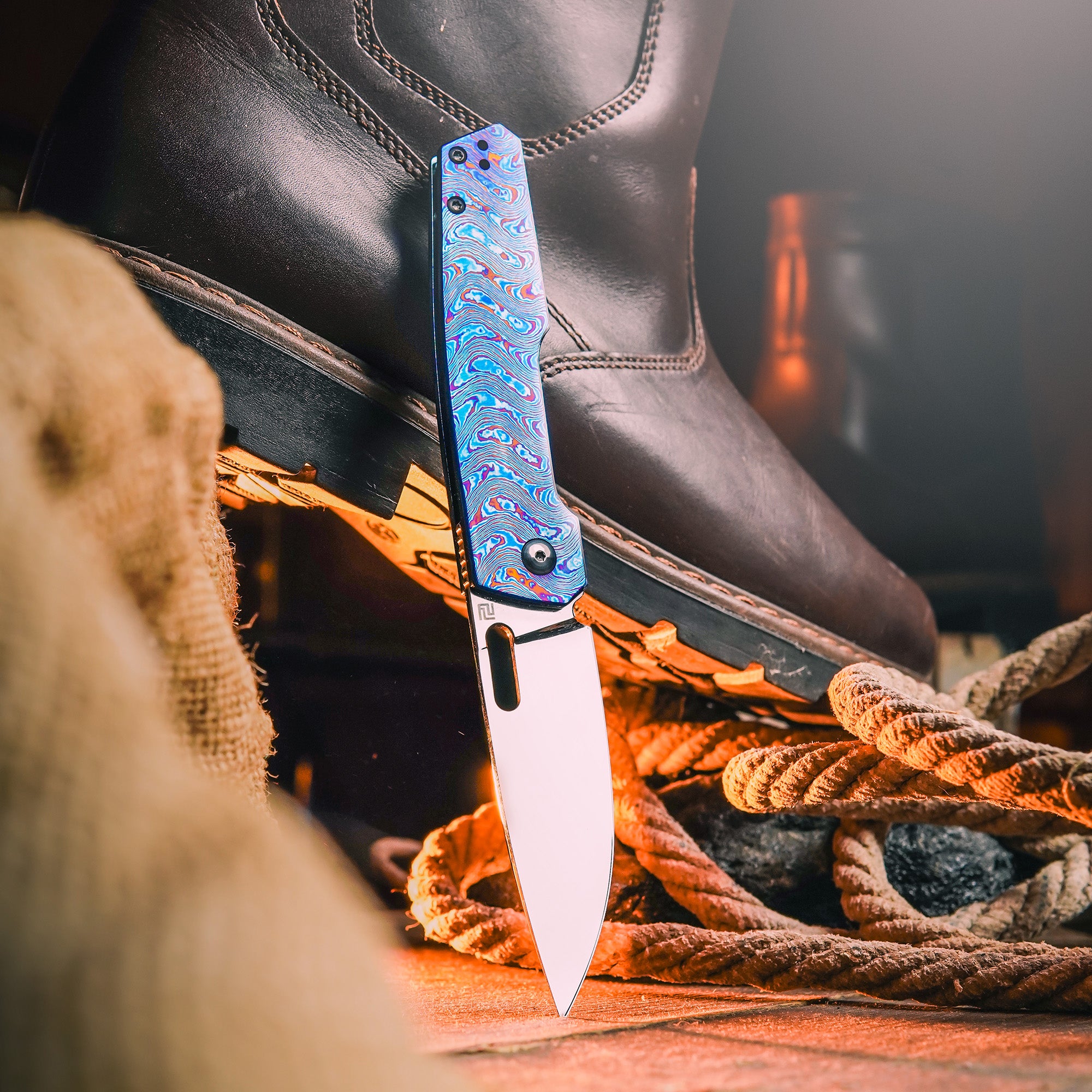
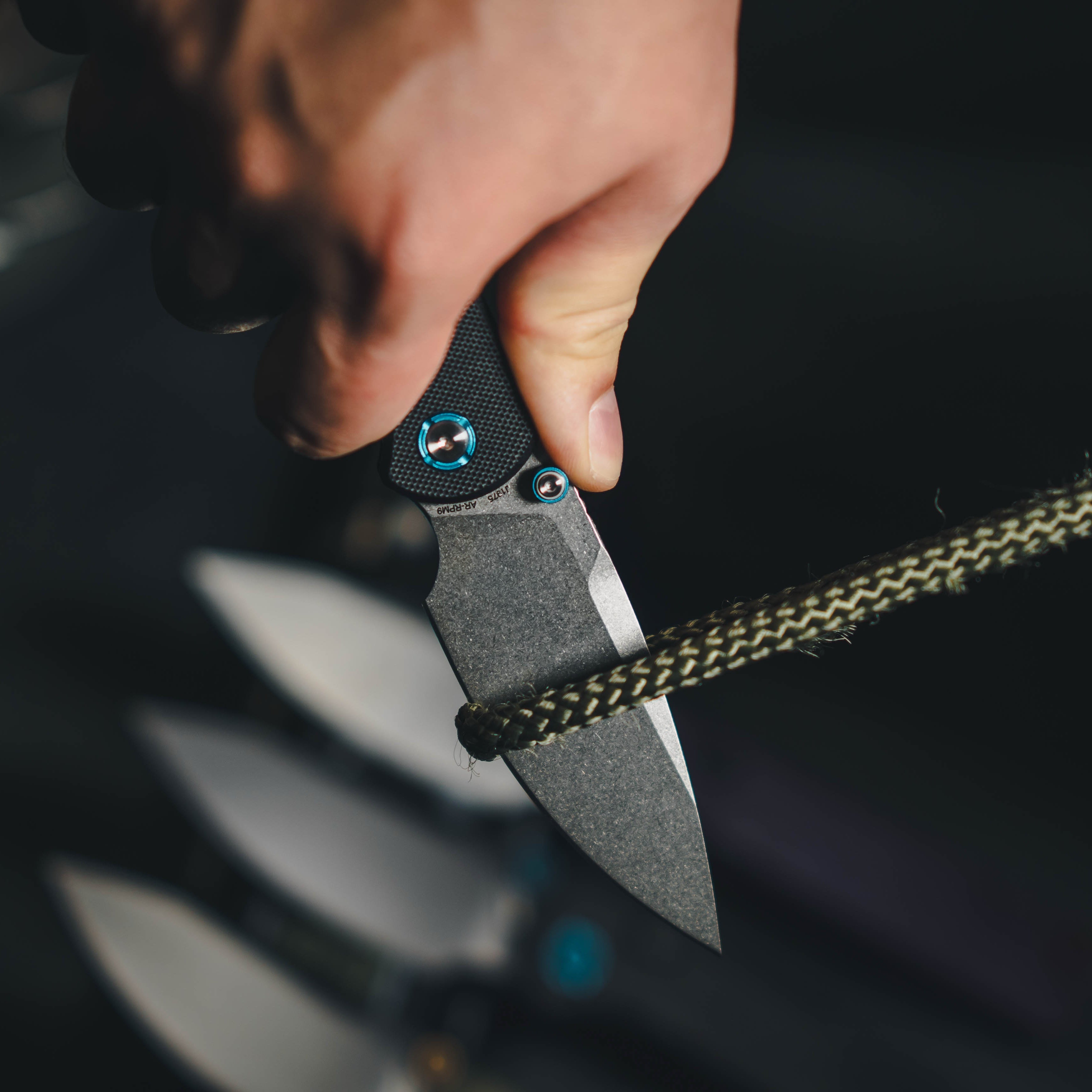

The CJRB Tigris J1919 is the biggest, bluntest-edged knife in the current CJRB flipper lineup, and that is the whole point. A 3.5-inch cleaver blade on a 0.13-inch spine, layered G10 handles, and a ceramic bearing pivot, at $49.99 to $59.99 depending on finish. Here is every configuration in stock and what each specification actually means in use.
The CJRB Tigris J1919 runs a 0.13-inch cleaver blade on a ceramic ball bearing pivot.
What the CJRB Tigris J1919 Is
The Tigris is a folding flipper built around a cleaver profile — a tall, straight-edged blade with a squared-off front. CJRB describes it as designed to deliver as much cutting power as possible while still fitting comfortably in a pocket, and the numbers back that up: it is the heaviest knife in this comparison at 6.35 oz.
- Model code: J1919
- Blade length: 3.5 inches (88.8 mm)
- Blade stock: 0.13 inches (3.2 mm)
- Blade style and grind: Cleaver, flat grind
- Steel: AR-RPM9, listed at HRC 59-61
- Handle material: G10, two differently textured layers
- Lock type: Liner lock
- Pivot assembly: Ceramic ball bearing with a ceramic detent
- Weight: 6.35 oz (180 g)
Tigris J1919 Specifications
| Specification | Tigris J1919 |
|---|---|
| Blade length | 3.5 inches (88.8 mm) |
| Blade thickness | 0.13 inches (3.2 mm) |
| Blade material | AR-RPM9 |
| Blade hardness | HRC 59-61 |
| Blade style | Cleaver |
| Blade grind | Flat |
| Handle material | G10 |
| Clip material | Stainless steel |
| Pivot assembly | Ceramic ball bearing |
| Lock type | Liner lock |
| Overall length | 8.5 inches (215.8 mm) |
| Closed length | 5 inches (127 mm) |
| Weight | 6.35 oz (180 g) |
The Two Tigris J1919 Configurations
Two SKUs are live. One is a coated blade with a two-tone handle, the other is a plain stone wash blade with white G10.
| SKU | Handle | Blade finish | Price | Compare at | Status |
|---|---|---|---|---|---|
| J1919-WH | White G10 | Stone wash | $49.99 | $79.98 | In stock |
| J1919-BU | Black and blue layered G10 | Black PVD coating | $59.99 | $79.98 | In stock |
Both are the same knife underneath — same steel, same blade geometry, same lock and pivot. Pick the black PVD version if you want a subdued blade and the grippier two-tone handle; pick the white version if you would rather have a finish that shrugs off scratches instead of showing wear on a coating.
Cleaver Blade Geometry: Why It Cuts the Way It Does
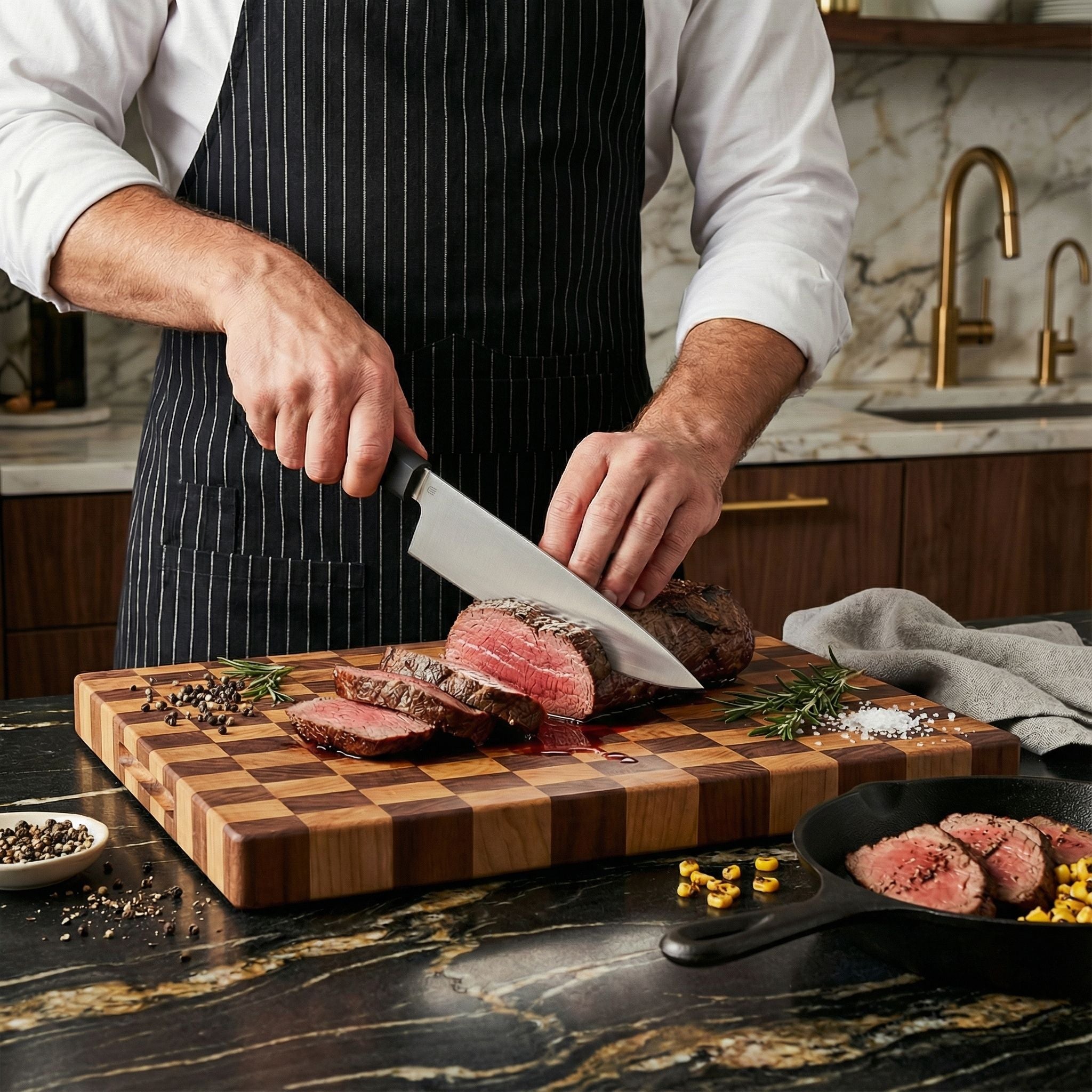
A cleaver profile puts a long, nearly straight edge under a tall blade face, with the tip squared off. Two things follow from that shape. First, there is a lot of edge in contact with the material at once, which makes it efficient on flat surfaces — think breaking down boxes on a bench or processing vegetables on a cutting board. Second, the tall blade face gives you a place to rest your off-hand thumb for controlled cuts.
The trade-off is the missing tip. There is no fine point for piercing or detail work, which is exactly why a cleaver is a specialist shape rather than a general one. CJRB has ground the Tigris flat and thin behind the edge despite the 0.13-inch spine, so the wide blade still slices instead of splitting. More on blade construction and grinds at Wikipedia's blade article.
Layered G10: Why Two Textures Instead of One
G10 is a fiberglass-reinforced epoxy laminate, and it is the default handle material on working knives because it resists temperature, water, and most solvents, and it does not conduct electricity. Wikipedia covers G10 if you want the material science.
The Tigris does something slightly unusual with it: CJRB layers two differently textured slabs of G10 on top of each other, so the handle carries a coarser grip zone against a finer one. In practice that means your fingers find traction where they load the handle hardest, without the whole surface being abrasive enough to chew up a pocket.
Deep-Carry Clip and the Extended Lanyard Hole
The Tigris ships with a deep-carry pocket clip, positioned so the knife sits low and at an angle that still leaves room to get your hand into the pocket past it. For a 6.35 oz knife, that angle matters more than it does on a lightweight — a bulky knife that sits proud of the pocket edge is the one that gets left at home.
There is also an extended lanyard hole sized to accept 550 paracord as well as larger cordage. That is a practical addition on a working knife: a lanyard gives you something to pull on when the knife is buried deep in a pocket, and it makes the knife easier to find by feel.
The Ceramic Bearing Pivot and Ceramic Detent
Inside, the Tigris runs a ceramic ball bearing pivot. Bearings replace sliding friction with rolling contact, so a heavy blade can still open snappily on the flipper tab even though it has more mass to move than a smaller knife. Ball bearings explains the mechanism.
The detent is the small engagement that holds the blade closed until you deliberately open it. CJRB specifies a ceramic detent on the Tigris, which keeps the closed retention crisp over time rather than softening as a steel detent wears against the blade tang. Combined with a liner lock, you get one-handed open and one-handed close with no change of grip.
Tigris vs Rodayo vs Kestrel: Which CJRB Flipper Fits You
These three are the current AR-RPM9 liner lock flippers, all at HRC 59-61 with G10 handles and ceramic bearing pivots. The decision is about blade shape and mass.
| Model | Blade length | Blade style | Weight | Price |
|---|---|---|---|---|
| Tigris J1919 | 3.5 in (88.8 mm) | Cleaver | 6.35 oz (180 g) | $49.99-$59.99 |
| Rodayo J1972 | 3.78 in (96 mm) | Drop point | 4.94 oz (140 g) | $54.99 |
| Kestrel J1962 | 3.31 in (84 mm) | Wharncliffe | 3.74 oz (106 g) | $49.99 |
Choose the Tigris if your cutting happens on flat surfaces and you want maximum edge in the cut at once. Choose the Rodayo if you want a conventional tip for everyday utility. Choose the Kestrel if you want the lightest carry and a wharncliffe edge for precise push cuts. Browse the full Tigris collection or the liner lock range to see what is currently available.
Sharpening and Maintenance for a Wide Cleaver Edge
A tall cleaver edge is arguably easier to sharpen than a curved one, because you can hold a constant angle across a long straight section without chasing a belly. Work in overlapping passes along the full edge, keep the angle consistent at around 15 to 20 degrees per side for a utility edge, and finish with light stropping passes on both sides. Science of Sharp has microscope-level documentation of what stropping does at the apex; the Rockwell scale explains the HRC 59-61 hardness rating on the listing.
Because AR-RPM9 is stainless, upkeep is minimal: wipe the blade after damp or messy work, clear debris from the pivot, and touch up the edge before it dulls completely. Current model and steel information lives at cjrbcutlery.net.
Want a heavy-cutting flipper with a ceramic bearing pivot? The CJRB Tigris J1919 is available in two G10 configurations — shop the Tigris collection or explore all new CJRB arrivals for reliable everyday carry.

Leave a comment
This site is protected by hCaptcha and the hCaptcha Privacy Policy and Terms of Service apply.