

A deba is a thick, single-bevel Japanese kitchen knife built for breaking down fish: the heavy spine and obtuse heel go through heads, spines and rib bones, and the rest of the blade then rides along the frame to lift a clean fillet. Its thickness and its one-sided grind are what separate it from every double-bevel knife in a Western kitchen.
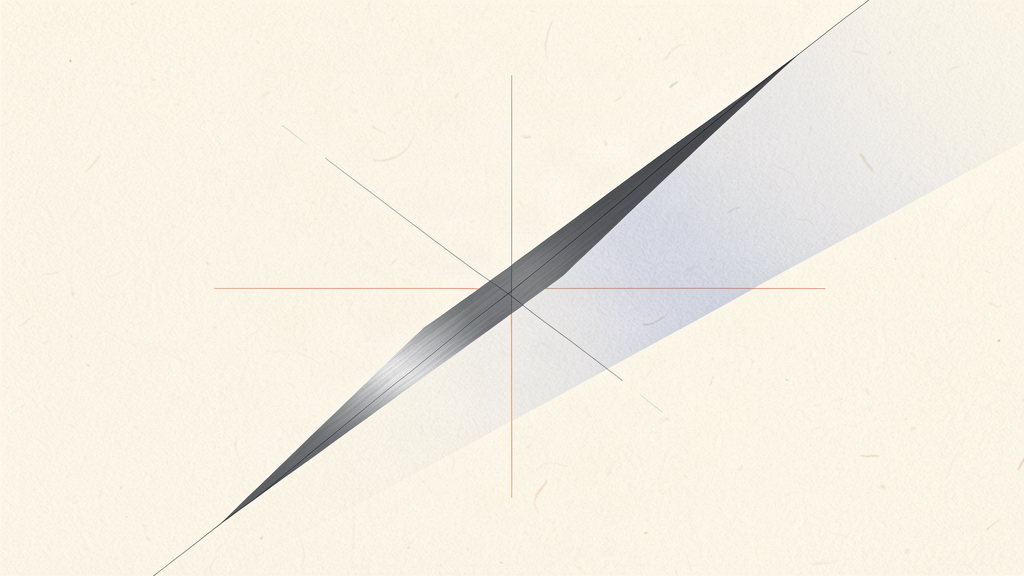
One bevel, one flat back: the asymmetric grind that makes a deba steer through a fish.
That combination sounds specialised, and it is. A deba is not a general kitchen knife that happens to be Japanese; it is a fish tool with a specific job and a specific set of habits that go with it.
What a deba is, and what the name means
Deba bōchō (出刃包丁) translates roughly to "fish-preparer" or "protruding blade". Wikipedia's entry on the deba bōchō describes it as a style of Japanese kitchen knife used primarily on fish, and occasionally on meat. It appeared during the Edo period in Sakai, the knife-making district south of Osaka that still supplies much of Japan's professional cutlery.
Three things define the pattern:
- Mass in the spine. A deba is the thickest of the Japanese kitchen knives, typically 5 to 7 mm of stock behind the edge on a normal-sized blade, and up to about 10 mm on the largest.
- A single bevel. One face is ground to the edge; the other is nearly flat with a hollow ground into it. There is no double-bevel version of a deba, which is unusual among Japanese knives.
- A tall, deep blade. The height gives the knife stiffness in the cut and gives your knuckles room, and it lets the heel be ground to a blunter angle than the rest of the edge.
In a traditional Japanese kitchen the deba sits in a trio of single-bevel knives alongside the yanagiba, a long slicer for raw fish, and the usuba, a vegetable knife. Each one is a specialist, and none of them is meant to cover for the others.
Why a deba is so thick
Filleting a fish is only half the job. Before the fillets come off, something has to go through the head, the collar and the spine, and that is work a thin blade cannot do without either chipping or flexing away from the cut.
The deba solves it in two places. The heel is ground at a much more obtuse angle than the rest of the edge, which puts a wedge of steel exactly where the load lands when you cut behind the head. The rest of the edge is thinner, so once the heavy work is done the same knife can slide along the ribs and separate flesh from bone with control.
That division of labour is the whole design. You are not meant to saw through a spine with the middle of the blade, and you are not meant to try delicate work with the heel. The knife has a heavy end and a fine end, and the skill is in using each for its job.
Anatomy of a single bevel
A single-bevel knife has three features worth naming, because they decide how it cuts and how you maintain it.
- The bevel face. The ground side, running from the edge up to a distinct line. On a broad-bevel deba that face can be most of the blade's height, which is why the knife looks like it has a huge secondary grind.
- The shinogi line. Where the bevel face meets the flat of the blade. It is the visual signature of a single bevel, and on a well-made knife it runs straight and parallel to the edge.
- The urasuki. A shallow hollow ground into the back, so that only the rim of the back and a narrow strip near the edge touch the stone. It reduces drag in the cut and makes it possible to flatten the back quickly when you sharpen.
Because the geometry is asymmetric, so is the behaviour. A single-bevel knife steers: it wants to travel toward the ground side. On a right-handed deba that means the blade pulls slightly to the right as it moves through flesh, and the back of the blade stays flat against the bone. Faced with a left-handed user, the same motion pushes the bevel into the fish, which is why left-handed deba exist as a separate build rather than a flipped version of the same knife.
Sizes: ko-deba, hon-deba, and the length you actually need
Deba are sold by blade length, and the naming follows size rather than shape. The small form is the ko-deba, the large form the hon-deba, or "true deba".
| Size | Typical blade length | What it handles |
|---|---|---|
| Ko-deba | About 10.5 to 13.5 cm | Small fish, sardines, mackerel, trimming and portioning |
| Mid-size deba | About 15 to 18 cm | The all-round professional size: sea bream, bass, salmon portions |
| Hon-deba | About 19 to 24 cm, and up to 30 cm on the largest | Big fish, tuna loins, heads that need real weight behind the cut |
Most people who buy one knife buy in the middle. A 16.5 to 18 cm deba will break down anything from a two-kilo bass upward, and it is short enough to control on a normal board. The very large deba are boat and market tools; they are heavy, and their weight is the point when you are taking the head off a fish the size of your forearm.
Deba versus fillet knife versus santoku
These three get confused constantly, mostly because all of them are advertised for fish.
| Deba | Fillet knife | Santoku | |
|---|---|---|---|
| Bevel | Single, asymmetric | Double, symmetric | Double, symmetric |
| Stock | Thick, 5–7 mm typical | Thin with flex | Thin to medium |
| Goes through bone | Yes, that is the design brief | No: the edge is too fine | Poorly: thin behind the edge |
| Follows the ribcage | Yes, on the flat back | Yes, that is its strength | Not its job |
| Vegetables and general prep | No | No | Yes |
The santoku is a useful reference point because it was invented in the 1940s, as the Wikipedia entry notes, to combine the "three virtues" of the deba, the nakiri and the gyūtō in one double-bevel blade. It borrowed the deba's fish role in name only. Where a deba is a dedicated breaker, a santoku is a compromise built for a home kitchen with one knife in it.
A fillet knife is the closer comparison in the hand, and the split is about bone. A flexible fillet blade is superb at following a ribcage and terrible at a spine. A deba is the opposite: it takes the heavy cuts and then does the fine work from the other direction, with the flat of the back pressed against the frame instead of the edge.
What a deba is not for
The limits matter as much as the uses, because a deba is easy to damage if you treat it like a cleaver.
- Not for beef, lamb or pork bones. The obtuse heel will cut fish heads; it is not a chopping tool for large mammal bone, and a thin single-bevel edge is a poor match for that kind of impact.
- Not for vegetables and general prep. The asymmetric grind steers in dense food, and the thickness splits rather than slices. Use a nakiri, a santoku or a chef's knife.
- Not for frozen food or bones on a board. Anything that puts the edge against something harder than the fish is asking for chips.
- Not a left-hander's knife unless it was built as one. Using a right-handed single bevel in a left hand pushes the bevel the wrong way through the cut.
Sharpening a single bevel
Sharpening is where most single-bevel knives are quietly ruined, because the technique is genuinely different from a double-bevel knife.
The bevel face is sharpened flat on the stone, held so the whole width of the grind contacts the surface and the angle is set by the existing geometry rather than by your wrist. Work the full length of the blade in overlapping passes and keep the shinogi line crisp: a bevel that gets rounded over the years turns a flat grind into a convex one and the knife stops cutting the way it was built to.
Then the back. A few light passes flat on a fine stone, edge trailing, is enough to maintain the urasuki: the hollow means you are only touching the rim and the strip behind the edge, and the goal is to keep that strip narrow and even, not to grind the hollow out.
Two habits keep the geometry honest. Sharpen little and often rather than hard and rarely, because a single bevel loses its flatness through heavy sessions. And check the shinogi line after every session; if it has started to wander, stop and reset the bevel before the error compounds.
If you are used to freehand sharpening at a fixed angle with a guide, expect to relearn the feel. The angle on a deba is not a number you hold, it is a plane you lay the blade onto.
Using it: a basic breakdown
The working sequence on a round fish is short, and the deba's two ends do different halves of it.
- Scale and rinse. Work on a stable board, with the fish dry enough to grip.
- Take the head. Cut down behind the pectoral fin and the collar, using the heel, until you are through to the spine. This is the one place where force is appropriate.
- Open along the frame. Turn the blade and run it along the backbone from head to tail, riding the ribs rather than cutting through them, with the flat of the back against the bone.
- Lift the fillet. Work back from the tail toward the head in long strokes, keeping the back of the blade on the frame so the edge stays in the flesh and out of the bone.
- Repeat and finish. Mirror the fish for the second fillet, then rinse and dry the blade before it goes back in the roll.
Watch the edge against the bone rather than the fish against the board. The flat back is your depth gauge, and the moment the blade lifts off it you are cutting meat that should have stayed on the fillet.
Buying checklist
- Match the length to the fish you actually buy. A 16.5–18 cm blade covers most home and serious home use; a ko-deba is a supplement, not a substitute.
- Confirm the handedness. Right-handed is standard, and a genuine left-handed deba is a special order.
- Look at the shinogi line. Straight, even and parallel to the edge on both sides of the blade means the grind was set properly.
- Check the back for a hollow. A flat back with no urasuki is cheaper to make and slower to maintain.
- Ask what the steel is and how it reacts to water. A carbon core takes a finer edge and needs drying after every use; a stainless or semi-stainless core tolerates a wet kitchen better.
If you are building a kit rather than buying a single specialist, the same logic applies to the rest of the drawer: a general-purpose blade for vegetables and everyday prep, and a dedicated tool for fish. Our knife types collection breaks the patterns down by shape and job, blade material covers what each steel will tolerate in a wet kitchen, and the fixed blade knives range shows how much of the deba's logic, thick spine and a stiff blade over a fine edge, carries over into outdoor knives. We do not make a deba, and we would rather say so than blur the line: what we do make is the everyday half of that toolkit, and you can see the full range in all products.
Care between sessions
Rinse and dry immediately, especially at the machi, the notch where the blade meets the handle, which is where water sits and rust starts. A carbon deba wants a thin film of oil in storage; a stainless one still wants to be dried rather than left in a sink. Keep it out of the dishwasher, out of a drawer full of loose utensils, and off the board face-down, where a single bevel can catch an edge on the way past.
Treat it as a fish tool with a heavy end and a fine end and it will last decades. Treat it as a cleaver and it will be a chipped, convexed reminder of why the pattern is shaped the way it is.


Leave a comment
This site is protected by hCaptcha and the hCaptcha Privacy Policy and Terms of Service apply.