




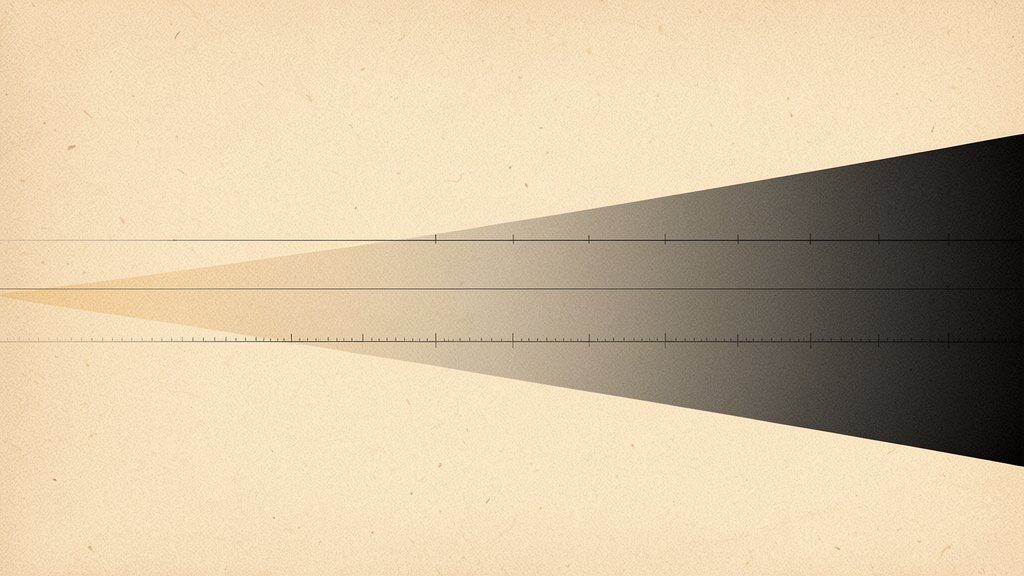
Distal taper is the thinning of a blade's cross-section from the handle end toward the tip. The steel is thickest at the ricasso and spine near your hand and becomes progressively thinner as it runs forward, so the tip is lighter and slimmer than the base. It is one of the few design features that improves balance, slicing and control at the same time, and one of the easiest to check with a pair of calipers in a shop.
A tapered spine moves mass back toward the hand and thins the front of the blade.
It is also the specification most often left off a product page, which is why two knives with the same steel, the same length and the same grind can feel completely different in the hand.
What distal taper means, in numbers
Every blade tapers to some degree, because the grind removes material toward the edge. Distal taper is about the spine: the thickness of the unground stock, measured at the top of the blade, from the ricasso to a centimetre behind the tip.
A knife with no meaningful taper might measure 3.0 mm at the ricasso and 2.9 mm near the tip. A strongly tapered blade might start at 3.5 mm and finish under 1.5 mm. Both are commercially common, and neither is automatically better. What changes is where the mass sits and how the front of the blade behaves in a cut.
This is separate from the edge geometry. A blade can taper beautifully along the spine and still have a thick, obtuse edge that refuses to bite. Taper describes the profile of the blade; the grind and the edge angle describe how it cuts. Good knives get both right.
Why it changes how a knife cuts and feels
Balance moves back into your hand
Steel is heavy, and the tip of a blade is the worst place to carry weight. Tapering the front section moves the centre of mass toward the handle, so the knife feels planted rather than nose-heavy. On a 200 mm fixed blade this is the difference between a knife that steers and one that has to be held up. On a folding knife the effect is smaller but still noticeable when you open and close it one-handed.
The tip stops wedging
A thick tip has to push material apart before the edge can cut it. That is why some knives skate across an onion or stall in a cardboard box: the steel behind the edge is acting like a wedge, splitting rather than slicing. A tapered tip presents a thinner cross-section, so it enters with less resistance and keeps moving.
Less weight, same length
Taper removes steel from the least useful place for mass. A blade with strong taper can be longer without being heavier, which matters for a knife that gets carried all day and used for a few minutes at a time.
It changes the flex profile
Thinner steel forward means the tip flexes more under lateral load. On a kitchen knife or a fine slicer that is desirable: the blade follows the cut instead of fighting it. On a knife meant for leverage and prying, it is the opposite of what you want, and this is the main trade-off explored further down.
The three broad ranges
Most production knives fall into one of three groups, and knowing which group you are looking at explains a lot about how the knife will behave.
| Taper | Typical spine change | Feel | Best suited to |
|---|---|---|---|
| Minimal | Under 0.5 mm over the blade | Nose-heavy, stiff, robust | Hard-use folders, choppers, utility blades that see twisting |
| Moderate | 0.5 to 1.5 mm | Balanced, predictable | Everyday carry, general hunting and camp knives |
| Strong | More than 1.5 mm, often to under half the base thickness | Light, quick, tip-forward in feel | Slicers, kitchen knives, fine game processing, fillet work |
The numbers are indicative rather than standardised. There is no industry definition of "full distal taper", and two makers can use the phrase to describe very different blades. Trust the calipers, not the adjective.
How to check it before you buy
- Use calipers. Measure spine thickness right at the ricasso and again about 10 mm behind the tip. Subtract. That number is the real taper.
- Sight down the spine. Hold the knife edge-down at eye level and look along the top edge. A tapered blade visibly narrows toward the point; a slab-sided one looks parallel.
- Balance it on a finger. Find the balance point. On a full-tang fixed blade, a point close to the front of the handle suggests meaningful taper or a skeletonised tang.
- Compare grind height. A tall grind removes more steel and often accompanies taper. Low, thick grinds usually come with slab-sided blades.
- Ask for the tip thickness. Some makers publish spine thickness at the tip. If they do, that is the number that matters most for slicing.
Taper and grind work as a pair
The blade is a compromise between cross-sections: spine thickness, grind height, edge angle and taper all interact. A full flat grind with strong distal taper produces the thinnest-cutting geometry available on a production knife, because both the profile and the bevel are removing material. A sabre grind with a thick spine and no taper is a wedge by design.
There is a useful third measurement: the thickness of the steel immediately behind the edge, often abbreviated as BTE. It explains why a heavily tapered blade can still cut poorly. If the bevel is short and blunt, the material has to spread around a wide shoulder even though the spine is thin. Taper helps the blade enter; the edge geometry decides how cleanly it separates.
Sharpening does not change taper. Grinding a new bevel works on the edge, not the spine, so the overall profile stays as it was made. This is why taper is a buying decision rather than a maintenance one: you can alter the edge angle, but you cannot thin a spine without removing a lot of steel and ruining the finish.
Where a thin tip costs you
Taper is not free. The same thinness that makes a tip slice makes it vulnerable, and a few habits punish it quickly.
- Prying. A tapered tip concentrates stress in the thinnest section of steel. Using it as a lever bends it, and bent tips are effectively permanent.
- Twisting in a cut. Rotating the blade to widen a slot loads the tip sideways, exactly the direction it is least able to resist.
- Dropping on a hard surface. A fine point folds or chips. It can be repaired, but it will never be as long again.
- Batoning and heavy chopping. Splitting wood with a strongly tapered blade is a good way to bend it. That job belongs to a thicker, stiffer profile.
None of this makes taper a flaw. It makes it a specialisation. A knife designed to slice thin material well should have it; a knife intended to be abused should not.
How much taper do you actually want
Match the profile to the job rather than to the specification sheet. If the knife is a light everyday carry used on packaging, cord and fruit, moderate to strong taper gives you the most cutting per gram and the least wedging. If it is a work knife that sees prying, scraping and twisting, favour a stiffer spine and accept the extra weight.
For kitchen work the answer is nearly always strong taper. Food separates most cleanly when the blade behind the edge is thin, and the same property that makes a chef's knife glide through an onion is what makes a thin-tipped folder feel sharp. For game processing, a tapered tip tracks through a cut with less resistance and gives finer control around joints.
The practical test is simple: decide what the knife will spend most of its life doing, then pick the profile that makes that job easier. Taper is one of the few specifications that tells you the answer honestly, as long as you measure it rather than reading the description.
For a deeper look at how the edge itself refines after sharpening, Science of Sharp documents the microscopic side of the same trade-off between thin geometry and durability.
If you want to compare profiles in person, hold a few folding knives up to the light and sight down the spine, then repeat the exercise with the fixed blade knives. The difference is easiest to see on thin, slice-first designs such as the pocket knives under $50 range, or browse the full catalogue and compare the thickest and thinnest spines you can find.

Leave a comment
This site is protected by hCaptcha and the hCaptcha Privacy Policy and Terms of Service apply.