

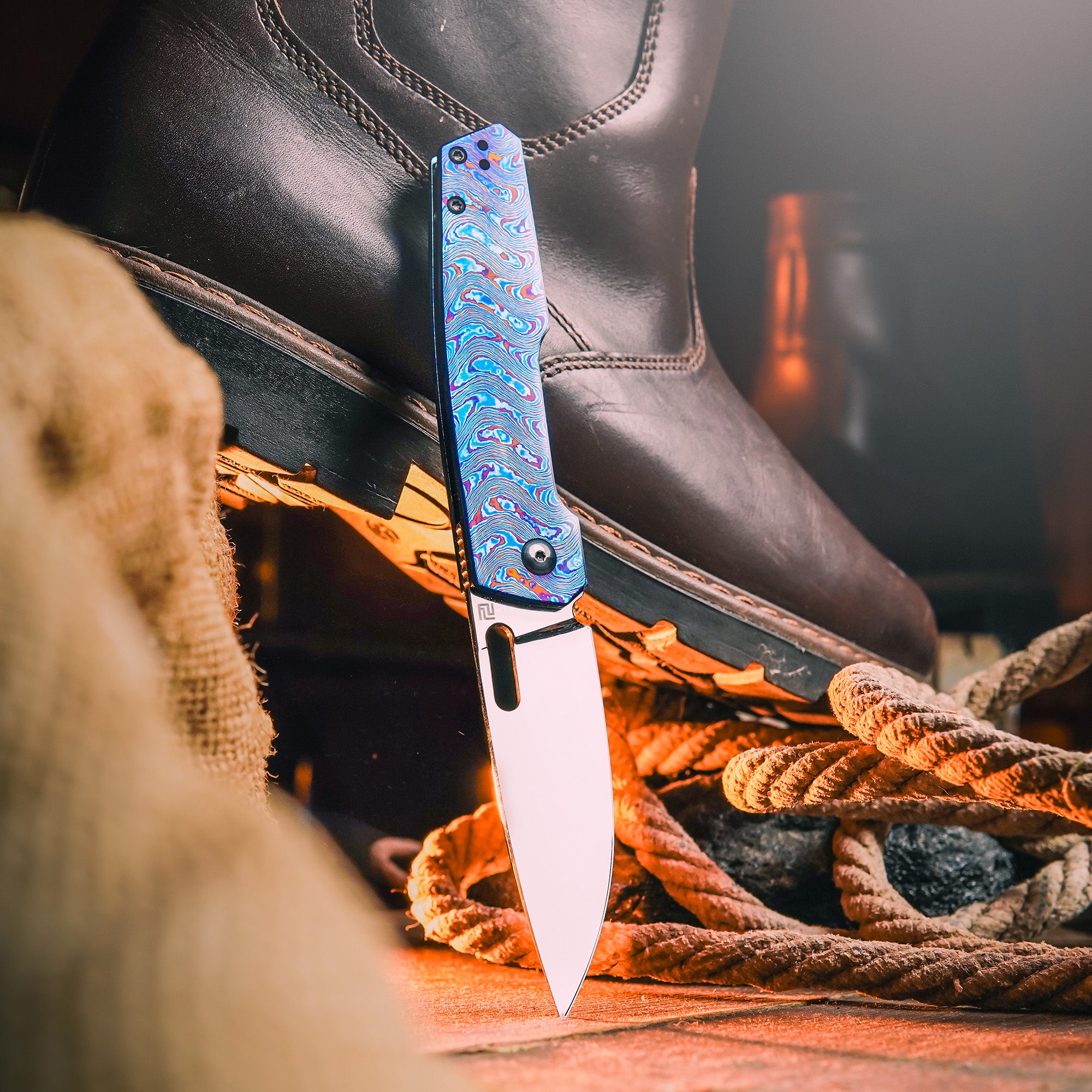
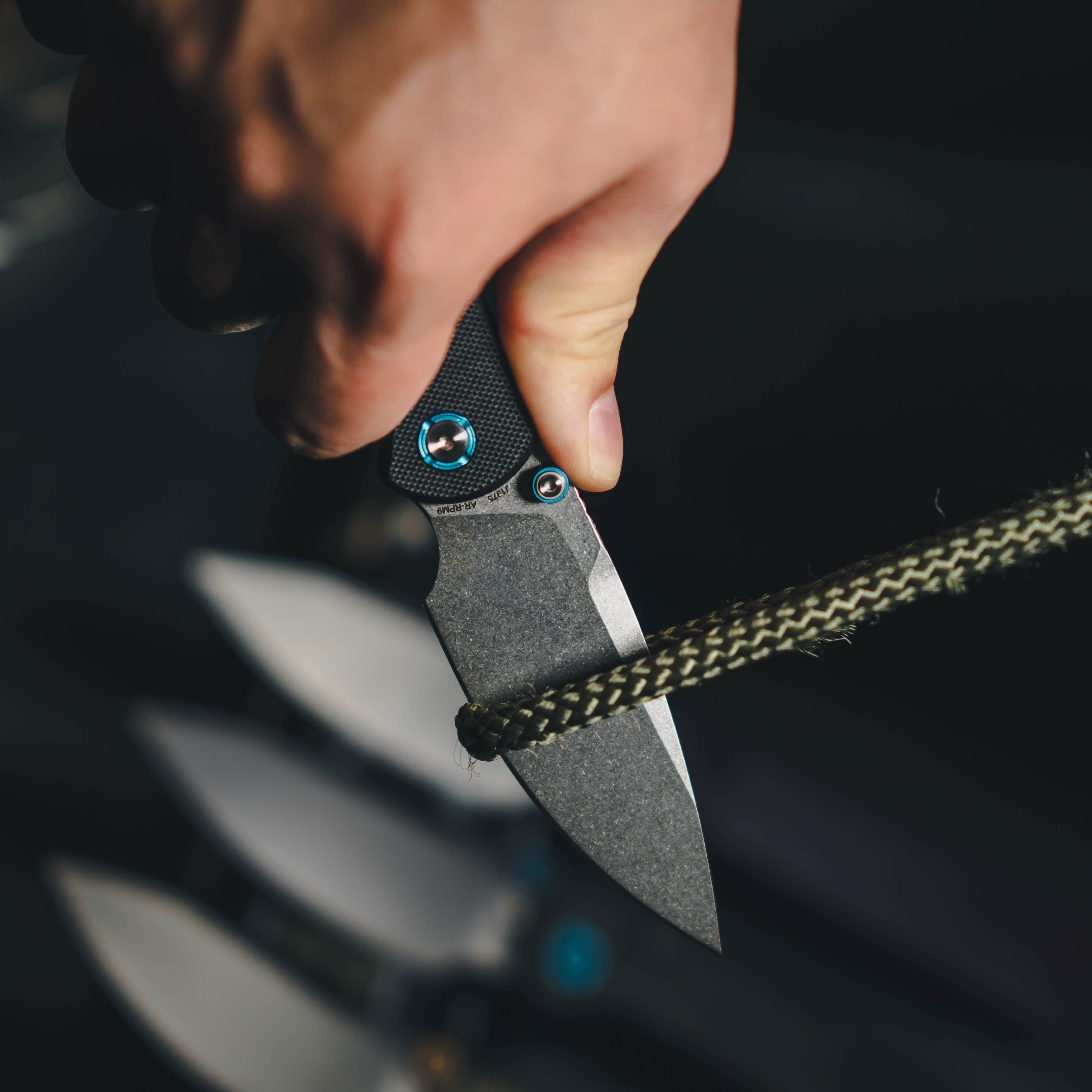
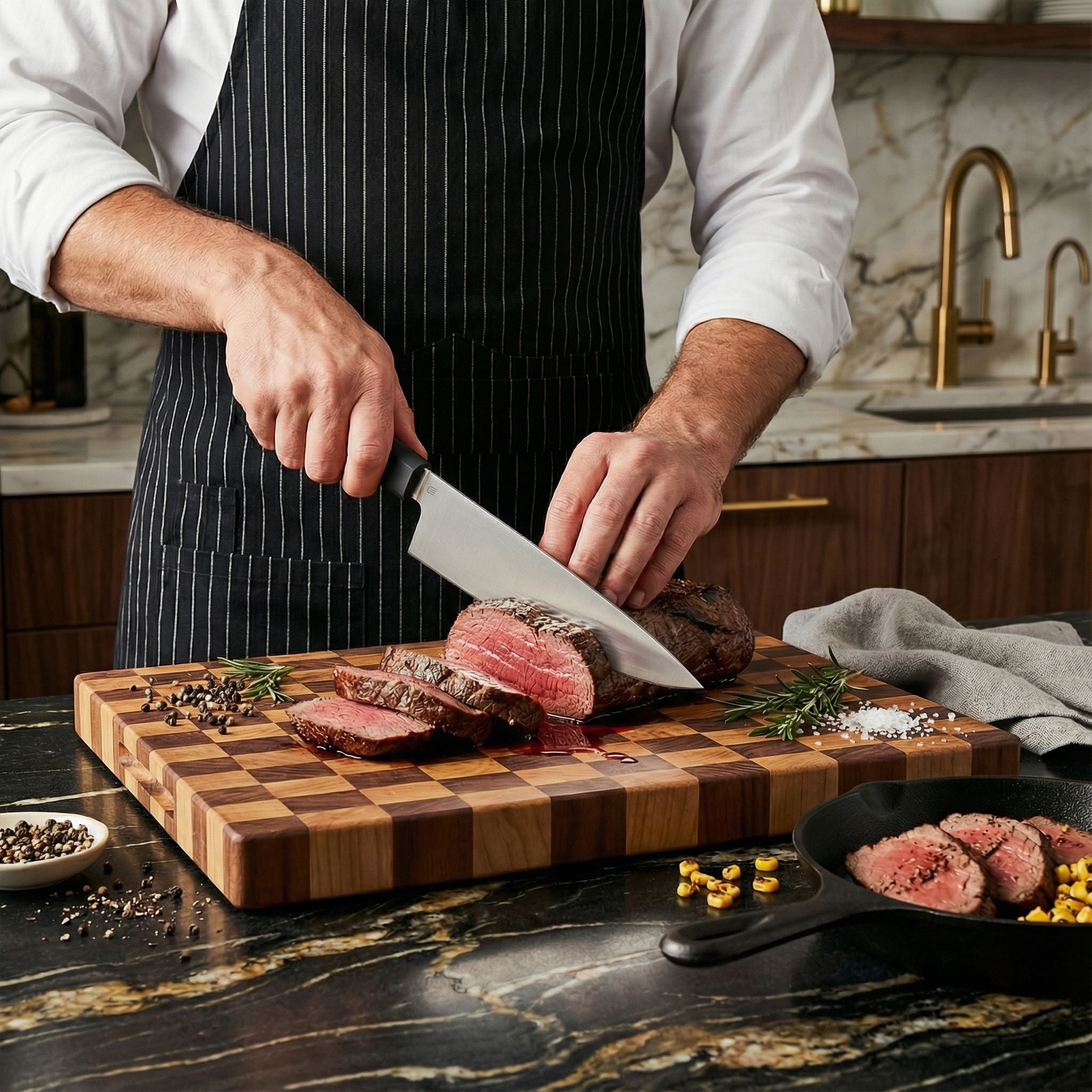

Search "is M390 steel good" and you get a wall of forum opinions. Here is the practical answer: M390 is one of the best all-around stainless steels you can put on an everyday-carry folding knife. It holds an edge for a long time, it shrugs off sweat, humidity and fruit acid, and it takes a fine, polished edge. There is exactly one honest trade-off, and one maintenance habit worth knowing before you buy. M390 is also the flagship steel across much of the Artisan Cutlery M390 lineup, so it is a fair place to start.
M390 is a third-generation powder metallurgy stainless: fine grain, very high wear resistance, and very high corrosion resistance.
What Is M390 Steel?
M390 is a martensitic chromium stainless steel made by Bohler-Uddeholm using a third-generation powder metallurgy (PM) process. The PM route atomizes the melt into fine powder and consolidates it under pressure instead of pouring a conventional ingot, which keeps the carbides small and evenly distributed through the matrix. The payoff is a fine-grained alloy with very high wear resistance and very high corrosion resistance — the two properties that pushed M390 to the front of the high-end folder market and made it a favorite for limited-edition runs.
| M390 at a glance | Detail |
|---|---|
| Producer | Bohler-Uddeholm (martensitic chromium stainless) |
| Manufacturing | Third-generation powder metallurgy (PM), fine-grained |
| Working hardness | Up to 62 HRC; most production knives run 60–62 HRC |
| Standout strengths | Very high wear resistance, very high corrosion resistance |
| Main trade-off | Modest toughness; high-carbide edges can micro-chip under abuse |
| Close equivalents | Carpenter CTS-204P, Crucible 20CV (CPM 20CV) |
| Also sold as | M390 Isomatrix, M390 MicroClean |
Composition and heat-treat data per the ZKnives M390 steel reference.
Why M390 Ranks So High for Everyday Carry
- Edge retention. The high carbide volume resists abrasive wear, which is exactly what kills an edge when you spend your week breaking down cardboard, cutting zip ties and slicing tape. M390 simply stays sharp longer than mainstream stainless alloys at the same geometry.
- Corrosion resistance. M390 is genuinely stainless in daily use. Pocket carry means sweat, humidity and food acids; M390 is one of the better alloys at resisting the pitting and staining that show up on lesser steels.
- Keen, easy-to-maintain edges. The fine grain structure lets M390 take a polished edge, and it does not throw the stubborn, floppy burr that some high-alloy steels are famous for — so finishing an edge is more predictable than you might expect from a super steel.
- Premium platform fit. Because M390 grinds and finishes cleanly, it is usually paired with titanium handles, ceramic ball bearings and frame locks rather than budget hardware.
The Honest Trade-Off: Toughness and Carbide Behavior
M390's edge retention comes from a large volume of hard carbides, and that is also where its weakness lives. Knife Steel Nerds maintains a comparative rating of knife steels by toughness, edge retention and corrosion resistance, and notes that high-carbide steels such as D2, S30V and M390 can lack the toughness and edge stability to keep a truly keen edge in rough use — in real-world cardboard testing, a high-carbide blade ended up micro-chipped while a tougher, lower-carbide steel stayed clean. See the Knife Steel Nerds steel ratings for the full comparison.
In practice that means:
- Buy M390 for slicing, cardboard, tape, rope, food prep, urban and office carry, humid climates and anyone who hates resharpening.
- Consider something tougher for heavy batoning, prying, hacking through dirty material, or cutting on hard surfaces where the edge takes lateral shocks.
M390 in the Artisan Cutlery Lineup
Artisan Cutlery runs M390 as its premium tier, usually on full titanium frame locks with ceramic ball bearing pivots and a stated hardness of HRC 60–62. Current models and list prices:
| Model | Blade | Handle / lock | Price |
|---|---|---|---|
| Tomahawk ATZ-1815G M390 | 3.94" (100 mm) drop point, 0.16" (3.98 mm) stock | Titanium, frame lock, 5.11 oz (145 g) | $224.99 |
| Hornet ATZ-1810G M390 | 3.82" (97 mm) spear point | Titanium, frame lock, 4.93 oz (140 g) | $224.99 |
| Apache Nomad ATZ-1813G M390 | 3.82" (97 mm) flat grind | Titanium with carbon fiber onlays, frame lock, reversible deep-carry clip | $209.99 |
| Orthodox ATZ-1817G M390 | 3.54" (90 mm) tanto | Titanium, frame lock, 4.05 oz (115 g) | $236.99 |
| Eterno ATZ-1818G M390 | 3.54" (90 mm) drop point, sand-polished satin | Titanium with carbon fiber inlay, frame lock | $236.99 |
| Cobra ATZ-1811G M390 | Premium M390 blade | Carbon fiber handle | $112.49 |
Every one of these shares the same recipe: M390 at HRC 60–62, a flat grind, a ceramic ball bearing pivot and a titanium deep-carry clip. Browse the full M390 collection or compare the titanium frame lock models side by side.
Sharpening and Caring for M390
- Give it a 15°-per-side edge. ZKnives recommends roughly 15 degrees per side for the best balance of performance and edge holding on M390; go thinner and the thin edge cannot support all of those carbides.
- Reprofile with diamond or CBN. M390's wear resistance works against your stones as well as your cutting tasks. Diamond plates or cubic boron nitride cut it far faster than soft water stones.
- Finish with light, consistent passes. Because M390 does not form a stubborn burr, a few alternating light strokes are usually enough — read Science of Sharp if you want to go deep on edge finishing.
- Wipe the blade down, clean the pivot. M390 resists corrosion but still benefits from a wipe after wet or acidic use, and a drop of knife lubricant keeps the bearings smooth. If a blade feels gritty, the fix is usually pivot maintenance rather than a new knife.
Is M390 Steel Good? The Verdict by Use Case
| If you mostly… | M390 verdict |
|---|---|
| Open boxes, cut tape and rope, general urban EDC | Excellent — long edge life, no corrosion worries |
| Carry in heat, humidity, or near salt water | Excellent — corrosion resistance is a headline strength |
| Prep food with your folder | Excellent — stainless, easy to keep clean and keen |
| Prize a polished, hair-popping edge | Excellent — fine grain supports refined edges |
| Chop, baton, pry or cut on hard surfaces | Look at a tougher, lower-carbide steel instead |
| Resharpen as little as possible | Excellent — this is the reason to pay for M390 |
M390 vs S35VN, 20CV and CTS-204P
M390 is closely related to two other premium stainless steels: Carpenter CTS-204P and Crucible 20CV (also sold as CPM 20CV). They are proprietary equivalents with similar design intent, so comparing "M390 vs 20CV" is largely a comparison between mills rather than between radically different alloys. If you want a balanced stainless with a little more toughness and easier sharpening, a CPM S35VN blade such as the S35VN models is the common alternative; our S35VN steel explainer and S90V vs S35VN comparison walk through that trade.
Quick Answers
- Is M390 steel good? Yes — it is one of the best edge-holding stainless steels available for a folding knife.
- Is M390 hard to sharpen? It is harder than average because of its wear resistance, but it takes a clean edge and holds it; diamond abrasives make short work of it.
- How hard is M390? Typically HRC 60–62 in production knives, with a working range up to 62 HRC.
- Will M390 rust? No in normal use. It is a stainless variant chosen partly for corrosion resistance, though any steel benefits from a wipe-down after wet use.
If your priority is an edge that is still working next month, M390 is the right call — and the M390 collection is where Artisan Cutlery puts it to work.

Leave a comment
This site is protected by hCaptcha and the hCaptcha Privacy Policy and Terms of Service apply.