

Rust rarely announces itself with a dramatic orange bloom. On a folding knife it usually starts as a speck of brown in the plunge grind, a shadow along the edge of a liner, or a rough patch under the pocket clip that you notice weeks later when the action feels gritty. By then the damage is done and you are sanding metal instead of using the knife.
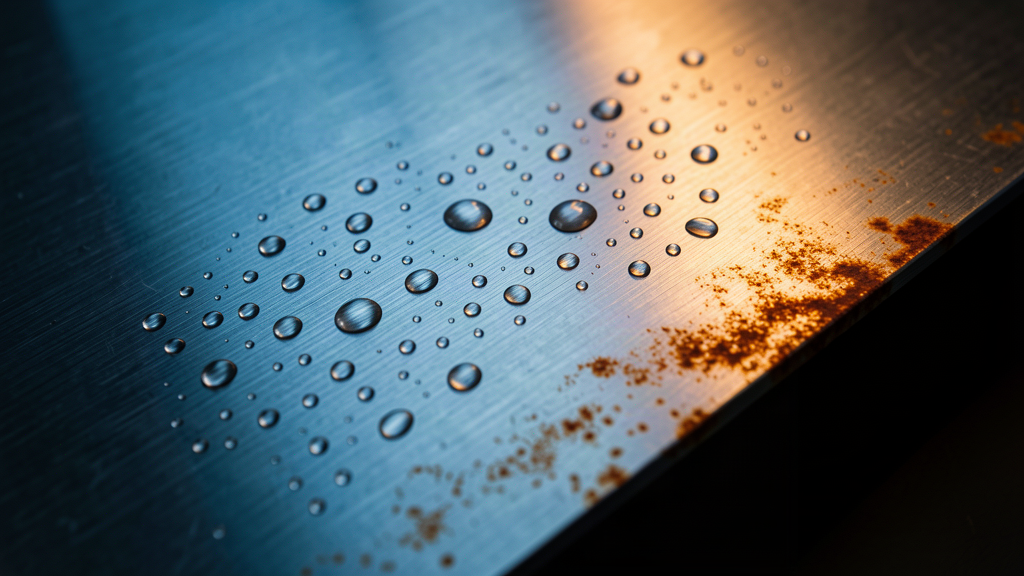
Water beads on a passive film until chlorides break it down locally — that is how a pit starts, not a uniform stain.
The frustrating part is that almost none of it happens in dramatic circumstances. It happens because a knife went into a pocket damp, sat in a leather sheath for a season, or spent a week in a humid bathroom drawer. This guide explains what actually causes rust on a "stainless" knife, the routine that prevents it in salt water and sweat, and how to store a knife so you are not fighting the same spots every year.
Why "stainless" steel still rusts
Stainless steel does not resist corrosion by being inert. It resists corrosion because chromium in the alloy forms a thin passive oxide film on the surface. That film is what separates the metal from the environment, and it is remarkably good at repairing itself when oxygen is available.
As Wikipedia's entry on stainless steel puts it, the corrosion resistance comes from a chromium content of 10.5% or more, which forms a passive film that protects the material and can self-heal when exposed to oxygen. Three things break that arrangement:
- Chlorides. Salt — from seawater, sweat or road spray — attacks the passive film directly. As pitting corrosion research describes, chloride ions complex the metal cations in the oxide layer and drive local dissolution, which is how pitting begins: a tiny hole rather than an even stain.
- No oxygen. A film that cannot reform cannot protect. This is why rust appears under a pocket clip, inside a sheath, or in the gap between scale and liner — not on the exposed blade flat.
- Trapped moisture. Water alone is a mild problem. Water that cannot escape, warmed by body heat and holding dissolved salts, is the real enemy.
The four places a folding knife actually rusts
- Under the pocket clip. Constant contact with fabric, body heat and sweat, with almost no airflow. This is the single most common rust site on a carried folder.
- Around the pivot and washers. Moisture wicks into the pivot assembly and stays there. The first symptom is usually gritty action, not visible rust.
- Between the scale and the liner. A crevice that holds water and lint together. Any knife with visible gaps at the liner seam is a candidate.
- The edge bevel and plunge grind. Thin geometry, exposed steel, and often the first place a micro-chip traps moisture.
After salt water: the ten-minute routine
Salt is not something to wipe off later. If a knife goes into the sea, into a sweaty waistband, or into a bait bucket, deal with it the same day.
- Rinse with fresh water. Lukewarm tap water, blade open, working the pivot through a few full open-close cycles so water flushes the assembly rather than sitting in it.
- Shake out and towel dry. Pay attention to the pivot, the liner gaps and the clip contact area — the places a towel does not reach on its own.
- Air dry fully open. Leave the knife open somewhere with airflow for at least an hour. Do not close it wet and put it in a pocket "for now."
- Oil the pivot, then the blade. A drop of a corrosion-inhibiting oil in the pivot, and a very thin film wiped across the blade and the clip contact area. Thin matters — a heavy coat traps grit and attracts lint.
Sweat deserves the same treatment as salt water, just less urgently. If you carry in a pocket all day in summer, wipe the blade and the clip area with a dry cloth in the evening and re-oil weekly rather than monthly.
Storage that does not create rust
Most rust on knives that "were fine when I put them away" happens in storage. The rules are simple:
- Never store a knife in a leather sheath. Leather holds moisture and can release tannins and salts against the steel. Sheaths are for transport, not for years of storage.
- Store open or slightly open in a dry, ventilated place — a drawer with airflow beats a sealed case in a humid room.
- Control humidity. A silica gel packet in the drawer or case is cheap insurance; recharge or replace it periodically.
- Keep the film of oil. A knife going into long-term storage should have a light coat of oil on the blade and a drop in the pivot.
- Avoid the bathroom and the kitchen sink cabinet. Both are humidity traps.
How much margin your steel gives you
Steel choice changes the maintenance burden, but it does not remove it.
| Steel type | Typical behavior in humid or salty conditions | What it asks of you |
|---|---|---|
| High-chromium stainless (S35VN, M390, 20CV-class) | Good margin; resists spotting during normal carry | Dry after salt exposure, light oil |
| Mid-chromium stainless (13–14.5% Cr budget grades) | True stainless; copes with sweat and humidity, less margin against salt | Rinse and dry after salt water, oil monthly |
| Tool steels such as D2 | Semi-stainless: roughly half the chromium is tied up in carbides, so free chromium is far lower than the total suggests | Wipe after every use, oil regularly, never store damp |
| Non-stainless carbon and high-hardness tool steels | Will patina and can rust from a fingerprint | Oil as routine, not as repair |
The pattern is worth internalizing: the number stamped on the spec sheet is total chromium, not chromium available to fight corrosion. A 12% chromium tool steel with high carbon can be less stain resistant than a 13% chromium stainless with modest carbon, because carbon takes chromium out of solution to form carbides.
If you already have rust
Surface rust — the orange film that wipes off and leaves a light shadow — is a ten-minute job. A metal polish or a fine abrasive pad applied along the blade length, followed by a clean wipe and an oil coat, will remove it. Work along the grind lines, not across them, and keep abrasives away from the edge if you can.
Pitting is a different problem. If you can feel a pit with a fingernail, the metal is gone and polishing will only widen the depression. Clean it out, keep it oiled so it does not keep growing, and accept that a pitted blade is a user rather than a collectible. Deep pitting near the edge or the plunge line is worth showing to a professional before you grind on it yourself.
A care calendar that actually gets followed
- Daily — wipe the blade dry after use; if you carried in a hot pocket, wipe the clip area too.
- Weekly — a drop of oil at the pivot, one open-close cycle to spread it, and a dry cloth over the blade.
- Monthly — check the liner gaps and under the clip with a flashlight; clean out lint, re-oil the blade lightly.
- After salt water or heavy sweat — full fresh-water rinse, dry open, oil the same day.
- Seasonally — inspect stored knives, refresh oil, replace silica packets, and check anything that lives in a sheath or a bag.
Artisan Cutlery models with more corrosion margin
If your carry environment is humid, coastal or sweat-heavy, start with the higher-chromium stainless builds rather than the tool steels. Artisan Cutlery's Sirius 1849P and Andromeda 1856P use S35VN blades, while the Hoverwing, Cobra, Eterno and Eagle models run M390 — a steel with substantially more chromium in the alloy. Those are the knives that tolerate a missed wipe-down without punishing you for it.
See the current lineup at Artisan Cutlery folding knives. Whichever you pick, the routine above is what keeps it looking new.
FAQ
Can stainless steel knife blades rust?
Yes. Stainless relies on a chromium oxide passive film, and that film is attacked by chlorides from salt and sweat, and cannot reform where oxygen is excluded. A stainless blade left damp under a pocket clip will rust.
Does WD-40 prevent knife rust?
It displaces water effectively, which is useful immediately after a wet day, but it is a light solvent-based product rather than a long-term protective film. For storage, a dedicated corrosion-inhibiting oil or a thin wax coat lasts much longer.
How do I stop sweat from rusting my knife?
Carry it somewhere other than a sweaty front pocket when you can, wipe the blade and clip area dry each evening, and keep a thin oil film on the steel. Sweat is salty water — treat it like salt water, just on a smaller scale.
Is patina the same as rust?
No. Patina is a stable, dark surface layer that forms on some steels and actually slows further corrosion. Rust is active oxidation that keeps eating metal. Patina is fine to leave; rust needs to be removed and the surface re-oiled.

Leave a comment
This site is protected by hCaptcha and the hCaptcha Privacy Policy and Terms of Service apply.