




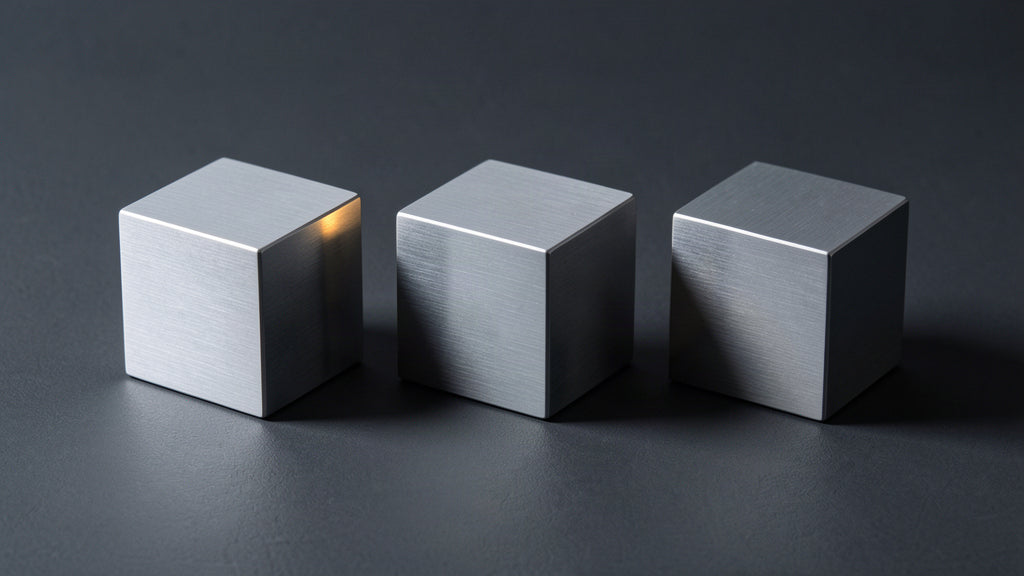
M390, CPM-20CV and CTS-204P are the same alloy in all but name. All three are published at roughly 1.9% carbon, 20% chromium, 4% vanadium, 1% molybdenum and 0.6% tungsten, because all three descend from one Bohler recipe — the other two are licensed copies made after the original proved itself in production knives. What actually differs between two knives carrying these labels is the powder-metallurgy process behind the steel and, far more importantly, the heat treatment the knifemaker applied.
Same chemistry, different mills: what changes is the heat treat, not the label.
That is the short answer most comparison pages bury under brand loyalty. The useful version is longer: it explains why a 60 HRC M390 blade and a 62 HRC M390 blade can behave like different steels, why "made in the USA" tells you nothing about which of the three you are getting, and how to read a spec sheet without being fooled by a name.
The short answer: one recipe, three mills
Bohler-Uddeholm in Austria developed M390. Latrobe Steel in the United States copied it and sold it as 20CV. Carpenter Technology produced its own version, first called Micromelt 20-4 and then renamed CTS-204P. Crucible sells it as CPM-20CV. Four trademarks, one chemistry, several decades of licensing history.
This matters practically in two ways. First, no mill has a secret ingredient — a knife in 20CV is not a downgrade from M390. Second, the name on the blade tells you almost nothing about quality; the heat treat code does, and most brands don't publish it.
Where the alloy came from
The lineage is documented and unusually clear, which is why it is worth knowing:
- 1950–51: David Giles at Latrobe patents A7 and D7 — cold-work tool steels with extra vanadium for wear resistance. D7 is a modification of D4.
- Early 1980s: Bohler introduces K190, a powder-metallurgy version of D7. It is a tool steel, not stainless, and Bohler wants a stainless version for the plastics industry.
- Late 1980s: Bohler develops M390 as a modification of K190, targeting high wear resistance plus genuine corrosion resistance. Toughness was explicitly not the design priority.
- 2005: Latrobe's copy, 20CV, appears in Timken's published steel data and in Blade magazine advertising. Timken-Latrobe works with SOG on CATRA testing, and SOG ships the Team Leader in 20CV.
- 2009–2010: Carpenter introduces its copy as Micromelt 20-4, renamed CTS-204P by early 2010.
- 2011: Carpenter acquires Latrobe. Crucible begins selling the grade as CPM-20CV.
The pattern is familiar in steel: one mill solves a wear problem, three others reproduce the chemistry, and the knife market ends up with four names for one alloy. If you want the full metallurgical account, Larrin Thomas documented it in M390 Steel — History and Properties.
Composition side by side
| Element | Bohler M390 | CPM-20CV | CTS-204P | What it does |
|---|---|---|---|---|
| Carbon | 1.90% | 1.90% | 1.90% | Hardness and carbide volume |
| Chromium | 20.0% | 20.0% | 20.0% | Corrosion resistance; forms chromium carbides |
| Vanadium | 4.0% | 4.0% | 4.0% | Very hard vanadium carbides — abrasive wear resistance |
| Molybdenum | 1.0% | 1.0% | 1.0% | Hot hardness, carbide formation, corrosion support |
| Tungsten | 0.6% | 0.6% | 0.6% | Additional hard carbides |
| Silicon | 0.7% | 0.7% | 0.7% | Deoxidation in melt |
| Manganese | 0.3% | 0.3% | 0.3% | Hardenability |
Read that table as a specification, not a shopping guide. The three columns are identical within normal mill tolerance. Any page claiming one of these has meaningfully better edge retention than another is describing a difference in heat treat, edge geometry, or both — and attributing it to the wrong variable.
What the numbers are actually buying
1.9% carbon with 4% vanadium puts a lot of very hard vanadium carbide in the steel. That is where the abrasive wear resistance comes from, and it is why these grades hold an edge through cardboard far longer than D2 or 14C28N. It is also why they are harder to grind and slower to sharpen.
20% chromium is the part most people underestimate. Chromium in solution — not just chromium in the analysis — drives corrosion resistance, and these grades score near the top of stainless knife steels. Larrin's corrosion testing on CTS-204P put it ahead of S30V, S35VN, S90V and SG2, and slightly ahead of S45VN. For a humid-climate or sweaty-pocket folder, that is the real daily benefit, not the CATRA numbers.
Molybdenum and tungsten are supporting cast: they add hard carbides and help the steel hold hardness at tempering temperature. They are why the numbers look different from a simple high-chromium stainless while the performance category stays the same.
Hardness and heat treat decide the edge, not the name
Bohler's current recommendation for M390 sits at an austenitizing temperature of 1150–1180 °C with a 60–62 HRC target and triple tempering. Within that window the blade is hard, wear resistant, and reasonably stable. Outside it, the alloy is wasted.
The clearest evidence is independent cardboard cut testing of production knives in these steels, measured in feet of cardboard cut:
| Knife and steel | Hardness | Feet of cardboard |
|---|---|---|
| Production folder, M390, low temper | 60 HRC | 267 ft |
| Production folder, 20CV | 60.8 HRC | 311 ft |
| Mid-tech folder, M390, secondary hardened | 59 HRC | ~336 ft |
| Production folder, M390 | 61.5 HRC | 351 ft |
| Mid-tech folder, M390, secondary hardened | 60 HRC | ~400 ft |
| Production folder, M390 | 62 HRC | ~400 ft |
Same alloy family, a 50% spread in edge retention. The 20CV knife at 60.8 HRC beat an M390 knife at 60 HRC. The mid-tech blade at 59 HRC, secondary hardened at 1140 °C, beat both. If you take one thing from this article, take that: the three-way name debate is a rounding error next to the tempering schedule.
For a buyer, the practical translation is simple. A brand that publishes a hardness range and actually holds it is worth more than a brand that prints "M390" on the blade and says nothing else. Ask what hardness the blade is run at before you assume you are getting 62 HRC performance out of a 58 HRC blade.
Toughness: the honest limitation
M390 and its twins are wear-resistance steels, not toughness steels. Published toughness figures land in a modest range — early testing showed roughly 8–9 ft-lb at about 62 HRC, and that number was later treated with suspicion because those samples likely carried excess retained austenite from an overly hot austenitizing step. Real toughness at 62 HRC is not the selling point.
What that means at the handle: do not pry with it, do not chop with it, and do not run a thin 12°-per-side edge on it if you cut near staples or grit. At 20° per side in a 0.10–0.13 inch stock it is an excellent folding-knife edge. At 15° per side with a lot of lateral load, it chips and you will spend an evening on a coarse diamond plate fixing it.
Sharpening: use the right abrasive
Vanadium carbides are harder than aluminum oxide. On an AlOx water stone, a high-vanadium blade feels glassy and slow; the stone abrades the softer matrix and skates over the carbides. Diamond or CBN cuts predictably and gets you to a burr in a fraction of the time.
One nuance worth knowing: because the matrix around those carbides is comparatively soft, M390-family steels are easier to sharpen with aluminum oxide than their wear resistance would suggest — the burr forms readily even if the bevel polishes slowly. The failure mode is not difficulty, it is over-polishing. Chase the burr, remove it, strop, and stop.
Which one should you buy?
| Situation | What to do |
|---|---|
| Two similar knives, one M390, one 20CV, same hardness and price | Buy on geometry, lock, and handle — the steel is a tie |
| Same knife available in M390 and S35VN | M390 for edge retention and corrosion; S35VN for toughness and easier sharpening |
| You cut cardboard, tape, and packaging daily | M390-family at 60 HRC or higher, 18–20° per side, stropped weekly |
| You work outdoors in wet, salty conditions | M390-family is the strongest corrosion argument in this class |
| You pry, chop, or cut near grit | Skip all three; choose a tougher steel like 3V or a thicker edge |
| You want one steel to learn sharpening on | Not this family — start on 12C27 or 8Cr13MoV, then move up |
FAQ
Is CTS-204P the same as M390?
Chemically, yes — both are published at about 1.9% C, 20% Cr, 4% V, 1% Mo and 0.6% W, and Carpenter's grade originated as a copy of M390. They are made by different companies with different powder-metallurgy processes and will be heat treated separately by each knifemaker, so finished knives can still differ.
Is 20CV as good as M390?
In published composition they are identical. In practice the difference you feel will come from hardness and edge geometry, not from the mill. A well-treated 20CV blade outperforms a lazily treated M390 blade, and the reverse is also true.
What hardness should M390 be run at?
Bohler's guidance targets 60–62 HRC with triple tempering. Under 58 HRC you lose much of the wear-resistance advantage; over 62 HRC you trade toughness for a small gain in edge retention and make the blade chippy.
Does M390 rust?
It resists corrosion very well — better than S30V, S35VN, S90V and SG2 in published testing — but it is stainless, not rust-proof. Salt water, acidic food left on the blade, and long storage in a damp sheath will still mark it. Dry it and oil the pivot.
Do I need diamond stones for M390?
Need, no. Want, yes. Aluminum oxide works and forms a burr, but diamond or CBN is faster and more predictable on 4% vanadium, and it holds flat longer, which matters more than abrasive type on a blade this wear resistant.
None of this is a reason to chase a steel name. It is a reason to ask two better questions when you are shopping: what hardness is this blade run at, and what angle is the edge ground to? Those two answers predict how a knife cuts far more reliably than which of the three trademarks is stamped on the tang. You can see where the family sits in our lineup in the M390 collection, compare it against the S35VN models for a toughness-first alternative, or browse the full folding knives range and the Artisan Cutlery lineup.

Leave a comment
This site is protected by hCaptcha and the hCaptcha Privacy Policy and Terms of Service apply.