
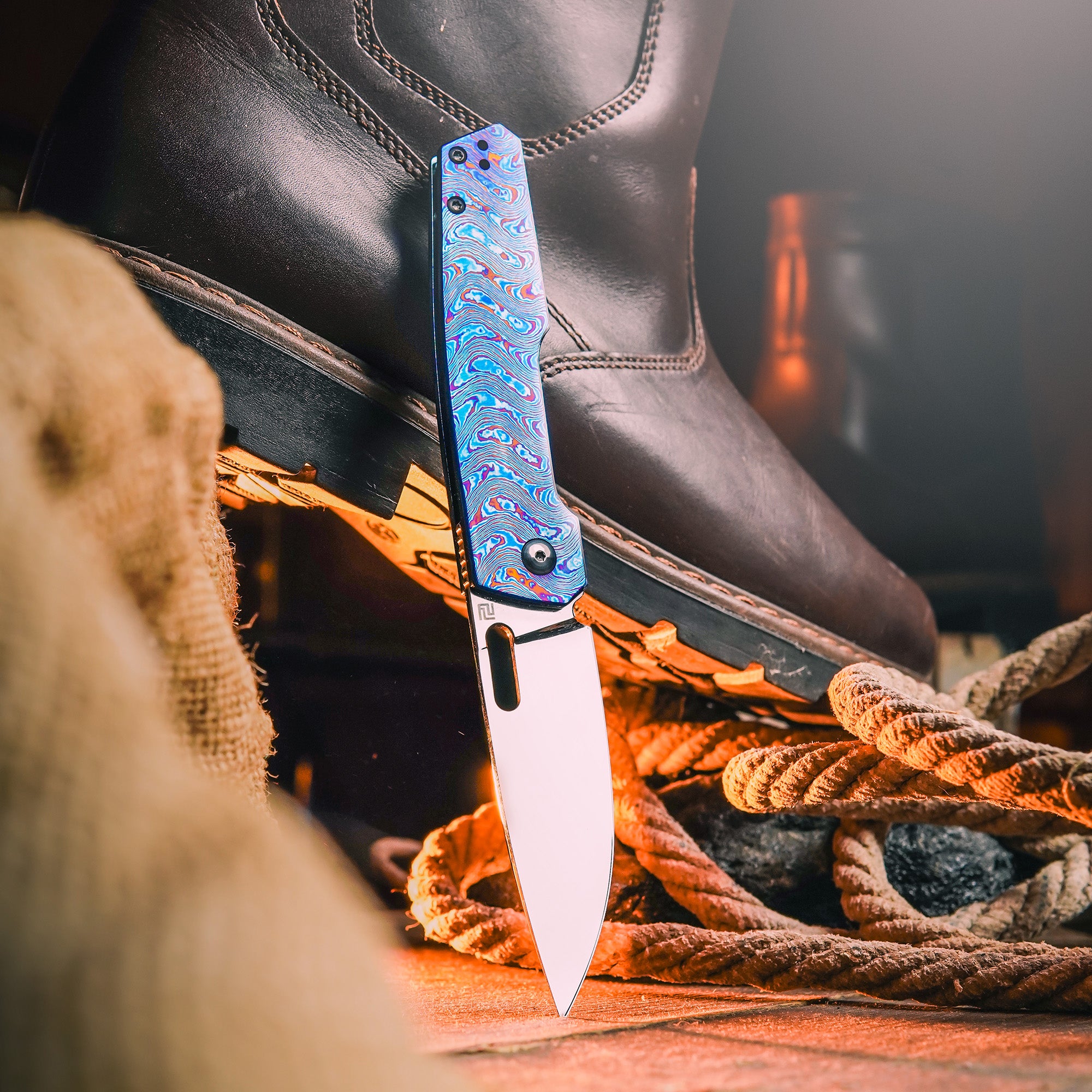
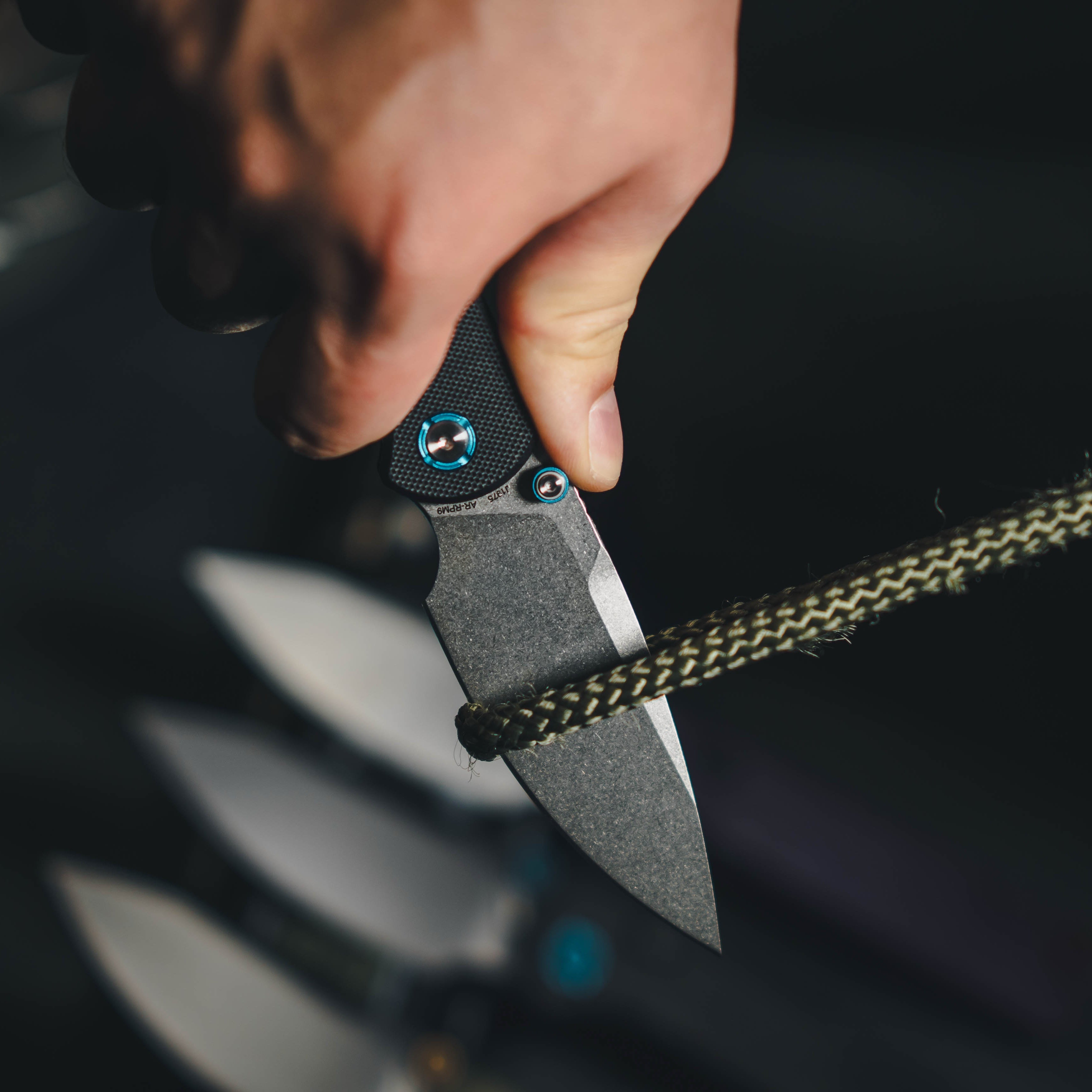
A ricasso is the unsharpened stretch of blade between the start of the cutting edge and the handle or guard. It is the flat section the edge stops short of, and on modern knives it is where your index finger goes, where a flipper tab is cut from, and where the grind has to make a clean transition into the handle.
The flat between plunge line and handle: where grip, strength and edge length meet.
The word sounds like sword terminology because that is where it comes from, but nearly every folding knife on a dealer's shelf has one. Learning to read it tells you how a knife is meant to be held and how much usable edge you are actually paying for.
What counts as a ricasso
Wikipedia's entry on the ricasso defines it as an unsharpened length of blade just above the guard or handle, found on knives, daggers, swords and bayonets, with examples dating back at least to the Bronze Age. That is a broad definition, and it is broad on purpose: the feature has been used for grip, for strength, for decoration and for simple manufacturing convenience across a very long stretch of history.
On a modern knife the ricasso is easy to find. Follow the edge from the tip back toward the handle. At some point the edge stops, and instead of continuing to the scales there is a flat or nearly flat band of steel. That band is the ricasso. Where the edge begins is the plunge line, the visible start of the bevel grind, and the two features are always read together because one defines the other.
The common confusion is with two neighbouring features that live in the same place:
- A sharpening choil is a small notch cut into the blade right where the edge would otherwise meet the ricasso. It gives a sharpening stone somewhere to finish so the heel of the edge does not round over into a hook over the years.
- A finger choil is a deeper relief cut into the blade so a finger can wrap in front of the handle, shortening the grip for precision work.
- The ricasso is the flat itself. A knife can have all three, two of them, or none, and the arrangement is one of the clearest design signatures a maker leaves on a blade.
Why makers leave a ricasso
There is no single reason, and the honest answer changes with the knife. Four recur consistently.
Strength at a high-stress point
The junction where blade meets handle is where a lot of load concentrates, and it is the one place on a knife where you cannot add material without changing the shape. Leaving the steel full-thickness and unsharpened there keeps a solid block right at that junction rather than a thin edge running into a pair of scales. Wikipedia notes this directly in its discussion of modern knives: a ricasso may offer greater blade strength at a high-stress point.
A place for the finger
A choked-up grip is how most precise cutting happens, and the ricasso is what makes that grip safe to use. Historically this was the whole point on long blades: the entry describes index fingers placed above the crossguard on medieval swords for grip strength and control, a habit that shaped the compound hilts of later rapiers. On a modern folder the same idea appears as a flat section you can rest a finger on without touching an edge.
Grinding and finishing
Bevel grinds have to start somewhere. A plunge line that runs cleanly into a flat ricasso is a much easier thing to grind consistently than a bevel that has to fade out into a handle. Wikipedia also notes the practical, unglamorous version of this: leaving a section unsharpened saves a maker time, because steel that will never be used for cutting does not have to be shaped and sharpened.
Design language
Some ricassos are purely visual. They break up a long blade, they give a flipper tab or a front flipper a natural home, and they give the eye a place to rest between the grind and the handle. A maker who tells you the ricasso is decorative is being honest rather than dismissive.
What a ricasso costs you
Every millimetre of ricasso is a millimetre of blade that is not cutting edge. That is the whole trade-off, and it is worth doing the arithmetic on a knife you are considering rather than trusting a photograph.
Take a typical 8.9 cm (3.5 in) blade with a 6 mm ricasso. The cutting edge is 8.3 cm, or about 93 percent of the blade length. Push the ricasso to 12 mm and the edge drops to 7.7 cm, about 87 percent. On a short blade, six percent of edge length is a real amount of cutting, and on a very compact knife it is the difference between a useful heel and a decorative one.
| Ricasso length on an 8.9 cm blade | Edge length left | Share of blade that cuts |
|---|---|---|
| None | 8.9 cm | 100 percent |
| 6 mm | 8.3 cm | About 93 percent |
| 12 mm | 7.7 cm | About 87 percent |
| 19 mm | 7.0 cm | About 79 percent |
The lesson is not that ricassos are bad. It is that on a small knife you want a short one, and that a long flat section with a lot of styling behind it is usually there because the design was drawn for looks first.
The ricasso on a folding knife
On a folder the ricasso does jobs the sword version never had to do.
- It is where the flipper tab lives. A flipper is cut from the ricasso so it can swing past the handle when the blade rotates. That geometry is why flippers usually have a wider flat there than a knife with a thumb stud.
- It is the closing safety margin. When you disengage a liner lock or a frame lock and let the blade fall, the edge arrives at your finger. A ricasso keeps the first few millimetres of that travel edge-free, which is a small thing that becomes important when you are closing a knife one-handed every day.
- It sets the detent geometry. The detent ball on a folding knife often rides on the tang, and the transition from tang to ricasso affects how the blade breaks free of its closed position.
- It gives a front flipper its leverage. On front-flipping knives, the pull point is usually on the ricasso specifically because there is steel there and no edge to catch a thumb.
None of this is visible in the marketing copy. It all shows up in the first week of carrying the knife.
The ricasso on a fixed blade
Fixed blades are where the historical logic survives most intact. The ricasso is the gap between the guard and the start of the edge, and it exists so that a hand can slide forward onto the blade without meeting something sharp. On a hunting or camp knife this is where you naturally grip when you choke up for detail work, and it is also where a maker will place a sub-hilt, an extra section of guard along the grip rather than up the blade, if the design calls for a second forward hand position.
A large fixed blade with a very long ricasso and a second set of quillons is a direct descendant of the two-handed sword layout, where the extra guard created a secondary grip on the blade itself. The scale changes; the logic of giving a hand a defined, protected place to hold does not.
Ricasso, choil, and plunge line compared
| What it is | What it does | What to check | |
|---|---|---|---|
| Ricasso | Unsharpened flat between edge and handle | Grip position, strength at the junction, a home for a flipper tab | How long it is relative to blade length |
| Plunge line | Where the bevel grind starts | Defines the heel of the edge | Straight, even, symmetric on both sides |
| Sharpening choil | Notch at the heel of the edge | Lets a stone finish the edge cleanly | Present or not, and whether it is deep enough to be useful |
| Finger choil | Relief cut for a finger | Shortened, choked-up grip | Whether your finger actually fits it |
A knife with no sharpening choil and a flush plunge line is not defective. Plenty of well-made knives are ground that way, and the consequence is simply that the heel is the hardest part of the edge to keep clean when you sharpen. A knife where the ricasso runs all the way to the plunge with a soft transition is the harder case: it looks smooth and it quietly rounds the heel every time the blade is worked on a stone.
How to judge one before you buy
- Measure it. Blade length minus ricasso gives you the edge you are getting. Do that sum on two or three candidates before deciding, especially on compact knives.
- Put your finger on it. A ricasso that is too narrow to hold is a design element, not a grip. If the flat is only two or three millimetres wide, treat it as decoration.
- Check the heel. Look at where the edge begins: it should be even on both sides and free of a burr or a wobble. An uneven plunge line is a grind that was rushed.
- Look for a choil notch. Not mandatory, but if the knife has one it should be a clean radius rather than a nicked-out square.
- Test the closing path on a folder. Open and close it slowly and watch where the edge passes your finger. A generous ricasso is the difference between a comfortable one-handed close and a habit of using two hands.
Sharpening around it
Most ricasso damage is sharpening damage, and it happens slowly enough that owners rarely notice.
The failure mode is simple. A stone, especially a guided system with a fixed clamp, will happily grind into the ricasso if you let it. Do that repeatedly and the flat develops a hollow, the plunge line migrates forward, and the heel of the edge turns into a rounded hook that no longer cuts at the board. The fix is to stop the stroke at the plunge line and to use the sharpening choil, if there is one, as the place to finish.
If the knife has no choil, work the heel last and lightly, and check the transition after every session against a straight edge. If the plunge line has started to wander, stop sharpening that section and leave it alone rather than chasing it; a slightly inconsistent heel is cosmetic, while a hollowed ricasso is a permanent change to the blade.
Keep the ricasso dry. On a fixed blade it is the widest, flattest piece of exposed steel near the hand, and on a carbon or semi-stainless blade it is a favourite place for a rust spot to appear after a wet day. A wipe and a thin film of oil costs nothing.
The short version
A ricasso is the unsharpened stretch between the edge and the handle, and it earns its place by making a knife stronger at the junction, safer to close and easier to grip precisely. It costs cutting edge, so on small knives you want it short. Read it alongside the plunge line and the choils, because the three together tell you more about how a knife was designed than the spec sheet does.
If you want to see how different designs handle that junction, our folding knives range shows flipper and front-flipper layouts where the ricasso does real mechanical work, the fixed blade collection shows the classic guard-and-flat arrangement, and knife types breaks the blade shapes down by job. For the wider vocabulary of blade and handle parts, the knife reference on Wikipedia is a reasonable starting point, and all products is the full lineup if you would rather compare shapes side by side.


Leave a comment
This site is protected by hCaptcha and the hCaptcha Privacy Policy and Terms of Service apply.