

In short: tactical folding knives move at retail on three things — a working entry price, a lock the customer can open and close one-handed at your counter, and a blade length that is legal in their market. Styling sells the first unit; those three decide whether the SKU reorders.
Why the tactical segment behaves differently from general EDC
In a general everyday-carry set the shopper is buying a daily tool and will trade finish for price. In the tactical segment the shopper is buying a role: duty belt, vehicle kit, range bag, hunting pack. That changes two things for a buyer.
First, the primary use is often gloved and one-handed, so lock operation and deployment matter more than blade finish. Second, this customer usually already owns a knife, so a new SKU has to beat something already in the drawer — most often on steel at a given price, rarely on looks. Assortments that underperform here are usually too wide rather than too narrow: eight silhouettes at the same price, with the same 3.5-inch blade, and nothing the customer can point at as an upgrade.
The three-tier price ladder
A retail tactical assortment works when every step up the ladder buys the customer something they can name out loud — a steel, a lock mechanism, a handle material. If two tiers differ only in color, the upper tier dies and drags the lower one with it, because the customer reads the whole shelf as one price band. The same logic that applies to any product mix applies here, with one tactical-specific twist: the depth of the assortment has to survive a customer who already owns a comparable knife.
Retail price ladder in the current Artisan line
Prices below are the published retail prices on artisancutlery.net at the time of writing. They are shown as a market ladder, not as dealer terms.
| Model | Steel | Lock | Blade | Retail | Role in the assortment |
|---|---|---|---|---|---|
| Zumwalt ATZ-1808P, G10 flat | D2 | Liner lock | 3.94 in (100 mm) | $48.95 | Entry step, first tactical purchase |
| Wizard 1870P-AL | 14C28N | Button lock | 3.47 in (88 mm) | $59.99 | In-store demo, corrosion-tolerant daily carry |
| Pyrite-Light J1945 | S90V | Button lock | 3.7 in (94 mm) | $79.99 | Steel-name upgrade at a mid price |
| Hectare-Alt J1935A | AR-SFII | Crossbar lock | 3.11 in (79 mm) | $89.99 | Short-blade SKU for restricted markets |
| Virginia ATZ-1807G | S35VN | Liner lock | 3.94 in (100 mm) | $107.24 | Known-steel step-up, full size |
| Virginia ATZ-1807G, M390 version | M390 | Liner lock | 3.94 in (100 mm) | $164.99 | Case stock, collector and gift tier |
Entry tier: the bench that pays the rent
Roughly the first third of a tactical shelf should sit where a customer can walk out with a knife and a sheath for under the price of a dinner out. The D2 liner-lock full-size knife is the classic occupant: a 3.94-inch drop point, G10 scales, a mechanism the buyer has seen before. It exists to start the relationship, not to make the month. Buy it for breadth and for the customer who is upgrading from a gas-station knife, and expect the reorder rate to be modest.
Mid tier: the reorder engine
The middle band is where a dealer makes money, because the customer has a reason to choose between two specific knives: a named steel, a faster mechanism, or a shorter blade that fits a local rule. A 3.7-inch button-lock folder in S90V at just under $80 next to a 3.11-inch crossbar-lock in AR-SFII at $90 gives the buyer two different arguments rather than one knife in two colors. This is the band to keep deepest.
Premium: case stock, not shelf stock
Above roughly $140 the knife stops being a working purchase and becomes a considered one. M390 at $164.99 in the same silhouette as the $107 S35VN version is a deliberate pairing: the customer who knows what M390 is will ask for it by name, and the customer who does not will still see a reason the two are priced differently. Stock it shallow, present it in a case, and do not expect it to carry the volume.
Lock type is a training decision, not just a spec line
Most tactical returns at retail are not defects. They are customers who could not work the lock the way the staff demonstrated it. That makes lock selection a staffing question as much as an engineering one.
Liner lock
Cheapest to produce, most familiar to shoppers, easiest to explain in one sentence. It is the right default for the entry tier. The trade-off is the close: some customers need two hands, and heavy gloves make it worse.
Button lock
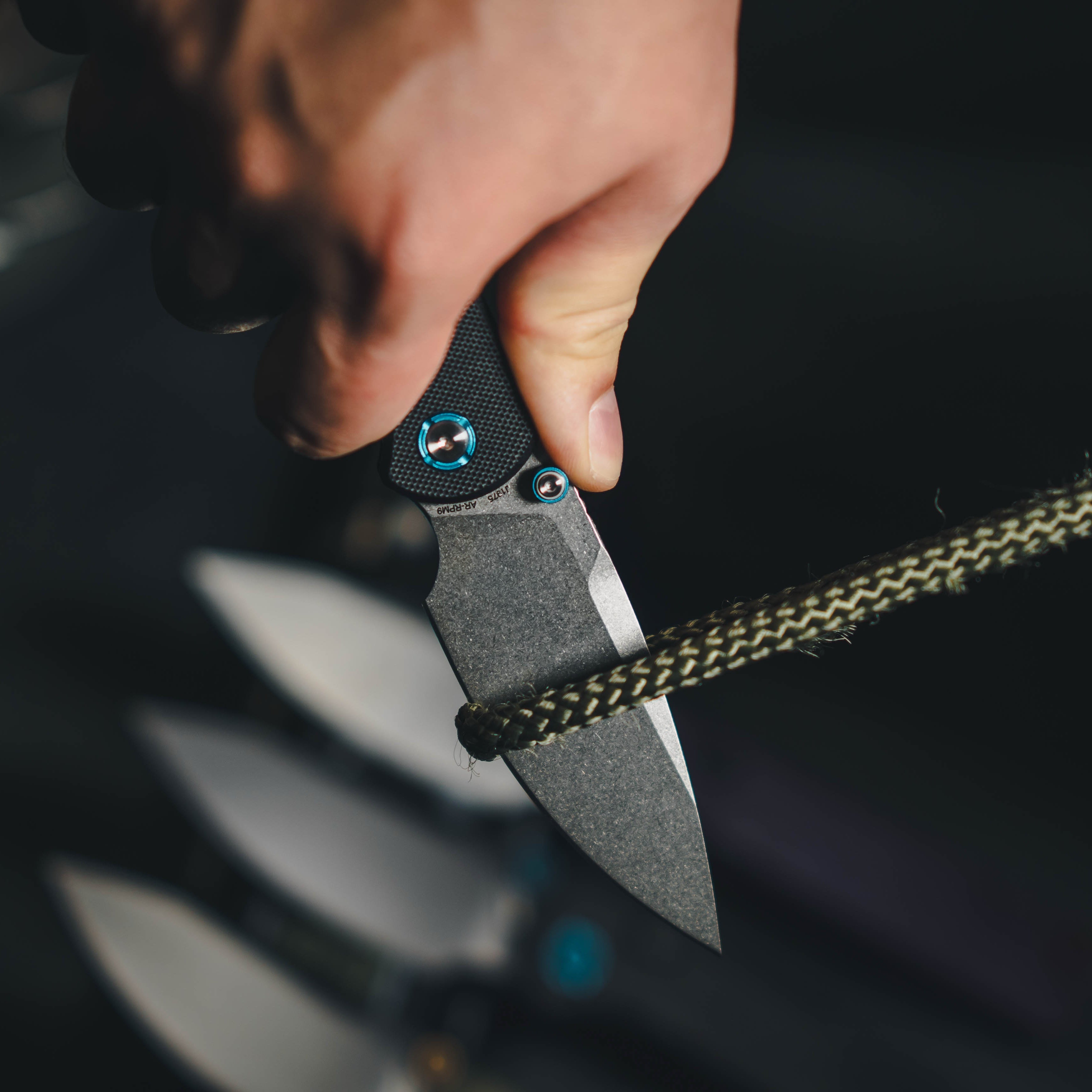
The strongest in-store conversion of the three, because the close is a single thumb press. It reads as premium even at a mid price. It is also the mechanism most likely to invite a legal question — rules on what counts as an automatic knife are written per jurisdiction and do not map cleanly to lock type, so confirm against your own market before you stock deep.
Crossbar lock
Ambidextrous, and the easiest story to tell a hard-use customer. The failure mode is demo skill: if staff cannot pull both sides cleanly, conversion drops and the knife looks defective. Train the pull before the knife goes on the shelf.
A practical rule: one lock family per price tier. Staff then learn three mechanisms instead of nine, and your return conversation gets shorter.
Carry two blade lengths, not two finishes
Blade length is the variable that decides whether a customer can legally carry the knife at all, and it varies enormously between states, counties and countries. A restricted market will not accept a 3.94-inch blade no matter how good the steel is, and an unrestricted market reads a 2.5-inch blade as a keychain tool. Stocking a short option inside the same family — a 3.11-inch crossbar folder beside a 3.94-inch liner lock — covers both without doubling the number of silhouettes you have to explain.
The corollary matters for cash flow: ten finishes of one restricted-length knife is not width, it is the same bet placed ten times.
What sits: five patterns worth avoiding
- Duplicate silhouettes at the same price. The customer picks the one that looks best in the case; the other three become dead stock.
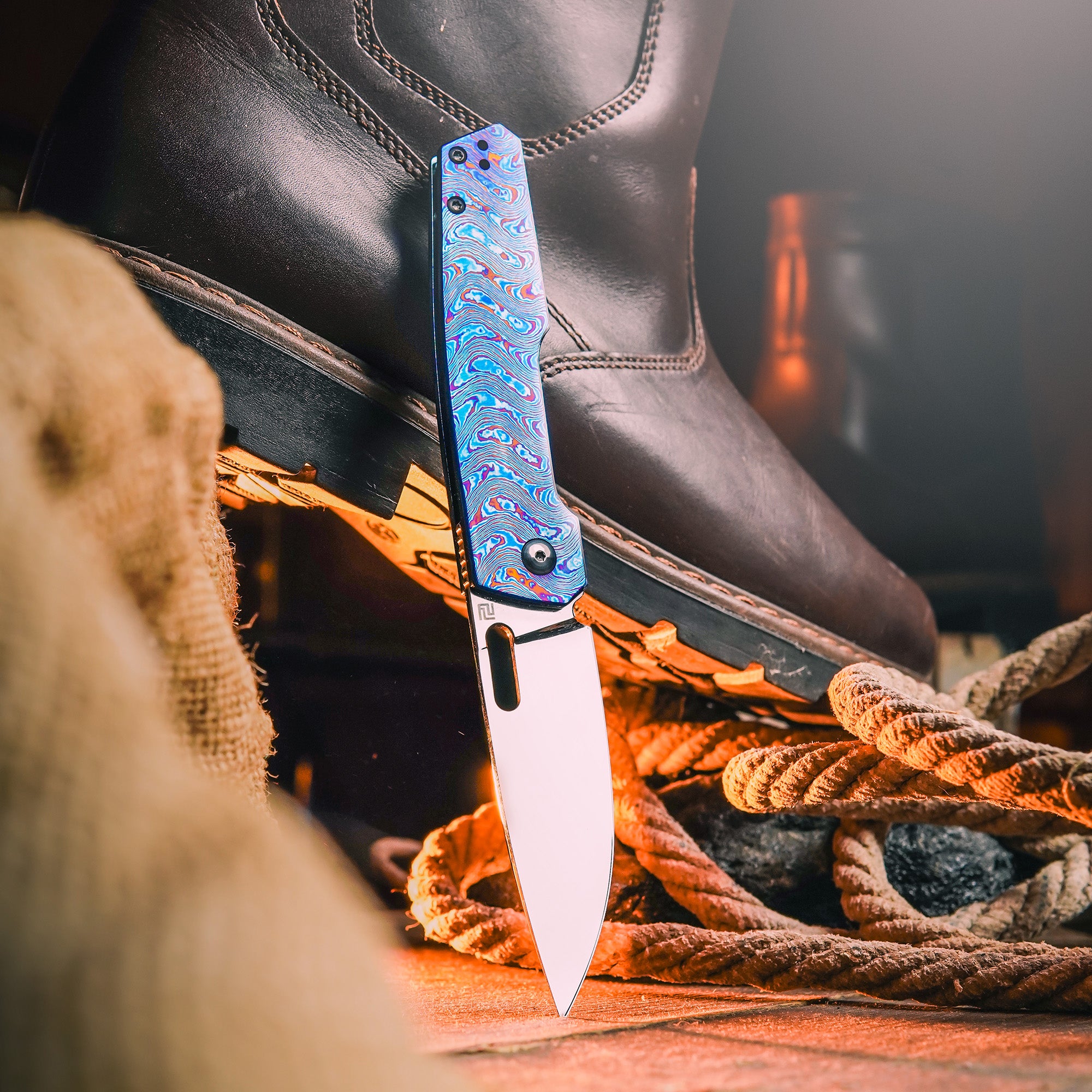
- Damascus-first tactical. Beautiful, and a real category, but the buyer is a collector rather than a repeat tactical customer. Treat it as a display piece with a long tail, not a ladder rung.
- Left-handed configurations in every model. Keep one or two. The demand is real but thin per SKU.
- “Tactical” under 2.5 inches. The styling promises a role the size does not deliver, and the customer feels it in the hand.
- The sub-$40 tactical knife. It converts, then returns, then costs you the inspection time and the shipping both ways. The margin does not survive the second trip.
The buying questions that actually predict sell-through
Before a first order, a few questions separate a SKU that reorders from one that does not — and none of them are about looks.
- Can the customer name the steel? If the answer is no, the knife competes only on price.
- Who owns lock-up after six months? A mechanism with a known wear part and available service is a safer bet than one with a silent failure mode.
- Are clips, pivots and hardware replaceable? Small parts availability decides whether a return becomes a repair.
- Is hardness consistent across lots? Ask how it is verified, not just what the target is.
- Can you buy a sample set before committing to a full run? Wholesale pricing, MOQ and lead time are quoted per program, so this is a conversation rather than a line item.
Building the first order
The arithmetic that matters is capital at risk: units per SKU, multiplied by the number of SKUs, multiplied by landed cost, plus anything you spend on display. Most first tactical orders fail by putting that whole number into one tier. Watching how fast the tier actually turns — inventory turnover rather than gross margin — is the correction that most dealers apply a quarter too late.
A more durable shape is two SKUs per tier — one full size, one short — with the deepest units in the mid band where the reorder actually happens. Then let sell-through, not the catalog, tell you which silhouette to deepen. Restock decisions taken from your own POS data beat restock decisions taken from a supplier's bestseller list, because the list was built for a different customer base than yours.
If you are building or resetting an assortment this quarter, price it against the program rather than against a catalog.
Apply to Become an Artisan Dealer
Artisan Cutlery supplies folding knives to dealers at wholesale pricing. MOQ, lead time and terms are quoted per program.


Leave a comment
This site is protected by hCaptcha and the hCaptcha Privacy Policy and Terms of Service apply.