
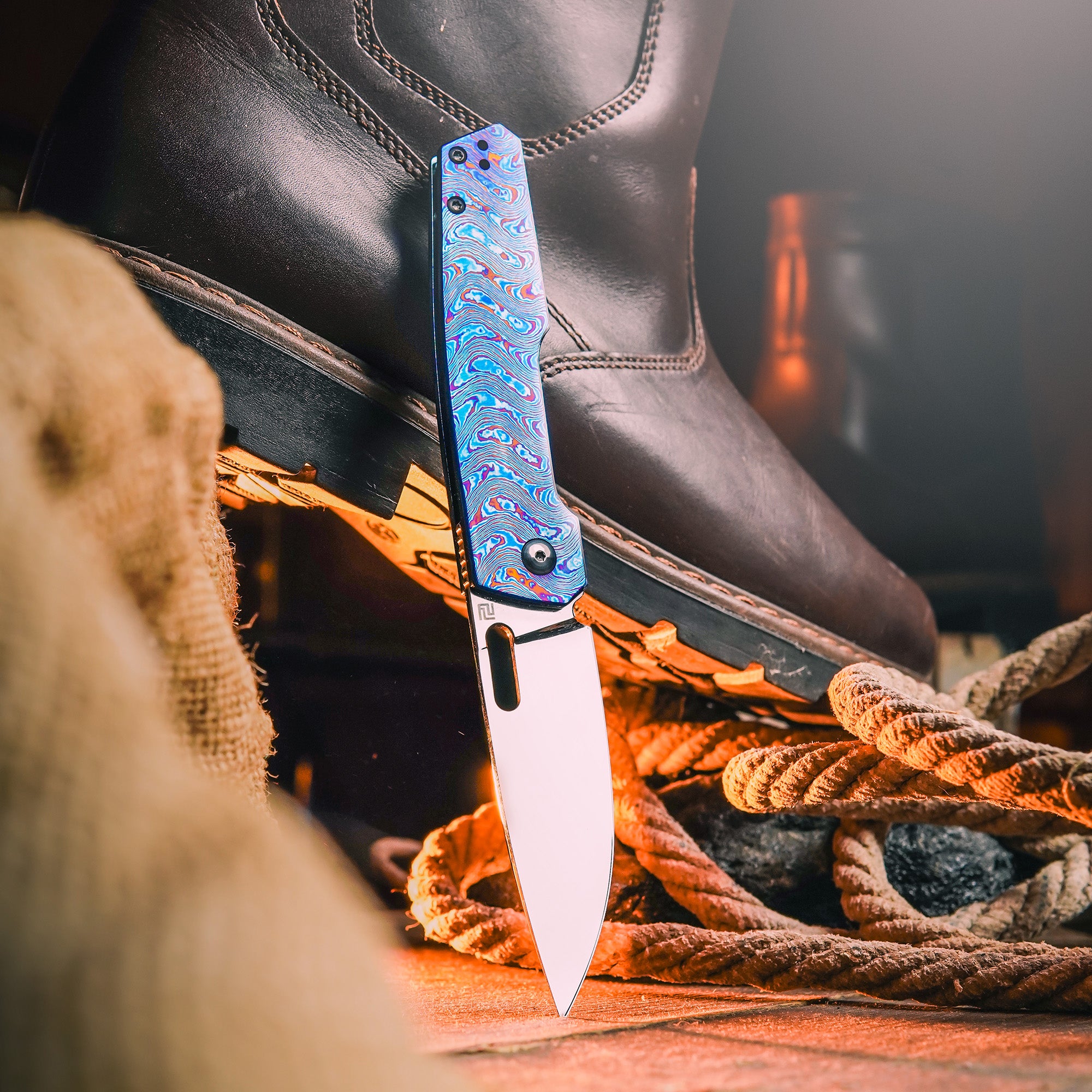
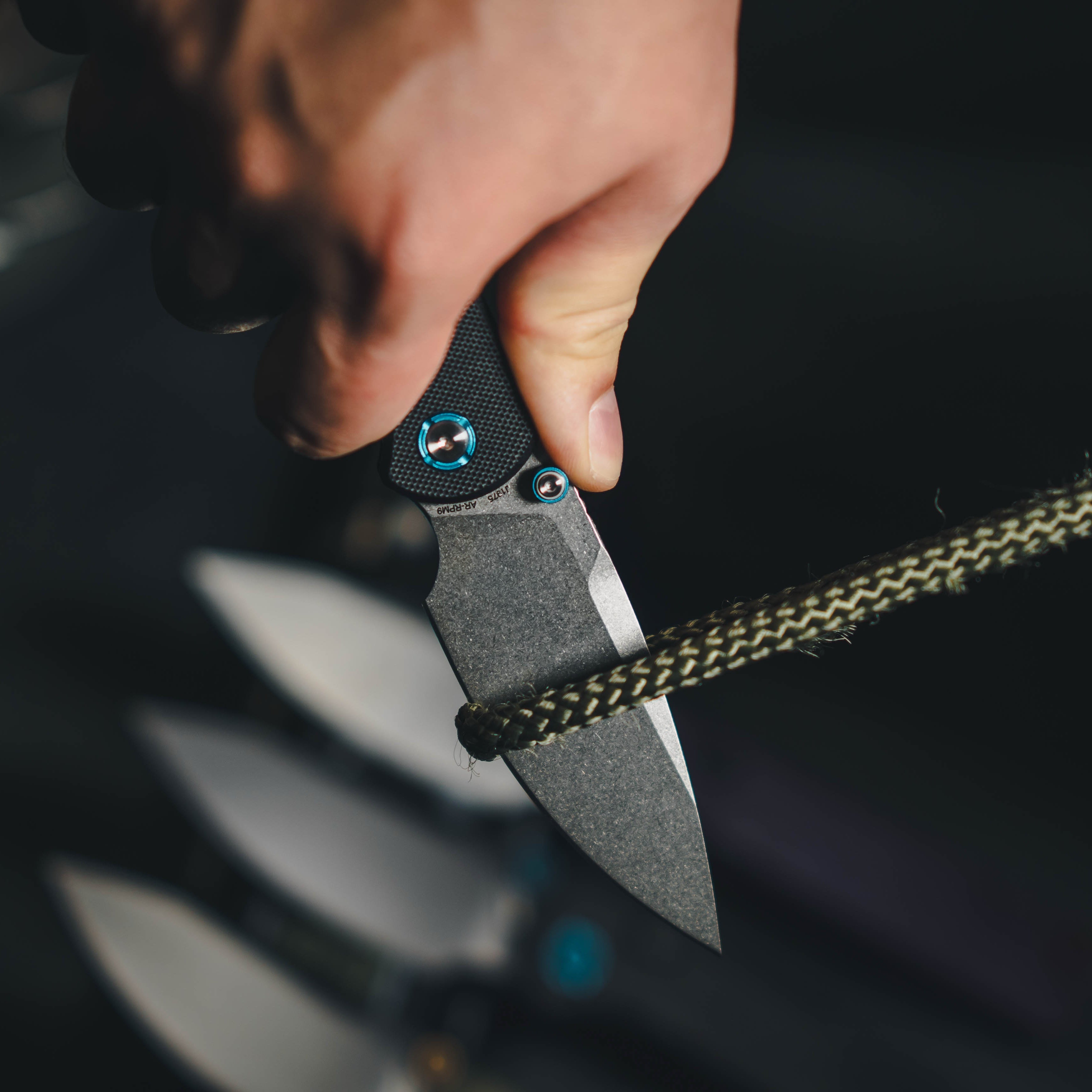
Shopping for a budget folding knife, the same two steel names keep turning up: 12C27 from Swedish mill Alleima (formerly Sandvik) and 8Cr13MoV, the Chinese stainless that shows up on countless affordable folders. Both are stainless, both are praised as tough and easy to sharpen, and both usually land on knives under $80. They are not the same steel, and the difference shows up in how the blade ages after a year of real carry.
Fine-grain stainless: 12C27 is built for toughness and easy sharpening; 8Cr13MoV trades consistency for a little more edge life.
This guide compares 12C27 steel and 8Cr13MoV on the things that actually matter at the pocket-knife level: chemistry, working hardness, edge retention, toughness, corrosion resistance, and how each behaves on a stone.
12C27 vs 8Cr13MoV at a Glance
| Property | 12C27 (Alleima / Sandvik) | 8Cr13MoV |
|---|---|---|
| Origin | Sweden; developed specifically for knife edges | Generic Chinese designation, closely related to Japanese AUS-8 |
| Carbon | ~0.60% | ~0.8% |
| Chromium | ~13.5% | ~13% |
| Other alloying | Mn ~0.4%, Si ~0.4%; no deliberate Mo or V | Small Mo and V additions |
| Hardness range | 54–61 HRC; most production knives 56–59 HRC | Commonly 57–59 HRC |
| Carbide structure | Extremely fine chromium carbides (max ~2 µm per Alleima) | Fine carbides, but consistency varies between suppliers |
| Strongest trait | Toughness, corrosion resistance, sharpenability | Low cost with a fine, aggressive edge |
| Weakest trait | Edge retention under abrasive work | Corrosion resistance and batch-to-batch consistency |
Chemistry: Simple and Clean vs Budget Alloy
12C27 is a deliberately simple martensitic stainless: roughly 0.60% carbon, 13.5% chromium, and very little else. There is no molybdenum, vanadium or cobalt in the standard grade, and the carbon level is moderate by modern standards. Alleima publishes the grade as a fine-carbide steel with primary carbides no larger than about 2 microns, which is the metallurgical reason it takes such a keen edge and sharpens so easily.
8Cr13MoV pushes carbon higher, to about 0.8%, and adds small amounts of molybdenum and vanadium to improve wear resistance and refine the grain. Knife Steel Nerds describes the grade as a generic Chinese designation closely matching Japanese AUS-8 — the practical takeaway is that the name describes a chemistry range rather than a single tightly controlled melt, so two 8Cr13MoV knives from different factories can behave differently.
Hardness and Heat Treatment
12C27 is usually run in the 56–59 HRC window on production knives. That is a deliberate compromise: the alloy can be pushed into the low 60s, but most makers trade a little edge retention for toughness and forgiveness, because fine-grained stainless at high hardness is more prone to rolling on thin edges. 8Cr13MoV typically ships in the 57–59 HRC band.
On paper the numbers overlap, and in the hand they often feel similar. The difference is that 12C27's tighter specification and very low inclusion content give more predictable results blade to blade, while 8Cr13MoV quality depends heavily on who made the knife.
Edge Retention, Toughness and Sharpening
- Edge retention: 8Cr13MoV generally holds a working edge a little longer in abrasive cutting such as cardboard and rope, thanks to its higher carbon and carbide content. Both steels fall well short of powder metallurgy grades like M390 or S90V, and both are realistic choices only if you accept periodic sharpening.
- Toughness: this is 12C27's home turf. Fine carbides and a low carbide volume let it support a thin edge without micro-chipping, which is why Scandinavian knife makers have used it for decades on hard-use outdoor blades.
- Sharpening: both are easy. 12C27 is the more forgiving of the two and responds quickly to a ceramic rod or a strop; it takes a polished, almost razor-like apex. 8Cr13MoV raises a burr readily and feels toothier off a coarse stone. For either steel, a 15–20 degree per side edge angle covers most everyday carry work, with 20 degrees reserved for harder use.
- Corrosion: 12C27's lower carbon means more of its chromium stays free to form the passive oxide layer, so it resists rust and pitting better in humid pockets, on the water, and after being put away damp. 8Cr13MoV is still stainless, but it needs more attention: dry it after use and keep a light film of oil on the blade.
Where You Actually Find Each Steel
12C27 is the classic Nordic stainless. It appears on Scandinavian outdoor knives, hunting patterns, slip joints and slim everyday carry folders — including our own 12C27 builds — and it is often chosen precisely because it can be touched up on a river stone in the field. 8Cr13MoV became the default budget folding-knife steel in the 2000s and still powers a huge share of entry-level flippers and liner locks.
Which One Should You Carry?
- Pick 12C27 if you want the toughest edge in this price class, you use your knife outdoors in wet conditions, you would rather strop than sharpen, or you care about a clean, polished edge.
- Pick 8Cr13MoV if you cut a lot of cardboard and packaging, you want the lowest possible price, or you treat your knife as a disposable work tool and do not mind touching up the edge often.
- Look higher if you want to sharpen rarely. Stepping up to 14C28N, AR-RPM9, S35VN or a powder steel such as M390 buys noticeably more edge life — at a higher price.
The honest summary: 12C27 steel wins on toughness, corrosion resistance and consistency, while 8Cr13MoV wins on up-front cost and slightly longer edge life in abrasive cutting. Neither is a bad steel — they are simply tuned for different priorities, and both reward a light touch on the stone.
Further Reading
- Alleima (Sandvik) 12C27M material datasheet — nominal composition and hardening data
- Knife Steel Nerds: testing Chinese knife steel 8Cr13MoV / 8Cr14MoV
- Knife Steel Nerds: knife steels rated by a metallurgist
- Sandvik / Alleima on Wikipedia
Browse our 12C27 steel knives to see how the alloy performs in a sharp, slim everyday carry folder.

Leave a comment
This site is protected by hCaptcha and the hCaptcha Privacy Policy and Terms of Service apply.