

Two stainless steels show up in almost every conversation about folding knives: 12C27, the Swedish workhorse that anchors budget and mid-range blades, and VG-10, the Japanese cutlery steel that has been the reference point for premium stainless for decades. They are often mentioned in the same breath, but they are not interchangeable — they sit at different points on the trade-off curve between edge holding, toughness, corrosion resistance and how much work it takes to keep them sharp.
Carbon content is the dividing line: 12C27 stays fine-grained and easy to sharpen, VG-10 carries a much larger carbide population.
This comparison sticks to published composition and metallurgy rather than marketing copy, then translates both into what you actually feel when you carry the knife for a month.
What Sandvik 12C27 Actually Is
12C27 is a martensitic stainless chromium steel produced by Sandvik. Its published nominal composition is deliberately lean: 0.60% carbon and 13.5% chromium, with 0.40% silicon and 0.40% manganese, and tight limits on phosphorus and sulfur. Sandvik positions the grade for high-quality professional knife applications, and its nearest standard equivalents are ASTM 420 and EN 1.4034/1.4037.
The important consequence of that lean chemistry is low carbide volume. With 0.6% carbon there simply is not enough carbon in the alloy to form large chromium carbide networks, so the microstructure stays fine and uniform. That single fact explains most of 12C27's personality: it takes a very keen edge, it sharpens quickly, and it resists corrosion exceptionally well for a martensitic stainless.
Sandvik's datasheet also shows how much the tempering temperature moves hardness on this grade — roughly 59.8 HRC after tempering near 150 °C, falling to about 53.6 HRC near 350 °C. Production knife makers pick a point inside that window based on how much toughness and edge stability they want, which is why two knives in the same steel can feel quite different.
There is also a kitchen-oriented sibling, 12C27M, with slightly lower carbon (0.52%) and higher chromium (14.5%) — a hint that the 12C27 family is tuned per application rather than sold as one fixed recipe.
What VG-10 Brings to the Table
VG-10 is produced by Takefu Special Steel in Echizen, Japan, and the name stands for "V Gold 10" — gold being a quality marker rather than a metallurgical one. Its published analysis is much more heavily alloyed than 12C27: about 1.0% carbon, 15.0% chromium, 1.0% molybdenum, 0.2% vanadium and 1.5% cobalt.
Those additions each do a specific job. Carbon at double the 12C27 level supports a far larger carbide population, which is what buys wear resistance. Vanadium forms very hard carbides that resist abrasion. Molybdenum improves both hardenability and corrosion resistance. Cobalt raises the steel's ability to hold hardness at elevated temperature during grinding and use.
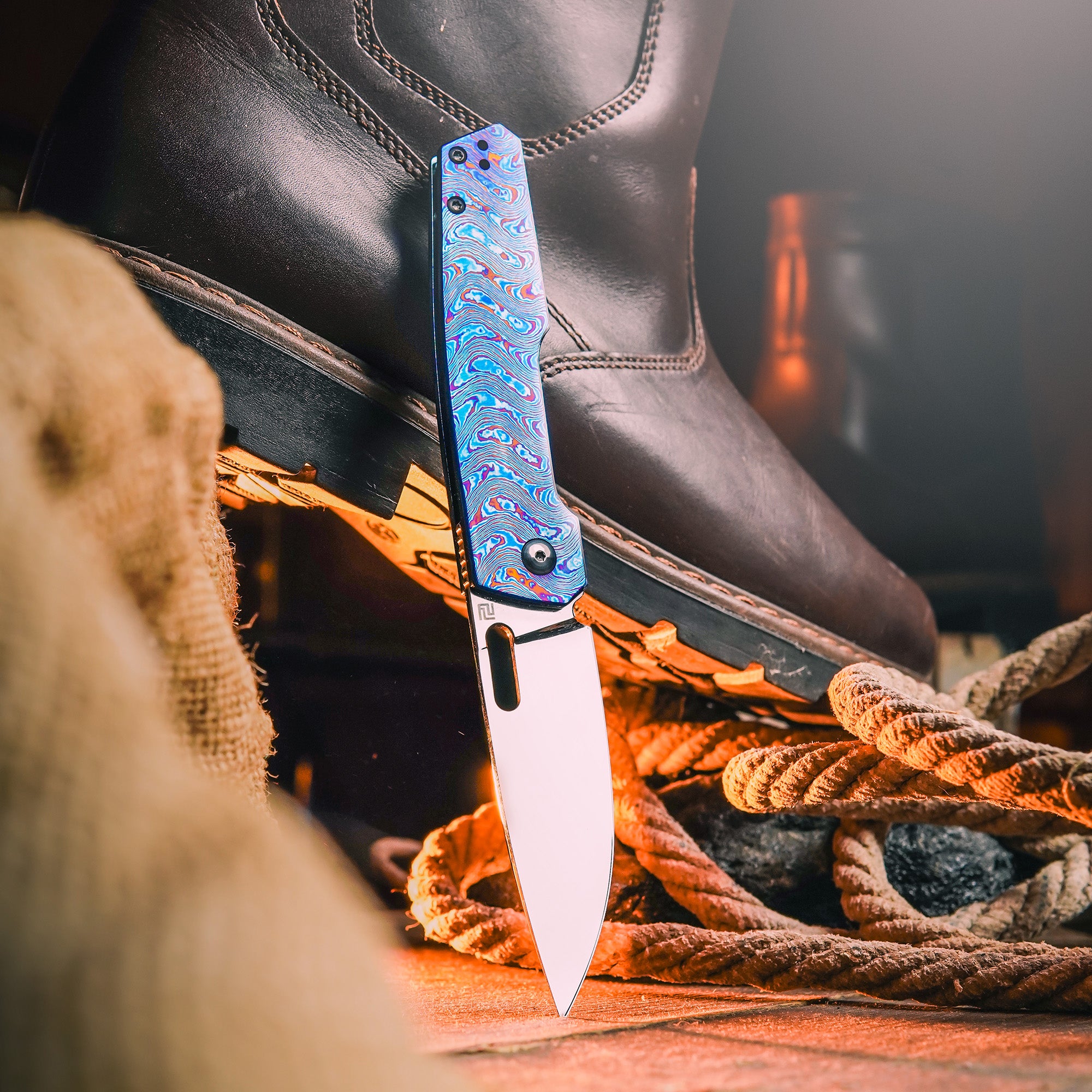
Takefu also sells a tungsten-bearing variant, VG-10W, with roughly 0.4% tungsten added. VG-10 is frequently used as the core of pattern-welded Damascus blades, where it is clad in softer layers — a construction you will see in Damascus folders across the Artisan Cutlery lineup.
Composition Side by Side
| Element | Sandvik 12C27 | VG-10 | What it changes |
|---|---|---|---|
| Carbon (C) | 0.60% | ~1.0% | Carbide volume and achievable hardness |
| Chromium (Cr) | 13.5% | 15.0% | Corrosion resistance, carbide forming |
| Molybdenum (Mo) | — | ~1.0% | Hardenability, pitting resistance |
| Vanadium (V) | — | ~0.2% | Hard abrasion-resistant carbides |
| Cobalt (Co) | — | ~1.5% | Hot hardness, edge stability under heat |
| Silicon (Si) | 0.40% | not published in this summary | Deoxidation, tempering response |
| Manganese (Mn) | 0.40% | not published in this summary | Hardenability, sulfur control |
Read the carbon and chromium rows together and the rest of the comparison falls into place. VG-10 has roughly 67% more carbon than 12C27; that extra carbon is what pays for the edge holding, and it is also what costs you sharpening time.
Edge Retention: Where VG-10 Pulls Ahead
Edge retention is mostly a wear problem. When you cut abrasive material — corrugated cardboard, dirty rope, zip ties, abrasive weed stems — the edge slowly wears away rather than deforming. Steels with a high volume of hard carbides resist that wear far longer.
VG-10's ~1% carbon and its vanadium content put it clearly ahead here. In practical terms, a VG-10 blade will keep slicing cleanly through a long stack of cardboard noticeably longer than a 12C27 blade of the same geometry, and it will hold a working edge through more sessions before you notice the slowdown.
12C27's advantage is not that it holds an edge longer — it does not — but that it restores an edge faster than almost anything else in the stainless category. A few passes on a fine stone or a ceramic rod bring it back to shaving sharp in under a minute. If you enjoy maintaining an edge as you go, that is a genuine benefit rather than a consolation prize.
Sharpening: 12C27 Is the Friendlier Steel
Fine, low-carbide microstructures grind quickly and deburr cleanly. 12C27 behaves exactly that way: it responds to simple equipment, it does not fight you when you chase a burr, and it tolerates a slightly inconsistent angle. For someone learning freehand sharpening, that forgiveness matters more than a spec sheet suggests.
VG-10 is not difficult, but it is slower. The carbide population resists abrasion, so the same stone does less work per stroke. Diamond or CBN abrasives cut it more predictably than natural or softer ceramic stones, and burr removal needs a lighter touch — pressing hard on a high-alloy stainless tends to bend a stubborn burr back and forth instead of removing it. Budget more time and less pressure.
Corrosion Resistance: A Narrower Gap Than You Expect
VG-10 carries more chromium (15% versus 13.5%), which sounds like the corrosion win. But chromium only protects the steel when it is in solution in the matrix; carbon tied up in carbides takes chromium with it. VG-10 has roughly 67% more carbon competing for that chromium, so the free-chromium advantage from the extra 1.5% is partly spent.
The practical result is that both are genuinely stainless in normal carry, and both will spot if you leave them wet with salt water or sweat. 12C27 is the more forgiving of the two in humid, coastal and sweaty-pocket conditions — a real consideration if you live somewhere that eats lesser steels. Neither is a saltwater dive steel, and treating either as one is a mistake.
Toughness and Failure Modes
Higher carbon and higher hardness generally come at the cost of toughness, and VG-10 follows that rule. Run very hard with a thin edge, it is more prone to micro-chipping under lateral load or impact than 12C27 is.
12C27's lower carbon and finer structure make it the more ductile of the pair. In practice that means it is more likely to roll an edge than to chip it — and a rolled edge is far easier to fix with a few stropping strokes. For a knife that gets used carelessly, dropped on pavers, or asked to pry something it should not, that failure mode is the friendlier one. Neither steel is a pry bar; the difference is how expensive the mistake is.
The Damascus Question
If you are shopping for a pattern-welded blade, the two steels are not really competing. VG-10 is a common core material for Damascus because it hardens to a strong, wear-resistant center while the outer layers provide the visual pattern and added toughness. 12C27 is rarely used in that role — it is normally a monosteel blade.
That means a Damascus purchase is usually a VG-10-core decision by default, and the composition comparison above applies to the cutting edge you actually use.
Which One Should You Carry?
There is no universal winner, but the decision is straightforward once you are honest about how you cut.
Choose 12C27 if you:
- Cut soft material and touch up your edge often rather than waiting for it to dull
- Live in a humid, coastal or high-sweat environment
- Sharpen on simple stones, a rod, or in the field
- Prefer a thin, keen, slicing-oriented edge geometry
- Want to spend less and get a knife you will not baby
Choose VG-10 if you:
- Cut a lot of abrasive material — cardboard, rope, packaging
- Want longer intervals between sharpening sessions
- Appreciate a Damascus blade or a premium Japanese stainless
- Are comfortable with diamond abrasives and a slower sharpening routine
- Accept a slightly higher risk of micro-chipping for better wear resistance
Where You Will Find Each Steel
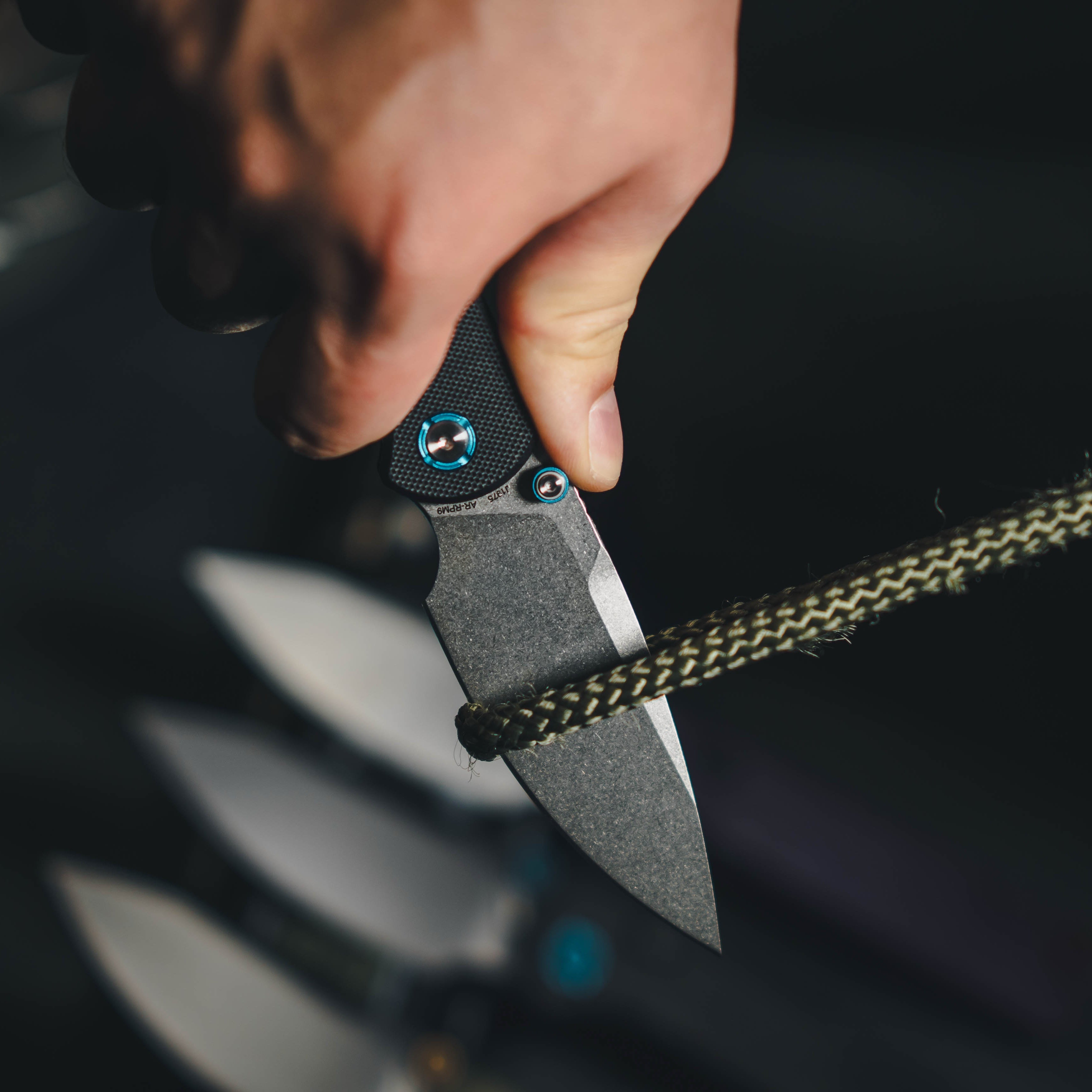
Artisan Cutlery and CJRB build with both. The CJRB Ria J1917 in 12C27 is a clean example of the budget-stainless approach — a light, thin-edged folder that is easy to keep sharp and hard to damage. For VG-10, look through the Damascus collection, where VG-10 cores are wrapped in pattern-welded cladding.
If you are still narrowing down blade geometry and lock type, the full folding knife collection is organized well enough to browse by family.
Frequently Asked Questions
Is 12C27 a good knife steel?
Yes — for the right job. Its fine grain, high corrosion resistance and easy sharpening make it an excellent choice for lightweight EDC and utility cutting where you are willing to touch up the edge regularly. It is not a high-wear steel and should not be judged as one.
Is VG-10 better than 12C27?
It is better at holding an edge through abrasive work and it is the more premium steel on paper. 12C27 is better at resisting corrosion, absorbing impacts without chipping, and taking a fresh edge quickly. "Better" depends entirely on which of those you value.
Which is easier to sharpen, 12C27 or VG-10?
12C27, by a clear margin. Lower carbide volume means faster grinding and cleaner burr removal. VG-10 rewards diamond or CBN abrasives and a light touch.
Does VG-10 rust?
It is stainless, not rust-proof. Left wet with salt water or sweat, it can develop spots like any martensitic stainless. Dry it after use and it will hold up well in normal carry.

Leave a comment
This site is protected by hCaptcha and the hCaptcha Privacy Policy and Terms of Service apply.