


Almost everything about a folding knife is engineered for consistency — the same steel, the same grind, the same tolerance on every unit. Natural handle materials are the deliberate exception. Two knives built on the same frame with walnut and bone scales are different objects, and the difference grows the longer you carry them.
Natural scales are hygroscopic: they take on and give back moisture with the air, which is why stability is a care issue rather than a materials issue.
That individuality is why wood, bone and stag have survived in an era of G10, titanium and carbon fiber. It is also why they need a care routine the synthetic materials do not. This guide covers how each material is prepared, how it behaves over years of carry, and what actually keeps it stable.
Why Natural Materials Behave Differently
Wood, bone and antler are all hygroscopic — they exchange moisture with the air around them. G10 and titanium do not. When humidity rises, natural scales take on a little moisture and swell; when the air dries out, they give it back and shrink.
That movement is small, but it happens against a rigid steel frame with screws through it. Over enough cycles it shows up as scales that sit slightly proud of the liners, gaps at the edges, or a screw that needs a quarter turn. Understanding that single mechanism explains nearly every care instruction below: your job is to keep the material's moisture content as stable as possible.
Wood Handles: Species, Grain and Stabilization
Not all wood is suitable for a knife handle. The useful species are dense hardwoods with closed grain — walnut, ebony, rosewood, cocobolo, olive and similar. Soft, open-grained woods dent, absorb finish unevenly, and move too much to stay flush against a liner.
Density and oil content matter more than the name on the label. Ebony is prized because it is extremely dense with very tight pores, so it polishes to a near-black surface that resists picking up dirt. Oily exotics like cocobolo are dimensionally stable and naturally water-resistant, but their oil content makes them harder to glue and finish consistently — which is a maker's problem, not a user's, but it explains why some exotics cost more in a production knife.
The biggest variable in modern wood handles is stabilization. Stabilized wood is dried, then impregnated under vacuum with a resin that cures inside the cells. The result is a composite: the wood's appearance with much of its moisture sensitivity removed. Stabilized scales barely move, resist staining, and need almost no oil. Unstabilized wood looks and feels more natural and develops a deeper patina, but it requires more attention and is more likely to shift over the years.
Grain orientation matters too. Scales cut so the grain runs lengthwise along the handle are stronger and move less across the width; end-grain and cross-cut pieces look dramatic but are more prone to movement and chipping at thin edges.
Bone Handles: Jigged, Smooth and Dyed
Knife bone is almost always bovine bone, sourced from the leg bones of cattle — dense, thick-walled material that takes a high polish. It is not the porous, chalky bone you might imagine.
Bone arrives in two broad styles. Smooth bone is sanded and polished flat, showing the material's fine grain and slight translucency; it reads as refined and works well on traditional patterns. Jigged bone is cut with a pattern of shallow grooves before dyeing, which mimics the texture of stag and gives dye somewhere to pool, producing the characteristic dark-in-the-valleys look.
Bone is harder and denser than most woods, and it does not swell and shrink as much — but it is also more brittle in thin sections. Drop a bone-scaled knife on a hard floor and the risk is a chip at an edge rather than a dent. It also yellows with age and UV exposure, which most collectors consider a feature: an old smooth bone handle develops a warm ivory tone that cannot be faked.
Because bone is an organic material, dyed bone can fade in strong sunlight over years. Store it out of direct sun if the color matters to you.
Stag: The Original Premium Scale
Stag is antler — typically deer or elk — and it is the only handle material on this list where no two pieces are genuinely alike. Antler grows as a bony core covered in a rough outer layer, and knife makers cut scales to preserve the transition between the two: the textured "bark" on the outside, the denser core underneath.
That structure is why stag handles show a natural ridge pattern, often with a visible seam where the bark meets the core. Premium pieces keep the bark intact along the spine of the handle and polish the exposed core.
Stag's weakness is its interior. Antler is more porous than bone, especially toward the center, and it can shrink and check over time if it dries out too fast or is stored in very low humidity. Older stag handles sometimes show fine cracks along the grain — usually cosmetic, occasionally a problem if they reach a screw hole.
Good stag is also a supply-limited material, which is a large part of why stag-handled knives command a premium over the same pattern in bone.
How Natural Materials Age
Aging is the point. Handled and carried, natural scales develop character that synthetics never will:
- Wood darkens and warms in tone, particularly unstabilized oily species. Edges round slightly where your hand sits. A well-used walnut handle after a decade looks nothing like a new one, in a good way.
- Bone moves from white toward ivory, dye settles into the jigging, and polished high points take on a soft sheen from handling.
- Stag polishes smooth at the contact points while the bark stays textured elsewhere, creating a two-tone surface that reads as genuine wear rather than damage.
What aging should not produce is movement — scales standing proud of the liners, gaps at the bolsters, or a rattling screw. Those are moisture-cycle problems, and they are largely preventable.
The Care Routine That Actually Works
Weekly, with normal carry
- Wipe the scales with a barely damp cloth and dry immediately with a soft cloth. Never let water sit on the material.
- Brush dust out of jigging and bark texture with a soft toothbrush — trapped grit is what dulls the finish.
- Check that the blade drops freely and the pivot feels normal.
Monthly
- Unstabilized wood: a very thin coat of mineral oil, left for a few minutes, then buffed dry. More oil is not better — pooled oil attracts dust and softens the surface.
- Stabilized wood: skip the oil. A microcrystalline wax applied sparingly and buffed is enough.
- Bone and stag: a light application of the same wax, buffed. Avoid soaking either material in oil; it can darken and soften porous antler.
- Wipe down the liners and pivot area with a dry cloth. Moisture trapped between scale and liner is what starts corrosion on the steel underneath.
Yearly
- Check screw torque with the correct driver — loose screws let scales move, and moving scales let moisture in.
- Inspect the inner face of the scales for dark staining, which indicates moisture has been getting behind them.
- Re-wax the scales and re-oil the pivot with a knife-appropriate lubricant.
- Review storage: 40–60% relative humidity is comfortable for both natural materials and steel. A dry safe with a desiccant pack can be too dry for stag over long periods.
What to Avoid
- Soaking or dishwashing. Hot water and detergent strip oils and drive moisture into the grain; heat then warps and shrinks the material as it dries.
- Alcohol and solvent cleaners. They pull oil out of wood and can lift dye from bone.
- Ultrasonic cleaners. Fine for an all-steel frame, rough on natural scales and on the adhesives and finishes around them.
- Drying on a radiator or in direct sun. Fast drying is what causes checking and shrinkage.
- Long-term storage in a leather sheath or a damp case. Leather holds moisture against the material and against the steel.
Matching the Material to the Job
| Material | Moisture stability | Impact resistance | Maintenance | Best for |
|---|---|---|---|---|
| Stabilized wood | High | Moderate | Low | Daily carry with wood looks |
| Unstabilized wood | Low | Moderate | High | Collecting, light carry, tradition |
| Bone | Moderate–high | Low–moderate | Low–moderate | Traditional patterns, dress carry |
| Stag | Moderate | Moderate | Moderate | One-of-a-kind handles, collectors |
If the knife lives in a pocket every day and gets used hard, stabilized wood is the low-drama choice. If it lives in a display case and comes out for occasions, unstabilized wood, bone and stag will reward you with far more character.
Natural Scales in the Artisan Cutlery Lineup
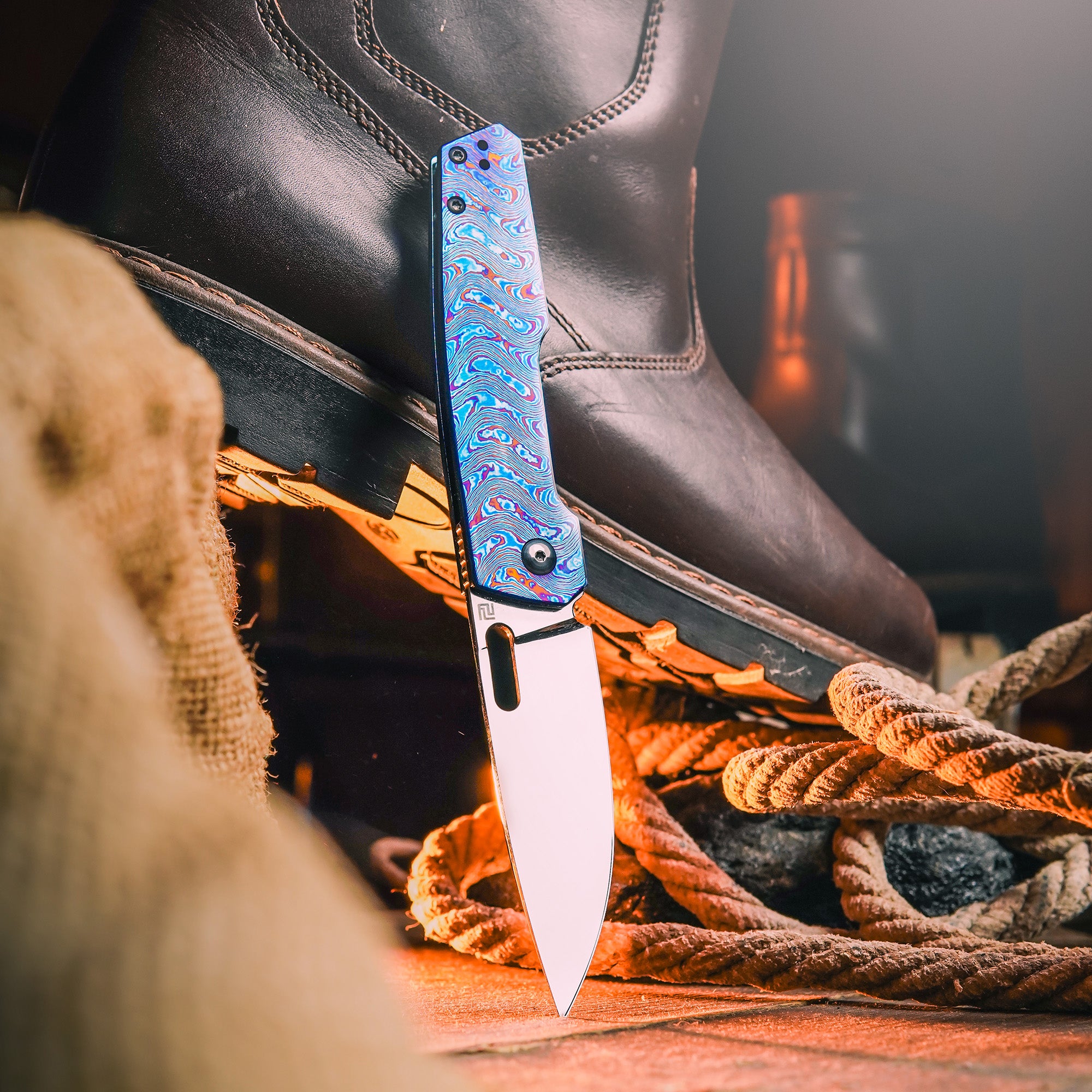
Two current examples show how differently the same idea can be executed. The Holm 1875 with copper and wood scales pairs a warm wood handle with copper bolsters — a combination that patinas on both materials at once and looks better at year three than at week one.
The Orthodox V2 in bovine bone takes the traditional route, with smooth bone over a modern liner lock frame — the kind of knife where the handle material sets the whole character. You can see the rest of that family in the Orthodox collection.
For scale materials beyond natural ones, the full folding knife collection shows how the same model changes personality across wood, bone, G10, micarta and titanium.
Frequently Asked Questions
Do wood knife handles need oil?
Only if the wood is unstabilized. A thin coat of mineral oil once a month is enough; buff off the excess. Stabilized wood is resin-impregnated and does not need oil — wax is sufficient.
Is bone a durable knife handle material?
Yes for normal use. Bone is dense and hard, and it handles moisture better than most woods. Its weakness is brittleness in thin sections, so it is more vulnerable to chipping from a drop than to wear from cutting.
Why does my stag handle have cracks?
Antler is porous toward the core and shrinks when it dries out too quickly or is stored in very low humidity. Fine surface checks are usually cosmetic; a crack that reaches a screw hole or crosses the full scale needs attention.
Can natural handles go in the dishwasher?
No. Heat, water and detergent will strip oils, swell the material and then shrink it as it dries, which is exactly how scales end up standing proud of the liners. Hand wash the blade only, and dry everything immediately.


Leave a comment
This site is protected by hCaptcha and the hCaptcha Privacy Policy and Terms of Service apply.