
Short answer: 440C is the better everyday stainless for most people — it resists rust, sharpens quickly and stays affordable. D2 holds a working edge longer, but it is less corrosion resistant and takes more effort to bring back to sharp. The right pick comes down to where you carry the knife and how often you are willing to sit down with a stone.
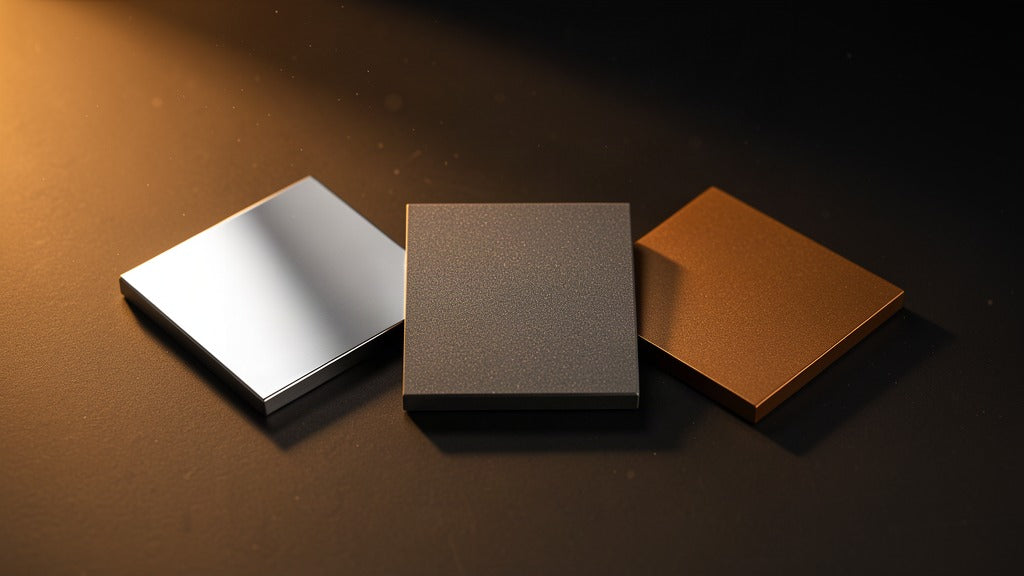
Steel swatches under raking light. Composition sets the ceiling; heat treatment decides whether you get it.
Both steels show up constantly on budget folding knives, and both get described with the same lazy marketing words: "premium," "high-end," "super steel." They are not the same material, and the differences show up after a few months of real carry rather than on the spec card.
What 440C and D2 actually are
440C is a martensitic 400-series stainless steel (UNS S44004, EN 1.4125) with the highest carbon content in the 440 family. Wikipedia's entry lists its composition as 0.95–1.20% carbon, 16.0–18.0% chromium, 1.00% manganese, 1.00% silicon and 0.75% molybdenum, and notes it can be heat treated to roughly 58–60 HRC. It was designed as a bearing steel, which tells you something about how it behaves: hard, wear resistant, and happy to run with a fine edge.
D2 is a cold-work tool steel from the high-carbon, high-chromium D series. Wikipedia lists 1.5% carbon, 11.0–13.0% chromium, plus 1.0% vanadium, 0.9% molybdenum, 0.45% manganese and 0.30% silicon, and describes it as "very wear resistant but not as tough as lower alloyed steels," with properties that are "very sensitive to heat treatment." Those two sentences explain most of what you will feel in use.
Side-by-side comparison
| Property | 440C | D2 |
|---|---|---|
| Family | Martensitic stainless (400 series) | Cold-work tool steel |
| Carbon | 0.95–1.20% | 1.5% |
| Chromium | 16.0–18.0% | 11.0–13.0% |
| Vanadium | Not specified in the standard grade | 1.0% |
| Molybdenum | 0.75% | 0.9% |
| Corrosion resistance | Moderate, but genuinely stainless in daily use | Lower; often called semi-stainless |
| Wear resistance | Good | Better |
| Toughness | Modest | Modest, lower than simpler alloys |
| Sharpening effort | Low to moderate | High |
| Typical use | Everyday folders, food prep, general utility | Hard-use folders, cardboard, jobsite work |
Corrosion: 440C wins clearly
The chromium number is the headline — 16–18% versus 11–13% — but the useful part is what happens to that chromium. In high-carbon steels, a large share of the chromium combines with carbon to form carbides. Carbides are what give the steel its wear resistance, and they also remove chromium from the surrounding matrix, which is the part that actually blocks rust.
Wikipedia makes this point directly about the D series: several D-type steels are "often considered stainless or semi-stainless, however their corrosion resistance is less than stainless steel due to the precipitation of the majority of their chromium and carbon constituents as carbides." With D2 you get a steel that survives normal handling but will spot if you leave it damp, cut fruit and forget it, or carry it in a sweaty pocket through a humid summer. 440C is not rust-proof either, but it forgives far more neglect.
If you live near the coast, work outdoors, or cook with your folder, that single difference usually settles the question.
Edge retention: D2's advantage is real
D2's extra carbon and its vanadium content buy more and harder carbides. In practice that means the edge keeps slicing cardboard, zip ties, plastic banding and abrasive material for longer before it goes dull. You will notice it most in repetitive cutting, where 440C starts to skate and reflect light along the edge while D2 is still biting.
The caveat is what "dull" means. D2 tends to wear to a smooth, polished edge that still cuts reasonably, whereas a 440C edge can roll or blunt in a more obvious way. Neither steel is a miracle: both are thin, hard edges on a folding knife, and both give up quickly if you twist the blade sideways in a cut.
Toughness: neither is a pry bar
D2 has a reputation as a tough tool steel, and that reputation comes from die applications, not from knife blades. Wikipedia's own description puts it below lower-alloyed steels in toughness. 440C is not a tough steel either — it trades toughness for hardness and wear resistance. On a folding knife, geometry matters more than the datasheet: a thin, acute grind in either steel will chip if you lever with it, and a thicker grind in either steel will survive more abuse than it should.
Use both as cutting tools and the toughness argument mostly disappears. Use either one to open a paint can and you will be resharpening.
Sharpening and maintenance
This is where the gap feels biggest in daily life.
- 440C responds well to a normal progression of stones, raises a burr predictably, and can be brought back with a few passes on a medium grit followed by light stropping. It is a friendly steel for someone learning freehand sharpening.
- D2 has a lot of carbide volume, so it rewards diamond or CBN abrasive and punishes soft stones. Expect more time per session, more attention to keeping the angle consistent, and less tolerance for sloppy passes. It also holds an edge long enough that you sharpen less often, which offsets some of the work.
Maintenance is the reverse trade. D2 wants a thin film of oil on the blade if it is going to sit, and it should be dried after every wet task. 440C mostly needs the pivot kept clean and the blade wiped down. Neither needs to be babied, but only one of them is comfortable being ignored.
Heat treatment is the wildcard
Two knives in the same steel can behave like different materials. Wikipedia's note that D2's mechanical properties are "very sensitive to heat treatment" is the most practical sentence on the page. A properly austenitized, quenched and tempered D2 blade with a sensible hardness target will out-cut a soft one by a wide margin; a rushed 440C blade can feel gummy and roll its edge on the first box.
That is why steel names are a starting point, not a verdict. A maker who publishes hardness ranges, grinds consistently and stands behind the heat treatment is worth more than a slightly better alloy from a factory that treats it as an afterthought.
Where 9Cr18MoV fits
You will see 9Cr18MoV on imported budget knives and wonder how it relates. The name follows the Chinese grade convention: roughly 0.9% carbon, 18% chromium, plus molybdenum and vanadium. Compositionally it sits in the same neighborhood as 440C, with the vanadium addition being the main difference. Treat it as a 440C-family stainless — decent corrosion resistance, easy sharpening, moderate edge holding — rather than as a D2 alternative.
Grind and geometry matter as much as the alloy
A thin flat grind in 440C will out-cut a thick saber grind in D2 through most soft material, simply because there is less steel behind the edge. Before you compare steels, compare the numbers that shape the cut: blade stock thickness, grind height and edge angle. A 3 mm blade ground thin slices better than a 4 mm blade ground thick, regardless of what the spec line says about carbon content.
The same logic applies to the edge you put on the knife. A lower angle cuts more aggressively and wears faster; a higher angle lasts longer and pushes material aside. If you sharpen a 440C blade at a conservative angle, it will hold up longer than a poorly angled D2 edge in most daily work. Steel sets the ceiling, geometry sets what you actually get day to day.
Which one should you carry?
Pick by the job, not by the label:
- Humid climate, coastal air, sweaty pocket: 440C.
- Kitchen duty, fruit, food prep on the go: 440C, every time.
- Warehouse, workshop, hours of cardboard: D2, and keep a strop or a diamond card nearby.
- You sharpen once a month and dislike maintenance: D2 holds the edge longer, but budget for proper abrasive.
- You are learning to sharpen: 440C teaches you faster, because feedback comes quickly.
- You want one knife for everything: 440C is the safer default; the corrosion margin matters more than the edge-retention margin when you only own one blade.
If neither feels like enough, the next step up is a particle-metallurgy stainless such as S35VN, which pushes corrosion resistance and toughness past both while keeping decent edge holding. That is a different price bracket, and it is worth it only once you know what you are buying.
FAQ
Is D2 stainless?
Not in the strict sense. It has 11–13% chromium, which is enough to resist light staining, but much of that chromium is tied up in carbides, so it stains more readily than a true stainless like 440C.
Does 440C hold a good edge?
Yes, for everyday cutting. It will not match D2 in abrasive wear resistance, but it takes a fine edge easily and touches up quickly.
Can I sharpen D2 with a regular whetstone?
You can, but it is slow work. Diamond or CBN abrasives cut the carbides far more efficiently and keep the bevel flat.
Which steel is better for a gift knife?
440C. It is forgiving of irregular maintenance, so the knife still looks and cuts well for someone who will not oil it every week.
Shop by steel
You can browse the full D2 collection or start with the broader folding knife range and filter by the steel you want. If you are unsure where to begin, the best sellers are a reasonable cross-section of grinds and sizes.
Read the primary sources if you want the raw numbers: Wikipedia on 440C and on tool steel.

Leave a comment
This site is protected by hCaptcha and the hCaptcha Privacy Policy and Terms of Service apply.