

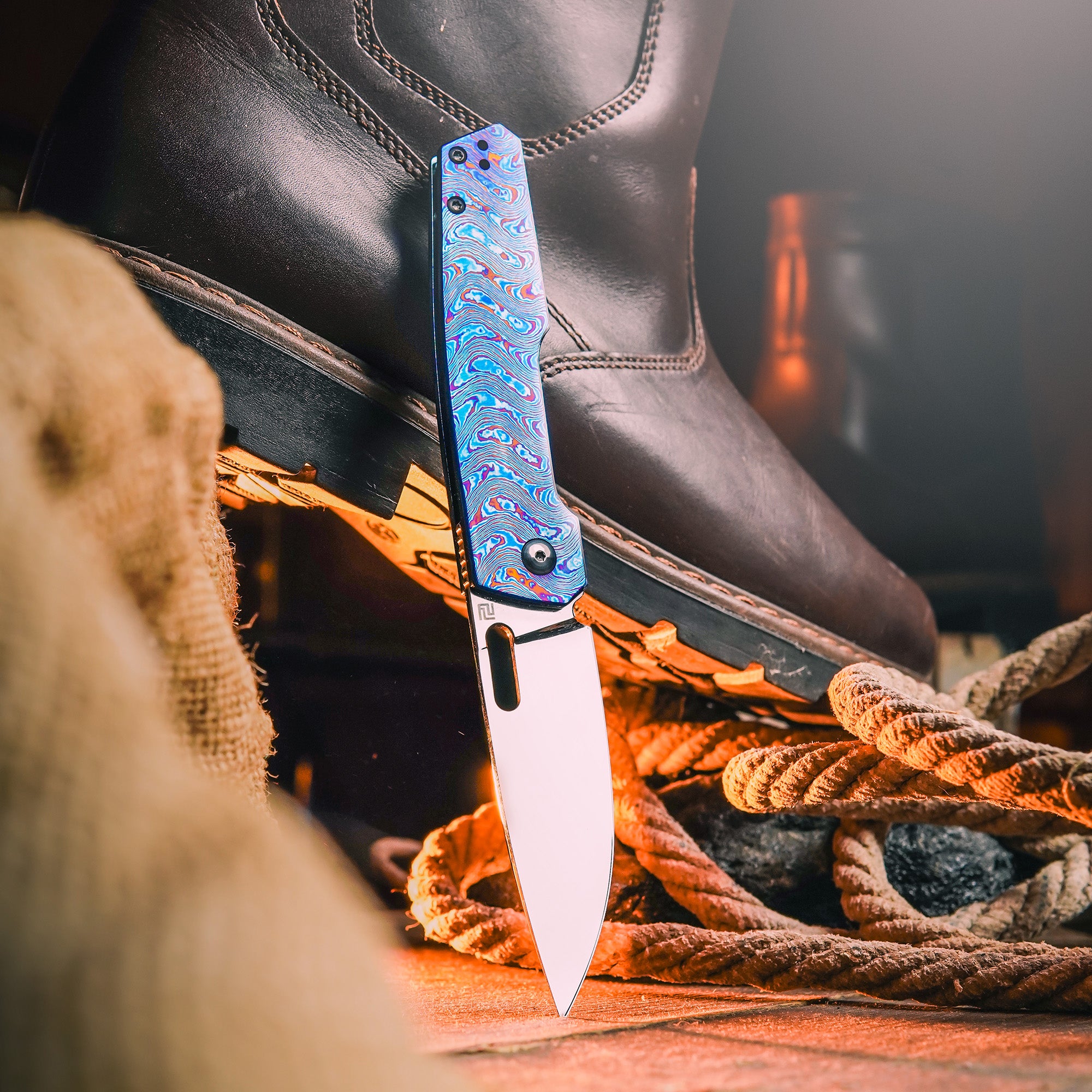
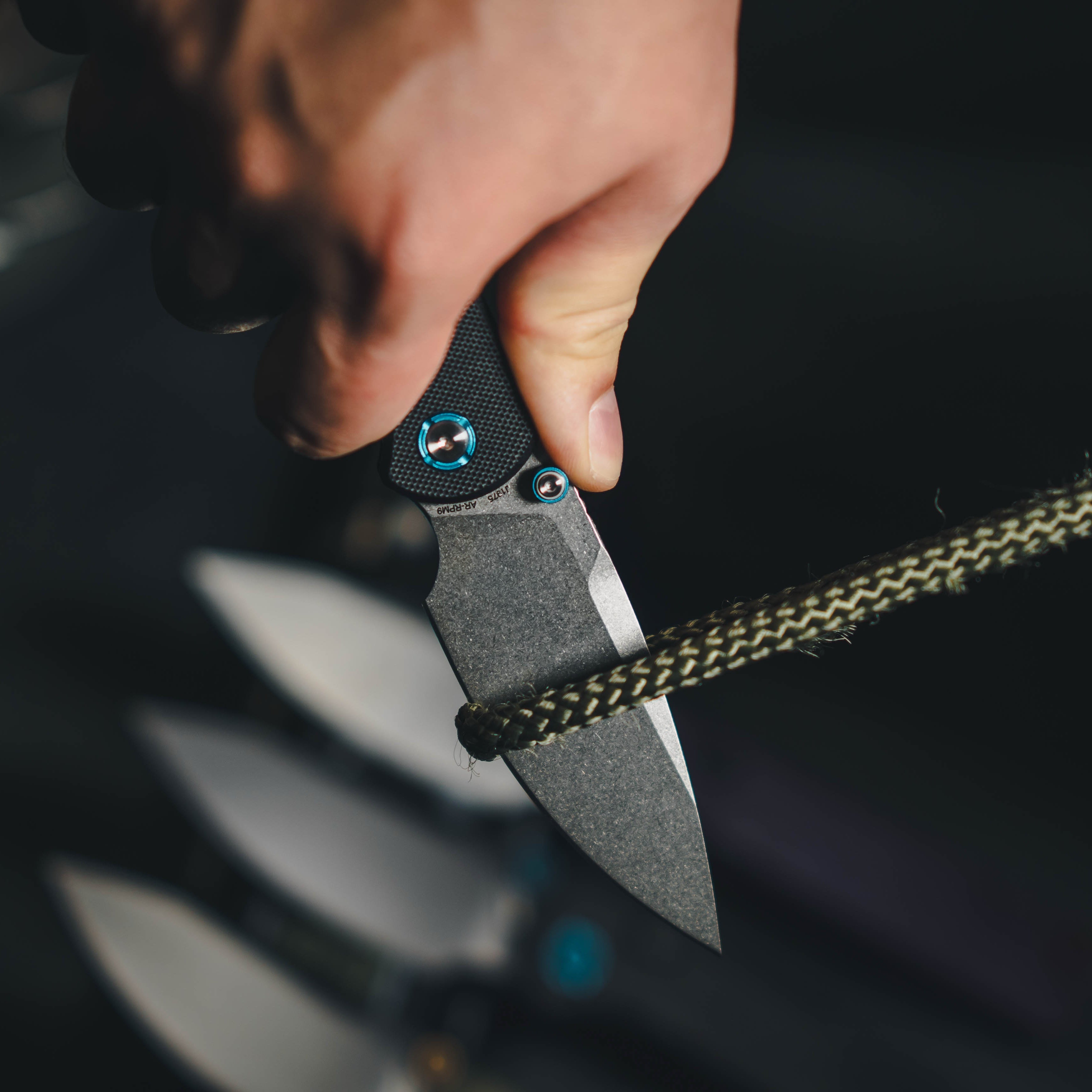
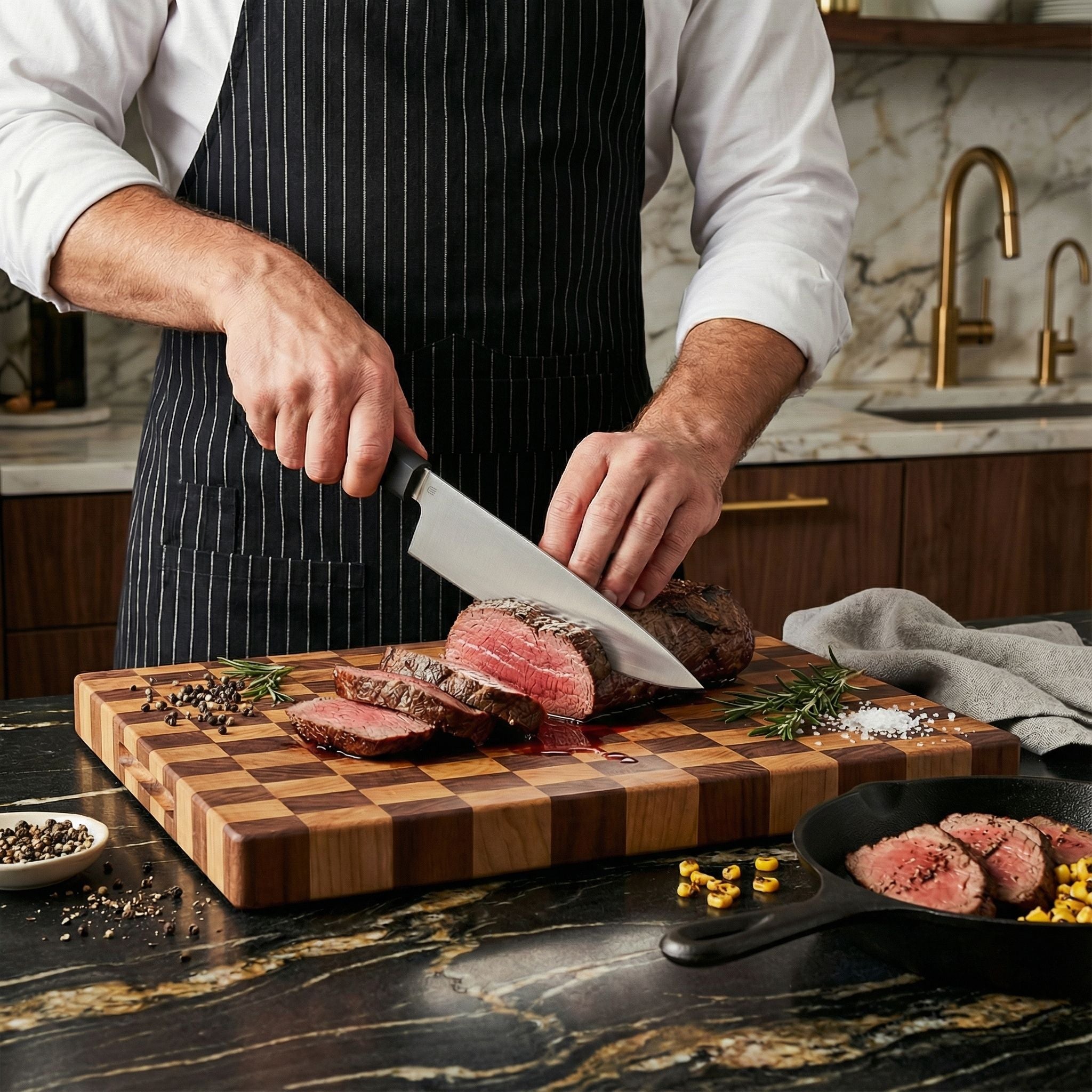

A bushcraft knife is not simply a big camping knife. It is a single tool expected to carve, split, prepare food, and strike a fire steel in the same afternoon — often with wet or gloved hands, far from a workbench. That combination of jobs is what shapes the blade grind, the steel choice, and the handle of every serious fieldcraft knife. This guide walks through the four jobs a bushcraft knife has to do, then explains how grind, length, steel, and handle geometry affect each one.
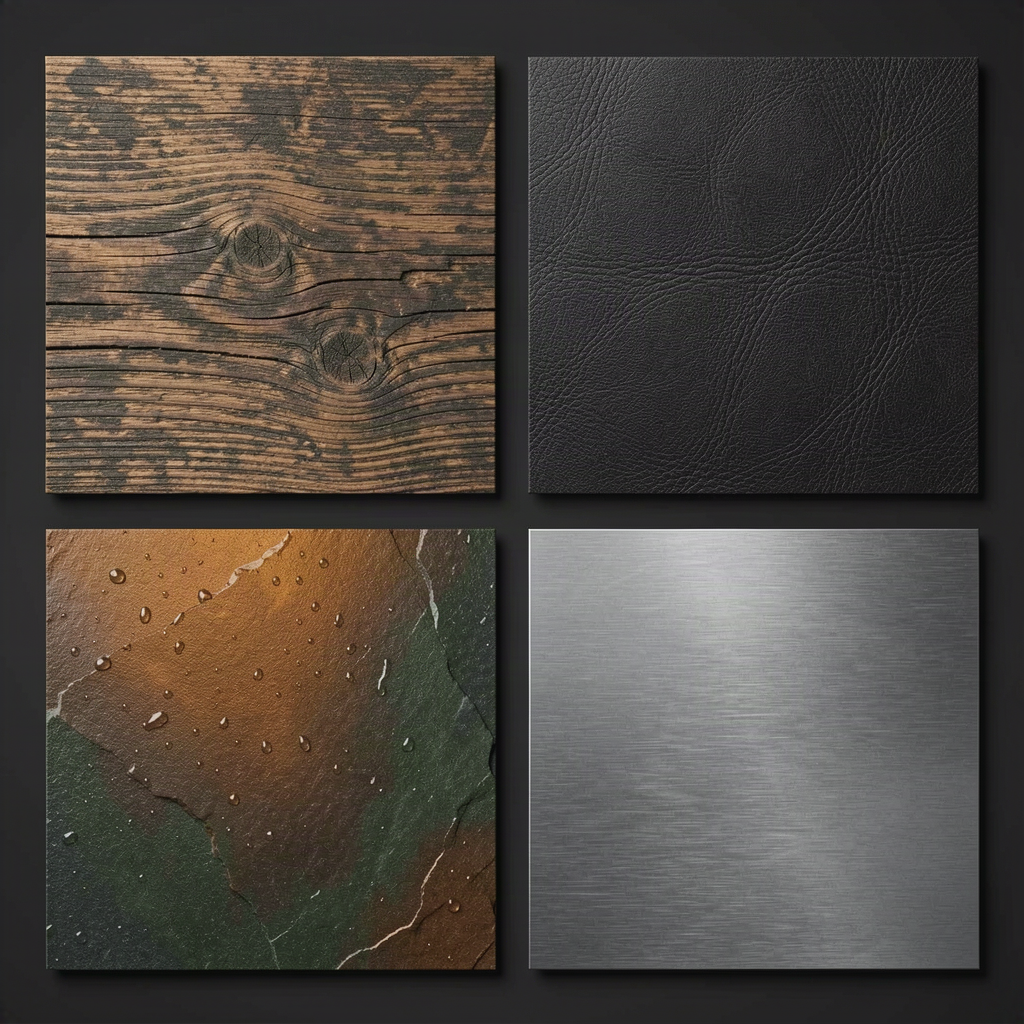
Fieldcraft materials: stabilized wood, leather, whetstone and tool steel each do a job in a working camp knife.
What Separates a Bushcraft Knife From a Camping Knife
A general camping knife slices rope, opens packaging, and cuts food. A bushcraft knife adds two harder jobs: woodworking (carving notches, feathersticks, and tent pegs) and controlled splitting (batoning kindling). It also has to survive being used repeatedly in wet, gritty conditions and then be sharpened in the field with a small stone.
- Carving and shaping — needs a thin enough edge and a controllable tip.
- Batoning — needs a stiff spine and a blade that can take impact without chipping.
- Food preparation — needs a clean, easily washed surface and reasonable corrosion resistance.
- Fire lighting — needs a spine that scrapes a ferrocerium rod and a handle that stays controllable in the cold.
Blade Grind: The Single Most Important Choice
Grind determines how the knife cuts and how easy it is to maintain. Three profiles dominate bushcraft.
| Grind | How It Cuts | Strengths | Weaknesses |
|---|---|---|---|
| Scandinavian (scandi) | A single flat bevel ground to a very small micro-bevel, no secondary bevel | Excellent wood control; easiest grind to sharpen freehand; bites into wood predictably | Weaker edge in hard impacts; thicker stock makes it a poorer slicer |
| Flat | Full-height or partial flat bevels meeting at an apex | Balanced strength and slicing; versatile for food and wood | More skill needed to sharpen freehand than a scandi |
| Convex | A rounded bevel with no hard shoulder | Very strong edge; resists chipping; sheds material well when chopping | Hardest to maintain without a strop or slack-belt method |
If you only ever own one bushcraft knife, a scandi or a flat grind with a thin edge is the most forgiving starting point: both can be brought back to cutting ability with a pocket stone and a few minutes of work. Convex grinds reward experience but punish carelessness during sharpening.
Blade Length and Thickness
Fieldcraft work is dominated by short, controlled cuts, so most bushcraft knives are deliberately compact. As a practical guideline:
- Length: a blade around 90–115 mm (roughly 3.5–4.5 in) handles carving, food prep, and most batoning without becoming unwieldy inside a shelter or while seated.
- Thickness: around 3–4 mm of stock is the usual balance. Thinner stock slices better; thicker stock survives abuse but stops being a good carver.
- Spine: a flat, squared spine is genuinely useful — it scrapes a ferro rod and can be struck with a baton without slipping.
Longer blades are better at chopping and processing larger wood, but if you carry an axe or a saw, the knife's job narrows back toward carving — and shorter is better.
Steel: Carbon, Tool, or Stainless?
Steel choice for fieldcraft is a genuine trade-off, not a ranking. The relevant properties are corrosion resistance, toughness, and ease of sharpening in the field.
| Family | Typical Behaviour | Field Notes |
|---|---|---|
| Simple high-carbon (e.g. 1095-class) | Very easy to sharpen, takes a keen edge, will rust | Ideal with a small stone and a wipe-down habit; needs oiling after wet use |
| Tough tool steels (e.g. 3V and A2 class) | High toughness, good edge stability, moderate corrosion resistance | A strong choice for batoning and hard use |
| Sandvik stainless (e.g. 12C27/14C28N class) | Low maintenance, easy sharpening, holds a usable edge | Very forgiving for wet climates and beginners |
| Premium stainless and powder steels | High wear resistance, higher corrosion resistance, harder to field-sharpen | Great edge retention, but a coarse pocket stone struggles to restore them |
Two rules of thumb cut through the debate. First, if you will be near water or salt, choose corrosion resistance over peak edge retention — a rusty edge is useless. Second, if you plan to maintain the knife with a pocket stone rather than a guided system, favour a steel that responds quickly to a few strokes. Knife Steel Nerds maintains detailed, data-driven explanations of knife steel properties if you want to go deeper than a table.
Handle Geometry for Hard, Wet Use
A bushcraft handle is a gripping surface that may be used with gloves, in the rain, and under pressure for hours. What matters:
- Length: your whole hand should fit, with a little room. Too short forces your pinky off the end, which reduces control during carving.
- Cross-section: a smoothly rounded oval or a gently contoured shape avoids hot spots during prolonged push cuts.
- Guard or finger shelf: a modest guard or a subtle index finger groove prevents your hand sliding forward during hard push cutting.
- Material: textured laminates (G10, Micarta) and stabilized wood stay grippy when wet and resist swelling. Bare wood and smooth metal are attractive but slippery in the rain.
- Pins and fasteners: check that handle fasteners sit flush; a proud pin becomes a blister generator under load.
Sheath and Carry in the Field
The sheath is part of the tool, not an accessory:
- Retention: invert the sheath and shake it. The knife must not fall out, and it must still draw without a fight.
- Material: leather is quiet and traditional but holds moisture; kydex drains and clicks positively but can mark a polished blade.
- Position: belt carry keeps the handle available; a dangler or drop-loop lets the sheath move with you when you sit or crouch.
- Drainage: any sheath you use near water should have a drain hole or an open bottom.
Field Maintenance in Wet Conditions
- Dry before sheathing. Most field rust happens between the blade and the sheath, not in the air.
- Carry a light oil film. A thin coat after each day's use is enough for carbon and tool steels.
- Touch up early. Restoring an edge with a few strokes on a fine stone is far faster than repairing a blunt one later. If you want to understand what is actually happening at the apex, Science of Sharp documents it with microscope images.
- Clean the handle. Mud and sap dry into an abrasive film. Warm water and a cloth, then let it dry fully before storage.
Choosing Your First Bushcraft Knife: A Checklist
- Does the grind match how you will sharpen — scandi or flat if you use a pocket stone, convex only if you have the method down?
- Is the blade around 90–115 mm, with 3–4 mm stock?
- Is the spine flat and squared enough to scrape a ferro rod?
- Does the handle fill your hand without hot spots, with a modest guard?
- Is the steel a sensible match for your climate — corrosion-resistant for wet, carbon for easy field sharpening?
- Does the sheath retain the knife inverted and drain when wet?
Bushcraft and Everyday Carry Overlap More Than You Think
You do not need a dedicated field knife to practise fieldcraft skills. A well-built folder with a strong lock handles feathersticks, cordage, and food prep perfectly well on a day hike, and it disappears into a pocket when you are back in town. Many outdoor carriers keep a fixed blade for camp tasks and a folding pocket knife for everything in between — an arrangement that covers the widest range of real work with the least equipment.


Leave a comment
This site is protected by hCaptcha and the hCaptcha Privacy Policy and Terms of Service apply.