


Most everyday carry knives are slicers. The CJRB Boxer J1967 is a cutter: a folding utility knife that takes standard replaceable blades, opens with a button lock, and comes out of the box with ten spare blades in the package. At $34.99 across all six editions, it is one of the few knives in the catalogue built for people who treat a blade as a consumable.
A 61-gram button-lock utility folder: replaceable blades, G10 scales, six colorways at the same price.
This guide covers what a folding utility knife is, the full J1967 spec sheet, all six Boxer editions side by side, and when a Boxer beats a traditional EDC folder.
What Makes a Folding Utility Knife Different
A conventional pocket knife carries a permanent, hardened steel blade that you sharpen and keep. A folding utility knife carries a thin, inexpensive blade that you swap when it dulls or chips. That single design decision changes everything downstream:
- You never sharpen. A fresh edge costs pennies and takes seconds to install.
- Damage is disposable. Cutting carpet, drywall, or wire does not ruin a $100 knife — it uses up a $0.30 blade.
- The blade is thin. Utility blades slice through material that would bind a thicker knife.
- The trade-off is robustness. Replaceable blades are not meant for prying, batoning, or heavy lateral loads.
That is the trade the Boxer makes, and it makes it deliberately. For background on this tool category, see the utility knife reference.
Boxer J1967 Spec Sheet
| Specification | CJRB Boxer J1967 |
|---|---|
| Blade length | 2.3 in (58.5 mm) |
| Blade finish | Stone wash |
| Blade holder | 2Cr |
| Blade material | Steel (replaceable utility blades) |
| Handle material | G10 |
| Clip material | Steel |
| Lock type | Button lock |
| Overall length | 5.67 in (144 mm) |
| Closed length | 3.37 in (85.5 mm) |
| Weight | 2.2 oz / 61 g |
| Included | 10 spare blades |
At 2.2 ounces the Boxer is one of the lightest folders on the site — roughly 40 percent of the weight of a titanium-handled knife of similar length. The 3.37-inch closed length disappears into a coin pocket, and the G10 scales give it a grip that a bare-metal utility knife cannot match.
All Six Boxer Editions
| Edition | Model code | Handle | Listed price |
|---|---|---|---|
| Black Mechanical | J1967-BBK | Black G10 | $34.99 |
| Blue Ripple | J1967-BU | Blue G10 | $34.99 |
| Green Watermelon | J1967-WM | Green G10 | $34.99 |
| Yellow Lemon | J1967-LM | Yellow G10 | $34.99 |
| Match Night Black Edition (exclusive) | J1967-BWC | Black G10 | $34.99 |
| Soccer Field Green Edition (exclusive) | J1967-GWC | Green G10 | $34.99 |
Every Boxer is the same knife mechanically; the editions differ in scale color and packaging. That is good news if you want a specific colorway: there is no performance penalty for picking the one you like. Check the live Boxer collection for current stock and any new colorways.
Why a Button Lock on a Utility Knife
The Boxer uses a button lock rather than the sliding collar found on most hardware-store utility knives. Two practical advantages follow:
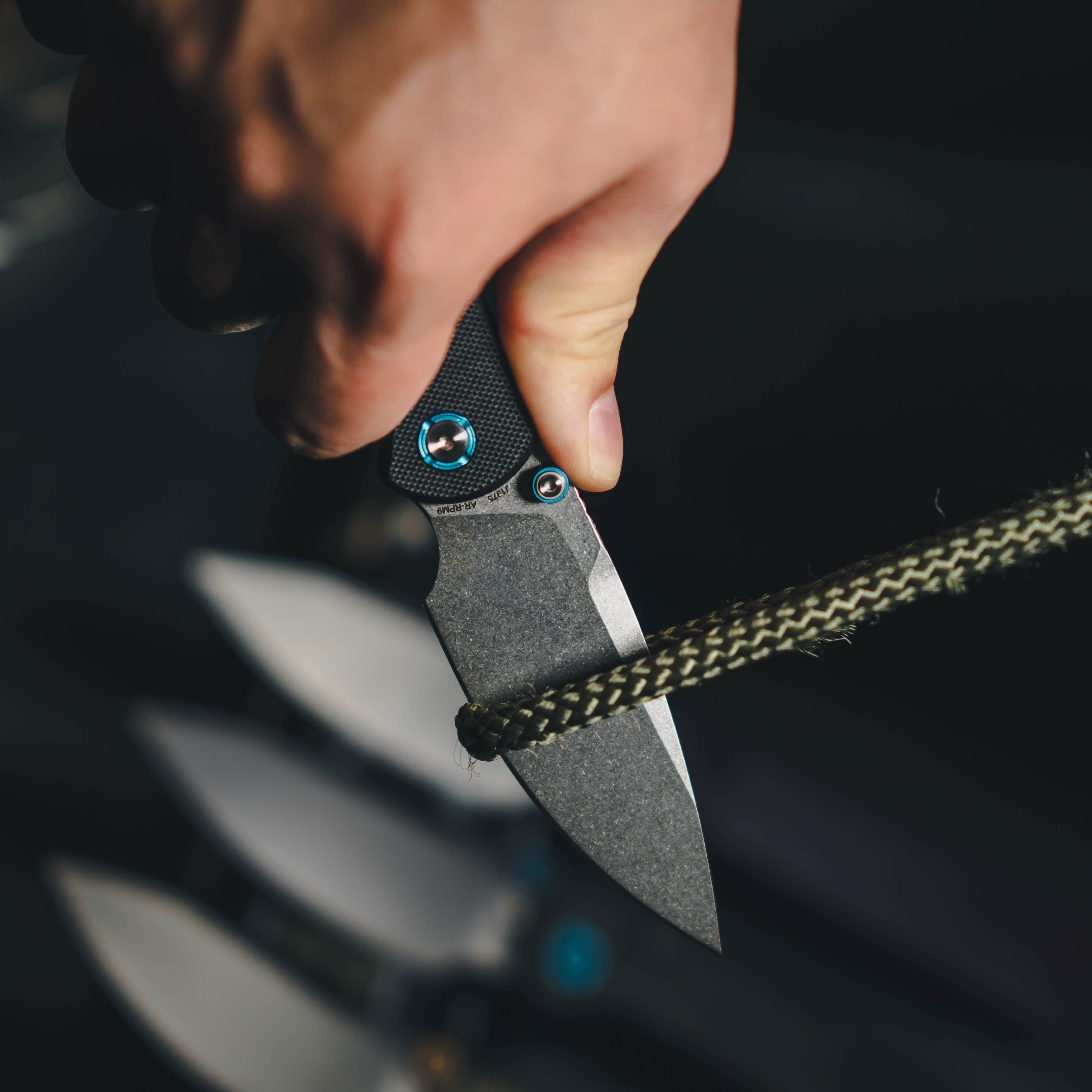
- One-handed, ambidextrous operation. Press the button and the blade swings free; there is no stiff slider to fight with gloves on.
- Safer closing. You can release and fold the blade with one hand without your fingers crossing the blade path.
A button lock also keeps the knife closed under pocket pressure far more reliably than a friction collar. If you have never used one, the mechanism is the same family covered in our folding knife range — press to release, flip to open, press to fold.
Replacement Blades: The Real Cost Story
The economics are the Boxer's strongest argument. A conventional EDC knife at $50 needs sharpening — time, a stone or a guided system, and eventual blade wear that never comes back. Ten spare blades ship in the box, and standard utility blades remain among the cheapest consumables in any hardware aisle.
That means a Boxer owner can keep a genuinely sharp edge in the knife indefinitely for very little money, and can throw the blade away the moment it hits a staple, a screw, or a nail. For anyone who cuts packaging professionally, the Boxer is arguably cheaper to own than a "better" knife.
Boxer vs a Traditional EDC Folder
| Question | Boxer J1967 | Traditional folder |
|---|---|---|
| Sharpening | Swap the blade | Hone and sharpen |
| Edge condition over a year | Always fresh | Gradually wears back |
| Blade thickness | Thin, slices cleanly | Thicker, more robust |
| Prying or heavy lateral load | Not intended | Possible within limits |
| Weight (this class) | 2.2 oz / 61 g | 3–5 oz typical |
| Best use | Packaging, trade work, daily cutting | General EDC, food, outdoor tasks |
The honest conclusion: a Boxer does not replace a pocket knife, and a pocket knife does not replace a Boxer. Many carriers own both — the traditional folder for general tasks, the utility knife for the dirty jobs.
Who the Boxer Is For
- Trade and warehouse work. Where blades meet cardboard, banding, and tape all day.
- Budget-conscious first knife. At $34.99 with ten blades, a beginner gets a lot of cutting for very little money.
- Lightweight carry. 61 grams is close to forgettable in a pocket.
- Anyone who hates sharpening. The edge is a consumable, not a project.
Skip it if you need a knife for food preparation, woodcraft, or anything requiring a sturdy fixed-geometry blade. For that role, browse folding knives and new arrivals instead.
Why 61 Grams Matters
Weight is the most underrated spec in everyday carry. A knife you notice in your pocket is a knife you leave at home, and the Boxer's 2.2 ounces puts it in the same class as a mid-size pen. For comparison, most G10-handled folding knives in the 3-inch blade range land between 3 and 5 ounces, and full titanium frame locks routinely run 4 to 6.
Two details make that number work. The G10 scales are lighter than metal liners and scales would be while remaining effectively immune to moisture, and the replaceable-blade architecture removes the need for a thick, load-bearing blade blank. The result is a tool you can carry in a shirt pocket, a coin pocket, or clipped to lightweight shorts without the knife dragging the garment down.
Where the Boxer Sits in the CJRB Lineup
CJRB's catalogue splits roughly into three groups: compact EDC folders (the Anansi and Mica class), mid-size all-rounders, and premium titanium builds with super steels like CPM S90V. The Boxer is deliberately outside all three — it is a tool-grade cutter sold at an entry price, not a collector's piece.
That positioning matters when you are deciding what to buy. If you want one knife for everything, a general-purpose folder is the more versatile answer. If you already own that knife and want to stop wearing it out on tape and cardboard, the Boxer is the specialist you add next. Browse the full CJRB Cutlery range to see both ends of that spectrum side by side.
Care and Blade Changes
Maintenance is minimal. Swap blades when the edge starts to drag, wipe the blade holder free of tape residue before installing a new blade so it seats flat, and keep the button-lock track free of grit if you work in dusty environments. Because the blades are thin carbon steel, a quick wipe after cutting anything damp prevents surface rust — the same discipline described in the pocket knife overview applies here, only more so.
If you want to understand how edge angle and steel choice affect cutting in general, Science of Sharp and Knife Steel Nerds are the two most useful references we know of.
Bottom Line
The CJRB Boxer J1967 is a specialist tool wearing an EDC knife's clothes: a 61-gram, button-lock, G10-handled folder that eats replaceable blades and never asks to be sharpened. At $34.99 in six editions, it is the cheapest way to stop dulling a good knife on jobs that were never meant for it.


Leave a comment
This site is protected by hCaptcha and the hCaptcha Privacy Policy and Terms of Service apply.