

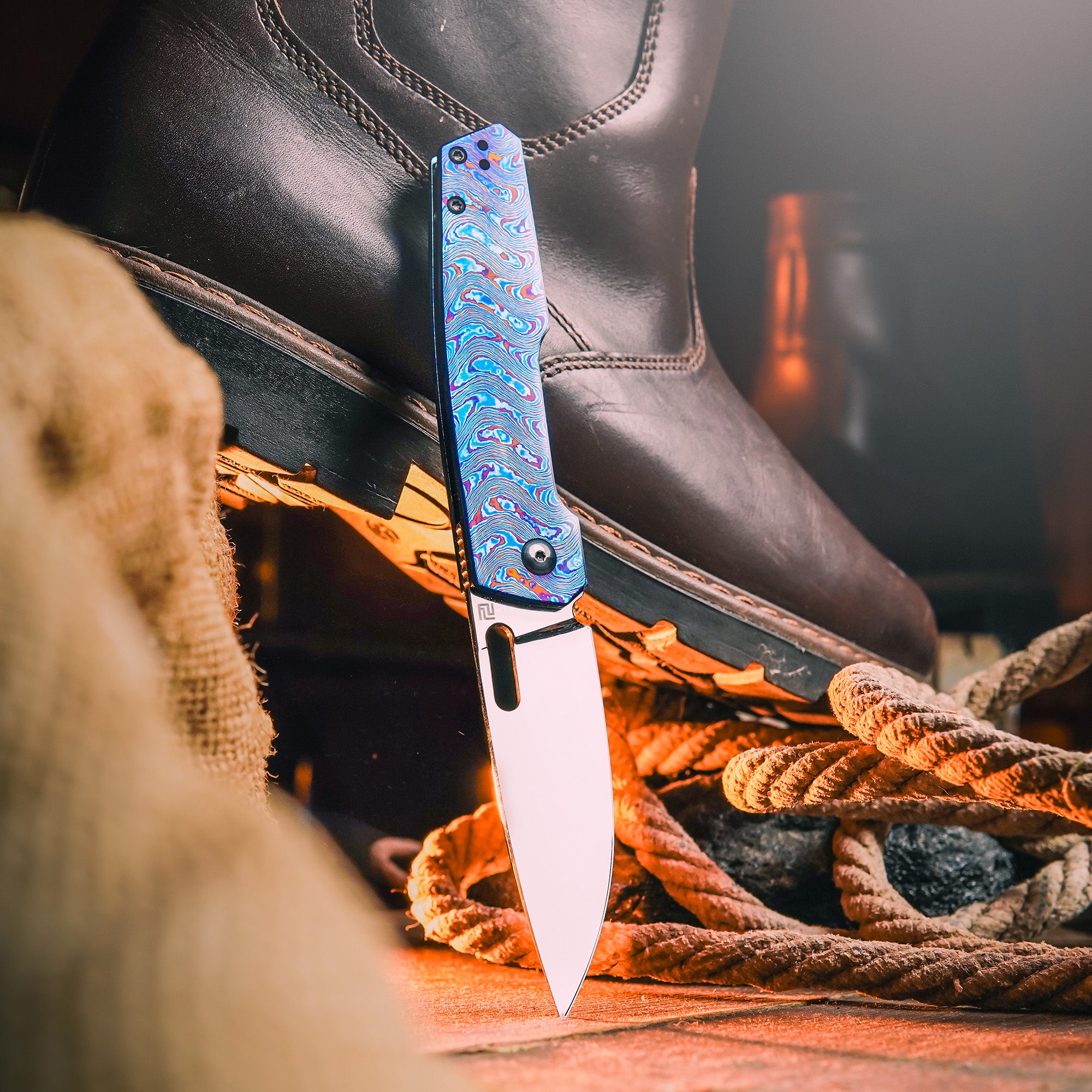
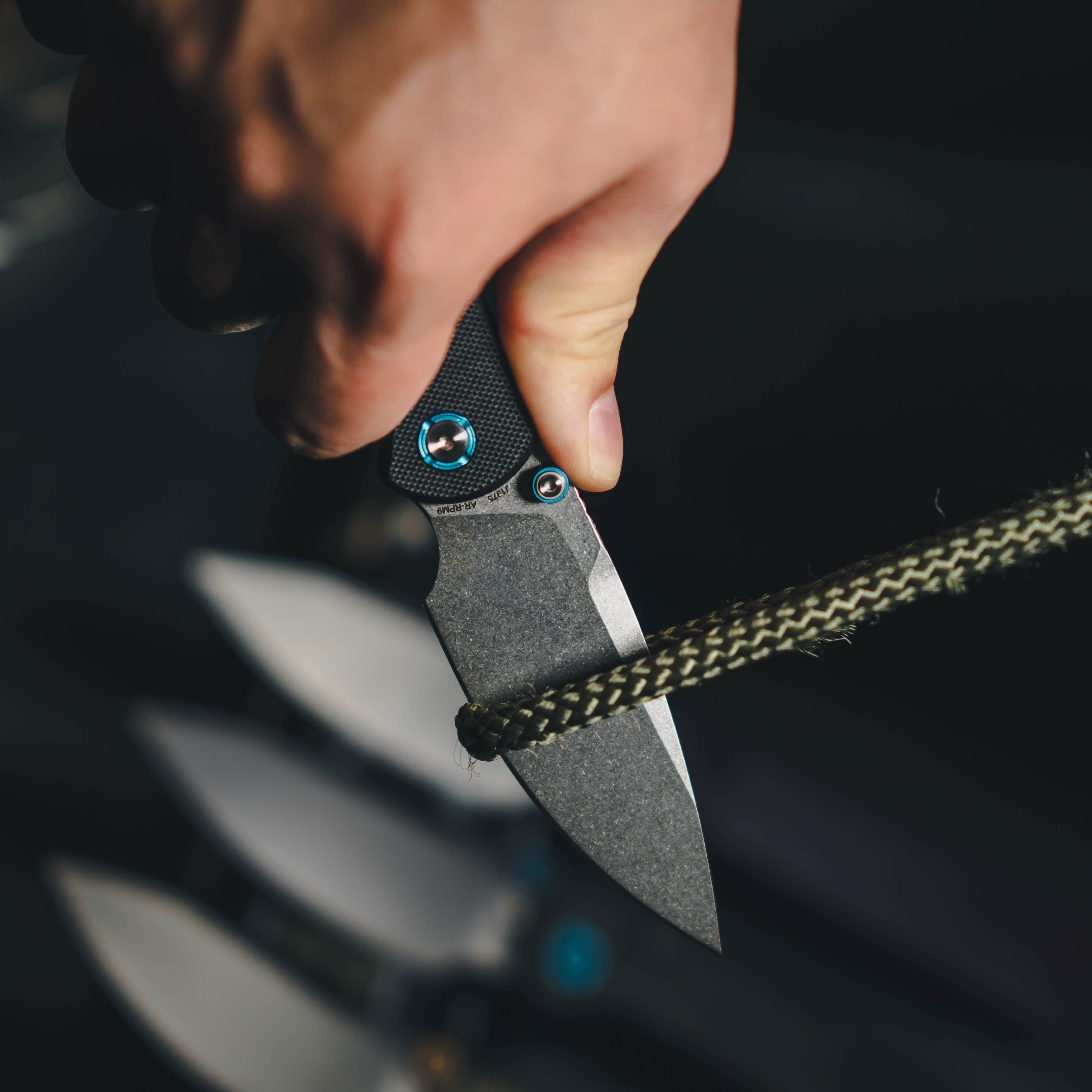
The CJRB Crag is the wide-blade workhorse of the CJRB line: a 3.43-inch cleaver-style folder built to take on cardboard, rope, zip ties, and packaging without the delicate feel of a slim gentleman's knife. Under the single model code J1904 the Crag has shipped in eleven distinct factory configurations, spanning budget G10 builds at $35.99 to limited Fat Carbon exclusives at $119.99.
The Crag family spans budget G10 builds up to Fat Carbon exclusives, all sharing the same 3.43-inch cleaver blade.
This guide walks the whole family: what the numbers on the spec sheet actually mean, how the four blade steels differ in daily use, which handle material suits which job, and which of the eleven configurations is the right starting point for you.
What Is the CJRB Crag?
The Crag is a mid-size liner-lock flipper with a broad, flat-ground blade. CJRB describes it as "a substantial cleaver-style knife that can tackle even the hardest tasks with ease," and one listing in the family calls the profile "a sheepsfoot with a more clipped point that gives both a sharp point and a large belly." Either way you read it, the result is the same in hand: a knife with an unusually wide blade for its length, a big cutting belly, and a tip that is still useful for piercing.
The pivot runs on ceramic ball bearings, the flipper tab opens the knife one-handed from either side, and the steel pocket clip is reversible. There is a lanyard hole milled into the tail of the handle.
Crag Spec Sheet at a Glance
| Specification | CJRB Crag (J1904 family) |
|---|---|
| Blade length | 3.43 in (87 mm) |
| Blade thickness | 0.13 in (3.2 mm) |
| Blade grind | Flat |
| Blade style | Cleaver (wide belly, clipped point) |
| Blade hardness | HRC 59–61 |
| Overall length | 8.15 in (207 mm) |
| Closed length | 4.72 in (120 mm) |
| Weight | 145 g / 5.08 oz |
| Lock | Liner lock |
| Pivot | Ceramic ball bearings |
| Deployment | Flipper tab |
| Clip | Steel, reversible |
That 145 g figure deserves a note. The Crag is not a featherweight — at 5.08 ounces it is roughly twice the weight of a compact aluminum-handled folder of the same blade length. If you carry in a jeans pocket every day and prefer a knife you forget is there, that weight is the main trade-off. If you want a knife that fills the hand and does not twist under load, the Crag's mass is a feature rather than a cost.
Every Crag Configuration, Side by Side
The eleven listings below are grouped by the code printed on the box, because that is the only reliable way to tell two Crags apart in the catalogue. Blade steel, handle material, blade finish, and listed price come straight from each product listing.
| Model code | Blade steel | Handle | Blade finish | Listed price |
|---|---|---|---|---|
| J1904 (G10) | D2 / AR-RPM9 | G10 — green, black, gray | Stone wash | $35.99 |
| J1904-CF | D2 / AR-RPM9 | Carbon fiber | Stone wash | $39.84 |
| J1904-BCF | AR-RPM9 | Carbon fiber | Black PVD | $39.99 |
| J1904-GCF | AR-RPM9 | Carbon fiber (sliver) | Gray PVD | $49.99 |
| J1904R (G10) | AR-RPM9 | G10 — black, gray, green | Satin | $49.99 |
| J1904R-CF | AR-RPM9 | Carbon fiber | Satin | $49.99 |
| J1904-BGD | AR-RPM9 | G10, glow in the dark | Black PVD | $49.99 |
| J1904C-A | D2 / AR-RPM9 | Copper | Stone wash | $55.99 |
| J1904D-CF | Rose Damascus | Carbon fiber | Pickled / etched | $89.99 |
| J1904-BWCF | 14C28N | Blue & white Fat Carbon (exclusive) | Black PVD | $119.99 |
| J1904-PUCF | 14C28N | Purple Fat Carbon (exclusive) | Black PVD | $119.99 |
Listed prices move with promotions, so treat the table as a starting reference and check the live Crag collection page for today's numbers and stock.
Crag Steel Options Explained
Four steels appear across the J1904 family, and the differences matter more than the marketing copy suggests.
- D2 tool steel. A high-chromium tool steel that has been the default budget-knife steel for years: strong wear resistance, less corrosion resistance than a true stainless, and a reputation for being a little harder to sharpen. See the D2 steel reference.
- AR-RPM9. CJRB's own powder-metallurgy stainless, used from the $39.99 builds upward. CJRB positions it as blending "edge retention, corrosion resistance, and ease of sharpening" — the practical pitch is a steel that shrugs off pocket humidity and touches up quickly on a stone.
- 14C28N. The two Fat Carbon exclusives step up to Sandvik 14C28N, a fine-grained stainless known for taking a very keen edge and resisting corrosion well, at some cost in raw wear resistance versus the higher-carbide steels.
- Rose Damascus. The J1904D-CF uses pattern-welded Damascus with a pickled and etched finish, so each blade shows a slightly different pattern. Damascus is a look and collector choice more than a performance upgrade; the pattern-welded construction background is covered in the Damascus steel overview.
If you want the sharpest edge with the least maintenance, 14C28N or AR-RPM9 are the easy answers. If you cut abrasive material all day and do not mind a steel that wants a diamond stone, D2 is still the value proposition.
Crag Handle Materials Compared
| Handle | What you get | Best for |
|---|---|---|
| G10 | Layered fiberglass composite, textured, effectively impervious to moisture | Hard use; the cheapest and most durable entry |
| Carbon fiber | Lighter scales with a woven pattern that shifts under light | Weight savings with a dressier look |
| Fat Carbon | Thick, marbled carbon-fiber sheet; the two exclusives | Collectors and limited-run buyers |
| Copper (J1904C-A) | Solid metal scales that patina with handling; the heaviest option | Anyone who wants a knife that ages visibly |
| Glow-in-the-dark G10 (J1904-BGD) | Charges in light and glows in the dark; black PVD blade | Finding the knife on a nightstand or in a dark bag |
Liner Lock, Bearings, and Daily Action
The Crag runs a liner lock: a spring-steel bar inside the handle that wedges behind the blade tang when the knife opens. It is the most common lock on folding knives, it is fully ambidextrous to operate once learned, and it is easy to inspect for wear — you can see the lock bar travel as the knife breaks in.
Combined with the ceramic ball-bearing pivot, the Crag's action is smooth and fidget-friendly out of the box. If your new Crag feels stiff or off-centre, that is usually a pivot-tension issue rather than a defect and settles with a small adjustment and a few days of opening and closing.
Is the Crag Right for You?
Buy the Crag if you cut a lot of cardboard, banding, or packaging; you like a wide blade with a big belly; you want a knife that feels substantial; or you want one model code with a cheap entry point and a collectible top end.
Look elsewhere if you need a sub-3-ounce carry, you prefer a fine piercing tip over a broad working edge, or you want a lock other than a liner lock.
Keeping a Crag Cutting
The Crag's flat grind and 0.13-inch stock make it straightforward to sharpen on a bench stone or a guided system. Two habits matter most: strop or touch up before the edge is fully dull, and keep the pivot free of grit if you cut dirty material. For edge-geometry background, Science of Sharp documents what actually happens at the apex during sharpening and stropping, and Knife Steel Nerds covers how carbide volume in steels like D2 and 14C28N affects edge retention and toughness.
See the Full Crag Lineup
The complete, currently listed Crag range — including any colors and exclusives that come and go — lives in the Crag collection. For the rest of the family, browse CJRB Cutlery or start from all folding knives.

Leave a comment
This site is protected by hCaptcha and the hCaptcha Privacy Policy and Terms of Service apply.