

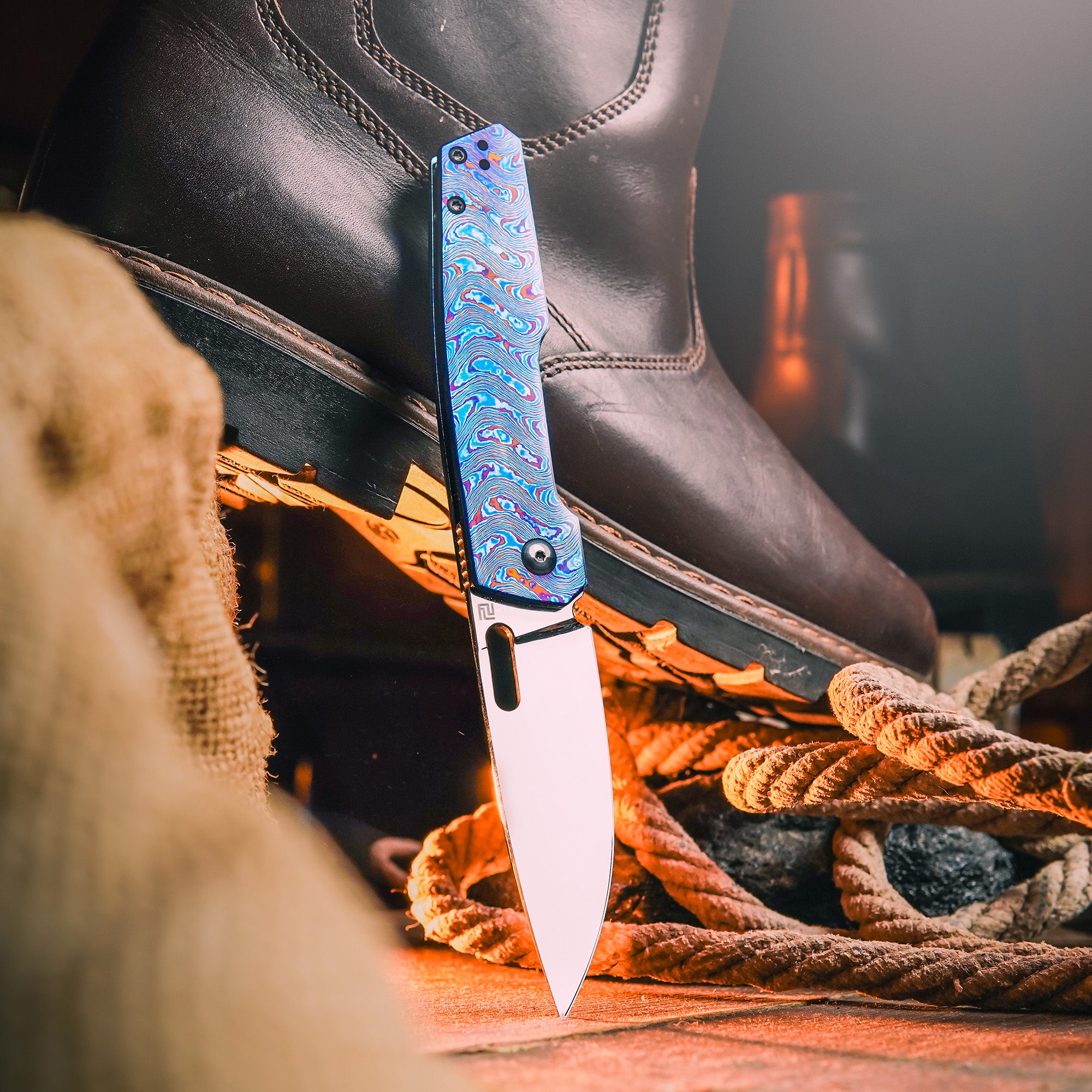

What the CJRB Kestrel J1962 Is
The CJRB Kestrel J1962 is a Ray Laconico design and one of the few sub-$50 folders in the CJRB line that pairs a wharncliffe blade with a liner lock. It is a 3.31-inch folder that weighs 106 g, ships in three G10 colourways at the same $49.99 price, and is built around a straight-edged blade profile you rarely see at this price point.
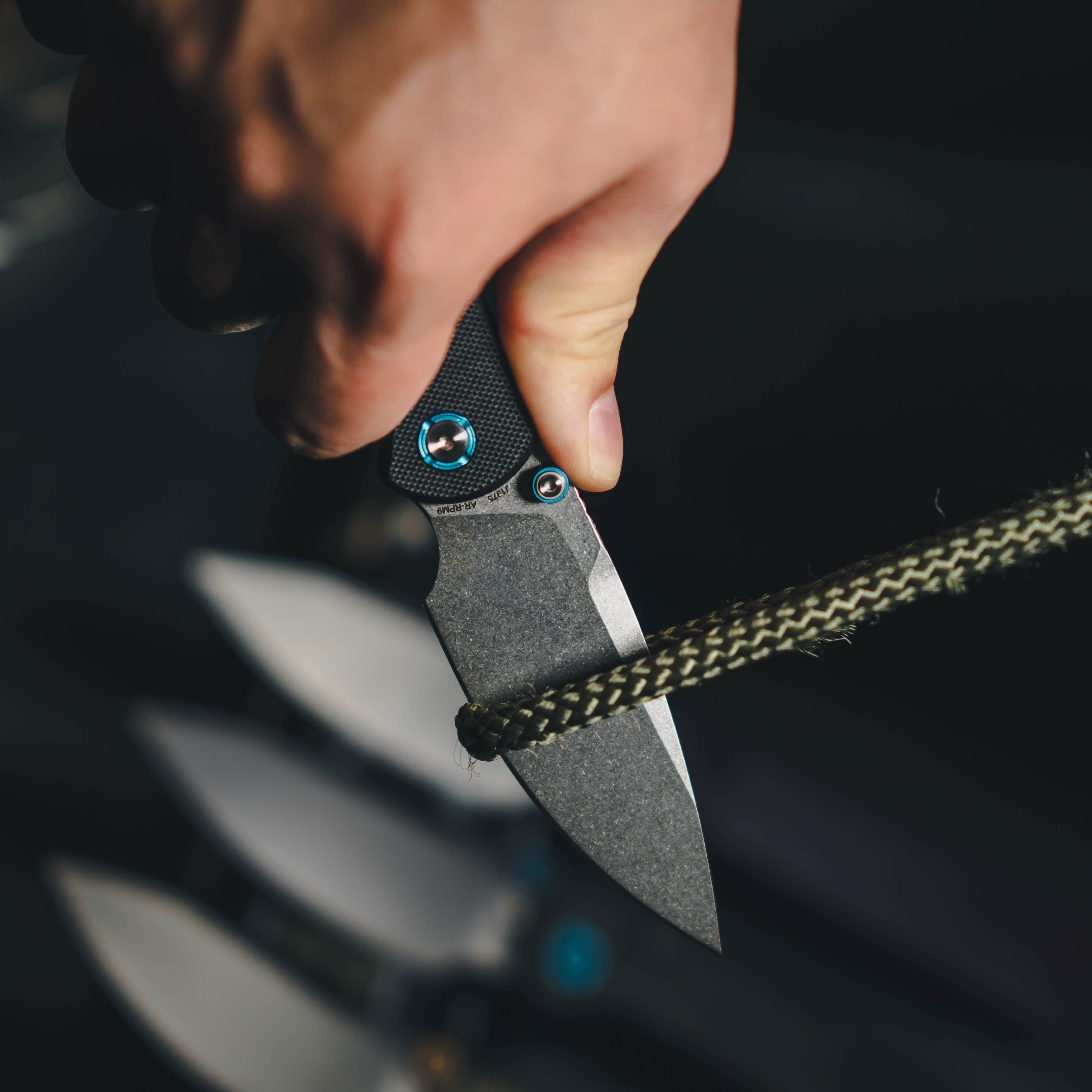
The Kestrel J1962 pairs a straight wharncliffe edge with a liner lock and AR-RPM9 steel.
CJRB publishes a short statement from Laconico on the listing: the Kestrel is inspired by a time early in his career when making folding knives was still new to him, and he draws inspiration from that era when he had limited tooling and relied primarily on design and creativity. Whatever you make of designer copy, the spec sheet backs up the idea of a simple, honest working folder: flat grind, ceramic ball bearing pivot, steel clip, no gimmicks.
The Reference Spec Table
These are the published specifications. All three Kestrel colourways share them exactly.
| Blade Length | 3.31 in (84 mm) |
| Blade Thickness | 0.13 in (3.2 mm) |
| Blade Style | Wharncliffe |
| Blade Grind | Flat |
| Blade Finish | Stone wash / black PVD coating |
| Blade Material | AR-RPM9 |
| Blade Hardness | HRC 59-61 |
| Handle Material | G10 |
| Lock Type | Liner lock |
| Pivot Assembly | Ceramic ball bearing |
| Clip Material | Steel |
| Overall Length | 7.6 in (193 mm) |
| Closed Length | 4.3 in (109 mm) |
| Weight | 106 g / 3.74 oz |
As with any spec sheet, run the arithmetic first: 84 mm of blade plus 109 mm closed equals the published 193 mm overall, so this table is internally consistent. The number that stands out is 0.13 in (3.2 mm) of blade stock — that is thick for a 3.31-inch blade, and it is the reason the Kestrel feels like more knife than its size suggests.
Why a Wharncliffe Blade
A wharncliffe is the straightest common blade profile: a dead-flat cutting edge running from the heel to a low, reinforced point, with no belly and no recurve. That geometry matters more than any steel label for what a knife is actually good at.
- Pull cuts are effortless. Because the entire edge meets the material at the same angle, a wharncliffe slices through tape, cardboard, shrink wrap and paper without wandering. The blade goes exactly where you point it.
- The tip is supported. There is no fine drop to the point, so the tip does not snap off under lateral load the way a needle-like clip or spear point can.
- Sharpening is straightforward. One continuous straight edge is the easiest geometry to hold a consistent angle on, whether you freehand or use a guided system.
The trade-off is the same geometry read the other way: no belly means no rocking cuts, so a wharncliffe is a poor choice for breaking down game or rocking through herbs. For an EDC knife used on packaging, zip ties, cord and cardboard, the straight edge is the better tool. Wikipedia's Blade and blade geometry pages cover the general edge-profile families if you want the wider picture.
AR-RPM9 at HRC 59-61
CJRB describes AR-RPM9 as a powder-form stainless steel with properties that make it ideal for daily-carry knives, and credits the powdering process for high hardness and superior toughness. The Kestrel runs it at HRC 59-61 with a flat grind, which is a sensible pairing: a hard, wear-resistant edge on a geometry that is easy to maintain.
Powder metallurgy is the reason AR-RPM9 behaves above its price point. Instead of a conventionally cast ingot, the alloy is atomised into a spray and consolidated, which produces a far finer and more uniform carbide distribution — the same principle behind the premium powder steels covered on Knife steel. The practical result is an edge that holds longer and sharpens more predictably than a cheap high-chromium stainless. See the AR-RPM9 collection for the rest of the line in this steel.
Three Colourways, One Price
All three Kestrel listings are in stock at $49.99, and each is its own product page.
| Colourway | SKU | Handle | Blade | Price | Availability |
|---|---|---|---|---|---|
| Black | J1962-BBK | G10 | AR-RPM9, stone wash / black PVD | $49.99 | In stock |
| Green | J1962-GN | G10 | AR-RPM9, stone wash / black PVD | $49.99 | In stock |
| Blue | J1962-BU | G10 | AR-RPM9, stone wash / black PVD | $49.99 | In stock |
No tier games, no steel upgrade, no price cliff — the only decision is colour. G10 is the reason all three come in at the same weight: it is a dense glass-fibre laminate that stays dimensionally stable and shrugs off moisture and temperature swings far better than wood, which is why it is the default handle material on most working folders.
Kestrel J1962 vs Other CJRB Wharncliffe Folders
The wharncliffe is uncommon in the CJRB catalogue, and the Kestrel is the largest of them. Every row below is in stock.
| Model | Blade | Lock | Handle | Weight | Price |
|---|---|---|---|---|---|
| Maileah J1918 | 2.39 in (60.8 mm) | Liner lock | G10 | 65 g | $30.99 |
| Hectare-Alt J1935A (carbon fiber) | 3.11 in (79 mm) | Crossbar lock | Carbon fiber | 79 g | $49.99 |
| Kestrel J1962 | 3.31 in (84 mm) | Liner lock | G10 | 106 g | $49.99 |
| Hectare-Alt J1935A (AR-SFII) | 3.11 in (79 mm) | Crossbar lock | Micarta | 72 g | $89.99 |
The Kestrel is the heaviest and longest by a clear margin, and it is the only wharncliffe here with a liner lock rather than a bar-style lock. If you want the lightest straight-edge carry, the Hectare-Alt in carbon fiber saves 27 g at the same price. If you want a wharncliffe that fills the hand and takes real work, the Kestrel is the one. Compare it with the Prado J1936, the other Ray Laconico design at CJRB — same designer, but a 3.76-inch clip point on a crossbar lock at 90-97 g and $57.00.
Weight and Carry Position
At 106 g (3.74 oz) and 7.6 inches open, the Kestrel sits squarely in mid-weight EDC territory. It is not a featherweight, and the 0.13-inch stock plus full steel liners explains where the grams go. What that buys you is a knife that does not flex or feel hollow when you bear down on a cut — the thing people usually mean when they say a folder feels solid.
In the pocket, the 4.3-inch closed length is compact enough for jeans and work trousers, and the wharncliffe's straight spine keeps the profile low. The steel clip handles tip-up carry, and the ceramic ball bearing pivot gives the opening a light, consistent action out of the box.
Who the Kestrel J1962 Is For
- Package and box duty. Nothing beats a straight edge for tape and cardboard.
- Trade and shop use. A supported tip and a thick flat-ground blade take the small abuses a work knife sees.
- First serious folder. At $49.99 with an in-house powder steel, AR-RPM9 at HRC 59-61, it is a real step up from a gas-station knife.
- Wharncliffe fans on a budget. This is the largest straight-edge profile CJRB sells under $50.
Listing Notes Worth Knowing Before You Buy
- One blade finish string covers three colourways. The green, blue and black Kestrel listings all publish Blade Finish as Stone Wash/Black PVD Coating, while each listing carries a single variant. If the finish matters to you, confirm which of the two applies to the colour you are ordering.
- The black colourway uses the base product handle. The Black J1962-BBK listing has no colour suffix in its URL, while Green and Blue do. Same knife, three pages.
- Blade length uses inch marks. The published row reads 3.31 in (84 mm); this guide spells the unit out so it cannot be misread as 3.31 inches of something else.
CJRB Kestrel J1962 FAQ
Is the Kestrel J1962 a liner lock or a crossbar lock?
A liner lock. CJRB lists it as Liner lock across all three colourways, and it is the only wharncliffe in the current CJRB range with that lock type.
What steel does the Kestrel use?
AR-RPM9, CJRB's powder-form stainless, at HRC 59-61 with a flat grind.
How much does the Kestrel weigh?
106 g (3.74 oz) with a G10 handle — heavy for a 3.31-inch blade, because of the 0.13 in blade stock and full liners.
Who designed the Kestrel?
Ray Laconico. CJRB credits him on the listing, and the Kestrel shares that credit with the Prado J1936 in the same CJRB line.
See all three colourways and the rest of the line in the CJRB Kestrel collection, or browse the full Artisan Cutlery folding knife catalogue for more everyday carry folders built for reliable everyday carry.


Leave a comment
This site is protected by hCaptcha and the hCaptcha Privacy Policy and Terms of Service apply.