



Detent tension is one of the most debated topics in the folding knife community — and one of the most misunderstood. A knife's detent determines how easily the blade deploys, how securely it stays closed, and how the action feels in daily use. Whether you prefer a snappy lightning-fast opening or a deliberate, controlled deployment, understanding detent tension will help you choose the right knife and tune it to your preferences.

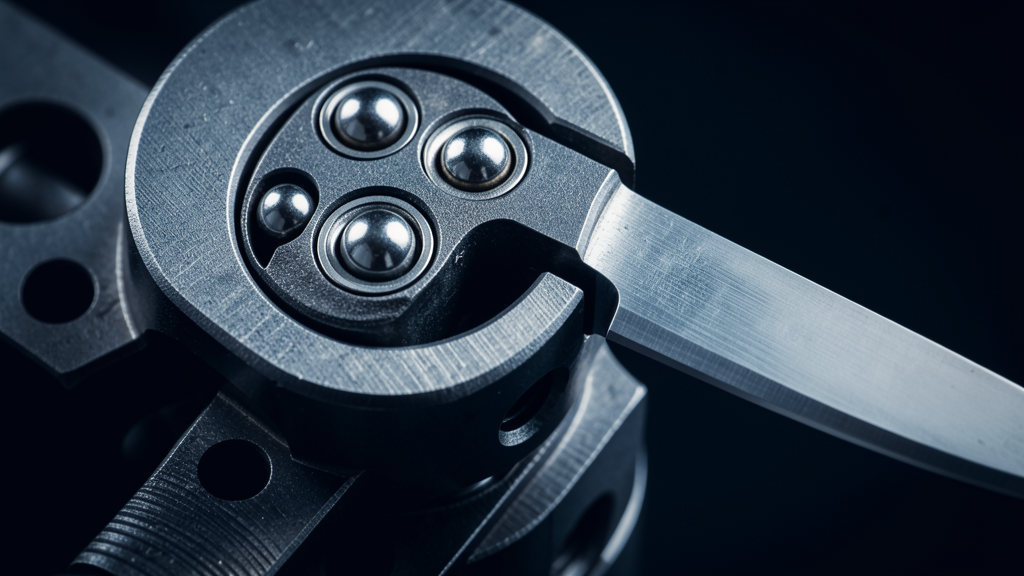
Detent ball and detent hole interaction in a frame lock folding knife
What Is Detent Tension?
The detent is the mechanism that holds a folding knife's blade closed when not in use. In most modern folding knives, a steel ball bearing — set into the lock bar (frame lock, liner lock) or handle scale (crossbar lock) — sits in a small divot (detent hole) on the blade tang. The pressure of this ball against the blade creates resistance that must be overcome to open the knife.
How Detent Tension Works
- Detent ball — Hardened steel or ceramic ball pressed into the lock bar
- Detent hole — Precision-drilled divot on the blade tang that the ball rests in
- Lock bar pressure — The force pushing the detent ball into the hole, determined by lock bar tension
- Release force — The amount of thumb/finger pressure required to push the ball out of the hole and swing the blade open
Light vs Heavy Detent: Pros and Cons
| Characteristic | Light Detent | Heavy Detent |
|---|---|---|
| Deployment speed | Fast, minimal effort | Snappier, requires more force |
| Closure security | Moderate — blade may open in pocket | Excellent — blade stays closed securely |
| Flipper action | Smooth but may feel mushy | Sharp, authoritative snap |
| Thumb stud/thumb hole action | Effortless, easy middle-finger flick | Can be difficult to roll open |
| Fidget factor | Easy to deploy repeatedly | Satisfying but tiring over many cycles |
Optimal Detent Tension by Deployment Type
Flipper Knives
Flipper tabs rely on the detent for a crisp, snappy action. The optimal flipper detent should provide enough resistance that pressing the flipper tab builds up energy before the blade overcomes the detent ball and snaps open. A detent that is too light on a flipper results in a sluggish, hesitant deployment. Too heavy and the flipper tab requires uncomfortable pressure to engage.
Target feel: You should feel a distinct "break" — a moment where resistance suddenly gives way to smooth motion.
Thumb Stud Knives
Thumb-opening knives benefit from lighter detent tension. Since the user's thumb provides limited mechanical advantage compared to a flipper tab, excessive detent force makes one-handed opening difficult. Middle-finger flick opening becomes nearly impossible with a heavy detent on a thumb stud knife.
Target feel: Smooth roll with a soft detent release. The blade should swing open with moderate thumb pressure.
Thumb Hole Knives (Spydie Hole)
Thumb holes offer the best mechanical advantage of any deployment method. The circular opening gives excellent leverage, allowing thumb hole knives to work well with moderate detent tension. This is why Spyderco and others can use relatively firm detents on thumb hole knives while maintaining easy deployment.
Target feel: Firm but predictable. The hole provides enough leverage that even a strong detent feels controllable.
Button Lock and Crossbar Lock Knives
Detent works differently in button lock and crossbar lock mechanisms. In crossbar lock (Axis-style) knives, the detent ball is mounted on a spring-loaded bar that slides vertically rather than pivoting. Button locks use a spring-loaded plunger. Both systems typically offer lighter detent feel compared to frame/liner locks.
Can You Adjust Detent Tension?
Detent tension is not always user-adjustable, but there are methods:
- Lock bar adjustment — On titanium frame locks, carefully bending the lock bar inward increases detent tension. Bending outward decreases it. This is risky and should be done incrementally.
- Detent hole modification — Deepening or reshaping the detent hole changes release force. Leave this to professionals.
- Detent ball replacement — Switching to a different ball size or material changes engagement. Ceramic vs steel balls create different friction characteristics.
- Lubrication — Applying nano-oil to the detent ball can slightly reduce perceived friction without changing actual tension.
Finding Your Detent Preference
- Try multiple knives — detent is a personal preference, not a universal "best"
- Consider your primary deployment method — flipper users generally prefer firmer detents
- Think about pocket safety — if you regularly carry in loose pockets, favor a firmer detent
- Test for 50-100 cycles — a stiff detent often breaks in over time
Artisan Cutlery tunes detent tension differently across its lineup to match each knife's intended deployment style. For flipper-focused models, expect a crisp, authoritative snap. For thumb hole or hybrid models like the Dark Wing, the detent is balanced to accommodate both opening methods without compromise.
For deeper technical analysis of detent mechanics and pivot systems, Science of Sharp offers excellent microscopy-based coverage of how these components interact.


Leave a comment
This site is protected by hCaptcha and the hCaptcha Privacy Policy and Terms of Service apply.