

Handle material is the spec that most often decides which price rung a folding knife occupies at retail. In Artisan Cutlery's published catalogue of 345 active folding models, the median G10-handled knife lists at $56.21, carbon fiber at $64.49, Micarta at $128.55 and titanium at $199.99 — same category, same blade-length norms, roughly a 3.5× spread driven mostly by what the handle is made of and how it is finished.
For a buyer, that spread is the useful part. Handle material is a lever you can pull to move a customer up or down the ladder without changing the blade story, and it is one of the few specs a shopper can evaluate by touch in the first five seconds. This guide covers what each material actually is, what it costs you in shelf price, which locks it usually ships with, and what to ask before you commit.
What handle material changes at retail
Four things, in roughly this order of commercial importance:
- Perceived tier. A customer who has handled five folding knives will read titanium and layered composites as "better" before they read the blade steel. That perception is what lets the same silhouette exist at $59 and at $199.
- Weight and balance. Titanium and aluminum frames are what make a large folder feel smaller in the pocket; G10 and Micarta over steel liners carry more mass. In this catalogue the median folding model weighs 4.05 oz, but the spread across handle families is much wider than that median suggests.
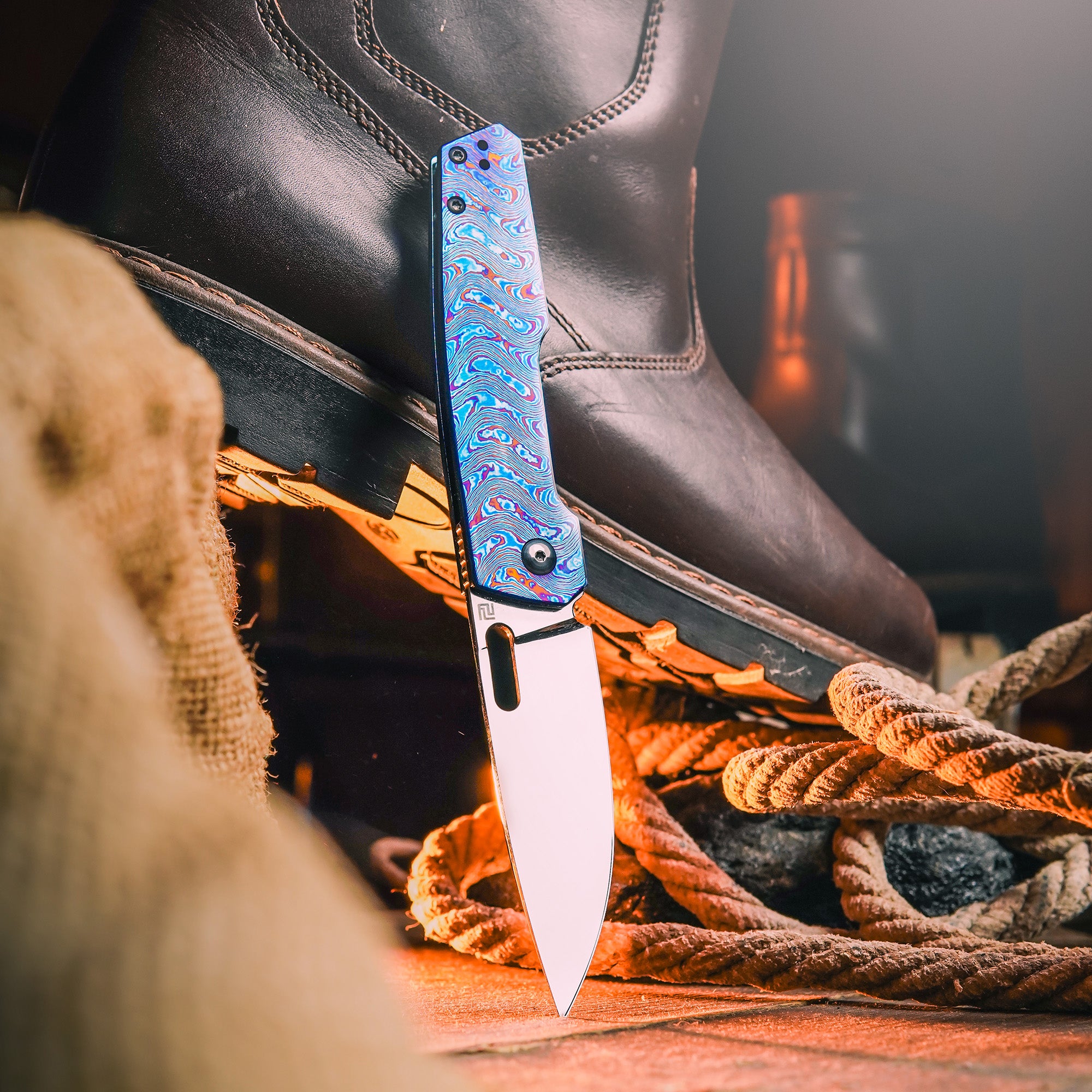
- Colour and texture as merchandising. G10 takes dye and texture patterns cheaply, which is how a single model becomes six SKUs on a pegboard. Titanium takes finishes — stonewash, bead blast, anodising, PVD — that read as premium under display lighting.
- Returns and warranty exposure. Delamination, fading, stripped clip screws and finish wear are handle problems, not blade problems, and they are the complaint category a retailer actually eats. Composite handles live or die on how the material is laminated and how the clip is anchored.
The materials buyers actually specify
G10 — the volume workhorse
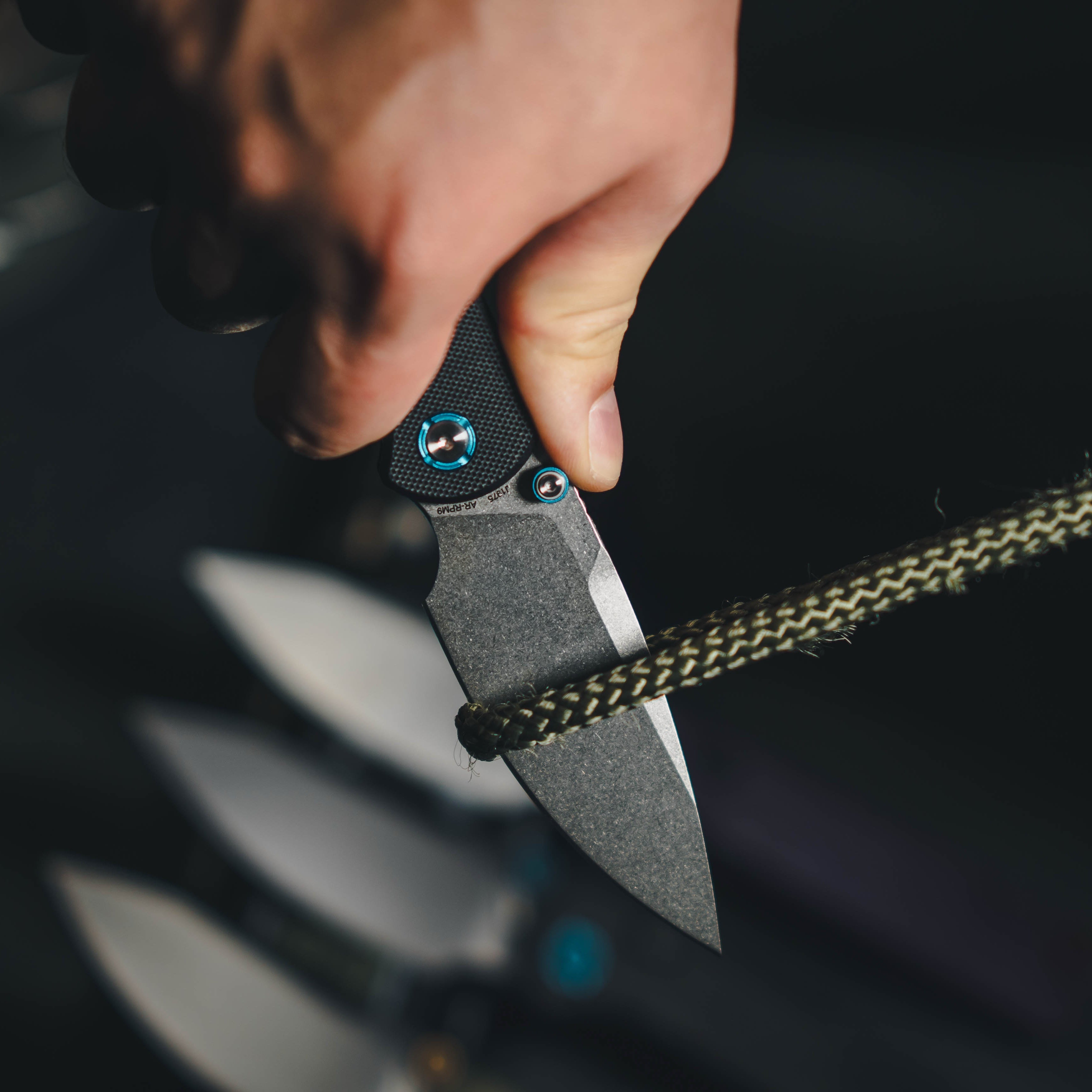
G10 is a glass-reinforced epoxy laminate, dimensionally stable, resistant to moisture and solvents, and available in an enormous range of colours and textures. In the catalogue it is the second-largest handle family (64 models, median $56.21, range $32.98–$192.00) and it is overwhelmingly paired with a liner lock — 49 of 64 G10 models. Steel content skews practical rather than exotic: 47 of those 64 run D2, 14C28N or 154CM-class steel.
That combination is why G10 owns the $35–59 rung. It is the only material that gives you texture, colour, and a credible look at a price a first-time buyer will pay. A $59.99 D2 folder with a textured G10 handle is the archetype: nothing about it reads as cheap, and the margin structure works at volume. Texture depth, colour stability under UV, and how the clip is screwed into the liner are the three things to inspect on a sample. See the material's G10 laminate background if you need the construction detail for a spec sheet.
Micarta — the mid-tier upgrade
Micarta is a layered composite of fabric, canvas or paper bonded in phenolic resin; the name began as a trade mark and is now used generically across the industry. It has a warm, matte, slightly fibrous surface that photographs well and ages visibly — which is either a feature or a complaint depending on your customer.
In the catalogue Micarta covers 31 models at a median of $128.55 (range $59.24–$214.28), and its lock pairing is markedly more upmarket than G10's: 10 frame locks, 8 button locks, 6 liner locks. Steel follows the same pattern — 18 of 31 run S35VN, MagnaCut or M390-class steel against only 5 in the mid stainless tier. In other words, Micarta is where a catalogue starts signalling "serious knife" without going to metal handles. A $59.99 D2/Micarta entry model sits at the bottom of that family and shows the material's value-tier ceiling clearly. Background: Micarta.
Titanium — the frame-lock default
Titanium handles in production folders are typically 6Al-4V, machined rather than moulded, and usually serve as the lock itself in a frame lock. That dual role explains the numbers: 163 of 345 models in this catalogue are titanium-handled (the largest family by far), median $199.99, range $55.49–$749.25, with 118 of the 163 built as frame locks and 22 as button locks. Steel is premium almost by definition — 143 of the 163 run S35VN, MagnaCut, M390, S90V or a comparable powder grade.
Commercially, titanium is the material that lets one silhouette carry a $149 price and a $249 price in the same case. A $149.99 S35VN frame lock in titanium is the natural step-up from a $59 G10 knife, and a $249.99 MagnaCut frame lock is the step above that. Watch two things when sampling: lock-bar geometry (a titanium frame lock that is not cut cleanly will feel sticky or develop play) and finish consistency between units, because anodised and PVD surfaces are the easiest place for a production run to look uneven.
Carbon fiber — the cosmetic upsell
Carbon fiber handles are usually a carbon weave laminated in epoxy, often over a G10 or liner substrate. They have the widest price spread of any family in this catalogue — 31 models, median $64.49, but a range of $32.98–$399.75 — because carbon fiber is used both as a genuine structural material and as a visual overlay on value-priced knives. Lock pairing here is the reverse of titanium: 28 of 31 are liner locks.
That makes carbon fiber your best value-tier upgrade. A $96.19 S35VN folder with a carbon fiber handle gives a customer the premium look at under $100. Ask whether the weave is structural or an inlay — the two read identically in photos and differently after a year of pocket carry.
Aluminum and FRN — the entry rungs
Aluminum (typically 6061 or 7075) is light, machines cleanly and takes colour well; in this catalogue it covers 10 models at a median of $79.49 with a tight $54.99–$89.99 spread, mostly liner locks. FRN — fiberglass-reinforced nylon — covers 6 models at a median of $79.99, and all six are button locks. Both materials are moulded or machined to a price and are the correct answer when the rung is under $100 and the goal is a knife that feels solid rather than premium. Aluminum with a button lock and 14C28N steel is a good example of the tier done properly — no material pretending to be something it is not.
Side-by-side: what each material does for the case
| Handle material | Models | Median shelf price | Price range | Most common lock | Best fit |
|---|---|---|---|---|---|
| G10 | 64 | $56.21 | $32.98–$192.00 | Liner (49) | Volume rung, colour depth, first-time buyers |
| Micarta | 31 | $128.55 | $59.24–$214.28 | Frame (10) | Mid-tier step-up with a warm, non-tactical look |
| Carbon fiber | 31 | $64.49 | $32.98–$399.75 | Liner (28) | Under-$100 premium look; gifting |
| Titanium | 163 | $199.99 | $55.49–$749.25 | Frame (118) | Enthusiast and collector core; the step-up tier |
| Aluminum | 10 | $79.49 | $54.99–$89.99 | Liner (7) | Lightweight sub-$100 models |
| FRN | 6 | $79.99 | $49.99–$99.99 | Button (6) | Value button-lock models |
Figures from Artisan Cutlery's published retail catalogue (345 active folding models, November 2026, excluding models under $15). Prices are public shelf prices, not wholesale terms.
Matching material to the customer in front of you
- Gun shop counter. G10 and aluminum, $35–99. Buyers here want a working knife that will not look worn out in a year, and they buy on feel and price together. Keep one or two titanium pieces as a trade-up.
- Outdoor and farm store. G10 first, Micarta second. Buyers value grip when wet and do not want a finish they have to think about. Titanium is a hard sell unless the store already has an enthusiast following.
- EDC boutique or knife-specialist case. Titanium and Micarta carry the wall. This is where customers compare lock feel and finish between models, so depth at $150–299 matters more than breadth at $50.
- Gift and general retail. Carbon fiber and coloured G10 with a $60–100 shelf price. The purchase is visual, the recipient is not comparing specs, and a distinctive handle does more work than a steel name.
What to ask before you commit to a handle family
- Is the material named to grade? "Titanium" and "carbon fiber" are used loosely in listings; ask for the alloy and for whether the carbon is structural or an inlay.
- How is the clip anchored? Threaded inserts versus screw-into-liner is the difference between a five-year handle and a two-year one.
- What is the surface treatment and how does it wear? Bead blast shows handling marks, PVD and anodising can chip at edges, stonewash hides the most. Ask what the finish looks like after a season of pocket carry, not on day one.
- Are colour and texture consistent across the run? Dye lots and laminate batches vary. Request units from the same lot if the model is going on a pegboard where mismatches are visible.
- What is the warranty position on delamination, fading and fastener pull-out? Get it in writing per material, because these are the claims your counter has to absorb.
- Does the handle family hold its dimensions across variants? A titanium version of a G10 model should not gain 4 mm of thickness; that is a different knife in the customer's hand.
Wholesale pricing, MOQ and lead time are quoted per program, so ask for them against the specific handle mix you intend to stock rather than as a single catalogue-wide number.
The short version
Buy the ladder, not the material. G10 fills the value rungs and gives you colour depth; carbon fiber is the cheapest credible upgrade; Micarta is the mid-tier signal; titanium is the frame-lock tier that carries your $150–250 volume and the collector's attention. Decide which rungs you are actually trying to win, then let handle material follow — and check the clip, the lamination and the finish before you check the price.
Stocking handle families across several price tiers? Artisan Cutlery builds folding knives in G10, Micarta, carbon fiber, aluminum, FRN and titanium, from D2 and 14C28N entry models through S35VN, MagnaCut, M390 and S90V frame locks. Wholesale pricing, MOQ and lead time are quoted per program, so your terms follow your assortment rather than a fixed list.
Model counts and price bands are drawn from Artisan Cutlery's own published retail catalogue (345 active folding models, November 2026) and quoted as public retail prices. They illustrate how handle material maps to retail tiers, not a price commitment. Wholesale terms are quoted per program.


Leave a comment
This site is protected by hCaptcha and the hCaptcha Privacy Policy and Terms of Service apply.