
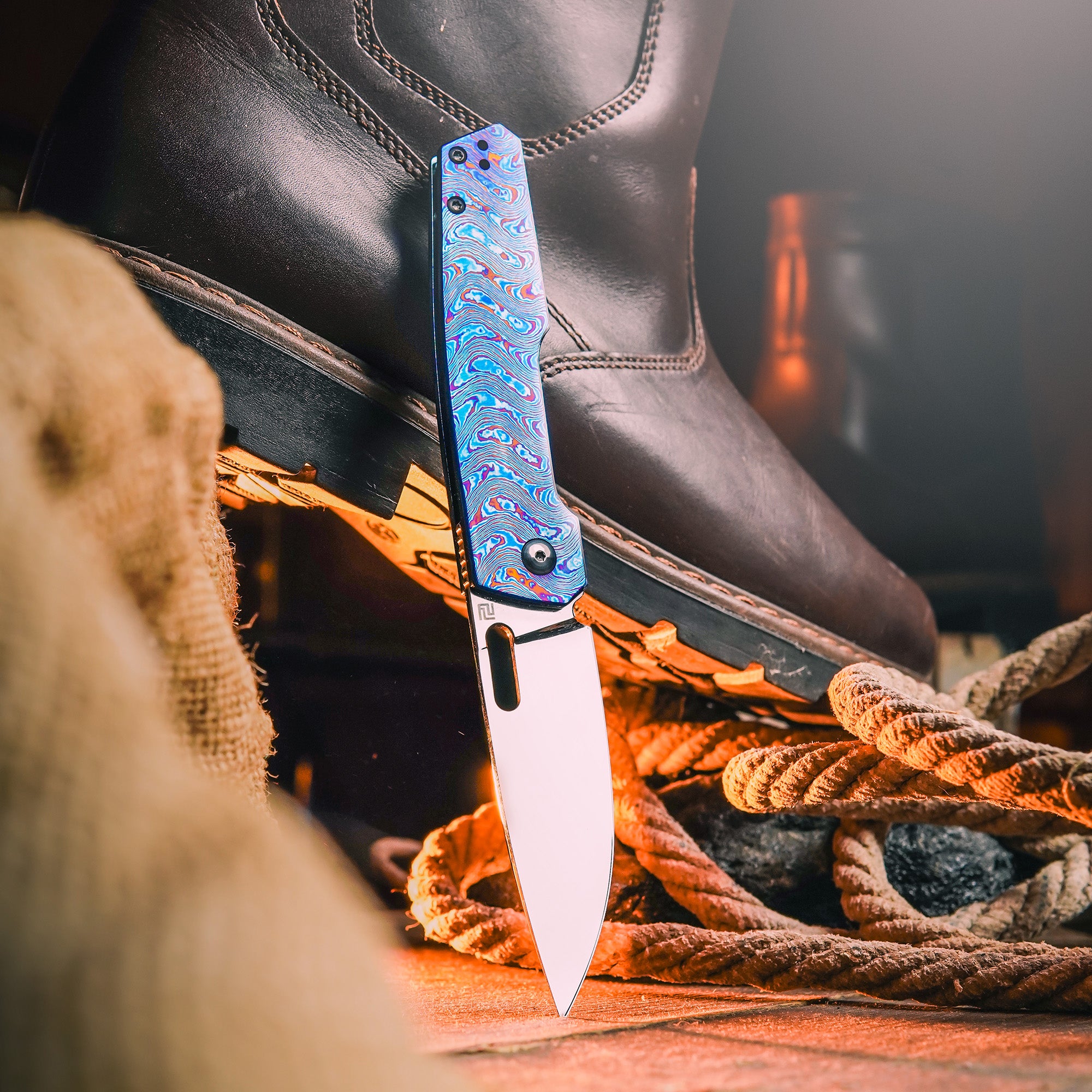
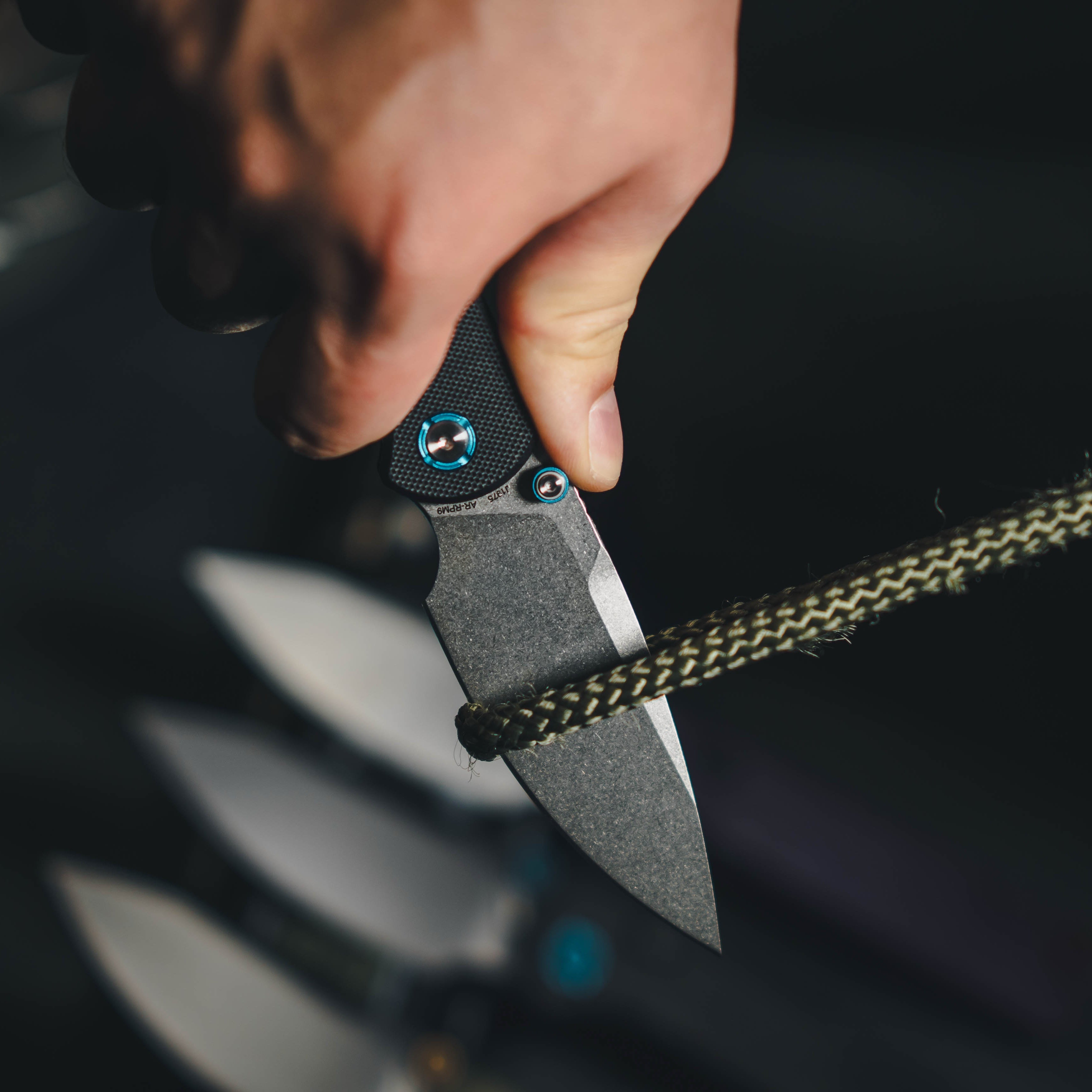
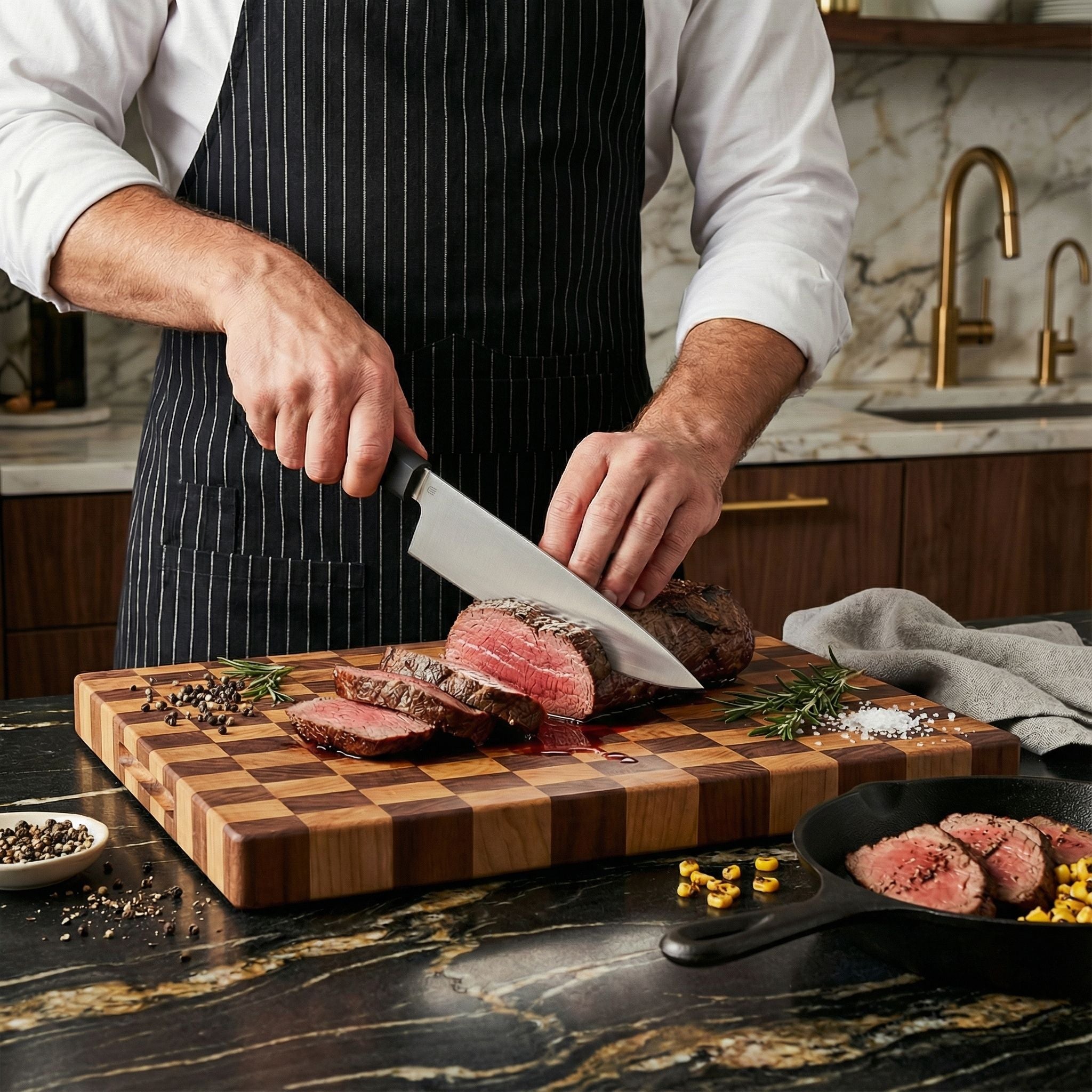
A neck knife is a small fixed blade — most run 2 to 4 inches of blade and a few ounces with the sheath — carried on a cord or chain around the neck instead of on a belt. It keeps the tool out of your pockets and off your waistband, which is exactly why anglers, hikers, and people who work at a bench like it. The carry is simple, but the details are not: sheath retention, cord length, and blade length decide whether the knife disappears under a shirt or swings into everything you lean over.
Cord, ring, and slate: the parts of a neck carry that decide how it feels after a week.
What makes a knife a neck knife
There is no formal definition, just a set of design habits. A neck knife is built to sit flat against the sternum, so the handle is usually skeletonized or wrapped instead of fitted with thick scales, the blade stock is thin, and the sheath is a close-fitting shell with no belt loop. Total weight is the number that matters most. A knife-and-sheath combo that runs much past 4 or 5 ounces starts to feel like a pendant you notice every time you lean forward.
Blade length follows the same logic. Two to three inches covers most cutting you do while standing — opening packages, trimming line, cutting cord, prepping food on a log. Longer blades add leverage you do not need and torque against the sheath when you sit down. If you want a compact fixed blade for heavier work, a belt sheath is a better answer than a bigger neck knife.
Carry methods and what each one asks of you
Cord versus chain
Paracord is adjustable, cheap, and quiet. Tie a loop, melt the ends, and you can set exactly where the sheath hangs. The catch is that a solid cord loop around your neck is a snag hazard, so build in a breakaway — a plastic side-release clasp, or a knot tied so it releases under load. Ball chains with a breakaway clasp solve the same problem by design, they do not absorb sweat, and they lie flatter under a collar. Chains do kink, though, and a kinked chain will not settle back into position after a draw.
Over the shirt or under it
Over the shirt is faster to reach and easier to keep clean. It is also visible, which matters anywhere a fixed blade draws attention. Under the shirt keeps the tool out of sight and out of the rain, but you pay with a slower draw and more sweat against the steel. Most people who carry every day end up under the shirt in town and over it outdoors.
Other mountings that use the same sheath
A neck sheath is usually just a shell, so the same knife can move to a belt clip, a pack strap, or a pocket. That flexibility is worth checking before you buy: look for rivet holes, a clip plate, or a sheath that accepts an aftermarket mount. A knife that only works on a cord is a knife you will stop carrying the first week it gets in the way.
The sheath decides whether the carry works
Retention is the whole game. The sheath has to hold an inverted knife through a run, a stumble, and a lean over a workbench, and still release cleanly with one hand. Three materials dominate, and each one trades something away.
| Sheath material | Retention | Wet conditions | Bulk and noise | Care |
|---|---|---|---|---|
| Kydex / Boltaron | Crisp snap, adjustable with screws | Unaffected by water | Thin but can clatter on hard surfaces | Rinse and dry; keep out of a hot car |
| Leather | Molds to the blade, softens over time | Absorbs water, holds moisture | Quiet, thicker than plastic | Dry slowly, condition occasionally |
| Nylon or fabric | Usually a flap or elastic insert | Absorbs water, dries fast | Lightest and quietest | Machine wear at the mouth, check stitching |
Whichever you choose, test it upside down and shaken before you trust it. A friction-fit sheath should give an audible click or a firm stop when the knife seats. If the knife comes out with two fingers and no effort, it will fall out eventually — usually somewhere inconvenient.
Blade and handle choices that matter
Steel
Neck carry puts steel against skin, and skin means sweat. Stainless is the practical default for that reason: it tolerates a humid day and a forgotten rinse far better than a high-carbon blade. Carbon steel still works if you dry and oil it, but it asks for more attention than most people give a knife they wear. The blade material collection groups the steels used across the lineup if you want to compare corrosion resistance and edge holding side by side.
Stock and grind
Thin stock is the point. A neck knife with roughly 2 to 3 mm stock and a full flat grind cuts far better than its weight suggests, because the geometry behind the edge does the work. Thick stock on a small blade turns the knife into a wedge and adds weight in the one place you do not want it.
Handle
A bare skeletonized handle is light and flat, and it is also cold, hard, and slippery once your hand is wet. Cord wrap fixes all three at the cost of a little weight and the need to rewrap every season or two. If the knife will do real work rather than serve as a backup, give the handle some texture: a few grooves, a wrapped section, or a shaped palm swell.
Drawing and re-sheathing without an accident
Practice with an empty sheath first, then with a dull trainer, and only then with the real knife. The draw is the easy half: grip the handle, pin the sheath with your off hand or your thumb, and pull straight along the sheath's axis instead of rocking the blade sideways. Re-sheathing is where people get careless. Look at the mouth of the sheath, set the tip against it, and slide in slowly until the knife seats. Never push a knife home by feel while you are walking or talking to someone.
Comfort details you only learn after a week
- Cord length. The sheath should sit near mid-sternum. Longer and it swings when you walk; shorter and the handle rides against your throat.
- Collar. A stiff collar hides the cord. A loose t-shirt shows the sheath's outline on the first step.
- Layers. Under-shirt carry in winter means moving two layers to reach the knife. Over-shirt carry in winter means the knife lives under your jacket.
- Sweat. A weekly rinse and dry is not optional. Salt sits in the sheath and along the flats.
- Straps. Seat belts and pack straps press exactly where a neck knife hangs. Most people lift the sheath aside rather than wear it under the strap.
Neck knife or small folding knife?
A lockback or frame-lock folder rides in a pocket, needs no cord, and is easier to put away when you are not using it. A fixed blade has no pivot to clean, no lock to work, and nothing to open under pressure. For cutting where your hands are wet or gloved, that difference matters more than the extra length. If you mostly cut at a desk or on a job site, the folding knives collection covers that ground; neck carry is for people who want the blade already open.
Sizing it to your body and your day
Start with the sheath, not the blade. A sheath with a wide mouth and a firm snap is easier to re-sheathe blindly than a narrow one, and easier re-sheathing means fewer nicked fingers. Then pick the blade length that matches the tasks you actually do, and only then look at steel. Someone who opens feed bags and trims paracord does not need a hard-use steel; someone who cuts rope in salt air does.
It is also worth measuring the sheath against your usual shirts. A sheath that sits at the top of the sternum hides better under a button-up; one that hangs lower works better under a hoodie. Small adjustments to cord length change the whole carry more than a different knife would.
Legal notes before you commit
Fixed blades are treated differently from folding knives in many places, and rules about concealed carry vary by city, state, and country. Some jurisdictions set a blade-length limit, some restrict concealed fixed blades outright, and airports and public buildings apply their own rules regardless of local law. Check the rules where you live and where you travel, and treat a neck knife as a tool you carry deliberately rather than something you forget about.
Who a neck knife suits, and who should skip it
It suits anyone who wants a fixed blade available while both hands are busy: fishing, hiking, garden work, a shop bench, or as a backup to a folder. It is a poor fit if you need a knife that takes real force, if you already wear an ID lanyard, or if anything around the neck bothers you — no amount of good design fixes that preference. Before choosing a shape, the knife types collection and the fixed blade knives collection show how much a blade profile changes what a knife is good at.
A short care routine
Rinse with fresh water after salt exposure, dry the blade and the inside of the sheath, and put a thin film of oil on any non-stainless steel. Check sheath screws and rivets monthly, because a loose screw quietly changes retention. Replace frayed cord before it fails, and store the knife outside the sheath when the sheath is leather and the storage is long. The routine takes a minute and it is the difference between a blade that looks new after a year and one that does not.
Pick the sheath first, then the blade length, then the steel, in that order. Most disappointing neck knives are not bad knives — they are good knives in a sheath that will not hold them, or on a cord that hangs them at the wrong height.


Leave a comment
This site is protected by hCaptcha and the hCaptcha Privacy Policy and Terms of Service apply.