




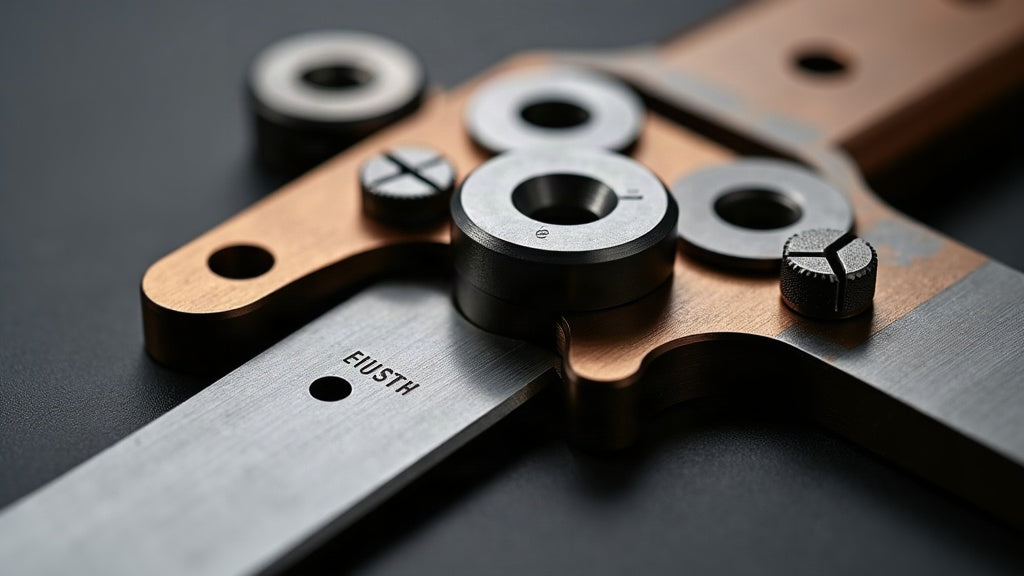
In short: the lock family you specify sets three cost lines at once — parts and assembly time, warranty exposure, and the retail tier the knife can occupy. Across the current Artisan Cutlery catalog the median published retail price of a liner-lock folder is $59.24 and of a frame-lock folder $199.99. The mechanism is doing a large share of that work, and it is the share buyers most often leave out of the cost comparison.
Where the cost of a lock actually sits
Buyers tend to compare mechanisms on a reliability chart and then discover the cost difference somewhere else on the line. In production, six lines move together:
- Parts count and material. A liner lock needs a separate hardened liner; a frame lock uses a cut in the handle itself, which usually pushes the handle to metal; a button lock adds a plunger, a spring and a pocket to machine.
- Machining tolerance. The slot that accepts the lock face is a fit, not a feature. Tighter tolerance means slower cycles and more tool wear.
- Assembly and tuning. Every mechanism has a tuning step at assembly. Mechanisms with more contact surfaces take longer to bring into spec, and that labor is invisible in a blank-cost comparison.
- Quality inspection. Lock-up testing is per unit, not per batch, on any program that cares about returns.
- Warranty and return exposure. A mechanism that a customer cannot operate properly comes back as a complaint even when it is built correctly.
- Serviceability. Springs, detents and safety switches are wear items. A design with an accessible wear part turns a return into a repair.
The families as they appear in a real catalog
The figures below come from the current Artisan Cutlery catalog: 321 of the 439 folding models publish a lock type. Bands are published retail prices, using the lowest variant price per model. They are shown as a market structure, not as dealer terms.
Liner lock — 94 models, $32.98 to $459.99, median $59.24
The cheapest mechanism to produce and the most familiar to shoppers, which is why it owns the entry tier. The trade-off is the close: some customers need two hands, and gloves make it worse. The Wren ATZ-1825P at $59.24 is a textbook occupant of this position — D2, 3.54 in blade, liner lock, G10.
Frame lock — 137 models, $42.99 to $749.25, median $199.99
The largest family by model count and the one that pulls the price ladder up, because the lock face is part of the handle: the material has to be thick enough and stable enough to act as a spring, which usually means titanium or steel rather than a polymer. The Hoverwing ATZ-1801P shows the floor of the family at $42.99 in D2 with a steel handle; the Fragarach 1879G shows the top of the working range at $199.99 in S90V with titanium and Fat Carbon, which is what a buyer is actually paying for in that tier.
Button lock — 53 models, $34.99 to $452.00, median $139.28, plus 5 models with a safety switch at $99.99 to $199.99
The strongest in-store conversion of the three main families, because the close is a single thumb press and reads as premium even at a mid price. It is also the family most likely to attract a classification question, so confirm how the mechanism is classified in your market before you commit to a deep buy. The Large Pyrite-Light J1945LG at $99.99 pairs CPM S90V with a safety switch, which is the version of this family to specify for a market that wants a secondary safety.
Crossbar lock — 4 models, $59.99 to $199.99
Ambidextrous by design, operated from both sides, and the easiest story to tell a hard-use customer. The catalog carries it in a narrow range, mostly on shorter blades: the Maximal J1954 is 2.95 in (75 mm) in AR-SFII on G10 at $59.99, which is the configuration a restricted market wants.
Recoil Lock V2 — 11 models, $69.99 to $299.99, median $79.99
Artisan’s own mechanism; the Blowback ATZ-1822GD was the first Artisan design to use the Recoil-Lock. It behaves commercially like the crossbar family — ambidextrous, mid-priced, sold on hard use rather than on trim — and the Doubletap J1970-BBK at $69.99 in D2 on G10 is the volume position inside it.
Top liner lock — 16 models, $59.99 to $266.66, median $149.99
A liner lock moved to the top of the handle, which solves the “my thumb cannot reach the liner” complaint without adding parts. It is the family that best rewards a handle-material story: the Bowie Pyrite J1942X-NM carries 14C28N on natural Micarta at $59.99 and 103 g.
Cost versus reliability, side by side
| Family | Models in catalog | Published retail band | Median retail | Wear and service | Warranty exposure | Best fit in a program |
|---|---|---|---|---|---|---|
| Liner lock | 94 | $32.98 – $459.99 | $59.24 | Liner face and detent | Low mechanical, higher operator error | Entry tier, volume |
| Frame lock | 137 | $42.99 – $749.25 | $199.99 | Lock face geometry, no separate liner | Low, sensitive to material grade | Premium tier, gift and collector |
| Button lock | 53 (+5 with safety) | $34.99 – $452.00 | $139.28 | Plunger, spring, safety switch | Medium; classification question | Mid to premium, retail conversion |
| Crossbar lock | 4 | $59.99 – $199.99 | — | Crossbar and springs | Low; ambidextrous demand | Hard-use, short-blade SKUs |
| Recoil Lock V2 | 11 | $69.99 – $299.99 | $79.99 | Sliders and springs | Low; new-mechanism training needed | Mid tier, tactical resale |
| Top liner lock | 16 | $59.99 – $266.66 | $149.99 | Liner face, reach geometry | Low; easier for the customer to operate | Mid tier, handle-material upsell |
Why the median price is the honest read on mechanism cost
It would be tidy to say the lock alone sets the price. It does not — steel, handle material and brand tier all move with it. What the median does show is the correlation a buyer has to plan around: a mechanism that requires a metal handle, tighter machining and a per-unit lock-up test lands in a different price tier than one that does not. Reading the median is a fast sanity check on a quotation: if a program assumes frame-lock pricing on a liner-lock build, or the reverse, one of the two numbers is wrong.
The corollary is the mistake worth avoiding: putting the cheapest mechanism on the premium SKU to protect margin. The customer who pays a premium price for a knife can operate it, and a mechanism that feels like a compromise is the fastest route to a return in a tier where returns are expensive.
The inspection sheet is where reliability is actually decided
Two suppliers can quote the same family and ship very different knives, because the properties customers notice are set by tolerance and testing rather than by the mechanism name. Specify the test, not just the target:
- Lock-up contact — how much of the lock face engages, and how it is checked on the line
- Blade play — vertical and horizontal, measured rather than felt
- Detent or slider force — specified as a range, because too light opens in a pocket and too heavy reads as defective
- Open and close cycles — the sample size per lot and the count per sample
- Spine pressure — the load applied to confirm the lock holds, with the failure criterion written down
- Safety and secondary devices — function tested on every unit, not sampled
Two suppliers quoting the same lock family are not comparable
Before treating two quotations as comparable, compare what sits around the mechanism:
- Pivot assembly. A ceramic ball bearing pivot and a washer pivot are different products at the same nominal spec; the catalog spec blocks name which one a model uses.
- Lock face hardness. Whether the contact surface is hardened, and to what range, decides how the lock wears across a season rather than a week.
- Spring material and life. The cheapest failure mode in any button or crossbar mechanism is a spring, and it fails after the warranty conversation has already started.
- Tolerance and sampling. A stated tolerance without a sampling plan is a wish; ask how many units per lot are measured.
- Hardware availability. Clips, pivots and screws that can be ordered turn a return into a repair.
Ambidextrous demand and the real cost of a mirrored variant
Crossbar-style mechanisms are operated from both sides and are ambidextrous by design, which is why they carry a premium in segments where a left-handed customer is a meaningful share of demand. Liner and frame locks are handed. Making one work for the other hand is not a finish option; it is a different part set, and that is why it belongs in the cost model rather than in the marketing plan.
Classification risk sits on the mechanism too
Opening method drives legal classification in most markets, and mechanism families blur the boundary in ways that vary by jurisdiction — in the United States, the Federal Switchblade Act governs interstate commerce in automatic knives while state law governs possession and sale, and the two are routinely confused. Before a deep buy of any mechanism that can be read as assisted or automatic, confirm the classification for each market you ship into and keep the confirmation with the purchase order. Product liability exposure on a misclassified knife is a larger number than any per-unit saving on the lock.
What to write on the purchase order
- Lock family and the exact mechanism designation the supplier uses internally
- Lock face material and hardness range, with the verification method
- Pivot assembly: bearing type, or washer material and thickness
- Lock-up contact, blade play and detent force, each with a numeric acceptance range
- Cycle count and sample size per lot
- Spring material and the specified replacement interval
- Spare parts list, with ordering path and packaging quantities
- A production sample approved before the mass run, from the same tooling
The commercial terms sit on top of that specification, and they are program-specific: wholesale pricing, MOQ and lead time are quoted per program, because they depend on the model, the finish and the volume rather than on a published rate card.
If you are opening a knife category or resetting one, price it against the program rather than against a catalogue page.
Apply to Become an Artisan Dealer
Artisan Cutlery supplies folding knives to dealers at wholesale pricing. MOQ, lead time and terms are quoted per program.

Leave a comment
This site is protected by hCaptcha and the hCaptcha Privacy Policy and Terms of Service apply.