




In short: a folding knife category in a physical store is won or lost on three operational things — you can lawfully sell and hand the knife to a customer in your jurisdiction, the display lets someone open a knife without waiting for a staff member, and your staff can demonstrate the lock one-handed without fumbling. Styling sells the second knife. Those three decide whether there is a second sale at all.
Why knives are a compliance business before they are a merchandising business
Most retailers who add a knife category treat it like adding hiking socks: pick a supplier, pick a price band, put it near the register. Knives do not behave that way, because the product is regulated at the point of sale and again at the point of carriage.
Four separate rule sets apply, and they do not move together:
- Age and identification. Many jurisdictions require a minimum age to buy a knife at retail. Your POS needs to prompt for it, and the prompt needs to be real rather than a checkbox staff click through.
- Carry and possession rules. Blade length, locking mechanism and opening method all appear in local statutes, and the thresholds differ between states, counties and countries. A knife that is unremarkable in one market is a restricted item two hundred miles away.
- Automatic knife rules. In the United States, the Federal Switchblade Act governs interstate commerce in automatic knives, while ownership, carry and sale inside a state are governed separately by that state. The two layers are frequently confused at the counter.
- Carriage and liability. Selling online adds carrier restrictions on top of the above, and a knife counter is a category your insurer will want described accurately rather than approximately.
None of this requires a lawyer on staff. It requires that you know which rules apply to your own selling footprint and can answer a customer’s question with a document rather than a guess. Where a rule is unclear in your market, confirm it with local counsel or your trade association before the SKU goes on the shelf — not after a customer asks.
The spec questions you must be able to answer at the counter
Almost every counter conversation reduces to the same short list. If a staff member cannot answer these from a printed sheet or the product page, the sale usually ends as a “let me think about it”:
- Blade length, in inches and millimetres, plus overall and closed length
- Blade steel and the published hardness range
- Lock type, named correctly
- Opening method — manual, assisted, or automatic — because this is the line the law draws
- Handle material and weight
- Country of origin and any packaging or warning text the supplier requires
Your first diligence step is the spec block, not the sample
A sample tells you how one knife feels in one pair of hands. A spec block tells you whether the knife is sellable in your market, how it should be displayed, and what to say when a customer asks a question you did not expect. Pull both before you commit to a quantity.
Worked examples from the current range: the Wren ATZ-1825P publishes a 3.54 in (90 mm) D2 drop point on G10 with a liner lock, which is enough information to answer a length question, a steel question and a mechanism question in one go. The CJRB Bowie Pyrite J1942X-NM publishes 3.35 in (85 mm) 14C28N, a top liner lock, Micarta scales and 103 g — the weight figure is what turns a “how does it carry” question into a number.
The discipline that matters is consistency: the same seven data points, in the same order, for every SKU on the shelf. That single sheet answers the customer, the carrier and the insurer without anyone improvising.
Display: build a price ladder, not a showcase
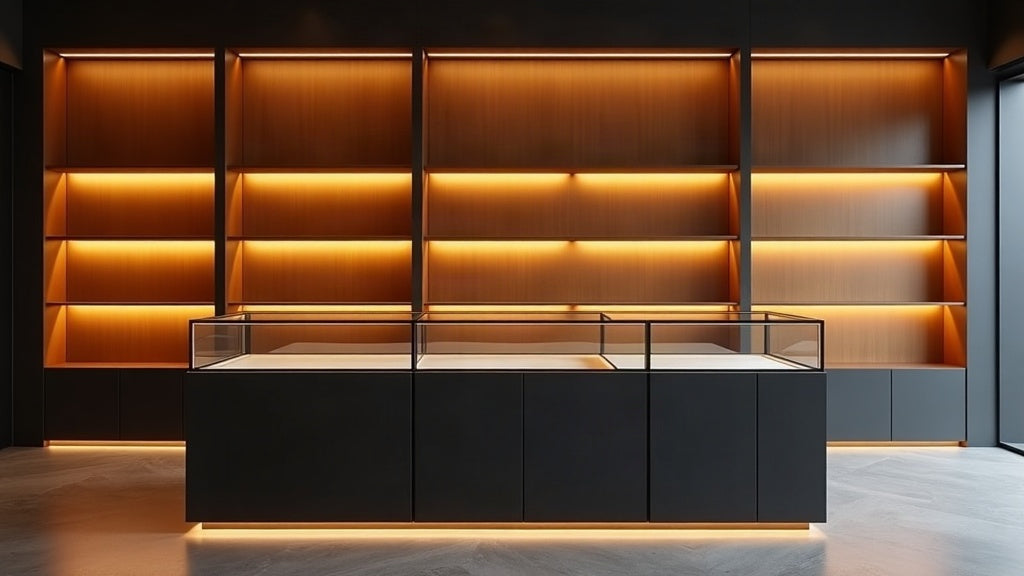
The most common display mistake is curating a case that looks good in a photograph. A case that sells has a visible ladder — an entry knife, a step-up knife and a case knife — where each step up buys the customer something they can name: a steel, a mechanism, a handle material, or a shorter blade that fits their local rule.
Three practical rules that hold across store formats:
- One open demo per mechanism family, not per model. A customer needs to feel the difference between a liner lock and a crossbar, not between two colors of the same knife.
- Put the boxes behind the counter. An open knife on a riser is inventory you cannot sell at full price, and shrink in this category is usually the demo unit that walked.
- Keep the price bands visually separate. If two tiers sit side by side with no gap, the customer reads the whole shelf as one price and buys the cheapest thing on it.
A case layout that covers five mechanisms without doubling your SKU count
The table below is a working example of a six-position folder case built from the current catalog. Retail prices are the published prices on artisancutlery.net at the time of writing and are shown as a market ladder, not as dealer terms.
| Model | Steel | Lock | Blade | Retail | Role in the case | Demo skill staff need |
|---|---|---|---|---|---|---|
| Wren ATZ-1825P | D2 | Liner lock | 3.54 in (90 mm) | $59.24 | Entry tier, first-knife buyer | The two-handed close, explained honestly |
| CJRB Maximal J1954 | AR-SFII | Crossbar lock | 2.95 in (75 mm) | $59.99 | Short-blade SKU for restricted markets | Two-sided pull, both hands |
| CJRB Bowie Pyrite J1942X-NM | 14C28N | Top liner lock | 3.35 in (85 mm) | $59.99 | Handle-feel upsell, Micarta story | Thumb-stud open, top-liner close |
| CJRB Doubletap J1970-BBK | D2, black PVD | Recoil Lock V2 | 3.86 in (98 mm) | $69.99 | Hard-use and duty buyer | Ambidextrous operation on the spot |
| CJRB Large Pyrite-Light J1945LG | CPM S90V | Button lock, safety switch | 3.7 in (94 mm) | $99.99 | Premium-steel step-up, safety demo | Engage and release the safety switch |
| Artisan Fragarach 1879G | S90V, titanium | Frame lock | 3.72 in (94.5 mm) | $199.99 | Case stock, collector and gift | Frame-lock release without looking |
Six positions, five mechanisms, three price tiers, and a short blade for customers in a restricted market. That is the shape worth copying: breadth comes from mechanism and length, not from twelve handle colors of one model.
Staff training: the demo is the sale, and the return is usually the demo too
Most knife returns in a physical store are not defects. They are customers who could not work the knife the way it was demonstrated to them. That makes the demonstration part of your cost of goods, because a return costs inspection time and freight in both directions whether or not the knife is faulty.
A three-move script is enough, and every staff member should run it identically:
- Open — name the opening method aloud (thumb stud, flipper, thumb hole) and open the knife yourself before handing it over.
- Lock check — press the spine of the blade against a padded block, never against a finger, and show the customer the play you are checking for.
- Close — close it in front of them, slowly, and then let them do it twice. The second attempt is where confidence is built.
Two rules keep this safe and consistent. Hand a knife over closed, edge away, handle first, and never hand over an open knife. And put one mechanism family per price tier so staff learn three mechanisms instead of nine — the counter conversation gets shorter and the demo gets better.
The compliance conversation, scripted rather than improvised
Improvised answers to legal questions are how stores end up in an argument they cannot win. Three things make the conversation repeatable:
- A one-page local summary behind the counter: age limit, blade-length thresholds that apply in your area, and which categories you do not stock at all. Keep the date it was last checked on the page.
- A refusal line staff can say without apologising twice: “I can’t sell this configuration here, but this one meets the same need.” Then have a compliant alternative within reach.
- The same rules online. If you also sell online, the age gate, the product restriction and the carrier limitation all need to be configured, not remembered. A knife that cannot legally be shipped to a state should be blocked at checkout, not caught by a human.
Which numbers tell you what to reorder
Sell-through per SKU, not per category, is the number that matters — a category can look healthy while three of its six SKUs are dead. Track it beside weeks of cover, so a slow seller is distinguishable from an over-bought seller.
Returns per lock family is the second number, and it is diagnostic rather than commercial: a return spike in one mechanism usually means a demo problem or a training gap, not a manufacturing one. The third is the demo-unit count — every open knife in a case is working capital that will never be sold at full price, and inventory turnover measured on the whole category will tell you within a quarter whether the case is earning its space.
POS-level data beats a supplier’s bestseller list for restocking, because the list was built for a different customer base. Use it for what to try, not for what to reorder.
The opening checklist
- Local rules confirmed and written down, with the check date
- Age prompt live at the POS, tested with a staff purchase
- Seven-point spec sheet printed for every SKU on the shelf
- One locked case or counter position with a demo knife per mechanism
- Boxes and spare stock stored behind the counter, not under it
- Three-move demo script trained on every staff member who sells knives
- A compliant alternative for every restricted item you stock
- Returns logged by SKU and by lock family, reviewed monthly
What to ask a supplier before the first order
The questions below separate a supplier you can build a category with from one you can only buy a box from:
- Is there a per-SKU spec sheet with blade length, thickness, hardness range, lock type and weight, in both units?
- Are spare parts available — clips, pivots, springs, hardware kits — and how are they ordered?
- Can you buy a sample set before committing to a quantity, so staff can train on the actual mechanisms?
- How is hardness verified per lot, and what is the acceptance range?
- Does the same family exist in a shorter blade length for restricted markets?
- What packaging, marking and warning text ships with the product?
- Are published retail prices fixed, or is there a resale price policy in writing?
Commercial terms sit on top of that list and are program-specific: wholesale pricing, MOQ and lead time are quoted per program, because they depend on the model, the finish and the volume rather than on a published rate card.
If you are opening a knife category or resetting one, price it against the program rather than against a catalogue page.
Apply to Become an Artisan Dealer
Artisan Cutlery supplies folding knives to dealers at wholesale pricing. MOQ, lead time and terms are quoted per program.



Leave a comment
This site is protected by hCaptcha and the hCaptcha Privacy Policy and Terms of Service apply.