
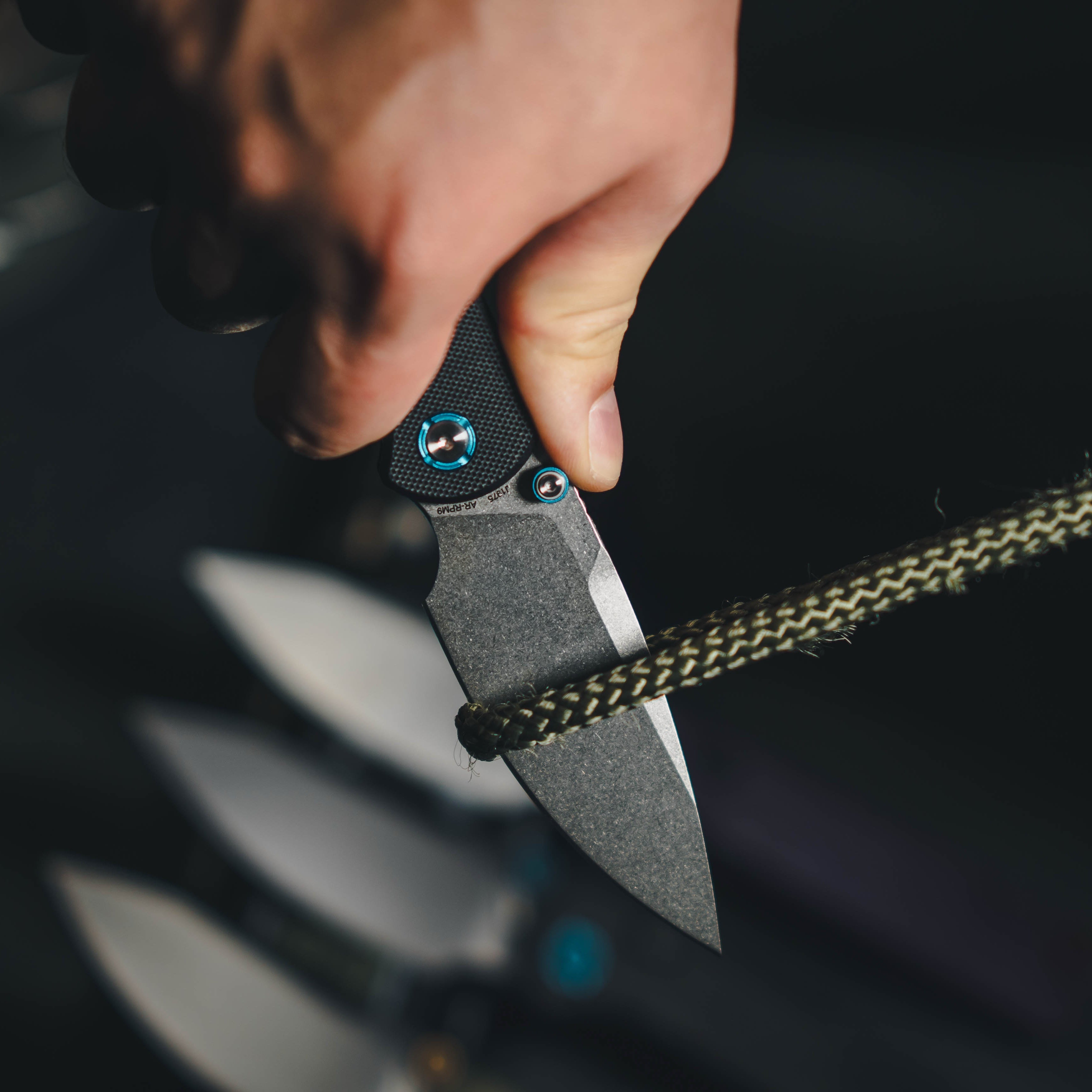
Most knife work goes wrong in the hand, not the blade. The grip that gives you the most control is the pinch grip: thumb and index finger on the blade flats just ahead of the handle, the remaining three fingers wrapped around the handle. It shortens your lever arm, puts the edge directly under your knuckles, and lets you feel the cut instead of guessing at it. For heavy chopping, switch to a full handle grip, sometimes called a hammer grip, where all four fingers wrap the handle and the thumb rests on the side.
Control starts in the hand: grip position sets the angle of every cut.
That is the short version. The longer version depends on the knife, the material, and how precise the cut has to be, so here is how each grip works, when to use it, and the mistakes that quietly cost people control.
Why grip decides control
A knife is a lever. Your wrist is the pivot point, and everything between your hand and the edge is working against you. The further your hand sits from the edge, the more your wrist has to correct for small errors, and the more the blade wanders. Move your hand forward onto the blade and you cut the lever short. You also gain something less obvious: feedback. With a finger on the steel you can feel the blade bind in a cut a fraction of a second before it slips, which is exactly when you want to slow down.
Grip also sets your cutting angle. A knife held with a loose, high wrist tends to skate across a surface. A knife held with the blade aligned to your forearm cuts in a straight, predictable line. Most of the advice below is really about getting the blade, wrist, and forearm into one plane.
The three grips worth learning
1. Pinch grip
Grip the blade itself, with the thumb and index finger pinching the flats just in front of the handle, and the middle finger tucked just behind them on the handle side. Your remaining fingers close around the handle. This is the grip most cooks use on longer, heavier kitchen knives because it gives the most precise control over the tip and the most direct feel for the cut.
Use it for: slicing, precision work, anything where the tip has to go exactly where you are looking. On folding knives, pinch the handle right at the pivot instead of the blade if your knife has a finger choil, which gets you similar control without putting skin near the edge.
2. Hammer grip (full handle grip)
All four fingers wrap the handle, thumb resting along the side or on top of the spine. This is the natural grip for people without culinary training, and there is nothing wrong with it. It is stronger and more stable for chopping, batoning-free woodwork, and any task where you are driving the blade rather than guiding it.
Use it for: chopping, heavier cutting, working with gloves, and any cut where you need maximum retention on the handle. The trade-off is precision: the tip is further from your hand, so fine work gets wobblier.
3. Thumb-on-spine grip
For controlled, shallow cuts, rest your thumb flat on the spine near the tip and wrap the handle normally. Your thumb becomes a brace that limits how deep the blade can travel and keeps the tip from diving. This is common in woodcarving, in opening packaging, and in any cut where you want the blade to stop at a specific depth.
Use it for: shallow cuts, carving, scoring, and detail work on flat material. Keep your thumb behind the cutting direction, never in front of it.
| Grip | Best for | Control | Power | Watch out for |
|---|---|---|---|---|
| Pinch grip | Slicing, precision, kitchen work | Highest | Moderate | Fingers close to the edge on bare blades |
| Hammer grip | Chopping, heavy cutting, gloves | Moderate | Highest | Wrist wandering on fine cuts |
| Thumb on spine | Shallow cuts, carving, scoring | High | Low | Thumb drifting into the cut path |
| Reverse grip | Pull cuts, close-in work | Moderate | Moderate | Harder to control the tip; use sparingly |
Matching the grip to the knife
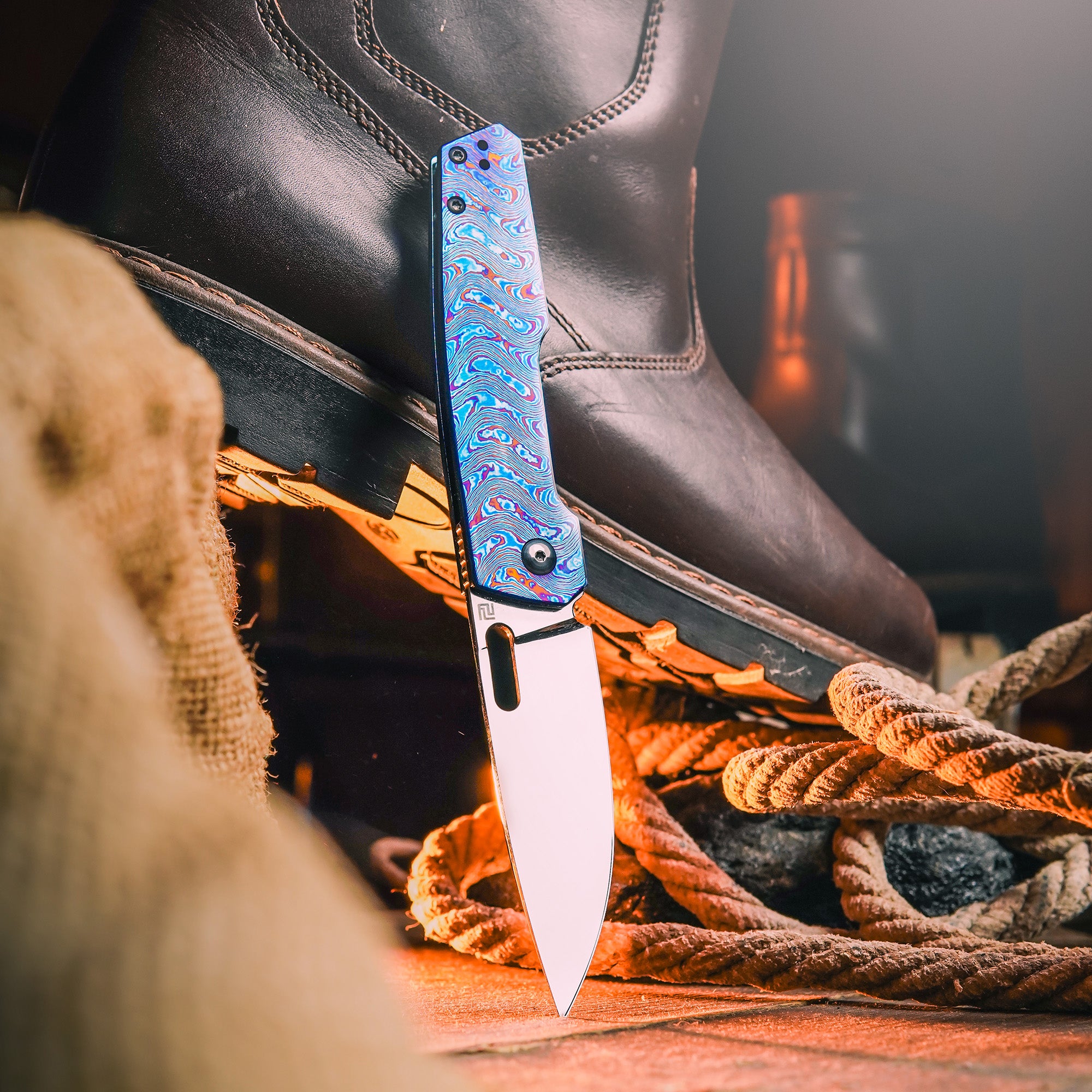
A folding knife gives you less real estate to work with. The handle is short, the pivot is close to your hand, and the blade is often under four inches, so the pinch grip usually means choking up to the finger choil rather than gripping steel. Keep your index finger on the choil and your thumb on the spine for detail work, and slide back to a full grip for anything that needs force.
A fixed blade has a longer handle and no pivot to worry about, so the full grip works for most tasks and the pinch grip is mostly a detail option. On a large fixed blade, keep your thumb and forefinger behind the guard and your hand well back from the blade; the extra length is where leverage turns into a loss of control.
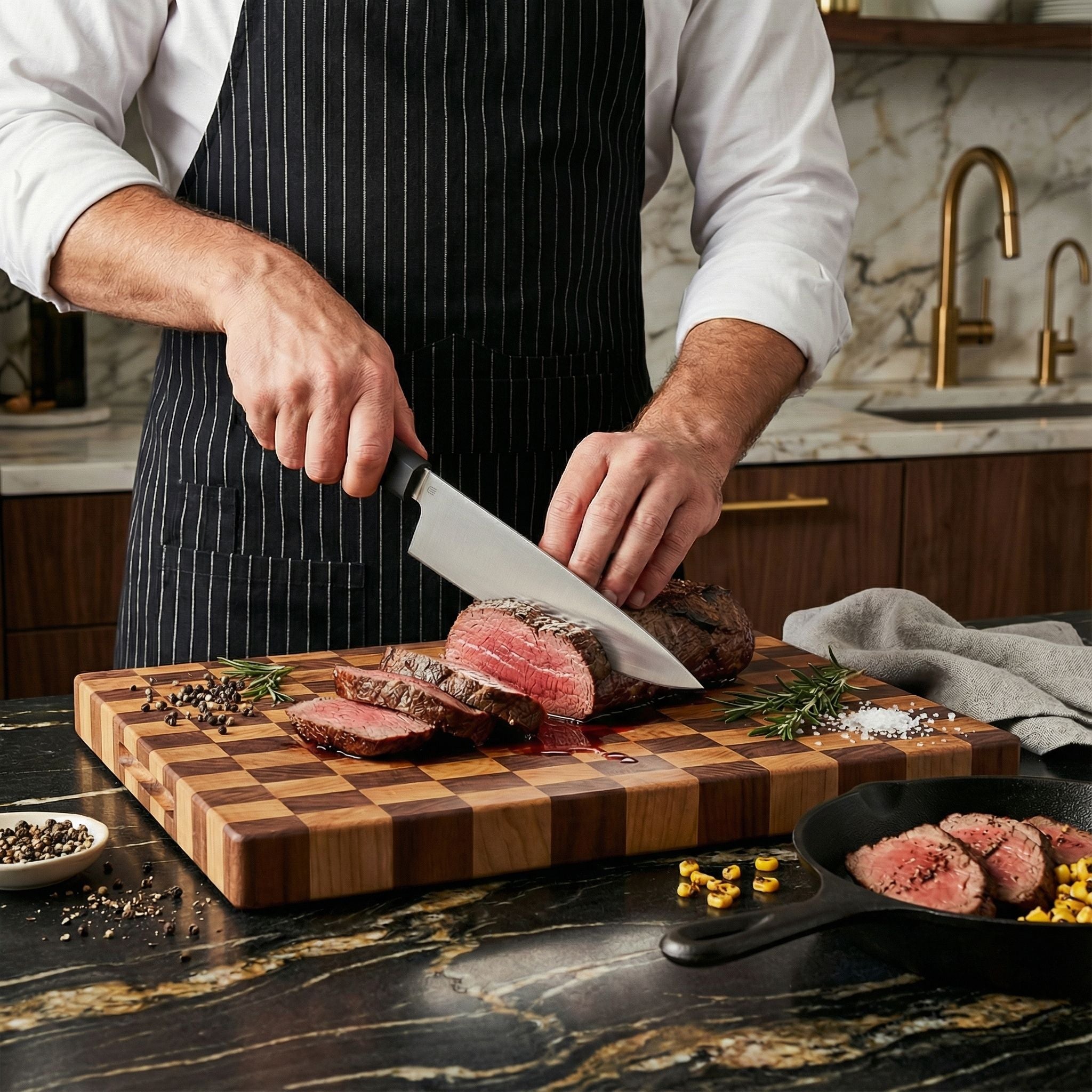
A kitchen knife rewards the pinch grip more than any other tool. Choking up on the blade puts your hand over the heel, which is where most of the cutting actually happens, and it turns the knife into an extension of your arm rather than a tool you are swinging. If you only change one habit after reading this, change that one.
For a small pocket knife doing utility work, the grip matters less than the cut direction. Small blades are usually used on packaging, cord, and tape, where the risk is not power but the blade closing on your fingers. Keep your off hand out of the path and cut away from your body.
The details that separate a good grip from a bad one
Keep the blade in line with your forearm
If you look down at your hand and the edge is angled away from your forearm, your wrist will fight the cut. Line the edge up with the direction your forearm points, then let your shoulder and elbow do the work. This single adjustment fixes most cases of a knife that will not cut straight.
Grip firmly, not tightly
A white-knuckle grip tires your forearm in a minute and makes your hand shake. You want enough pressure that the knife cannot rotate in your palm, and no more. If the handle is slippery, fix the handle, not your grip: textured G10 or a lanyard does more for control than squeezing harder.
Thumb placement is a steering decision
Thumb on the spine gives you downward control and a natural depth stop. Thumb on the side of the handle gives you lateral control and a more relaxed wrist. Thumb wrapped under the handle gives you the least control of the three and should be a habit you break early.
Wrist straight, elbow soft
A bent wrist loses power and accuracy at the same time. Keep the wrist neutral, keep the elbow slightly bent, and let the motion come from the shoulder for long cuts. This matters more as the knife gets heavier, which is why a heavy chopper feels awful after five minutes if you are cutting from the wrist.
Grip mistakes that show up again and again
- Choking up too far on a bare blade. Without a choil or a guard, your index finger has nothing to stop it from sliding forward. Grip the handle or the choil, not the flat.
- Cutting toward your own hand. The most common kitchen injury is a dull knife plus a grip that puts fingers in the path. Curl your fingertips under and use your knuckles as a guide.
- Holding the knife at an angle to the board. A tilted blade wanders, and a wandering blade is the one that slips.
- Death grip on a small folder. Small knives need light hands and short, controlled strokes, not force.
- Ignoring the lock. On a folder, confirm the blade is fully open and locked before you load the edge. A half-open blade under pressure is how folders close on fingers.
How to practice a new grip
Pick one grip and use it for a week on low-stakes material: paper, cardboard, vegetables, cord. Do not switch every cut. The point is to build the habit of aligning the blade with your forearm and keeping your off hand out of the path. Once the pinch grip feels normal on a kitchen knife, fine work gets noticeably easier, and you will find yourself reaching for it on folders too.
If you want to build a knife that suits a pinch grip, look for a handle with a forward finger choil, a modest guard, and enough texture that your hand does not slide. Our knife type guides break down which shapes suit which grips, and the best sellers page is a good place to see the handles most people end up with.
Frequently asked questions
Is the pinch grip better than a normal grip?
It is better for control and precision, not for power. Use it when the cut has to be accurate. Use a full handle grip when the cut has to be strong.
Where should my thumb go on a folding knife?
On the spine, near the base of the blade, for downward control. If the knife has a thumb ramp or jimping there, that is exactly what it is for. See the anatomy overview on Wikipedia for the parts of the blade the terms refer to.
Should I hold a knife differently with gloves?
Yes. Gloves reduce feel, so move back to a full grip, slow down, and keep your off hand further from the cut. Do not rely on a pinch grip through thick gloves; you cannot feel the blade bind.

Leave a comment
This site is protected by hCaptcha and the hCaptcha Privacy Policy and Terms of Service apply.