
Titanium Damascus Knife Guide: Patterns, Grades, and Care
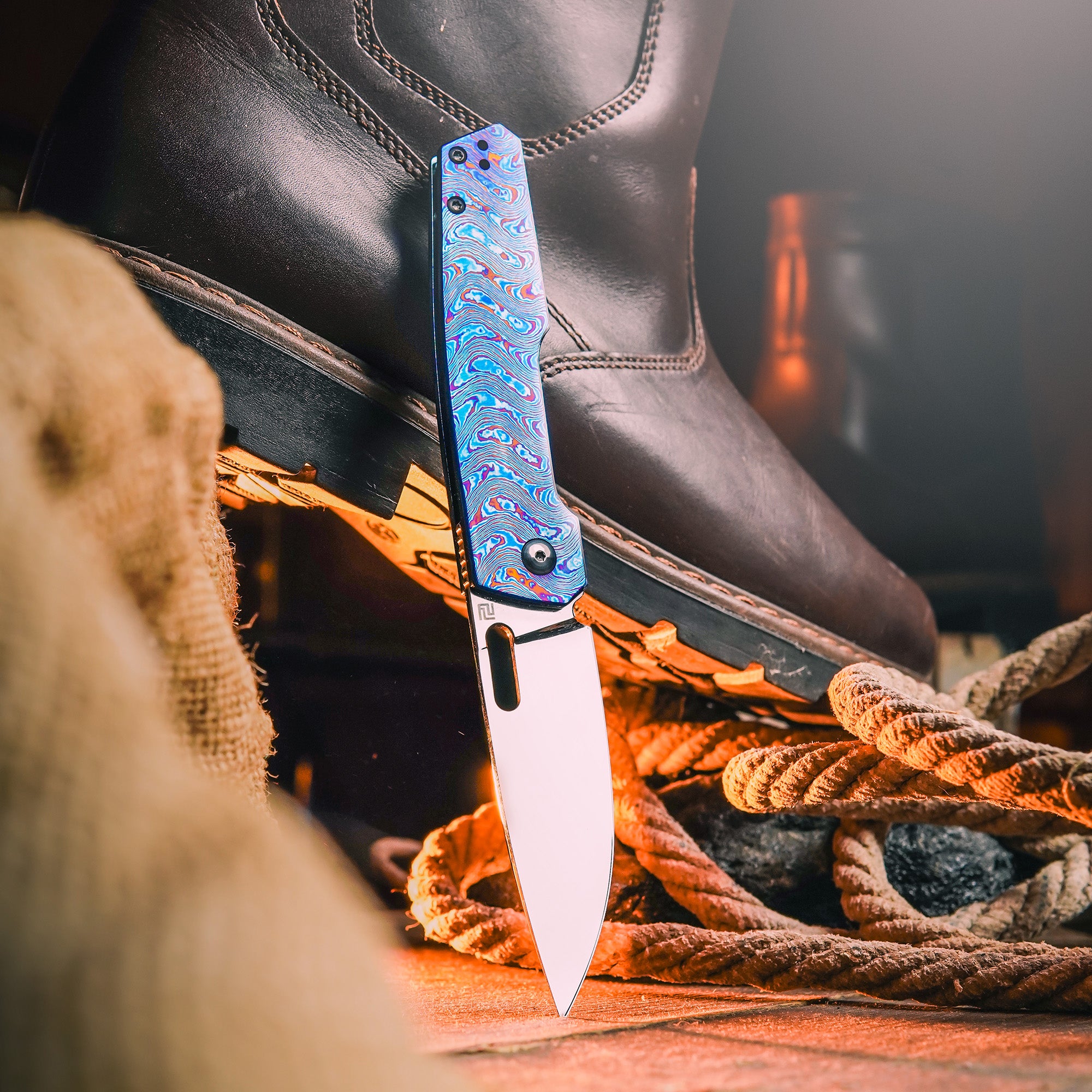
Most titanium damascus knives are not damascus blades. The layered, iridescent metal that pulls people toward a premium folder is usually the handle, the pocket clip, the pivot collars or the backspacer, while the cutting edge itself is steel. Titanium damascus is made by diffusion-bonding thin sheets of two or more titanium alloys under heat and pressure, then folding, twisting and grinding the block so those layers read as a pattern, and finally anodizing the surface so each alloy takes color differently. That is the entire trick — and once you understand it, the pricing, the patterns and the care rules on these knives all start to make sense.
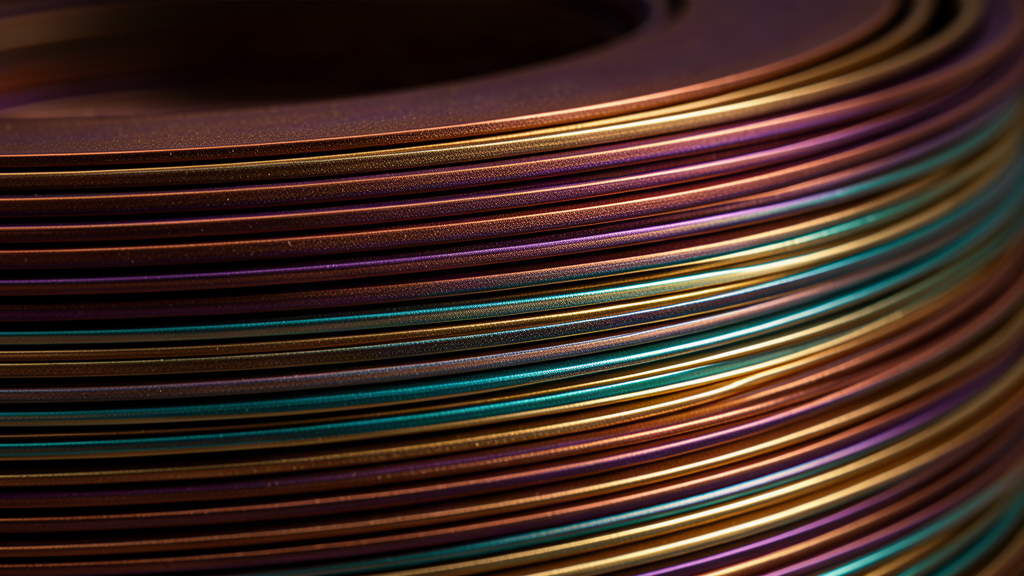
Two alloys, one etch: the visible banding is a difference in how each layer reacts, not a coating.
What follows is the practical version: what the material actually is, how it is built, why it almost never becomes a blade, how to judge a pattern before you pay for it, and how to keep the color from turning muddy.
What Titanium Damascus Actually Is
Titanium damascus is a laminate of titanium alloys, not a steel. Common builds pair commercially pure titanium — Grade 2, soft, ductile, easy to color — with Ti-6Al-4V, also called Grade 5, which is significantly stronger and harder. Titanium alloys behave differently under acid and under anodizing voltage, and that difference is what produces visible banding. Many makers use three or more alloys to get a wider color range.
Because there is no carbon in the stack, nothing in the material can be hardened the way blade steel is. Grade 5 titanium lands around the mid-30s on the Rockwell C scale; a decent pocket knife blade runs 58 to 62. That gap is the reason a titanium damascus knife is a display and touch object rather than a cutting tool.
"Timascus" is the trade name most people use for the material, and it is used loosely — some sellers apply it to any layered titanium, some reserve it for specific alloy stacks. Ask what alloys are in the laminate before you assume you are getting the same thing as the photo that sold you on the idea.
How It's Made, Step by Step
- Surface preparation. Sheets are cleaned and stacked in alternating alloys. Any oxide or oil left on a face becomes a place where the bond fails later.
- Diffusion bonding. The stack is held under pressure at high temperature in vacuum or inert gas. Titanium oxidizes aggressively when hot, so an oxygen-free environment is not optional.
- Manipulation. The bonded billet is heated and worked — twisted, folded, flattened, or cut and re-stacked — depending on the pattern the maker wants.
- Shaping. The patterned billet is milled into scales, clips, collars or backspacers, then hand-finished.
- Etch. A controlled acid etch removes material at slightly different rates on the two alloys, so the layers stand proud by a few microns and catch light.
- Color. Anodizing grows a thin oxide film whose thickness determines the color. Heat coloring is the alternative and is far less predictable.
The labor is front-loaded. A billet has to be built and patterned before a single part exists, and a single mistake at the bonding stage shows up much later as a line of delamination along an edge.
Why It's Rarely Used for Blades
Titanium is a wonderful handle material and a mediocre edge material. It has low thermal conductivity, it galls against itself, and it wears quickly under abrasion — three traits that are all wrong for a cutting edge. A titanium edge will roll and dull against cardboard in a way that a 14C28N or S35VN blade simply will not.
There is also a construction reason. Patterned titanium is expensive per square inch and is produced in plates, and knife blades are long, thin and highly loaded. Turning that material into a blade wastes most of the cost and produces a knife that cuts worse than a $40 steel folder. When you see a listing for a "titanium damascus knife," read the spec sheet — the blade is almost always steel, and the damascus is furniture.
That is not a knock. A titanium damascus clip or pivot collar on a well-made folder is a legitimate upgrade: it does not rust, it does not need oil, it is non-magnetic, and it is roughly 40 percent lighter than an equivalent steel part.
Patterns You'll See
| Pattern | How it reads | What to check |
|---|---|---|
| Ladder | Regular horizontal rungs across the part | Rungs should stay parallel as they wrap the curve |
| Twist | Diagonal ripples, like a rope cross-section | Ripple spacing should be even, not smeared at one end |
| Raindrop | Round or teardrop pools in a field of finer lines | Pools should be distinct, not blurred into the background |
| Mosaic | Grid or tiled blocks, often with a core | Junctions between blocks should be crisp |
| Flame / abstract | Free-flowing bands with no repeat | No dead zones where the etch washed out |
Pattern quality is really a question of contrast. A good etch gives you a hard edge between alloys with a visible step you can feel with a fingernail. A weak etch looks painted on — the pattern is visible but flat, and it tends to dull faster as the surface wears.
Color: Anodizing and Heat
Anodizing titanium is an electrochemical process: the part goes into an electrolyte bath and voltage drives oxygen into the surface, growing an oxide film. Film thickness controls how light interferes at the surface, and that is what produces bronze, purple, blue, teal and green — the mechanism behind thin-film interference coloring. Voltage sets the color; the alloy beneath sets how that color saturates. This is why the same voltage window gives you a bronze on Grade 2 and a duller brown on Grade 5, and why a well-made part shows the pattern as a color shift rather than a painted stripe.
Heat coloring uses a torch or oven instead of a bath. It is faster and cheaper, and it is much harder to control — the oxide grows unevenly, colors can look scorched, and the result is generally less durable. If a listing brags about color but never mentions anodizing, assume heat.
Both finishes are thin. Anodized oxide on titanium is measured in tens of nanometres, so abrasion, not time, is what kills the color.
How to Judge One Before You Buy
- Layer density. Finer layers read as richer pattern. A billet with 30 or more layers shows detail that a 10-layer stack cannot.
- Pattern continuity across parts. On a set of matching scales or a clip-plus-collar pairing, the pattern should look like it came from the same billet.
- Edge integrity. Look at the outside corners of the part. Delamination shows up there first as a hairline split or a lifted flake.
- Etch depth. It should be tactile but shallow. Deep etching looks dramatic and traps dirt.
- Magnet test. Pattern-welded steel damascus is magnetic; titanium is not. It is a crude test, but it is a fast way to catch a listing that is selling steel damascus as titanium.
One more: ask whether the blade is steel. If a seller will not say, that is your answer.
Care That Preserves the Color
Treat the finished surface as a coating, because that is what it is. Wash with mild soap and water, dry immediately, and skip anything abrasive — no metal polish, no Scotch-Brite, no polishing compound. Those will take the oxide off and leave you with bare grey titanium in a patch.
Avoid chlorine and strong acids around the part. Titanium handles salt water well, but the oxide film does not handle bleach. Store the knife dry and away from other metal that could rub against it in a drawer.
If the color does wear through, it can be restored. The part has to be polished back to bare metal and re-anodized at the correct voltage — a job for the maker or a specialist, not a home touch-up. Polishing alone will not bring the color back.
Which One Should You Pick?
Decide what the knife is for before you decide how much damascus you want.
- Daily carry, hard use: a standard production folder with a titanium damascus clip or pivot collars. You get the material without paying for a full dress handle, and you do not have to baby a surface that sits in your pocket.
- Rotation piece, light use: full titanium damascus scales on a steel blade. The pattern is the point, so buy the pattern you actually like rather than the one with the most layers — the limited edition run is where these usually show up.
- Display or collection: a matched set from a single billet, with documented alloys. Resale depends on provenance more than on pattern flash.
- Heavy outdoor use: skip it. Titanium damascus adds cost and weight savings you will not notice while the steel blade does all the work.
If you are shopping by material rather than by model, browse the layered and pattern-welded pieces in our damascus collection and compare them against the straight blade material lineup before you commit.
FAQ
Is titanium damascus a real damascus steel?
No. Damascus steel is pattern-welded iron and carbon steel. Titanium damascus is a laminate of titanium alloys — no carbon, no hardenable martensite, and no relationship to historical wootz or modern pattern-welded steel beyond the visual idea of layers.
Will a titanium damascus blade hold an edge?
Poorly. Titanium sits in the mid-30s on the Rockwell C scale while blade steels run 58 to 62, and it abrades quickly. Nearly all "titanium damascus knives" have steel blades and titanium furniture.
Does the color wear off?
The anodized oxide layer does wear, but slowly and only where it rubs. High-contact spots — clip tips, scale edges, pivot collars — go first. It can be re-anodized after polishing.
Can I anodize it at home?
People do, using a DC power supply and an electrolyte bath, but titanium damascus adds a complication: two alloys means two color responses. Practice on scrap from the same billet or you will get a two-tone result you did not plan.
How do I tell titanium damascus from steel damascus?
Weight and a magnet. Titanium is roughly 40 percent lighter than steel for the same volume and is not magnetic; pattern-welded steel damascus is magnetic. Neither test tells you the alloy mix, so ask the maker for that separately.

Leave a comment
This site is protected by hCaptcha and the hCaptcha Privacy Policy and Terms of Service apply.