


Walk into any knife display and you are looking at a dozen knives that all fold, yet almost none of them work the same way. The differences come down to two questions: how does the blade stay open, and how does it get there? Everything else — steel, handle material, size — sits on top of that framework.
This guide covers every major type of folding knife, what each locking and opening system is actually good at, and which styles suit which jobs.

Folding knives split by lock family first, then by how the blade is deployed.
The Two Big Families: Slip Joints and Locking Folders
The oldest division in folding knives is whether the blade locks. A slip joint relies on a backspring that holds the blade open under tension but can still be folded with hand pressure. A locking folder adds a mechanical bar, liner, plunger or pin that physically blocks the blade from closing.
Slip joints are simpler, lighter, and legal in more places; locking folders are safer for hard use because the blade cannot fold on your fingers. Everything below is a variation on that idea. For a full anatomy walkthrough, see pocket knife.
Liner Lock Folding Knives
A liner lock uses one of the handle's metal liners as a spring. When the blade opens, the liner slides behind the blade tang and blocks it from closing; you release it by pushing the liner sideways with your thumb.
- Strengths: simple, thin, cheap to make well, and easy to clean because the lock is inside the handle.
- Trade-offs: the release is one-sided and usually needs some break-in.
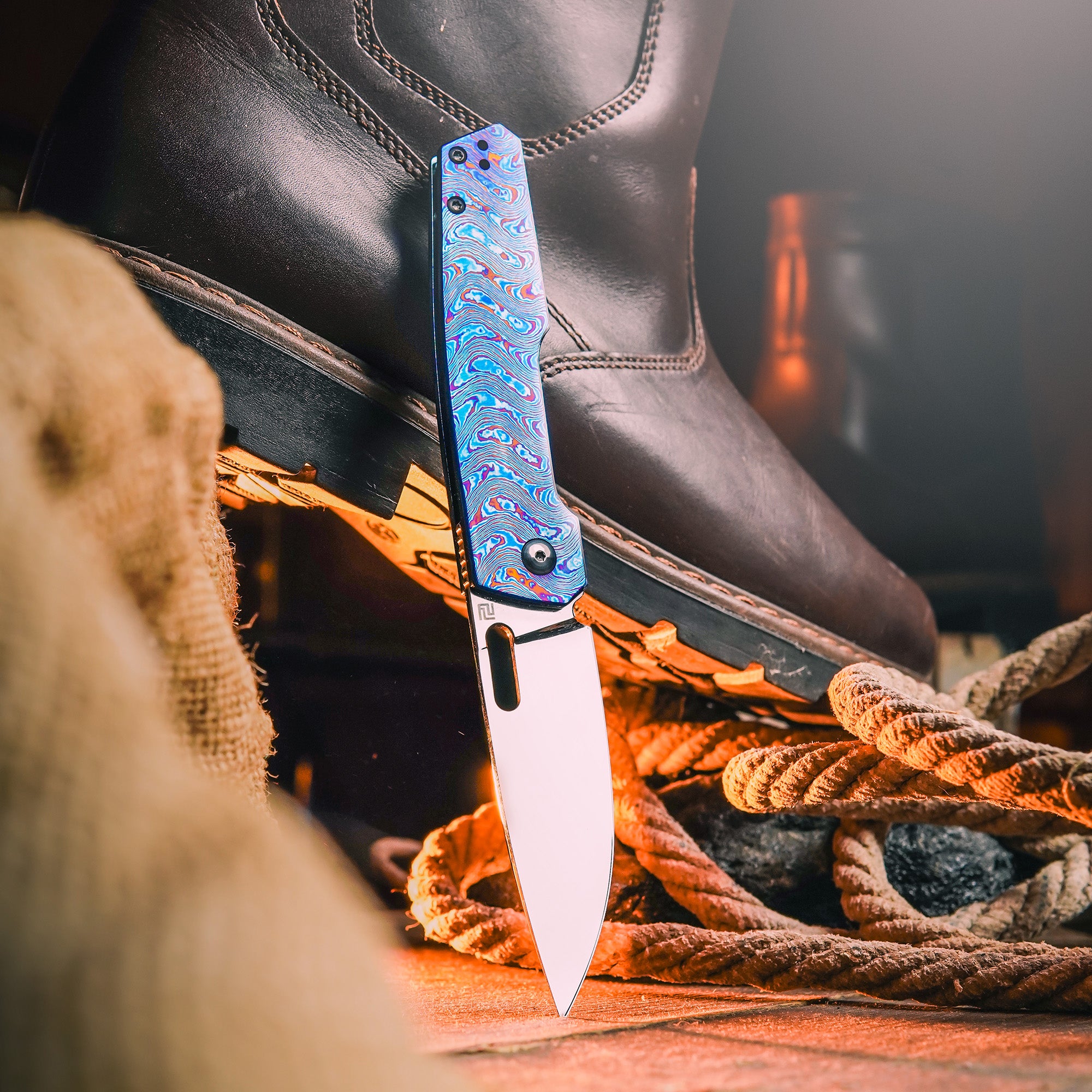
- Examples: Artisan Cutlery Orthodox V2 (a flipper and liner lock on G10, $44.99) and the Mousebird 1889G (top liner lock, N690 steel, micarta). See liner lock for the mechanism in detail.
Frame Lock Folding Knives
A frame lock is the liner lock's stronger sibling: instead of a thin inner liner, an entire handle slab acts as the lock bar. Because the lock is the frame, there are fewer parts and the lockup is exceptionally rigid.
- Strengths: very strong lockup, fewer parts, no separate lock liner to flex or wear.
- Trade-offs: typically titanium or steel handles, so it is heavier and more expensive than a liner lock.
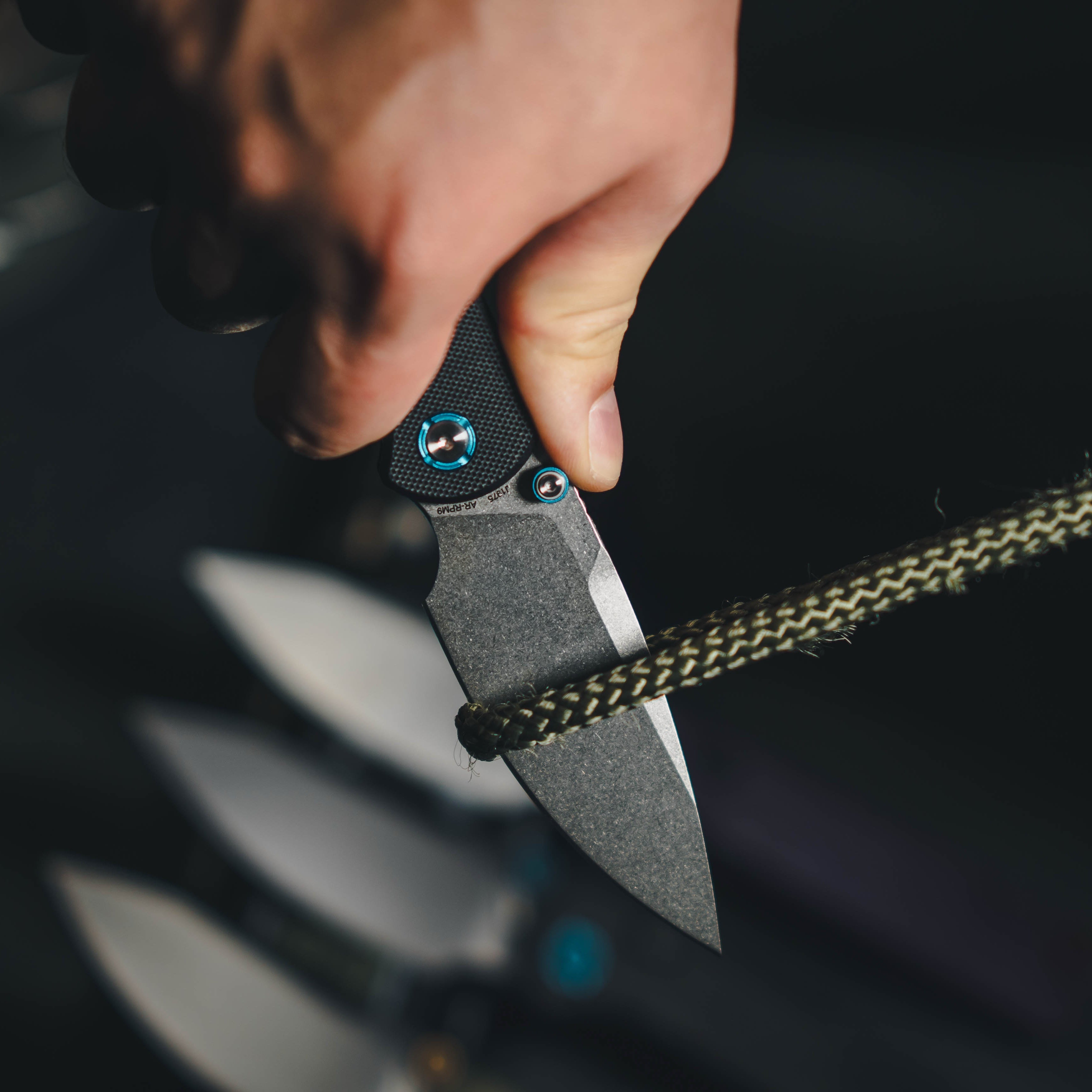
- Examples: Artisan Cutlery Revel 1867T-AR (titanium, AR-RPM9, $89.99) and the Sirius 1849P in S35VN. Background: frame lock.
Button Lock Folding Knives
A button lock uses a spring-loaded plunger that drops into a notch in the blade tang. Press the button and the blade swings free — no finger in the path of the edge, and no handedness.
- Strengths: fast, fully ambidextrous, easy to close one-handed, and the most fidget-friendly of the traditional locks.
- Trade-offs: the button adds a moving part and a hole in the handle, and grit in the mechanism is felt immediately.
- Examples: Revel Button Lock ($44.99) and the CJRB Feldspar J1912. Browse the full button lock collection.
Crossbar and Recoil Lock Folding Knives
Crossbar-style locks put a spring-loaded bar across the blade tang, held under tension by two omega springs. Pull the bar back and the blade drops shut. The Recoil Lock V2 is the version of this design used across the CJRB and Artisan Cutlery lines.
- Strengths: ambidextrous, very smooth fidget action, and the blade is held under spring tension in both directions.
- Trade-offs: more internal parts to keep clean, and a light detent that some users find too easy to open.
- Examples: CJRB Bolt ($49.99) and the CJRB Doubletap with Recoil Lock V2. More options in the crossbar lock collection.
Slip Joint Folding Knives
A slip joint has no lock at all. A backspring keeps the blade open under spring tension, and half-stops or notches give it a defined half-open position.
- Strengths: light, simple, elegant, and usually the most legally flexible folding design.
- Trade-offs: the blade can fold under hard pressure — carry it as a cutting tool, not as a pry bar.
Back Lock (Lockback) Folding Knives
A back lock places a rocker bar in the spine of the handle. Pressing the lever at the rear lifts the bar out of the tang notch and releases the blade.
- Strengths: extremely strong and self-adjusting as the lock wears; classic, and equally usable with either hand.
- Trade-offs: heavier, harder to open and close one-handed than modern locks.
Friction Folders
A friction folder has no lock and no spring — the pivot is simply tightened so the blade stays where you put it, and a tang extension prevents the blade from closing on your fingers.
- Strengths: minimal parts, easy to maintain, and legal almost everywhere.
- Trade-offs: two-handed opening and closing for most people.
Flippers, Front Flippers and Thumb-Stud Openers
Opening method is a separate axis from lock type, and two knives with identical locks can feel completely different to open:
- Flipper tab: a tab on the blade tang that you flick with your index finger. Fast and one-handed.
- Front flipper: a small tang extension above the pivot, flicked with the thumb. Very compact and elegant, but it demands a good detent.
- Thumb stud or thumb hole: push the blade open with your thumb. The most intuitive opening for new users and the least dependent on detent tuning.
Assisted-Opening and Automatic Folders
Assisted-opening knives use a spring to finish an opening you start by hand. Automatic knives open entirely from a button or lever. Both are heavily regulated — check your state and country before buying, since legality varies by blade length and mechanism.
Utility and Replaceable-Blade Folders
The last category does not really care about steel at all: a folding utility knife takes standard replaceable blades. The CJRB Boxer J1967 ($34.99, button lock, G10 handle, ten spare blades included) is the practical answer when your cutting is mostly packaging.
Folding Knife Types at a Glance
| Type | How it locks | Best for | Representative model |
|---|---|---|---|
| Liner lock | Handle liner springs behind the tang | Everyday carry, easy maintenance | Artisan Cutlery Orthodox V2 |
| Frame lock | Handle slab itself is the lock bar | Hard use, maximum lockup rigidity | Artisan Cutlery Revel 1867T-AR |
| Button lock | Spring plunger into the tang | Fast, ambidextrous one-hand use | Artisan Cutlery Revel Button Lock |
| Crossbar / recoil lock | Spring bar across the tang | Smooth fidget action, ambidextrous | CJRB Bolt, CJRB Doubletap |
| Slip joint | Backspring tension only | Light duty, legal flexibility | Traditional style folders |
| Back lock | Rocker bar in the handle spine | Strength and durability | Classic lockback folders |
| Friction folder | Pivot tension only | Simplest possible carry knife | Tang-extension folders |
| Utility folder | Lock plus replaceable blade | Packaging, warehouse, trade work | CJRB Boxer J1967 |
How to Choose Your Type
- Decide left or right handed first. If you are left-handed, prioritize button and crossbar-style locks; they are ambidextrous by design.
- Match the lock to the workload. Light cutting suits slip joints and liner locks; repeated hard cutting suits frame and back locks.
- Choose the opening method you can use with gloves or cold hands. Flipper tabs are the most forgiving; front flippers and thumb holes the most compact.
- Check your local law on locking mechanism, not just blade length — some jurisdictions treat automatics and gravity knives differently from manual folders.
- Then pick steel and handle. Those choices matter, but they are meaningless if the lock and opening method do not fit how you actually use the knife.
Everything above is available to browse in one place: the folding knives collection, with button lock and crossbar lock subsets if you already know which action you want.


Leave a comment
This site is protected by hCaptcha and the hCaptcha Privacy Policy and Terms of Service apply.