


Almost every everyday-carry decision comes back to one question: do you want a blade that folds into your pocket, or one that does not fold at all? The two formats solve different problems, and the marketing around both tends to oversell its side. Folders are presented as the only sensible daily choice; fixed blades are presented as the only serious tool. Neither claim survives contact with an actual week of use.
This comparison breaks the decision into the factors that genuinely change how a knife performs and how often you carry it: deployment, lock reliability, footprint, legal exposure, and task fit. By the end you should know which format suits your routine — and why some carriers end up with both.
The Fundamental Trade-Off
A folding knife trades structural simplicity for portability. The blade rotates on a pivot and is held open by a locking mechanism, which means the knife can disappear into a pocket but also means the blade is connected to the handle by a single small axis rather than a continuous piece of steel. A fixed blade trades portability for structural integrity: there is no pivot to loosen, no lock to fail, and no mechanism to collect lint and pocket grit.
That is the whole argument in two sentences. Everything else — cost, maintenance, legal risk, comfort — follows from it.

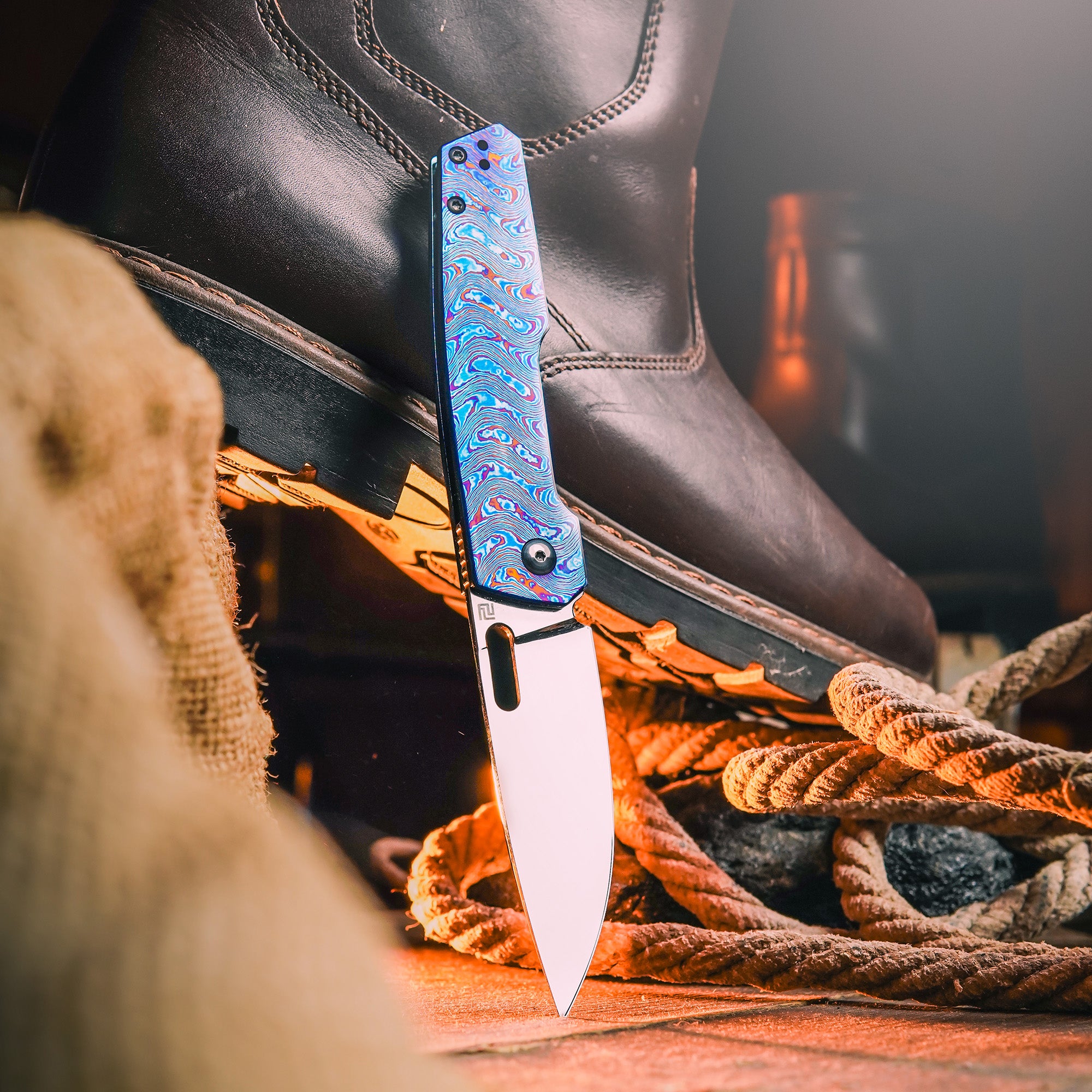
A folding knife compresses into a pocket; a fixed blade keeps a continuous piece of steel from tip to pommel.
Deployment and One-Handed Use
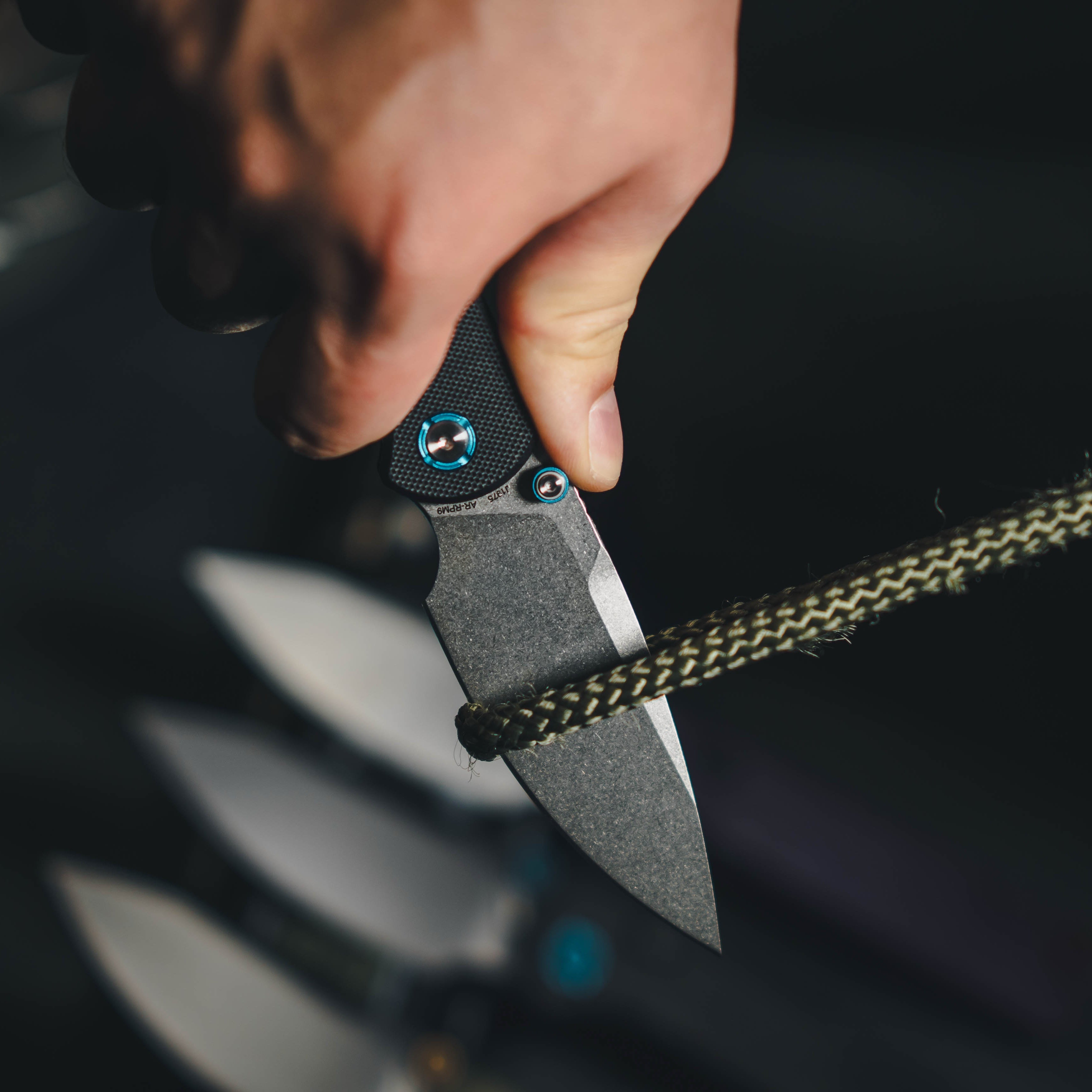
Folders win on convenience in the situations that dominate daily carry: opening a package at a desk, cutting tape in a stockroom, trimming a thread. A well-tuned flipper, thumb stud, or thumb hole lets the knife open one-handed in a second and close just as quickly, without the blade ever being set down. For tasks that arrive in short bursts and demand a free hand, this matters more than any specification on the box.
Fixed blades win on immediacy when the knife is already out. Drawing from a sheath is a single motion with no mechanism to defeat, and there is no chance of a partial open or a missed detent. In cold weather, with gloves on, or under stress, that simplicity is a real advantage.
The practical nuance is that a folding knife's deployment speed depends heavily on detent tuning and pivot condition. A folder with a gritty pivot or a weak detent is slower and less safe than a modest fixed blade. Maintenance is not optional on the folding side of this comparison.
Lock Reliability and Long-Term Wear
A fixed blade has no lock, so it cannot fail. That statement is not marketing; it is the reason fixed blades dominate hard-use categories. The blade is a single piece of steel extending into the handle, and the only failure points are the handle material and the pins or bolts that hold it together.
A folding knife's lock is a wear item. Liner locks and frame locks rely on a lock bar that travels across the blade tang, and that interface changes over years of opening and closing. Crossbar and button locks rely on springs that can fatigue or collect debris. None of this means folders are unsafe — modern locking folders are engineered to hold far more load than daily tasks demand — but it does mean the mechanism deserves periodic inspection. If the lock engages late on the tang, or if vertical blade play develops, the knife needs attention before it goes back in a pocket.
For most carriers this is a maintenance question rather than a safety question. For anyone who uses a knife hard, far from help, in wet or dirty conditions, it becomes a reliability question.
Carry Comfort and Footprint
A folding knife with a clip occupies a sliver of a pocket. That is its entire competitive advantage, and it is a large one. It sits flush against the seam, it does not swing, and it does not require a belt, a strap, or a wardrobe decision. In an office, a city, or any environment where a visible tool draws attention, the folder disappears.
A fixed blade requires a sheath, and a sheath requires real estate: belt, waistband, boot, or neck. Each position has consequences. Belt carry is the most stable and the most visible. Inside-the-waistband carry is more discreet but adds bulk and can interfere with sitting. Horizontal belt carry keeps the profile low but limits blade length. Neck carry is concealable under a shirt but swings unless the sheath is well designed.
The overlooked variable is handle length. A fixed blade's handle is not compressed by a pivot, so a fixed blade with the same blade length as a folder will generally have a longer, more comfortable grip. That is a genuine ergonomic advantage — and it also means the fixed blade takes up more space.
Legal Realities
This is where the comparison stops being about preference. In many jurisdictions, fixed blades face stricter rules than folding knives: open-carry-only requirements, length thresholds, or outright prohibitions on certain designs. Folding knives are more often treated as ordinary tools, though many places cap the blade length that may be carried and some cities regulate locking mechanisms or one-handed opening.
The rules vary at state, county, and municipal level, and they change. None of this is legal advice, and no article can substitute for your own local statute. What matters practically is that the fixed-blade side of this comparison carries more legal risk in more places, which is one reason folders dominate urban everyday carry. If you travel, verify both the destination's rules and the transport rules for crossing jurisdictions. A general overview of knife types helps with terminology, but the statute is the authority.
Task Fit: Where Each Format Actually Excels
Urban and office daily carry
The folder wins without much competition. Light, discreet, one-handed, and easy to pocket at the end of the day. The tasks are light and the knife is carried far more than it is used.
Hiking, camping, and field work
The fixed blade wins. Batoning, prying, clearing brush, and processing wood all put lateral and impact loads on a blade that a folding pivot was never designed to absorb. A fixed blade in this role is not a preference; it is the correct tool.
Food and kitchen-adjacent use
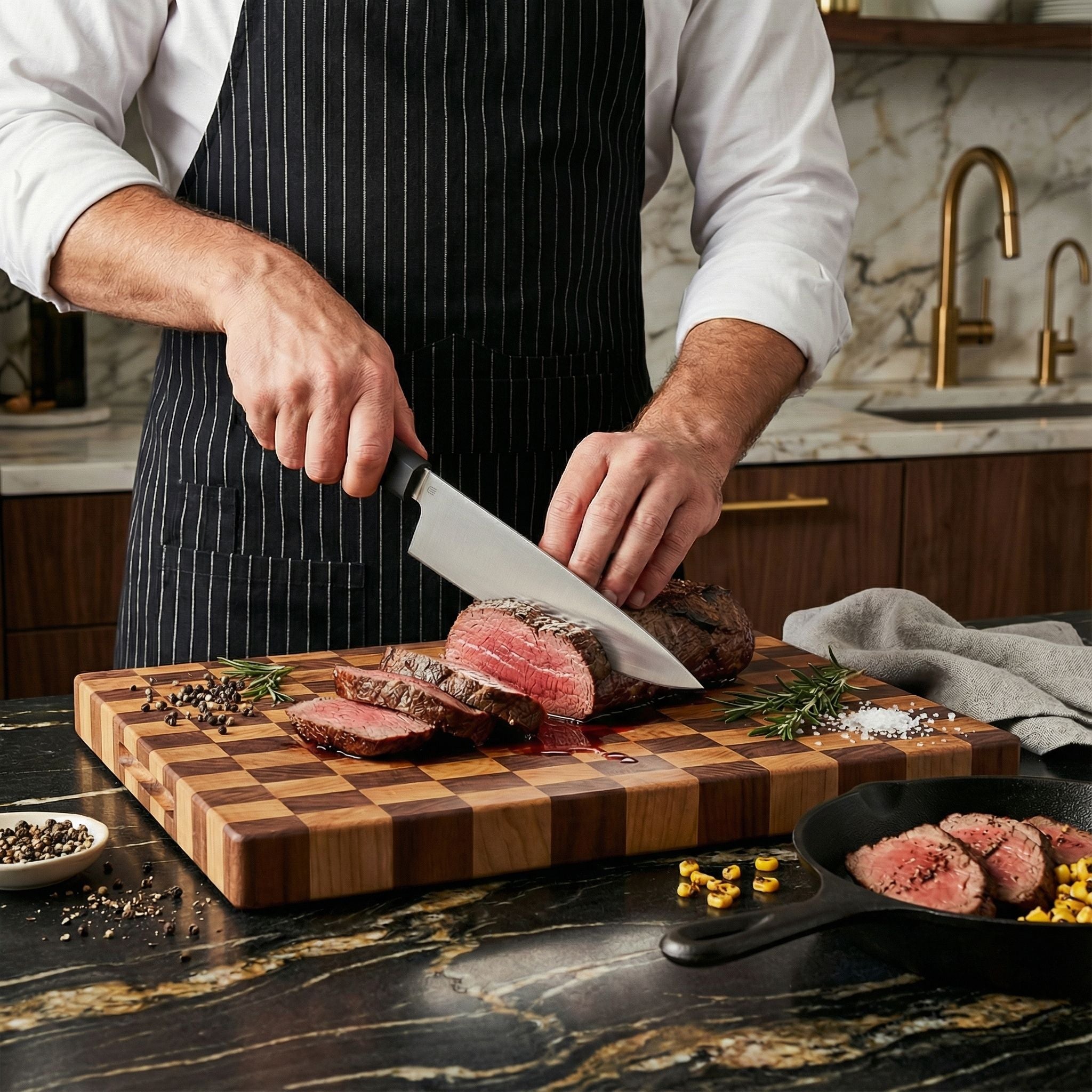
A fixed blade is easier to clean thoroughly, has no pivot to trap residue, and is more comfortable during long cutting sessions. A folder can do the job, but it demands more careful cleaning afterward.
Backup and last-resort roles
A small fixed blade — often a neck knife — has an advantage in that it cannot fail to open. For a tool that might be needed once, under stress, simplicity is worth the carry cost.
Side-by-Side Comparison
| Factor | Folding knife | Fixed blade |
|---|---|---|
| Portability | Excellent — pocket, clip, no sheath | Requires a sheath and a carry position |
| Structural strength | Limited by pivot and lock | Blade and tang are one piece |
| Deployment | Fast one-handed with practice | Instant once drawn |
| Maintenance | Pivot, detent, and lock need attention | Minimal — clean and oil the blade |
| Legal exposure | Generally lower; length caps common | Generally higher; more restrictions |
| Grip length for a given blade | Shorter — the pivot consumes handle space | Longer and often more comfortable |
| Best role | Everyday urban carry, light utility | Field use, hard use, backup |
When a Folding Knife Is the Right Answer
- You carry in an office, a city, or any environment where a visible tool is a problem.
- Your cutting tasks are short, light, and frequent.
- You want one-hand opening and closing without setting the knife down.
- You change clothes often and do not want to re-rig a sheath.
- Local law restricts fixed-blade carry more tightly than folders.
If that describes your week, start with the folding knife collection and prioritize pivot quality and lock geometry over blade length.
When a Fixed Blade Is the Right Answer
- You spend real time outdoors, and the knife is a working tool rather than a pocket accessory.
- You may need to apply lateral load, pry, or strike the spine.
- You want zero mechanism-related failure points.
- You process food or game and need a knife that cleans completely.
- You want the most comfortable grip for a given blade length.
In that case the fixed blade collection is the correct starting point, and the question becomes sheath design rather than lock design.
The Hybrid Approach Most Experienced Carriers Use
The format argument assumes one knife has to do everything. In practice, experienced carriers stop optimizing for a single do-everything tool and start assigning roles. A compact folder covers the office week; a fixed blade covers the weekend and the trail; a small fixed blade in a neck or pocket sheath covers the gap where a folder might be legally awkward or mechanically unwelcome.
This is also the honest answer to the "which is better" question: the format should follow the task, and most people have more than one kind of task. Buying one expensive compromise is usually worse value than buying two modest knives that each do their job properly.
What to Check Before You Buy Either Format
- Confirm local law first. Length limits, mechanism restrictions, and carry-mode rules should be settled before you shop.
- Match handle to hand. Grip length matters more than blade length on both formats.
- On a folder, test the lock. Check for vertical play, late engagement, and stickiness when releasing.
- On a fixed blade, evaluate the sheath. Retention, draw angle, and ride height decide whether you actually carry it.
- Choose steel for the environment. Corrosion resistance matters more for a knife carried against skin or in wet conditions. Sources such as blade geometry references and steel-focused technical writing are more useful than marketing copy.
- Plan maintenance. A folder needs periodic cleaning and lubrication; a fixed blade needs very little.
Frequently Asked Questions
Is a fixed blade stronger than a folding knife?
Yes, structurally. The blade and tang are a single piece of steel, so there is no pivot or lock to absorb or fail under load. A modern locking folder is strong enough for daily tasks, but it is not the same class of structure.
Can I carry a fixed blade every day?
Many people do, particularly with compact blades and well-designed sheaths. The obstacles are legal restrictions and social visibility rather than weight or comfort.
Which is better for a first EDC knife?
A folding knife is usually the more practical first purchase: easier to carry legally, easier to pocket, and sufficient for most daily cutting. Add a fixed blade once you have a task that calls for one.
Whichever format you choose, buy for the ninety percent of your week rather than the one percent of imagined emergencies. Browse the full Artisan Cutlery catalog to compare folding and fixed designs side by side.


Leave a comment
This site is protected by hCaptcha and the hCaptcha Privacy Policy and Terms of Service apply.