
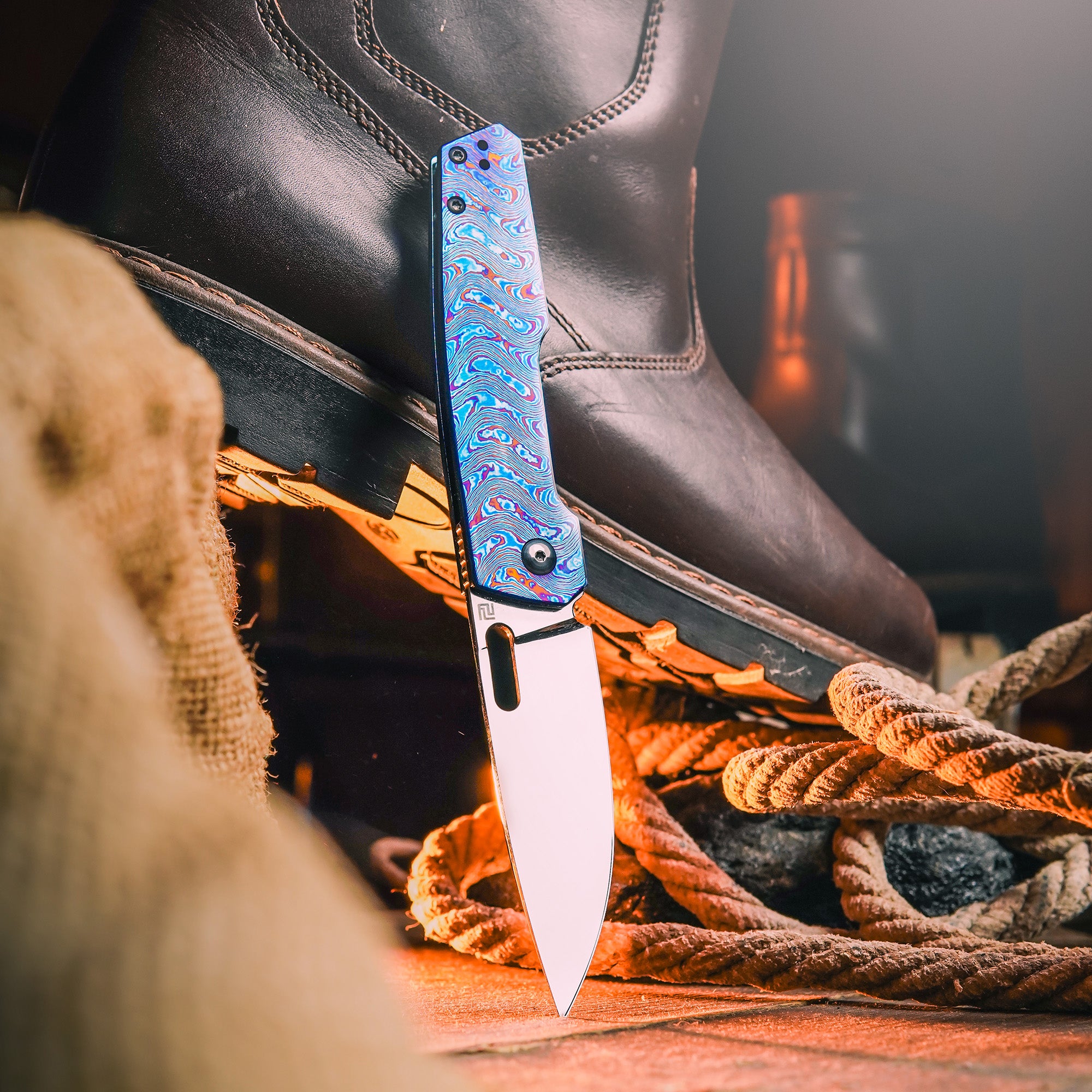
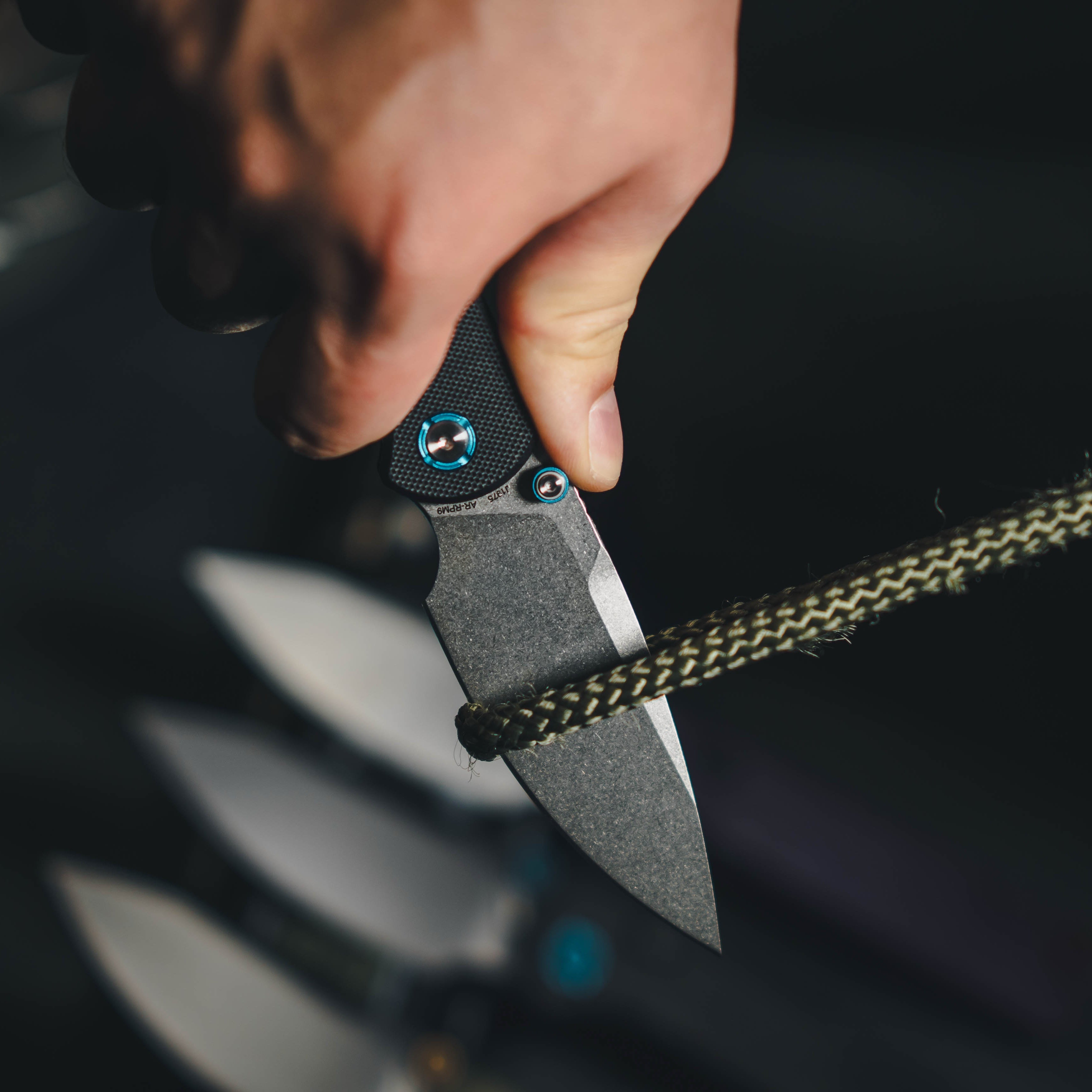
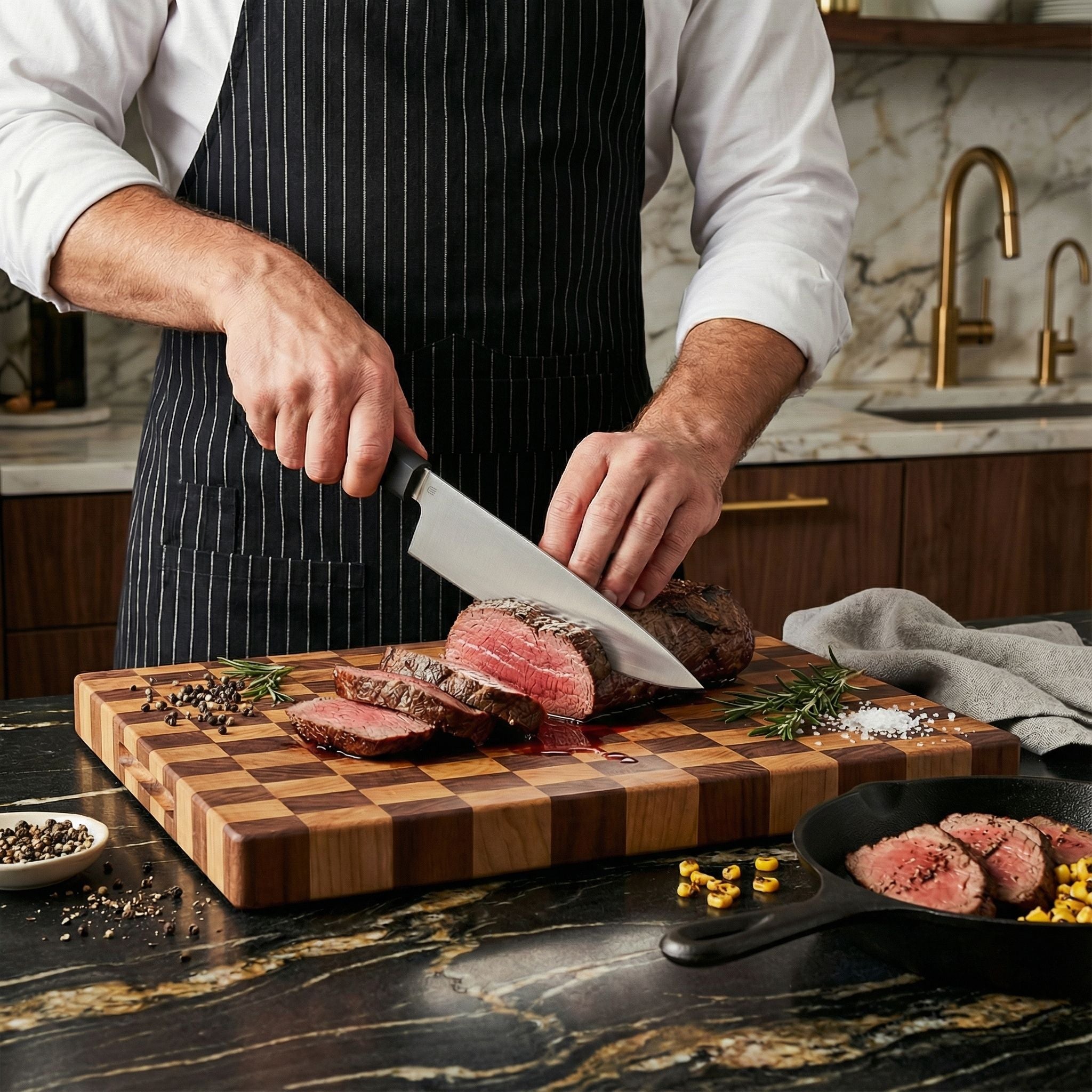

A wharncliffe blade is one of the most useful — and most misunderstood — shapes in everyday carry. Where a drop point curves up into a belly that slices beautifully, a wharncliffe runs a dead-straight edge the whole way to the tip. That single design decision changes what the knife is good at: it turns the entire edge into a cutting surface, and it puts the tip exactly where the edge is going.

The wharncliffe trade-off: a dead-straight edge and an in-line tip buy control in exchange for the belly a drop point uses for slicing.
This guide explains what a wharncliffe blade is, why the straight edge matters, what it is genuinely good for (and what it is not), how it compares with a sheepsfoot and a drop point, how to sharpen one without rounding the tip, and which wharncliffe EDC knives from Artisan Cutlery and CJRB are worth carrying right now.
What Is a Wharncliffe Blade?
A wharncliffe blade has a straight cutting edge, with a spine that drops down at a shallow angle to meet the tip. There is no belly and no recurve: the edge is a straight line, and the point sits on that same line.
That last detail is what separates a true wharncliffe from a sheepsfoot. A sheepsfoot also has a mostly straight edge, but its spine curves down to a slightly rounded tip that sits above the edge line. A sheepsfoot cuts straight; a wharncliffe cuts straight and points like a marking knife.
The pattern is named after Lord Wharncliffe, and it earned its following in Sheffield, England, where it became a staple blade shape on the small penknives people carried for trimming quills, cutting paper, and opening parcels. The job it was designed for — controlled, straight, repetitive cuts on thin material — is exactly the job most of us still use a pocket knife for.
Why the Straight Edge Matters
- Full edge contact on every cut. With no belly, the whole edge engages the material in a push cut. On cardboard, tape, and shrink wrap that means fewer passes and less sawing.
- The tip is in line with the edge. The point travels exactly where the edge is headed, which makes detail cuts predictable instead of approximate. It is the reason wharncliffe profiles show up on craft knives and utility blades.
- Nothing to snag. A deep belly can pull material or ride up out of a cut. A straight edge tracks.
- Simple geometry to keep sharp. There is no recurve to chase and no belly to re-profile, so the edge is easy to maintain on a flat stone.
- Strong, thin tip. The spine drops toward the point, so the blade stays substantial through most of its length and then tapers quickly — the point stays usable for prying-free detail work while the edge stays thin behind the bevel.
What a Wharncliffe Blade Is Good For
- Opening boxes and clamshell packaging. This is the classic wharncliffe job: a controlled tip, a straight edge, and no belly to wander off the seal line.
- Push cuts and bench work. Cutting against a mat, board, or bench is where the straight edge shines — you cut downward without the blade rocking.
- Trimming, deburring, and scoring. Tape lines, labels, gaskets, plastic flash, caulk: the tip does the work and the edge finishes it.
- Cord, rope, zip ties, and hose. A straight edge grabs the material and severs it in one clean stroke rather than sliding along it.
- Craft and hobby work. Leather, foam board, vinyl, and veneer all reward a blade that cuts in a straight line.
- Everyday utility around the house and job site. If your knife spends its life opening things rather than processing game, the wharncliffe is arguably the most efficient shape you can carry.
Where a wharncliffe falls short: no belly means no rocking cut. It is a poor choice for skinning, filleting, peeling, and rocking through herbs on a cutting board, and it is not the shape to reach for if you want to sweep through material in one curved motion. If you hunt, fish, or cook with your folder, a drop point will serve you better — and for marine and rescue work where the tip should be dull, a sheepsfoot is the safer answer. For a folding knife that opens a dozen packages a week, though, the wharncliffe wins on control.
Wharncliffe vs Sheepsfoot vs Drop Point
| Blade shape | Edge and tip | Best at | Trade-off |
|---|---|---|---|
| Wharncliffe | Perfectly straight edge; crisp tip sits on the edge line | Push cuts, detail work, boxes, scoring, cord | No belly — useless for rocking or skinning cuts |
| Sheepsfoot | Straight edge; spine curves down to a rounded tip set above the edge | Safety-first cutting, marine and rescue use, boxes | Less precise point than a wharncliffe |
| Drop point | Curved edge with a belly; tip sits near the centerline | All-round EDC, slicing, field and food use | Less tip control; belly can ride out of a cut |
You can see the family resemblance across the catalog: CJRB's CJRB Cutlery line leans heavily on wharncliffe and sheepsfoot profiles, while the wider folding knives range at Artisan Cutlery covers everything from leaf shapes to tantos.
Grinds, Steels, and Edge Angles
Wharncliffe blades are almost always flat ground. A flat grind gives you a thin, stable edge with a clean plunge line, and because the edge is straight there is no transitional geometry to manage near the tip.
Steel choice follows the same logic as any utility knife: you want a balance of edge retention and toughness, because a wharncliffe gets used every day. CJRB publishes an HRC of 59–61 for AR-RPM9, the powder-metallurgy steel used across the best-selling Pyrite and Ruffian builds — a sensible range that keeps the edge stable without becoming brittle. Premium versions step up to CPM 20CV, AR-SFII, S35VN, and S90V for people who cut a lot of cardboard and would rather sharpen less often.
For edge angle, use the knife's actual job as your guide:
- Utility and box cutting: a 20°-per-side micro-bevel keeps a working edge far longer against tape, grit, and staples.
- Detail and craft work: 15–17° per side cuts cleaner in soft material, with the understanding that it needs touch-ups sooner.
- Keep it consistent: because the edge is straight, the whole bevel contacts a flat stone at once — a light touch is all you need.
Sharpening a Wharncliffe Without Rounding the Tip
The crisp tip is the reason you carry a wharncliffe, and it is also the first thing a hurried sharpening session destroys. The fix is technique, not equipment.
- Match the existing bevel. Colour the bevel with a marker and confirm your angle before you remove metal.
- Use a flat stone. A water stone, diamond plate, or guided system all work; a slack belt or a worn stone with a dished surface is what rounds tips.
- Stop the stroke at the tip — do not lift. Rolling the blade up as you reach the point is what turns a wharncliffe into a rounded sheepsfoot.
- Deburr with edge-leading strokes. A few light passes at the same angle clean up the burr without thinning the tip.
- Strop to finish. Stropping restores the polished edge without changing geometry. For a deeper look at what actually happens at the apex, Science of Sharp documents edge behaviour under the microscope better than any forum thread.
Best Wharncliffe Knives for Everyday Carry
Every model below is a live build with a wharncliffe blade, verified on the Artisan Cutlery store. Prices are as listed at the time of writing.
| Knife | Blade | Handle / lock | Price |
|---|---|---|---|
| CJRB Pyrite Wharncliffe J1925A | 3.11" (79 mm) AR-RPM9, HRC 59–61 | Steel handle, button lock | $43.32 |
| CJRB Ruffian J1924 | 3.09" (78 mm) AR-RPM9 | G10, liner lock — Dirk Pinkerton design | $43.32 |
| CJRB Kestrel J1962 | 3.31" (84 mm) AR-RPM9 | G10, liner lock — Ray Laconico design | $49.99 |
| CJRB Pyrite-Alt Wharncliffe, Ultem | 3.11" (79 mm) AR-RPM9 | Ultem, button lock | $59.99 |
| CJRB Pyrite Wharncliffe, titanium | 3.11" (79 mm) AR-RPM9 | Titanium, button lock | $69.32 |
| Artisan Cutlery Cazador ATZ-1848P | 3.48" (88.28 mm) AR-RPM9 | G10, liner lock | $74.99 |
| CJRB Large Pyrite-Alt Wharncliffe J1925AL | 3.7" (94 mm) AR-SFII | Steel handle, button lock | $99.99 |
| CJRB Pyrite-Alt Wharncliffe, 20CV + copper | CPM 20CV, button lock | Copper, button lock | $139.99 |
| Artisan Cutlery Trust 1886G-GY | 3.758" stonewash S35VN | Titanium and aluminium, frame lock | $192.00 |
| Artisan Cutlery M14-V1 ATZ-1886G | 3.58" (91 mm) S35VN | Titanium and carbon fibre, frame lock | $266.65 |
If you want one recommendation: the Pyrite Wharncliffe J1925A at $43.32 is the most wharncliffe per dollar in the lineup — a 3.11" AR-RPM9 wharncliffe on a button lock that opens and closes one-handed. Step up to the titanium-handled version or the Ultem build and you keep the same blade with a lighter, warmer handle. For a smaller, hand-filling alternative, the Ruffian J1924 is a stout 3.09" wharncliffe designed by Dirk Pinkerton. Looking for a collector piece instead? The limited editions and Artisan Cutlery range include S35VN and S90V builds with wharncliffe profiles.
Who Should Carry a Wharncliffe?
- Anyone whose knife opens things. Retail, warehouse, receiving, mailroom, eBay sellers, and anyone who lives in cardboard.
- Trades and technicians. Electricians, low-voltage installers, HVAC techs, and finish carpenters use a knife as a marking and trimming tool as much as a cutter.
- Office and studio workers. A wharncliffe is the least intimidating useful blade shape, and it does not scare the packaging.
- Crafters and hobbyists. Straight cuts in leather, foam board, and vinyl are exactly what the profile was invented for.
Skip it if: you hunt, fish, or cook with your folding knife. Buy a drop point for that work and keep the wharncliffe as your second knife — which, honestly, is how most people end up carrying both.
Wharncliffe Blade FAQ
Is a wharncliffe blade good for everyday carry?
Yes. For utility EDC — opening packages, scoring, trimming, cutting cord — the straight edge and in-line tip make it one of the most efficient shapes available. It is less versatile than a drop point for outdoor and food tasks.
What is the difference between a wharncliffe and a sheepsfoot?
Both have straight cutting edges. The difference is the tip: a wharncliffe ends in a crisp point on the edge line, while a sheepsfoot's spine curves down to a rounded tip that sits above the edge. The wharncliffe points; the sheepsfoot is deliberately blunter.
Are wharncliffe blades hard to sharpen?
They are among the easiest. A straight edge means the full bevel contacts a flat stone at once, with no recurve to chase. The only skill involved is stopping at the tip instead of rolling over it.
Can you use a wharncliffe blade for self-defense?
We do not recommend choosing a knife for self-defense at all. A wharncliffe is a cutting tool, and its lack of a belly makes it a less effective defensive shape than a curved blade in the hands of someone with training. Carry for utility, and rely on awareness and distance for safety.
Pick the Shape, Then Pick the Steel
Once you have decided a straight edge is what your pocket actually needs, the rest of the decision is simple: choose a steel that matches your volume of cutting and a handle that matches your hand. Browse the full folding knife range, narrow it down by steel and handle in best sellers, and see the rest of the buying guides on the Artisan Cutlery blog.


Leave a comment
This site is protected by hCaptcha and the hCaptcha Privacy Policy and Terms of Service apply.