

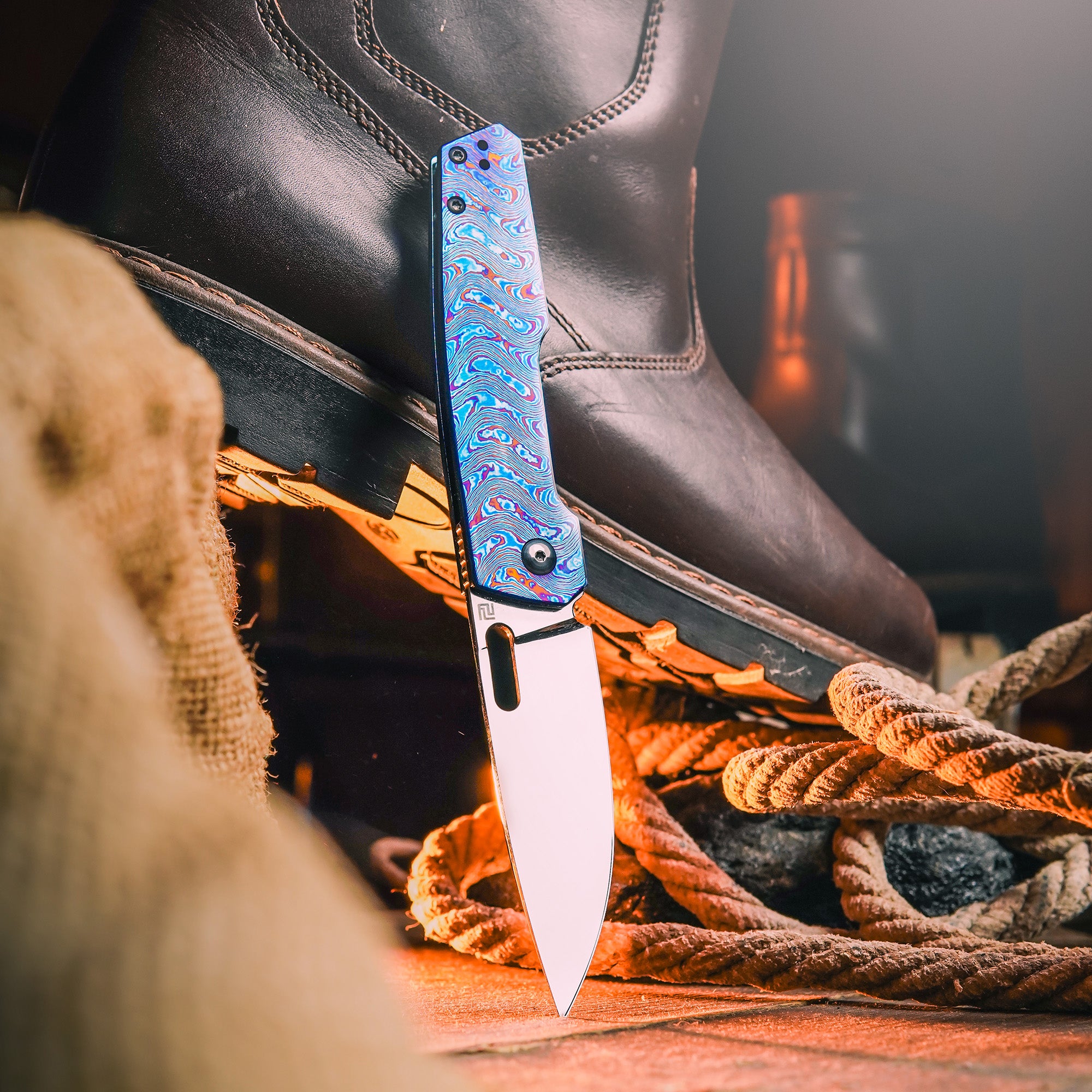
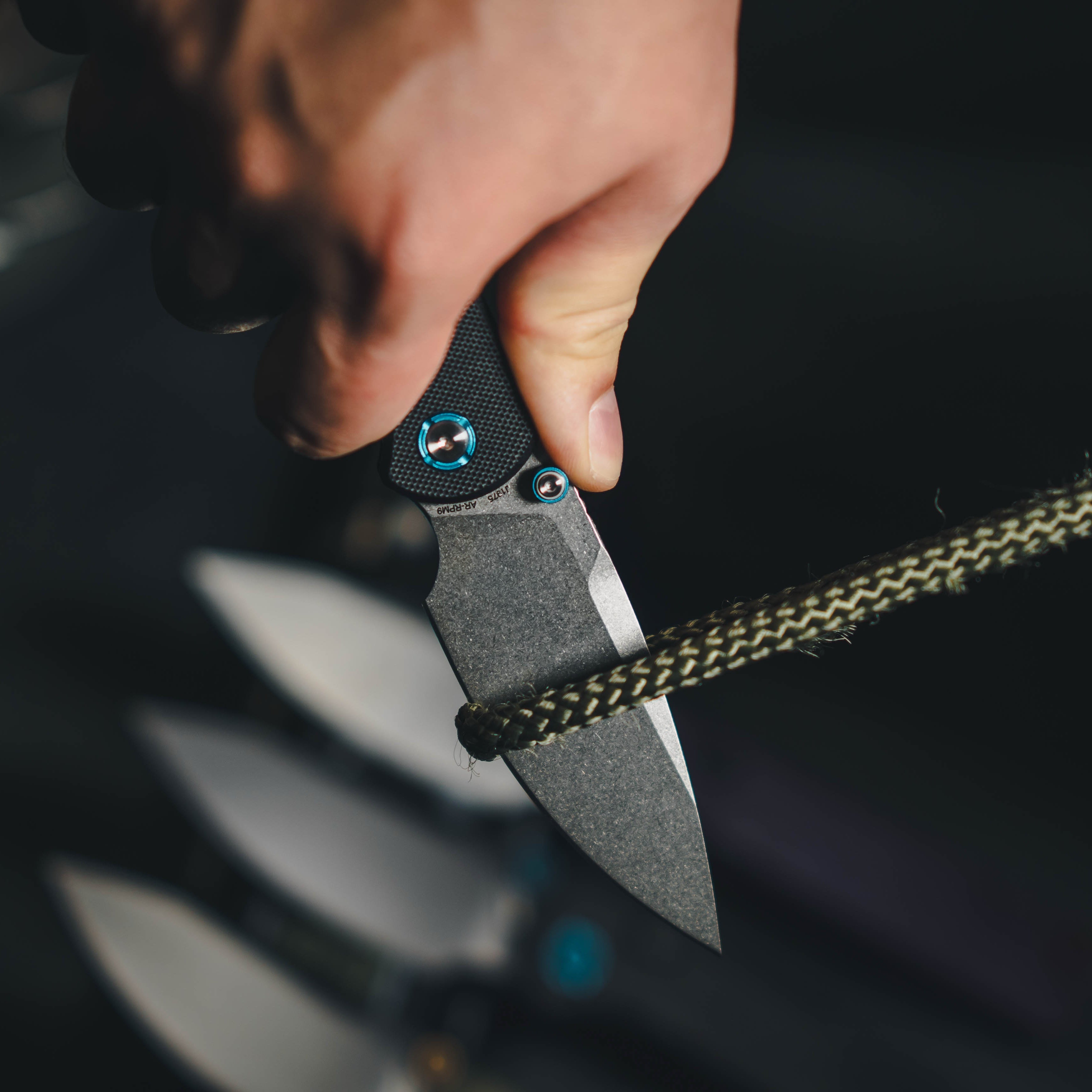

The same Artisan Cutlery Tomahawk pattern is listed at $44.99 in D2 with a G10 handle and at $598.50 in M390 with a titanium damascus handle. Nothing about the shape changes. The cutting edge is the same length. So what exactly are you paying 13 times more for?

Every price tier buys something specific: steel, geometry, action, materials. Past about $200 the steps get smaller - and more personal.
That is the whole question behind every "is it worth it" argument in the knife world, and it has an honest answer: at each step up the ladder you buy a specific, nameable improvement — until you don't. Knowing where those steps are is how you avoid overpaying and how you avoid wasting money on upgrades you will never feel.
Where the Money Actually Goes
Price in a folding knife is built from a short list of real costs. None of them are marketing.
- Blade steel. A powder-metallurgy stainless like S35VN, S90V, or M390 costs the maker several times what AR-RPM9 or D2 costs per pound, and it is harder on grinding belts and cutters.
- Heat treatment. The same steel at 57 HRC and at 61 HRC are different products. Premium lines run tighter, more consistent processes — and sometimes cryogenic treatment — because a soft heat treat wastes an expensive steel.
- Blade geometry. Thinner stock, thinner grinds behind the edge, and hand-finished bevels take time. A well-ground budget knife cuts better than a badly ground premium one.
- Action and pivot. Ceramic bearings, tuned detents, and pivots that stay smooth after a thousand openings cost more than washers and a plain pivot.
- Handle material. G10 and FRN are cheap and excellent. Titanium, fat carbon, timascus, and machined metal cost multiples more — for feel and looks, not for cutting performance.
- Fit and finish. Blade centering, flush liners, even chamfers, and clean lockup are labor. This is where the biggest perceived jump between a $50 knife and a $200 knife actually lives.
- Design and production volume. A licensed designer collaboration and a limited run both raise unit cost before a single cut is made.
What the Catalog Actually Shows
Forget abstract tiers for a moment. These are median list prices across active variants in the current Artisan Cutlery and CJRB catalog, grouped by blade steel. The pattern is the point:
| Steel tier | Median list price | Entry point in the catalog | What you are buying |
|---|---|---|---|
| AR-RPM9 (powder, budget) | ~$50 | $29.99 | Fine-grained stainless, easy to sharpen, workhorse performance |
| D2 (tool steel, budget) | ~$52 | $34.99 | Strong wear resistance, needs a little care against rust |
| 14C28N (stainless, mid) | ~$66 | $54.99 | High toughness, excellent corrosion resistance |
| CPM S35VN (powder stainless) | ~$190 | $89.99 | Balanced premium stainless, usually paired with titanium |
| S90V (high-vanadium powder) | ~$200 | $79.99 | Long edge life, more sharpening effort |
| M390 (premium powder stainless) | ~$225 | $112.49 | High wear resistance with real stainless behavior |
| Damascus | ~$187 | $69.99 | Pattern-welded aesthetics first, performance second |
Two things stand out. First, the jump from budget powder steel to premium powder steel roughly quadruples the median price. Second, the floor of each tier overlaps the tier below it — you can buy S35VN for $89.99 or AR-RPM9 for $98.24, which means the tier label alone never tells you whether a specific knife is a good deal.
The Same Design at Three Prices
The cleanest way to see what money buys is to hold the design constant. Artisan's Tomahawk family does exactly that:
| Tomahawk build | Blade | Handle | List price |
|---|---|---|---|
| ATZ-1815PS | D2 | G10 (flat) | $44.99 |
| ATZ-1815P | D2 | G10 (curved) | $52.49 |
| ATZ-1815G | CPM S35VN | Titanium | $187.49 |
| ATZ-1815GS | M390 | Titanium | $205.70 |
| ATZ-1815GS (damascus ti) | M390 | Titanium damascus | $598.50 |
Between $44.99 and $187.49 you get a genuinely better blade steel (D2 to CPM S35VN) and a full titanium handle in place of G10 — the two upgrades that actually change how the knife feels and performs. Between $187.49 and $205.70 you get a modest steel change, S35VN to M390. Between $205.70 and $598.50 you get a handle material — the blade is identical. That last step is a collector's purchase, not a cutting-tool purchase, and pretending otherwise is how people end up disappointed.
The same ladder shows up in the Beest family: an AR-RPM9 liner lock with an aluminum or brass handle runs $69.99–$89.99, while the S35VN titanium frame lock is $199.99. And in the Ria: $32.98 in 12C27 versus $54.41–$59.99 in AR-RPM9 on the identical platform.
Diminishing Returns Start Around $200
Up to roughly the $200 mark, more money buys measurably better cutting: harder and more wear-resistant steel, thinner and more consistent grinds, better action, and tighter tolerances. Those are things you feel every time you use the knife.
Past that mark, the improvements get narrow. Edge retention gains a few percent. Fit and finish goes from excellent to exquisite. Materials get more exotic. A $225 knife is not twice as good at cutting as a $110 knife — it is more durable in the edge, nicer in the hand, and more pleasant to own. Whether those count as "worth it" is a personal call, not an engineering one.
When a Cheap Knife Is Genuinely the Right Call
- You will abuse it. Scraping, prying, cutting on concrete, loaning it to someone who does not know knives. A $45 D2 or AR-RPM9 folder does all of it without anxiety.
- It lives in a bag or a car. A glovebox or travel knife should be inexpensive, stainless, and replaceable.
- You are still learning what you like. Blade shape, lock type, and handle size matter more than steel, and you can only learn them by carrying a few knives.
- You sharpen often anyway. If you enjoy maintaining an edge, paying for extreme edge retention is paying for something you will never use.
When Premium Genuinely Pays Off
- High-volume cutting. Warehouse and jobsite work — cardboard, hose, banding — is exactly where S35VN or M390 pays for itself in time saved sharpening.
- You want one knife for a decade. Better steel plus better tolerances means the knife still feels tight long after a budget folder has developed play.
- Thin geometry matters to you. Expensive knives are usually ground thinner behind the edge, and that is a performance difference you notice in the first cut, not the hundredth.
- You are buying design and materials. Titanium, fat carbon, and limited runs are legitimate reasons to spend. Just be honest that you are buying feel and looks.
Five Questions Before You Upgrade
- What did my current knife fail at? If the answer is "nothing", you are buying curiosity, not capability.
- How often do I actually sharpen? Rare sharpeners get the most out of premium steel. Frequent sharpeners get the least.
- Does the steel change, or only the handle? Compare the same model across tiers — a titanium handle does not cut better.
- Is the geometry good? A thin, well-ground budget blade outperforms a thick, poorly ground premium one every time.
- Am I paying for a limited run? Scarcity pricing is real pricing. It is fine to pay it; it is not fine to expect cutting performance from it.
How to Buy Smart
Pick the platform first — the blade shape, handle size, and lock you actually want — then choose the steel tier that matches your use. If you cut occasionally and maintain your edge, an AR-RPM9 or D2 build around $50 is not a compromise; it is the correct answer. If you cut daily and resent sharpening, the $130–$200 tier with S35VN or S90V is where the money genuinely works.
Spend the premium on steel and geometry, not on handle exotica, unless the handle is the point for you. And buy the tier that matches how you actually use a knife, not the tier that matches how you imagine you will.
The Verdict
Expensive knives are worth it when you are paying for edge life, thin geometry, and tolerances you will feel for years. They are not worth it when you are paying for a handle material, a limited badge, or the assumption that price and cutting performance move together forever. The good news is that the budget tier has never been better — a $45 D2 folder today cuts like a knife that cost three times as much a decade ago.
Compare tiers on the same designs in the full Artisan Cutlery and CJRB lineup, and see what powder steel does at the budget end in the AR-RPM9 collection. For the metallurgy behind edge retention and toughness trade-offs, Knife Steel Nerds is the reference worth reading, and Wikipedia's knife steel overview covers the grades in plain language.


Leave a comment
This site is protected by hCaptcha and the hCaptcha Privacy Policy and Terms of Service apply.