




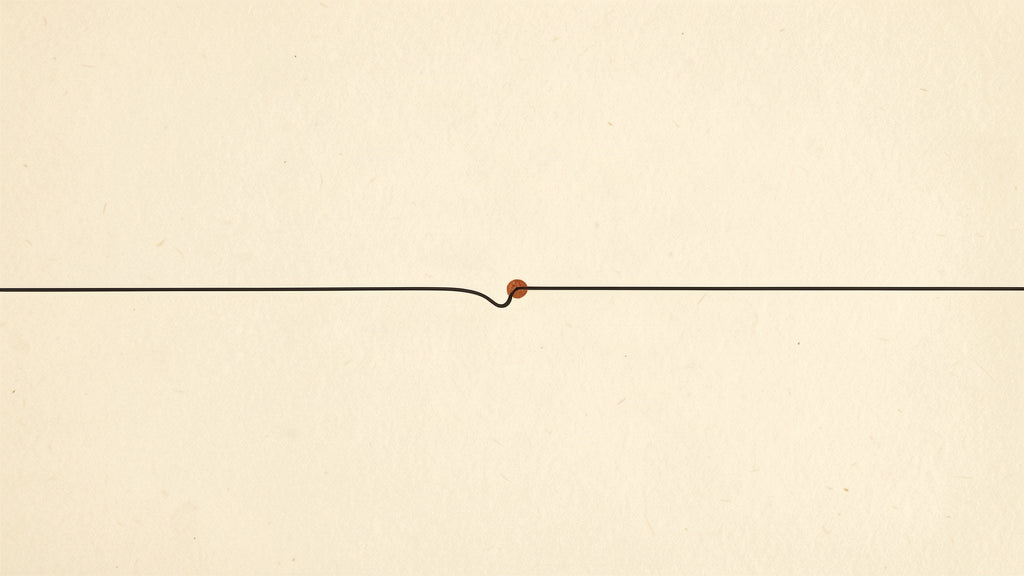
A rolled edge can be pushed back into line in about a minute with a smooth steel or a few light passes on a fine stone. A chipped edge has lost steel and cannot be pushed anywhere — it has to be ground back past the damage. Telling the two apart is the entire job, because the wrong fix makes both worse.
A rolled apex bends away from the light; a chip interrupts the edge line. Diagnosis decides the fix.
Most people assume any dull or damaged knife needs a full sharpening session. Usually it needs one minute and the correct diagnosis, and the difference between a knife that lasts fifteen years and one that is ground away in three is knowing which of the four common edge failures you are looking at.
The four things that actually happen to an edge
| Failure | What you see | Typical cause | Fix |
|---|---|---|---|
| Rolled edge | Edge leans to one side, feels smooth on one face and catches on the other | Hitting hard plastic, bone, or a wire; steeling at too steep an angle | Realign with a smooth steel or fine stone, light pressure |
| Chipped edge | Visible missing metal, a nick you can feel with a fingernail | Glass or ceramic plate, staples, bone, lateral twist | Grind the whole edge back past the chip |
| Burnt edge | Straw, bronze, or blue tint near the edge; will not hold sharpness | Power sharpening with too much heat | Grind back past the softened zone |
| Wire edge | Feels razor sharp, collapses on the first cut | Sharpening on one side only, or too much pressure on a fine stone | Light alternating passes, then strop |
How to diagnose in thirty seconds
The light test
Hold the blade edge-up under a bright light and look straight down the edge line. A healthy apex disappears into a hairline. A rolled section shows a bright glint where the edge has bent away from the light. A chip shows an obvious interruption in the line, and a wire edge can look like a faint fuzz along the apex.
The fingernail test
Drag a fingernail perpendicular to the edge, never along it. A chip catches. A roll feels smooth on the side it leaned toward and slightly sharp on the other. A wire edge feels soft and slightly gritty rather than crisp.
The board test
If the knife glides through paper but stalls on a tomato, the apex is rolled or there is a wire edge. If it snags at one spot only, that spot is chipped.
Fixing a rolled edge
Rolling is the most common and the most fixable. The steel has bent, not left. Use a smooth honing steel, not a grooved one, and match the angle the bevel already has rather than forcing a steeper one. Three to five light passes per side, alternating, with the rod held vertically and the blade drawn down and across at the existing angle. Light pressure is the point; heavy pressure on a grooved rod removes metal and creates a fresh burr, which is sharpening, not realigning.
A ceramic rod works the same way and cuts slightly faster, which is useful on harder stainless and risky on very thin edges. A fine stone used flat, two or three near-weightless passes per side, also realigns a roll and leaves a cleaner apex than a rod.
Do not steel a serrated edge. The rod only touches the tips of the scallops and rounds them.
Fixing a chipped edge
Chips are a material problem. The missing steel has to come off the rest of the edge, which means the whole bevel gets reprofiled, not just the damaged section.
Shallow chips
A chip you can just feel with a fingernail usually comes out on a 320 to 600 grit stone. Work the full length of the edge, not only the chipped area, or you will create a dip that never sharpens properly again. Raise a burr along the entire edge on one side, flip, raise it on the other, then refine and strop. Expect the edge to move back a fraction of a millimeter.
Deep chips
A chip you can see from arm's length needs a coarse stone, 220 to 400 grit, and patience. Grind until the chip is gone across the full bevel, checking under light every few passes. If the chip is deeper than the bevel can absorb, you have two honest options: take the whole edge back until the chip disappears, accepting a shorter blade, or leave the chip and sharpen around it if it sits near the heel where it rarely contacts food.
A broken tip
Tips break because they are the thinnest, most levered part of the blade. There are two ways to restore one. Regrind the tip down along the existing spine line, which keeps the blade profile but shortens it. Or drop the spine down to meet the edge, which preserves length but changes the blade shape and may soften the point. On a working knife, the first option usually looks better and cuts better; on a collector piece, the second preserves more of the original silhouette.
Burnt edges and why they never come back
If the steel near the edge has a straw or blue tint, it was overheated, most likely on a belt grinder or a dry buffing wheel. That color is oxidation from tempering temperatures, and the hardness there is gone. No amount of stropping fixes it: the softened zone has to be ground away until clean steel is exposed, which is a real reprofiling job. This is the single strongest argument for hand sharpening or a slow, water-cooled system on a knife you care about.
Preventing the next chip
- Change the board, not the knife. Glass, ceramic, stone, and bamboo are all harder than a knife edge. End-grain wood and soft plastic are the two that spare it.
- Stop twisting. Most chips come from a lateral load, not a downward one — prying a package open, levering through a joint, or cutting on a curve with the tip buried.
- Match the angle to the steel. A very thin 15 degree edge on a hard, brittle steel chips under board contact. 18 to 20 degrees per side is the practical compromise for a knife that gets used hard.
- Keep frozen food out of the rotation. A thin edge forced into ice is a chip with a schedule.
- Do not store loose in a drawer. Edge-to-edge contact between two blades does the same damage as a dropped knife.
If you want a knife that tolerates this kind of use without drama, the stainless steels in our folding knives collection are chosen for toughness as much as wear resistance, and the best sellers are the models that customers actually put through it.
Two special cases worth knowing
The chip in a serrated edge
Serrated edges chip on the scallop tips, which take the contact. You cannot grind a serrated edge flat without destroying it, so the repair is a tapered round or triangular rod worked into each scallop individually, matching the existing file angle. Go slowly: it is easy to turn a few chipped tips into rounded scallops that stop grabbing altogether. If a serrated edge has more than a couple of damaged tips, professional service is the better call.
Rust pits that look like chips
A deep pit from corrosion can look exactly like a chip under light, and the difference matters. A pit has soft, dark metal around it and often a halo of staining; a chip has clean steel at the base. Sharpening a pit away just exposes more corroded steel underneath, and the knife will keep pitting. Grind until you reach clean metal, which may be deeper than the pit looked, then sharpen normally and keep the blade oiled afterwards.
How many passes, honestly
There is no fixed count, but there is a reliable stopping signal: the burr. Grind one side until a burr runs the full length of the edge and can be felt along the opposite face, then flip. Fewer passes than that means the two bevels still have not met, and the edge will feel sharp on one side and useless on the other. This is the same logic that makes the burr the only trustworthy checkpoint when you sharpen a pocket knife from scratch, and it applies just as well to repairing damage.
When to stop and send it in
Send the knife to a professional if the chip is deeper than roughly half the bevel height, if the tip is gone by more than a couple of millimeters, or if the blade has a burnt zone and you do not have a coarse stone and the patience to remove it evenly. A regrind that removes too much from one spot leaves a dip that shows up as a permanent weak point, and fixing that costs more blade than the original problem.
For everything short of that, a 320 grit stone, a fine stone, and a strop cover ninety percent of edge damage. Our knife accessories range has the maintenance basics, and if the blade is beyond saving, the new arrivals page is where most people start over. The mechanics of apex formation are documented in detail on Wikipedia's knife sharpening article and, with microscope evidence, on Science of Sharp.
The short version
Look at the edge under light before you touch a stone. If it leans, realign it. If it is missing metal, grind the whole edge back or send it out. If it is tinted, it is burnt and no honing will save it. Same knife, three completely different jobs, and the diagnosis takes less time than reading this paragraph.

Leave a comment
This site is protected by hCaptcha and the hCaptcha Privacy Policy and Terms of Service apply.