

If you read about premium folding knife steels for long enough, you meet a familiar trade-off: D2 takes a superb edge but stains, while stainless steels shrug off rust but often surrender some wear resistance. CTS-XHP was engineered to close that gap. Carpenter Technology's powder-metallurgy alloy is routinely described as "a high hardness 440C stainless, or a corrosion-resistant D2" — and that single sentence explains why it has become a favourite among makers who want D2-like performance without D2-like maintenance. In this guide we put CTS-XHP against CPM S35VN, CPM S30V and D2 on composition, edge retention, toughness and corrosion so you can judge which one earns a place in your rotation.
Powder-metallurgy steel: a fine, uniform carbide structure is what separates CTS-XHP from conventional cast alloys.
What Is CTS-XHP Steel?
CTS-XHP is a powder-metallurgy (PM) stainless alloy from Carpenter Technology. It is air-hardening and, according to Carpenter Technology's data sheet, can reach a maximum hardness of 64 HRC, with the composition balanced so that a minimum of 60 HRC is achievable simply by air cooling from hardening temperatures of 1850–2000°F. That forgiving heat-treat window is unusual, and it is one reason small makers like it: the steel is less fussy than its peers.
- Maker: Carpenter Technology
- Process: powder metallurgy, air-hardening
- Family: high-carbon, high-chromium stainless
- Corrosion resistance: equivalent to 440C, per Carpenter
- Claim to fame: D2-level wear resistance in a stainless package
The powder-metallurgy process matters. Instead of being cast and rolled, PM steels are atomised into a fine powder and consolidated, which produces a very uniform, fine carbide distribution. Carpenter specifically notes that CTS-XHP's fine carbides let it take a keenly sharp edge and polish to a high lustre — useful when you are chasing a thin, slicey grind rather than a tough, toothy edge.
CTS-XHP vs S35VN, S30V and D2: Composition
Each of these alloys attacks the wear-versus-corrosion problem differently. The table below lists typical published compositions (nominal values from manufacturer data).
| Steel | Carbon | Chromium | Vanadium | Molybdenum | Niobium |
|---|---|---|---|---|---|
| CTS-XHP | 1.60% | 16.00% | 0.45% | 0.80% | — |
| CPM S35VN | 1.40% | 14.00% | 3.00% | 2.00% | 0.50% |
| CPM S30V | 1.45% | 14.00% | 4.00% | 2.00% | — |
| D2 | 1.55% | 11.50% | 0.80% | 0.90% | — |
Read the chromium column first. Chromium is what makes a steel "stainless," and the conventional threshold is generally quoted at 13% in solution. CTS-XHP sits at 16%, the same neighbourhood as 440C, which is why Carpenter can promise corrosion resistance equivalent to 440C. D2, at roughly 11.5% chromium, falls just under that line — technically a semi-stainless tool steel, and the reason a D2 blade will spot if you put it away damp.
CTS-XHP vs D2: The "Stainless D2" Claim
D2 became legendary in knife circles for its wear resistance, and its reputation is earned: the steel holds an edge far longer than simple carbon steels. Its weakness is that low chromium content. CTS-XHP takes a different route to a similar destination — it keeps carbon high (1.60%) and pushes chromium up to 16%, then relies on PM processing to distribute the carbides finely.
The practical result is a steel that sharpens and wears like a premium tool steel while behaving like stainless steel in the pocket. If you have ever loved a D2 blade but hated the maintenance, CTS-XHP is aimed squarely at you.
CTS-XHP vs S35VN and S30V
Crucible's CPM stainless steels take the opposite approach to CTS-XHP. Rather than maximising chromium, they lean on vanadium and niobium carbides, which are harder and more effective at resisting wear than chromium carbides. CPM S35VN, for example, carries 3.00% vanadium and 0.50% niobium; substituting niobium carbides for some vanadium carbides makes it roughly 15–20% tougher than S30V without losing wear resistance, and it is aimed at 58–61 HRC.
| Metric | CTS-XHP | CPM S35VN | CPM S30V | D2 |
|---|---|---|---|---|
| Aim hardness | 60–64 HRC | 58–61 HRC | 58–61 HRC | 58–62 HRC |
| Corrosion resistance | Excellent (440C-equivalent) | Very good | Very good | Low (semi-stainless) |
| Edge retention | High | High | Very high | High |
| Toughness | Good | Very good | Good | Moderate |
| Best for | Thin, keen slicers | Balanced EDC | Edge-holding EDC | Value work knives |
The vanadium content in S30V (4.00%) gives it a slight edge on pure abrasive wear, but it also makes the steel a little more prone to chipping at very thin geometry. S35VN trades a fraction of that vanadium for niobium and comes out tougher and easier to machine — which is why so many production and mid-tech folders have standardised on it.
Edge Retention, Toughness and Corrosion Compared
- Edge retention: S30V and S35VN post high CATRA numbers relative to 440C on Crucible's in-house testing; CTS-XHP's high carbon and chromium carbides put it in the same high-retention bracket, and its fine PM carbides let it support a keener edge.
- Toughness: Crucible reports transverse impact toughness around 10–12 ft-lbs for S30V and S35VN; convention suggests D2 sits in a similar band but is chippier at thin angles, while CTS-XHP's finer structure is generally described as forgiving for a high-hardness steel.
- Corrosion: CTS-XHP and the CPM stainless pair are all in the "carry it wet without worry" class; D2 is not, and it will patina or rust if neglected.
Which Powder Steel Should You Choose?
- Want a stainless D2? CTS-XHP. It gives you tool-steel wear resistance and 440C-class corrosion, and it takes a beautiful polished edge.
- Want the safest all-rounder? CPM S35VN. Tough, stainless, easy to sharpen, and honed by years of real-world EDC use.
- Want maximum edge life and don't mind a little more sharpening effort? CPM S30V.
- Want value and pure cutting aggression? D2 — just keep it dry and oiled.
None of these four is "best." They are four different answers to the same metallurgical question, and the right one depends on how you carry, cut and maintain your knife.
Where These Steels Show Up in a Real Line-Up
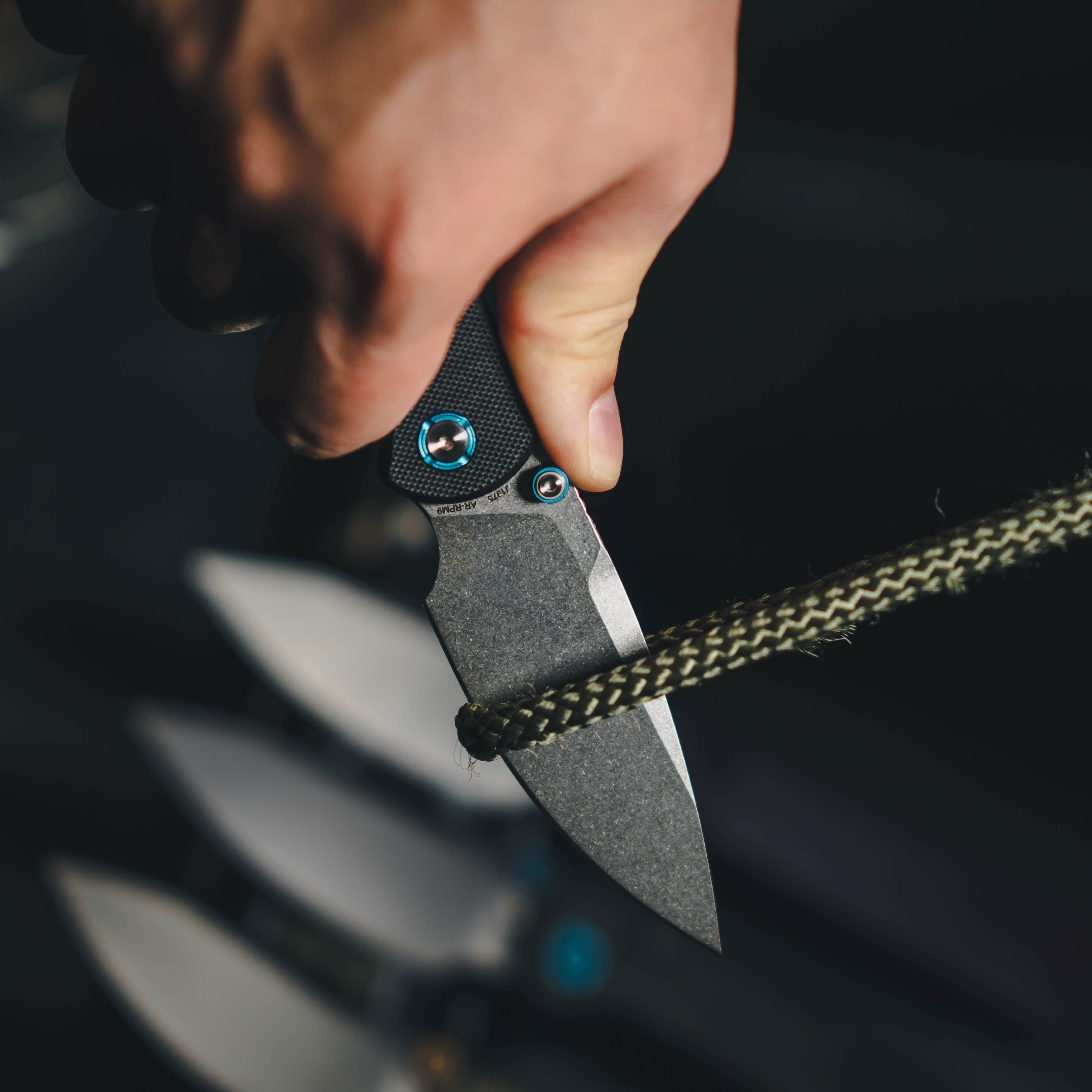
Artisan Cutlery's folding-knife range spans exactly this spectrum — from D2 and AR-RPM9 workhorses up to CPM S35VN, M390 and S90V in titanium. You can browse the full spread in the Artisan Cutlery folding knife collection, or look at a specific example: the Arion ATZ-1843G pairs an S35VN blade with a titanium and Fat Carbon handle, a good illustration of what a modern premium stainless can deliver.
Whichever alloy you land on, the fundamentals do not change: a well-heat-treated steel with good geometry will out-cut a hyped steel with a bad grind every time.


Leave a comment
This site is protected by hCaptcha and the hCaptcha Privacy Policy and Terms of Service apply.