

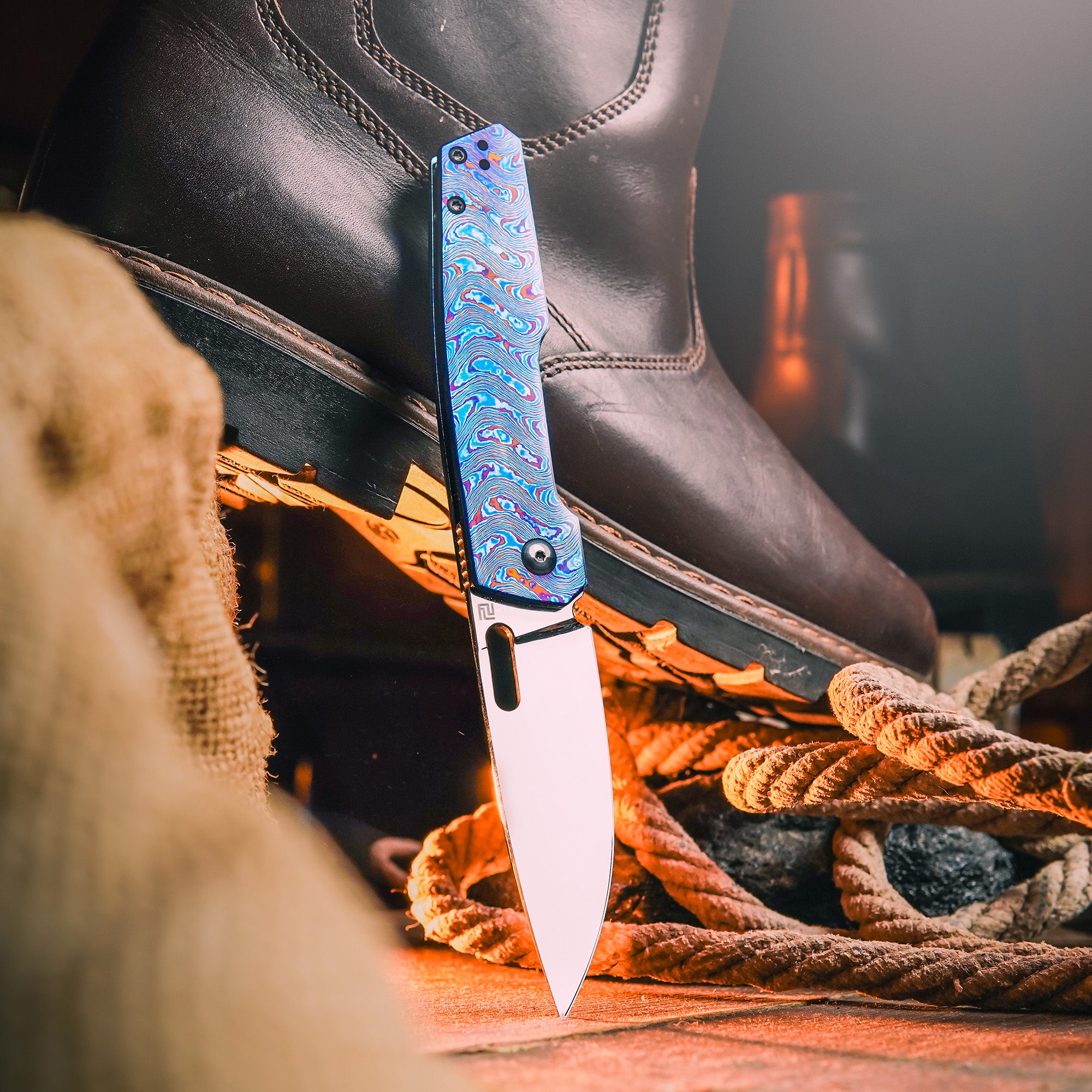
Walk through any high-end custom knife gallery and you will see handles that look impossible: swirling bands of blue, gold, purple and bronze, flowing across a metal surface like an oil slick caught in steel. These are not coatings and they are not Damascus steel. They are titanium Damascus — a family of layered titanium-alloy materials that includes Timascus, Mokuti, Zircuti and zirconium. Understanding what they are (and what they are not) is the difference between buying a beautiful knife and buying a knife that suits how you actually carry it.
Layered titanium and zirconium billets reveal their pattern only after anodising or heat colouring.
What Titanium Damascus Actually Is
Titanium Damascus is a layered composite forged from two or more different titanium alloys — most commonly Grade 5 (6Al-4V) and commercially pure Grade 1 or Grade 2 titanium. Like pattern-welded steel, the layers are bonded into a single billet, then twisted, carved, forged and machined so that the pattern flows through the material rather than sitting on top of it.
The crucial difference from steel Damascus is the anatomy: because the alloys are titanium, the material cannot be hardened to blade-steel hardness. Titanium Damascus is a furniture material. It belongs on handles, bolsters, pocket clips, backspacers and pivot collars — not on a cutting edge.
Timascus: The Original Titanium Laminate
Timascus is the best-known trade name in the category. It is a trademarked titanium laminate associated with Alpha Knife Supply and developed by knifemakers including Tom Ferry and Bill Cottrell, whose manufacturing process was patented. Because it was the first widely available titanium laminate, "Timascus" is often used loosely as a catch-all term for any patterned titanium — the way "Kleenex" gets used for tissues.
- What it is: layered titanium alloys, pattern-welded through the billet
- Where it goes: scales, clips, bolsters, accents
- Signature look: loud, high-contrast multicolour flows after anodising or heat colouring
Mokuti: Titanium Mokume by Chad Nichols
Mokuti is a second titanium laminate, produced by Nichols Damascus (Chad Nichols). The name is a portmanteau of mokume-gane and titanium. Like Timascus it is bonded from 6Al-4V plus commercially pure titanium, but Nichols is known for distinct proprietary patterns and tight quality control. If Timascus is the household name, Mokuti is the connoisseur's alternative — the same physics, a different visual language.
Zircuti and Zirconium: The Dark Contrast
Zircuti is a zirconium-and-titanium laminate, and it exists for one reason: contrast. Zirconium responds to heat and anodising with far darker, blacker tones than titanium, so a Zircuti handle can deliver a near-black background shot through with coloured titanium layers. Pure zirconium is also used for handles in its own right, valued for its heft — zirconium is a dense metal, noticeably heavier in the hand than the titanium it sits beside, and it develops a dark, protective surface oxide.
Mokume-gane: The Japanese Ancestor
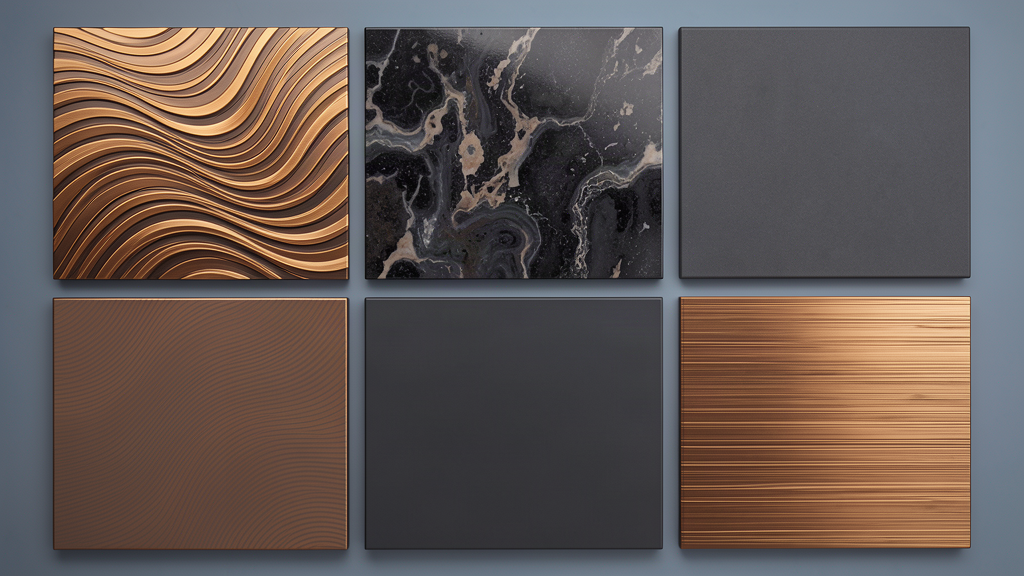
All of these names nod to mokume-gane, a traditional Japanese metalworking technique that layers contrasting non-ferrous metals — copper, silver, gold, shakudō and shibuichi — into a billet and patterns it into wood-grain-like figure. Mokume-gane is not Damascus steel and it is not titanium: it is a laminate of soft, decorative metals, prized on bolsters and guards, and it develops a patina over time. Titanium Damascus is, in effect, mokume-gane's modern aerospace-material descendant.
| Material | Made from | Typical use | Look |
|---|---|---|---|
| Timascus | Titanium alloys (e.g. Grade 2 + 6Al-4V) | Scales, clips, bolsters | Bright multicolour flows |
| Mokuti | Titanium alloys, Nichols patterns | Scales, accents | Distinct proprietary figure |
| Zircuti | Zirconium + titanium | Accents, inlays | Black-and-colour contrast |
| Mokume-gane | Copper, silver, gold, shakudō | Bolsters, guards | Wood-grain metal |
How the Colours Appear
None of these materials is painted or dyed. The colour is a physical effect: when titanium is heated or anodised, a very thin transparent oxide layer grows on the surface, and that layer refracts light much like the rainbow on a soap bubble. Because different titanium alloys grow their oxide at different rates, a single piece can show several colours at once.
There are two ways to create the effect:
- Heat / flame colouring: the piece is torched and shifts through gold, purple and blue as it warms. Organic and richly graduated, but less precise.
- Anodising: the piece is submerged in an electrolyte and driven by a DC supply — voltage sets the colour. Precise and repeatable.
| Anodising voltage (approx.) | Resulting colour |
|---|---|
| 10–15 V | Bronze / dark gold |
| 20–25 V | Dark blue / purple |
| 28–30 V | Bright blue |
| 50–55 V | Yellow / gold |
| 70–75 V | Pink / magenta |
| 90 V+ | Teal / green |
One quirk worth knowing: true red and true black are essentially out of reach on plain titanium, which is exactly why zirconium — with its darker oxide — is so valued for contrast work.
Why These Materials Are Not Blade Steels
It is tempting to imagine a knife with a matching Timascus blade. Resist the idea. Titanium alloys do not harden the way high-carbon steel does, so a titanium Damascus blade would be far too soft to hold a functional edge — it would dull almost immediately.
- Not magnetic — titanium is non-magnetic, unlike steel Damascus.
- Rust-proof — inherently corrosion-resistant; no oiling required against moisture.
- Light — titanium is roughly 45% lighter than steel of the same volume.
- Decorative and structural only — handles, clips and hardware, never a cutting edge.
Care: Protecting the Colour
Because the colour lives in a surface oxide film rather than in the metal itself, it is durable but not indestructible. Hard abrasion or aggressive polishing can dull or remove the effect. In practice the care routine is simple:
- Wipe the surface with a soft cloth and mild soap; skip abrasive polishes.
- Avoid scouring pads and harsh chemicals on coloured surfaces.
- If you carry the knife hard, accept that high-wear spots may lighten — many collectors treat that as honest character.
Where Exotic Materials Fit in a Collection
Timascus, Mokuti and zirconium are collector-grade accents. They signal a build where appearance was treated as seriously as cutting performance — typically paired with a premium blade steel and precise machining. If you are drawn to patterned metal but want something more everyday, Artisan Cutlery's Damascus collection brings pattern-welded steel blades together with titanium and carbon-fibre handles, and the wider folding knife line-up spans everything from D2 workhorses to M390 and S90V titanium. Two representative builds: the Arion ATZ-1843GD (Damascus blade, carbon-fibre handle) and the Blowback ATZ-1822GD (Damascus blade, titanium handle).
Choose titanium Damascus for the look, the light weight and the rust-proofing. Choose Damascus steel when the patterned material needs to actually cut. Knowing which is which is half of collecting well.

Leave a comment
This site is protected by hCaptcha and the hCaptcha Privacy Policy and Terms of Service apply.