
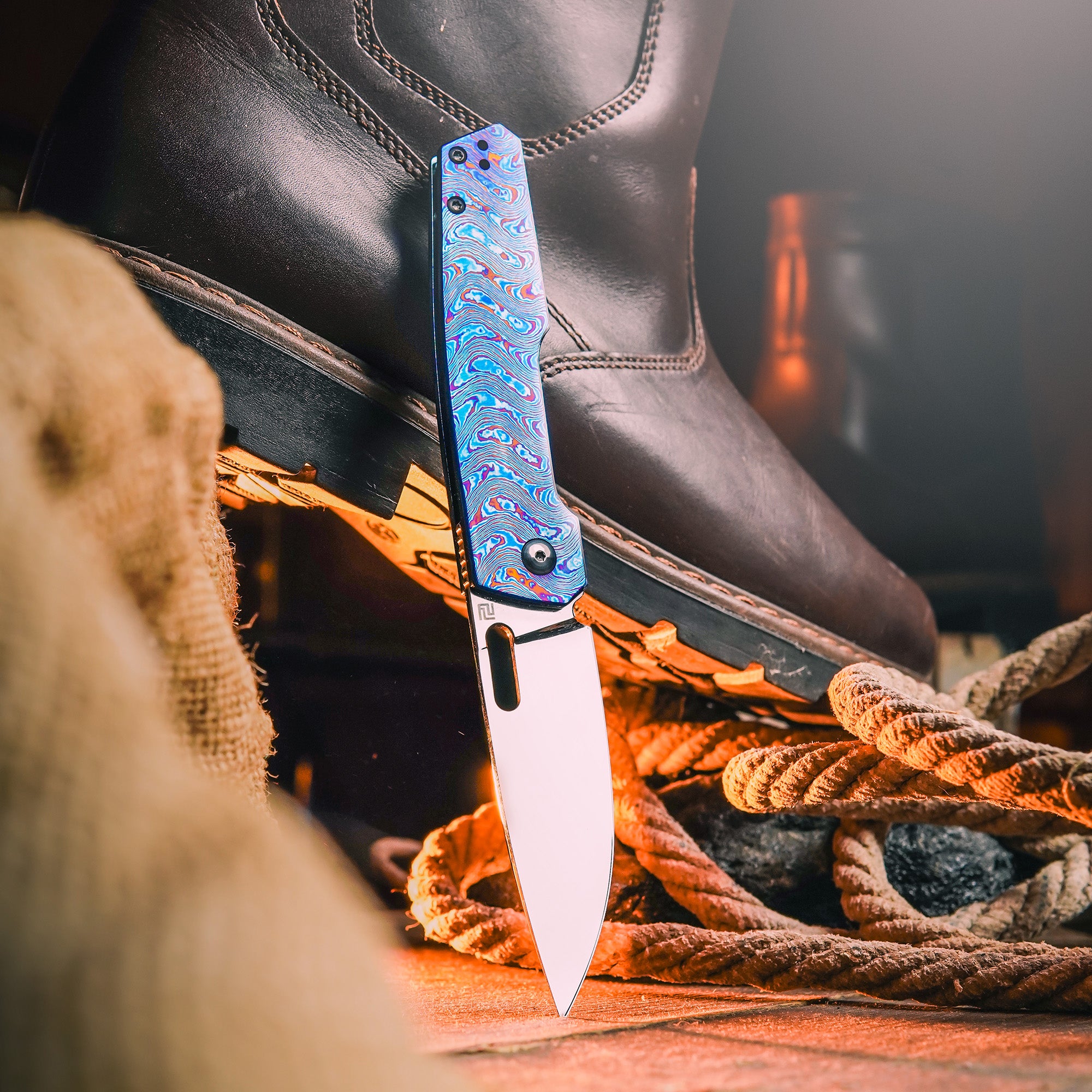
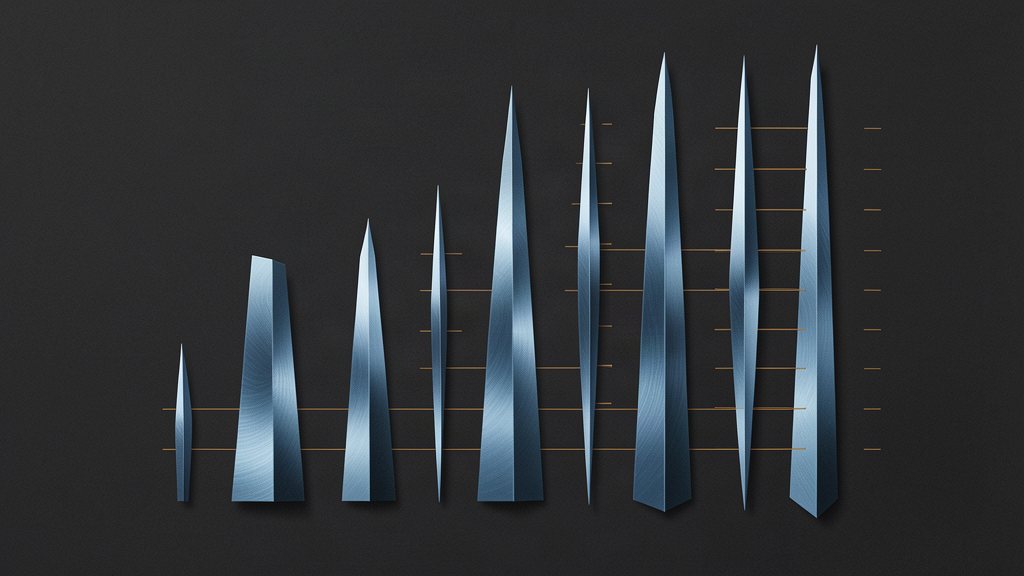
A dagger is defined less by its fittings than by its symmetry: two edges, a centered point, and a blade built to thrust as readily as it slices. That symmetry makes blade length the single most consequential specification on the whole knife. Length decides how the dagger balances in the hand, how much of it disappears into a sheath or a pocket, how quickly the point responds to a change in grip, and — more often than buyers expect — whether the knife is legal to carry where they live.
Yet most buying guides treat length as a footnote, listing a number with no context. This guide takes the opposite approach. It breaks daggers into practical length classes, explains the blade-to-handle ratio that actually predicts how a dagger will feel, and walks through the trade-offs that separate a knife you carry every day from one that lives in a display case.
Why Dagger Blade Length Matters More Than You Think
On a single-edged folding knife, a longer blade mostly means more cutting edge. On a dagger, length changes the geometry of the entire tool. A double-edged blade has to stay symmetrical down its centerline, so every additional inch of length adds mass forward of the hand, shifts the balance point toward the tip, and increases the leverage the blade exerts on the wrist.
That forward mass is not automatically bad. It is what gives a longer dagger its authoritative feel and its smooth follow-through. But it also makes fine work clumsier, makes the knife harder to control in tight spaces, and makes concealment more difficult. The right length is therefore the one that matches the way the knife will actually be used, not the longest blade the buyer can justify.

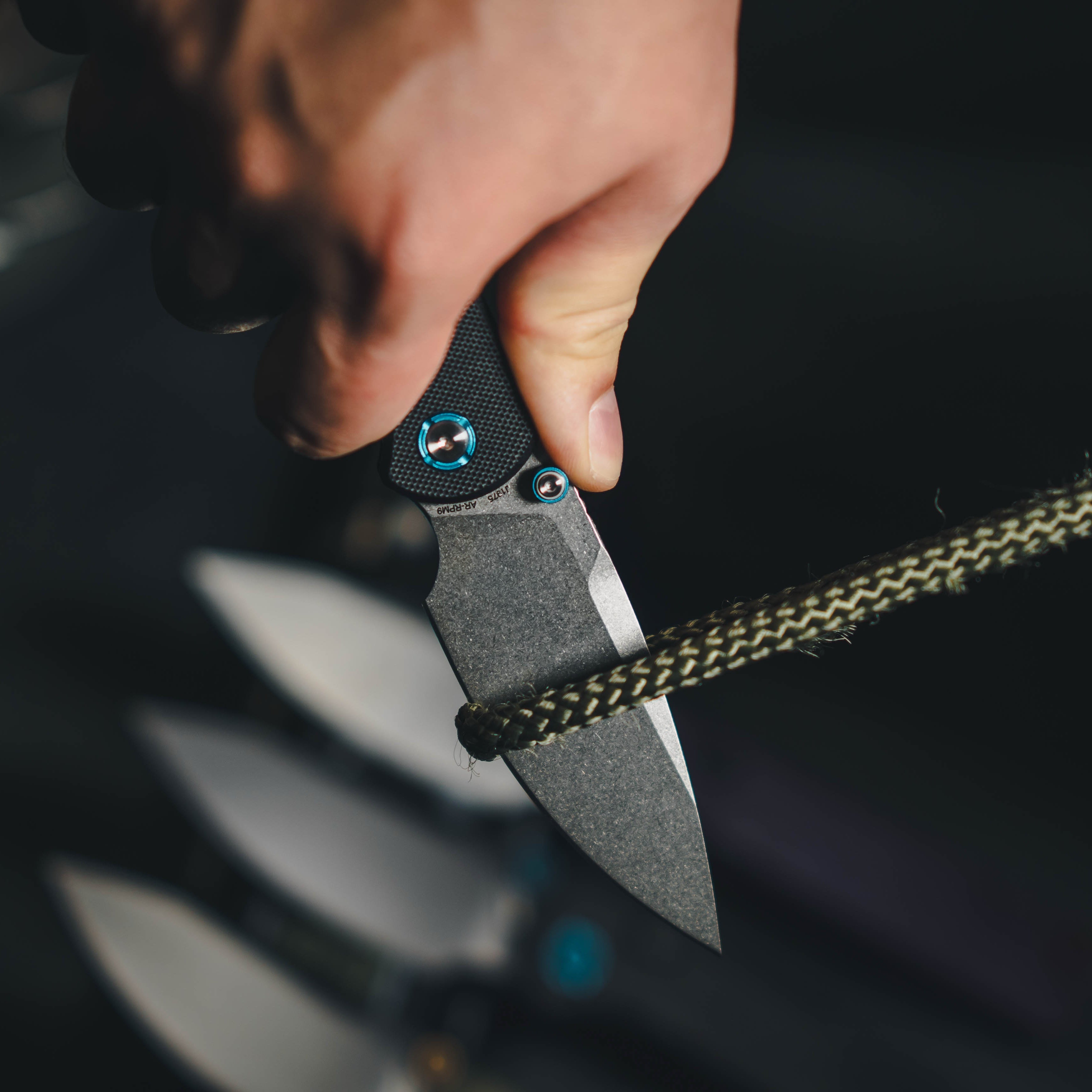
Blade length and blade-to-handle ratio together determine how a dagger balances and controls in the hand.
The Three Practical Length Classes
Daggers sold today cluster into three broad working categories. Treat the numbers as conventions rather than rules — makers vary, and a well-designed knife at the edge of a category can outperform a poorly designed one in the middle.
| Class | Typical blade range | Character | Best suited to |
|---|---|---|---|
| Compact | Roughly 3 to 4 inches | Light, fast, easy to conceal; point control is immediate | Pocket and neck carry, daily utility, backup roles |
| Mid-size | Roughly 4.5 to 5.5 inches | The balance point sits closer to the guard; more reach without much weight penalty | Boot carry, belt carry, general field use, collection centerpieces |
| Long | 6 inches and up | Strong forward presence; slower to redirect; demands a committed grip | Display, historical interest, heavy utility, dedicated outdoor roles |
Compact daggers are the class most people can genuinely carry every day. Because the blade is short, the point sits close to the hand, which makes the knife feel intuitive the first time it is picked up. The trade-off is reach and leverage: a compact dagger does not do heavy work gracefully, and its short edge means more sharpening cycles per year if it is used hard.
Mid-size daggers are where most of the classic military and boot patterns live. The extra inch or two buys noticeably more reach while keeping the knife light enough to carry on a belt or inside a boot without constant awareness. This is also the class where handle design starts to matter as much as blade length, because the longer blade magnifies any mismatch between the handle and the hand.
Long daggers are a different animal. Once a blade passes about six inches, the knife stops behaving like an extension of the hand and starts behaving like a tool with its own momentum. That can be exactly what a collector or a historical-replica buyer wants. It is rarely what an everyday carrier wants.
Blade-to-Handle Ratio: The Number That Predicts Feel
Absolute length tells you how big a dagger is. The ratio of blade length to handle length tells you how it will feel. Most well-balanced daggers land somewhere between a 1:1 and a 1.2:1 blade-to-handle ratio. Push the ratio higher and the knife becomes tip-heavy and fast in the hand but tiring to hold for long periods. Push it lower and the knife feels planted and steady but sluggish.
Two daggers with identical blade lengths can therefore behave completely differently. A knife with a long handle and a compact blade will feel neutral or even handle-heavy, which suits precise work and long cutting sessions. A knife with a short handle and a long blade will feel eager and forward, which suits sweeping strokes and thrusting but punishes fatigue.
When comparing options, measure from the front of the guard (or the front of the handle, on a guardless design) to the tip, and compare that figure against the usable handle length — the distance from the front of the handle to the butt, not including any pommel decoration you cannot grip.
Matching Length to Use
Everyday utility
For opening packages, breaking down boxes, cutting cord, and the dozen small tasks that define daily carry, a compact dagger in the 3 to 4 inch range is almost always the right answer. The blade is long enough to be useful and short enough to control precisely. Full-flat or high-hollow grinds in this class slice cleanly, and the symmetrical tip is genuinely handy for scoring and piercing.
Field and outdoor work
Outdoor use pushes toward the mid-size class. More blade means more reach for cleaning fish, dressing small game, or cutting wet rope, and the extra mass helps with materials that resist a light blade. A mid-size dagger with a sturdy spine and a handle that fills the palm is a practical field companion, though a single-edged design remains the better choice for sustained woodcraft.
Collection and historical interest
Collectors are free to optimize for historical accuracy and visual proportion rather than carry convenience. Long daggers, reproduction patterns, and dramatic blade profiles belong here. The only caution is to buy from makers who can document their materials and heat treatment, because a display piece with an unverifiable steel specification is a decoration, not a knife collection asset.
Legal Blade Length Limits
This is the part of the decision that catches the most buyers off guard. Many jurisdictions regulate the length of a blade that may be carried, and 3 to 4 inches is a common threshold in the United States, with some cities setting stricter limits than the state around them. Separately, daggers are sometimes classified as prohibited weapons regardless of length, or restricted to open carry in specific contexts.
Because these rules vary at the state, county, and municipal level, and because they change, no article can substitute for the current text of your local law. Check your state statute and your city code directly, and if you plan to travel, check the destination too — a knife that is unremarkable at home can be a criminal matter a few hundred miles away. The overview of knife legislation is a reasonable starting point for understanding how the categories are drawn, but the statute itself is the authority.
Folding Dagger vs Fixed Dagger: How Length Changes
A folding dagger loses nothing in blade length by folding, but it loses handle. The pivot and the portion of the handle that must house the blade when closed mean that a folding dagger with the same blade length as a fixed blade will generally have a shorter grip. On a knife designed for thrusting, grip length is not a detail — it is where control comes from.
The practical consequence is that folding daggers tend to feel best in the compact range, where the shorter handle is still long enough to fill the hand. Fixed daggers scale up more gracefully, which is why the mid-size and long classes are dominated by fixed blades. If you want a double-edged knife you can drop in a pocket, look at the folding knife collection; if you want the full-length experience, the fixed blade collection is the better starting point.
How to Grip-Test a Dagger Before You Buy
- Measure your hand, not the knife. Note the distance from the base of your palm to the tip of your index finger. A handle shorter than that measurement will leave your pinky hanging, which is tolerable on a compact utility knife and unpleasant on a thrusting blade.
- Check where the guard lands. With a natural grip, the guard or finger groove should sit just in front of your index finger without forcing your hand backward.
- Feel the balance point. Rest the knife on your index finger. A balance point at or just behind the guard feels neutral; one well forward of the guard feels tip-led.
- Test the point's response. Rotate your wrist slowly with the knife held normally. A well-proportioned dagger follows without lag; an oversized one overshoots.
- Confirm the sheath matches. A long blade in a short sheath, or a compact blade rattling in a universal sheath, undermines everything the length was supposed to buy you.
Length Interacts With Width, Thickness and Grind
Blade length is not read in isolation. A long, thin, distal-tapered blade flexes under lateral load; a short, thick blade with a high saber grind is rigid but a poor slicer. Daggers intended for utility usually benefit from a thinner stock and a full-flat or high-hollow grind, which keeps the edge thin behind the bevel. Daggers intended as display or historical pieces can afford more stock thickness because cutting efficiency is not the priority.
Steel choice compounds the effect. Toughness matters more as blades get longer and thinner, because a long blade sees more bending load. The Knife Steel Nerds reference material is the most rigorous public source on how toughness, edge retention, and corrosion resistance trade against each other, and it is worth reading before assuming that the hardest available steel is the right one for a long, slender dagger.
Common Mistakes When Choosing Dagger Length
- Buying for the fantasy rather than the carry. A knife that stays in a drawer because it is too big to take anywhere provides no utility.
- Ignoring handle length. The most common fit problem on daggers is a grip that is one finger too short, not a blade that is one inch too long.
- Assuming legal means unrestricted. A blade under the state limit can still be a problem under a city ordinance or in a specific venue.
- Overlooking sheath geometry. Retention, draw angle, and ride height all depend on blade length matching sheath design.
- Chasing length for reach. For most practical tasks, control beats reach; a compact dagger used confidently outperforms a long one used cautiously.
Frequently Asked Questions
Is a 4-inch dagger too small for practical use?
No. A 4-inch double-edged blade handles daily cutting tasks comfortably and remains the easiest class to carry legally and discreetly. The limitation is heavy work, not ordinary use.
Do longer daggers cut better?
They cut more per stroke because they present a longer edge, but cutting performance depends more on grind geometry and edge angle than on length. A well-ground compact dagger will out-slice a thick, long one on most soft materials.
What blade length should a first dagger be?
Start in the compact to lower mid-size range. It is the most forgiving to handle, the easiest to carry, and the least likely to run into legal limits. Add a longer piece once you know what you want from it.
Whether you are building a working rotation or a display shelf, the useful question is not "how long can I get" but "how long can I control." Answer that honestly and the rest of the specification falls into place. Browse the full Artisan Cutlery lineup to compare blade lengths, handle shapes, and steel options side by side.


Leave a comment
This site is protected by hCaptcha and the hCaptcha Privacy Policy and Terms of Service apply.