


Understanding Knife Blade Shapes
The shape of a knife blade determines how it cuts, what tasks it excels at, and how it carries. From the piercing point of a clip-point to the slicing belly of a drop-point, each knife blade shape has specific strengths and trade-offs. Whether you're choosing your first folding knife or adding to a collection, understanding blade geometry helps you match the tool to the task.

Each blade shape offers distinct cutting advantages for different tasks.
Below is a breakdown of the most common blade shapes found on modern folding knives, with their best-use scenarios.
Each blade shape offers distinct cutting advantages for different tasks.
Common Blade Shapes Compared
| Blade Shape | Best For | Key Feature |
|---|---|---|
| Drop Point | All-purpose EDC, hunting | Strong tip, curved belly for slicing |
| Clip Point | Detail work, piercing | Concave clip on spine, fine tip |
| Spear Point | Piercing, symmetrical cutting | Centered tip, symmetrical profile |
| Tanto | Tactical, hard-use piercing | Angular tip with high strength |
| Wharncliffe | Box cutting, utility work | Straight edge, strong tip control |
| Sheepsfoot | Safety cutting, rescue | Blunt tip, straight cutting edge |
| Reverse Tanto | EDC, general cutting | Drop-point belly with tanto-style tip |
Drop Point — The EDC Standard
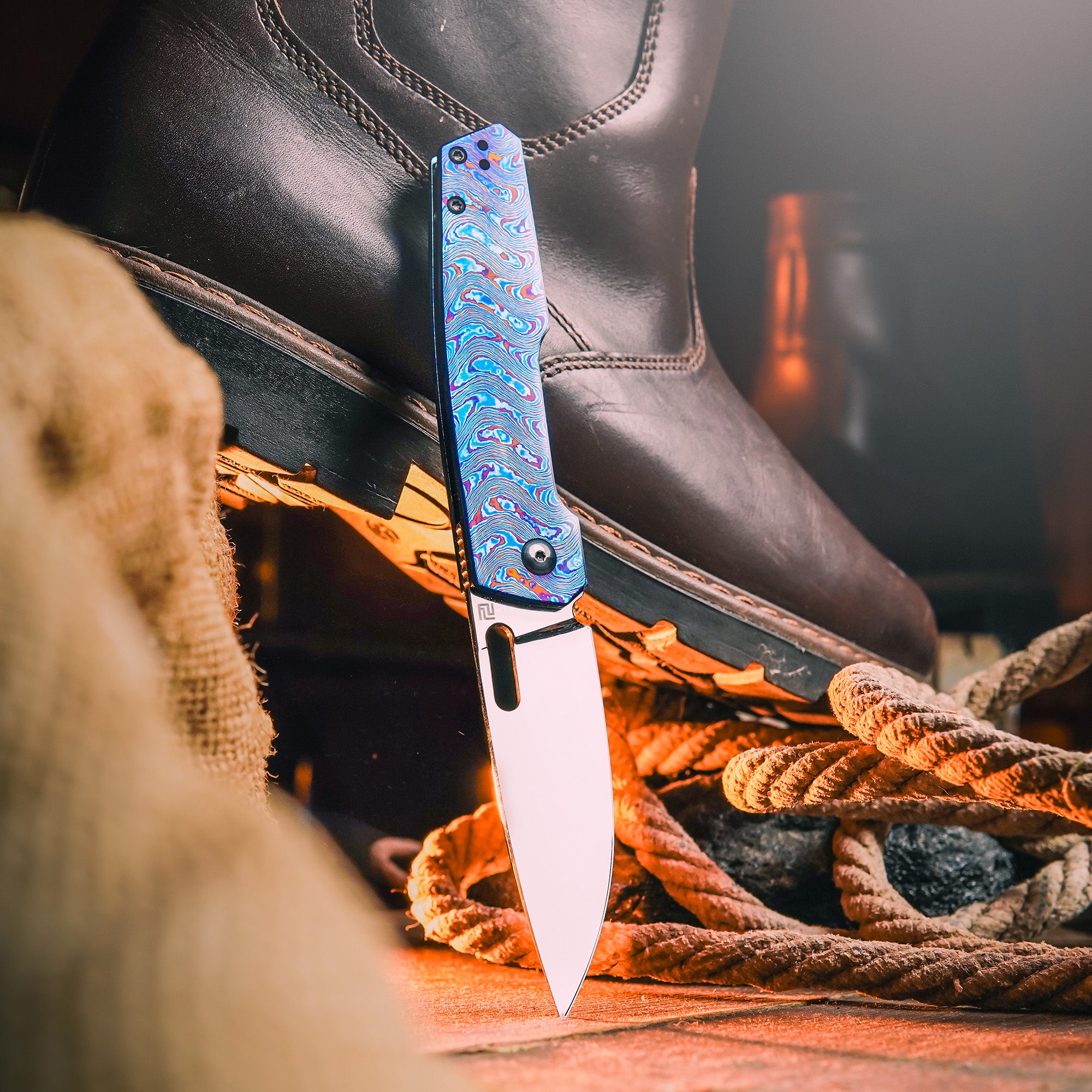
The drop-point blade is the most versatile shape for everyday carry. The spine curves downward toward the tip, creating a strong point that resists breaking while maintaining a generous belly for slicing. This shape is ideal for general-purpose cutting from opening packages to food prep. Most of Artisan Cutlery's folding knife lineup features drop-point variations because of their broad utility.
Clip Point — Precision Piercing
The clip point features a concave curve cut out of the spine near the tip, creating a finer point for detailed piercing work. The iconic Bowie knife popularized this shape. In a folding knife, clip-point blades excel at tasks requiring precise tip control.
Tanto — Tip Strength
Inspired by traditional Japanese swords, the tanto blade uses an angular transition rather than a curved belly, creating an extremely strong tip. This shape is favored for tactical and hard-use applications where tip breakage is a concern.
Wharncliffe — Utility Expert
The wharncliffe blade has a straight edge that meets the spine at the tip, giving maximum cutting edge in a straight line. It's excellent for box cutting, slicing rope, and any task where the entire edge contacts the cutting surface.
Choosing the Right Shape for You
Your choice depends on what you cut most. For general EDC, a drop point or reverse tanto is hard to beat. If you do a lot of box-cutting or utility work, a wharncliffe is ideal. For a do-everything knife that disappears in the pocket, browse the complete Artisan Cutlery catalog and look for the blade shape that matches your cutting habits. For more on blade geometry fundamentals, Wikipedia's blade entry provides an excellent overview of edge geometry and blade terminology.



Leave a comment
This site is protected by hCaptcha and the hCaptcha Privacy Policy and Terms of Service apply.