
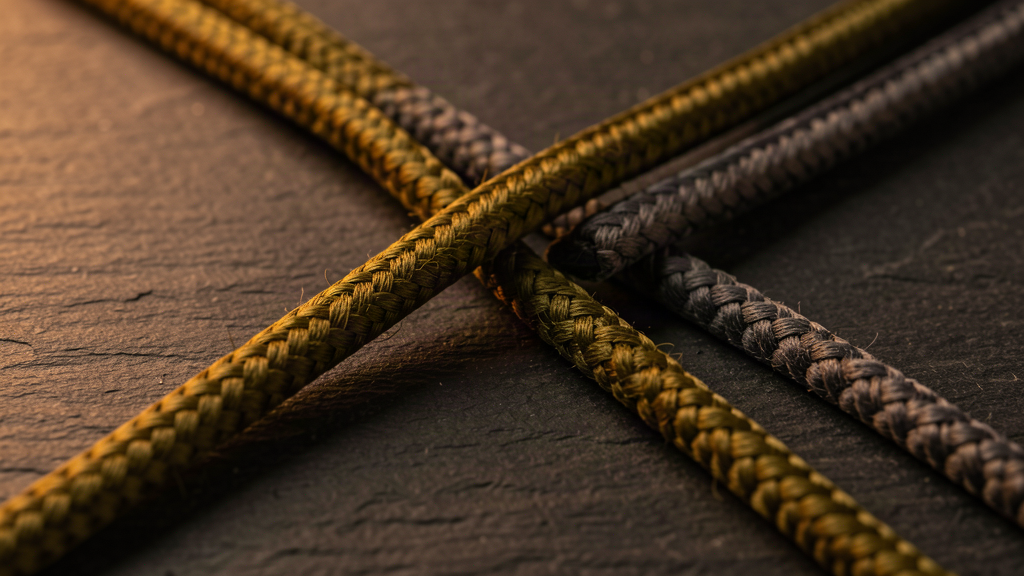
A lanyard is one of the oldest accessories in the world of cutting tools. Defined broadly, it is a length of cord, webbing or strap used for attachment, carrying, restraint or retrieval, and historically lanyards were used to secure exactly the kind of equipment you would hate to drop: weapons, whistles, marlinspikes and knives. On a modern folding knife the idea has shrunk to something much simpler and much more useful: a short loop of cord through the handle that keeps the knife attached to you, easy to fish out of a pocket, and recognisably yours.
An overhand knot is the anchor of almost every knife lanyard — simple, compact, and permanent once loaded.
This guide covers what a knife lanyard actually does, the different ways a knife can accept one, the cords and knots worth learning, how to care for the cord, and when to leave it off entirely.
What a Knife Lanyard Is Really For
A working lanyard does three jobs well and one job badly.
- Retention. Over water, off a ladder, on a roof or anywhere a dropped knife means a lost knife, a cord looped around the wrist or clipped to a belt keeps the tool with you. This is the original purpose and the reason lanyards exist at all.
- Retrieval. A short fob hanging out of a deep pocket turns a two-handed dig into a one-finger pull. On knives with a strong pocket clip and a deep-carry profile, the fob is often the fastest access point you have.
- Identification and control. A cord and a bead give your hand something to find in the dark, and a coloured cord makes it obvious which knife in a drawer is yours.
What a lanyard is not is a substitute for a pocket clip, a grip aid, or safety equipment. A lanyard looped over a wrist during hard cutting can become a snag hazard on anything that rotates, and no knife lanyard is rated to arrest a fall or carry a load. Keep them short, inspect them, and take them off for mechanical work.
Five Ways a Knife Accepts a Lanyard
Attachment hardware varies more than most buyers expect. The catalogue is a good field guide, because the same store carries all five arrangements.
| Attachment | How it works | Example from the catalogue | List price |
|---|---|---|---|
| Lanyard hole | A hole drilled through the handle or back spacer; cord passes through and knots | Artisan Cutlery Eagle 1816P, D2 blade, carbon fibre handle | $60.19 |
| Lanyard hole, premium | Same arrangement on a titanium frame folder | Artisan Cutlery Eagle 1816G, S35VN blade, titanium handle | $199.49 |
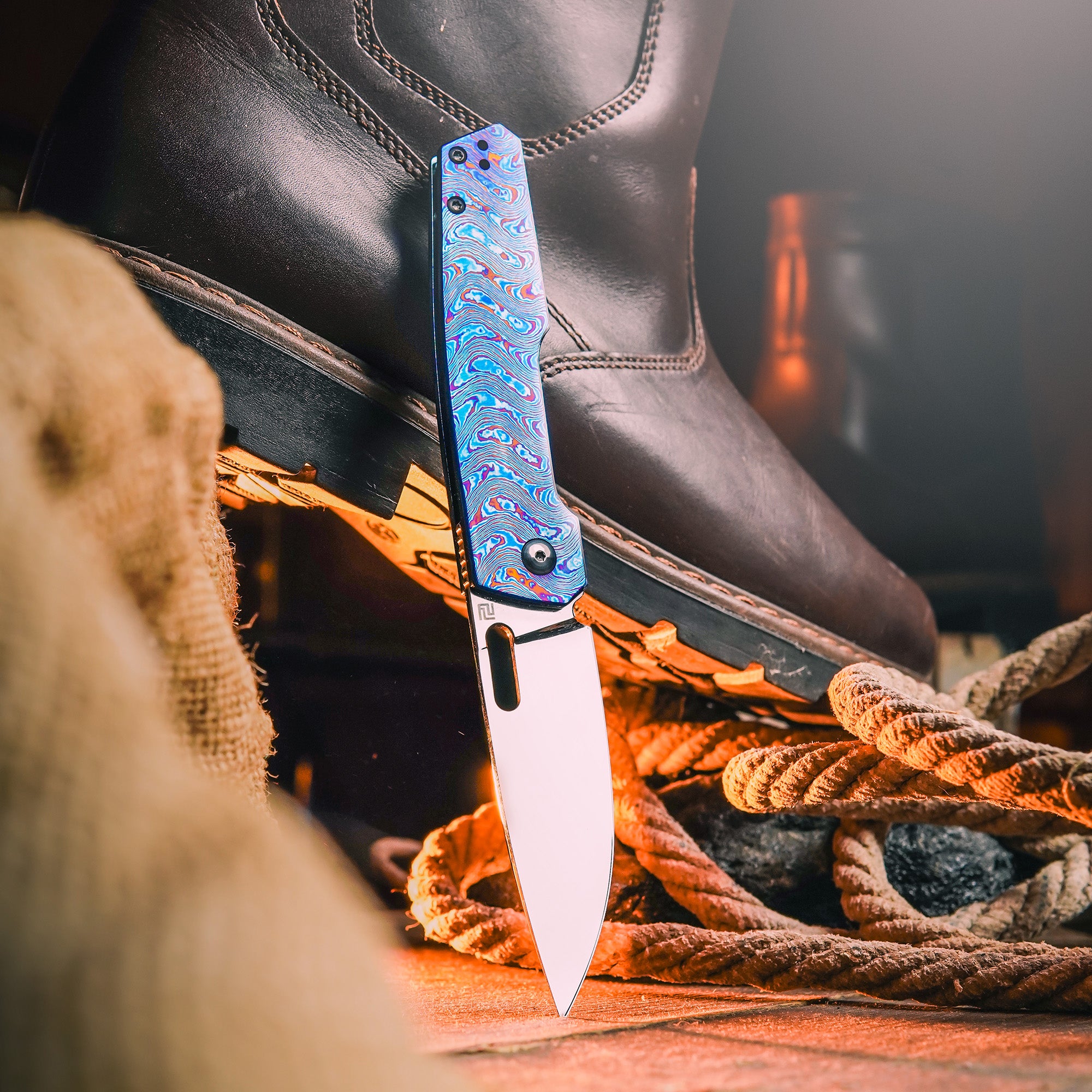
| Hidden lanyard post | A post set into the handle that the cord ties around, so nothing protrudes when unused | Artisan Cutlery Centauri 1839G, S35VN blade, micarta and titanium handle | $199.99 |
| Hidden lanyard hole | A recessed opening in the handle spine; tidy and snag-free | Artisan Cutlery Arion 1843G, S35VN blade, micarta and titanium handle | $199.99 |
| Removable lanyard loop | A dedicated loop piece that can be taken off without touching the pivot | Artisan Cutlery Cobra 1811P, D2 blade, G10 handle | $59.24 |
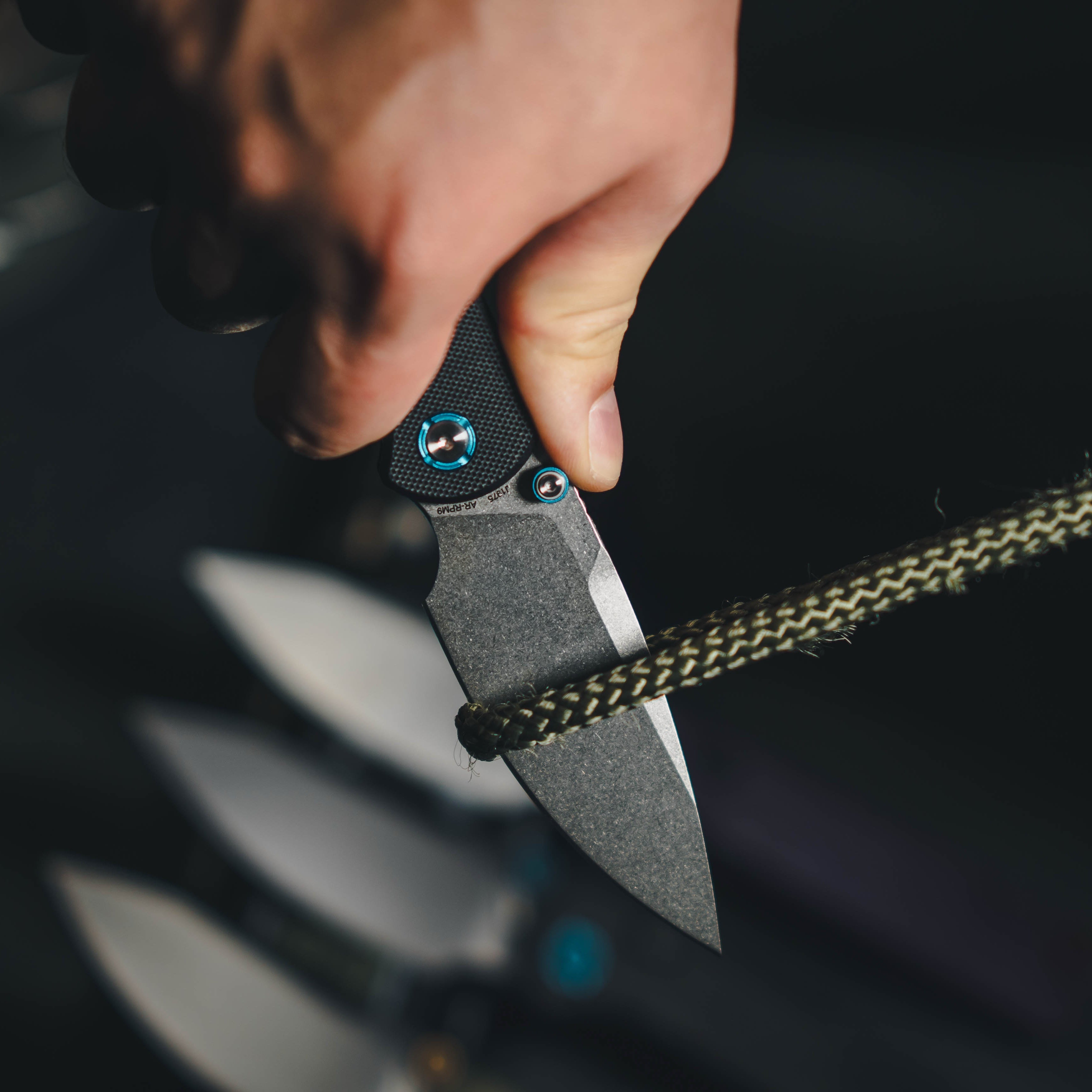
Fixed blades work differently. On the Sea Snake 1842B, an AR-RPM9 fixed blade, the cord lives on the Kydex sheath: the knife ships with an Atwood lanyard on the sheath to make the whole package easier to carry at $39.98. That is the pattern to copy for a sheath knife, because a cord on the handle of a sheathed blade gets in the way of the draw. Small neck knives are the other special case: the CJRB Spud uses a secure lanyard clip with a quick release system, so the cord can break away under load, which is exactly what you want around a neck.
Prices above are the list prices on the site at the time of writing.
Cord Materials Compared
| Cord | Strengths | Weaknesses | Best for |
|---|---|---|---|
| 550 paracord (Type III) | Braided nylon sheath over seven inner cords; strong, washable, easy to seal by melting | Nylon stretches slightly; bulky on small knives | Most folding knives, wrist loops, fobs |
| Leather thong | Traditional look, ages and darkens with use, lies flat | Not washable, dries out, cannot be melted to finish an end | Classic folders, fixed blades, sheath lanyards |
| Thin nylon or polyester cord | Low profile, wide colour choice, cheap to replace | Less abrasion resistance than paracord | Tight lanyard holes, dress knives |
| Bead chain or cord with a bead | Turns the lanyard into a pull tab and a fidget piece | Hardware can rattle or scratch a handle finish | Deep-carry folders, collectors |
Paracord deserves its reputation. Genuine MIL-SPEC MIL-C-5040 Type III cord has seven inner cords each made of three strands inside a braided sheath of around 32 interwoven strands, and because the whole construction is nylon it is slightly elastic and can be finished by melting the cut end into a rounded stopper. The inner strands can also be pulled out and used as thread or fishing line in a pinch, which is why the cord shows up in so many pocket kits.
The Three Knots That Cover Nearly Every Knife Lanyard
Overhand knot
The workhorse. It is one of the most fundamental knots in existence, the basis for dozens of others, and it works as a stopper exactly as it is. The catch is that it jams badly under load, so treat it as a knot you intend to leave in place.
The diamond knot, also called the knife lanyard knot
This is the decorative knot that turns a plain loop into a finished-looking fob, and it is literally named for this job: the diamond knot is a knot for forming a decorative loop on the end of a cord such as on a lanyard, and many people call it the knife lanyard knot precisely to distinguish it from the larger four-strand version. It is a four-strand diamond implemented in two strands, which is why a single piece of paracord can produce such a chunky, tidy knot.
Square knot, properly the reef knot
The reef knot joins two cords of similar diameter in a flat, symmetric package. It is a good way to close a loop or tie off a decorative wrap, and a bad way to join anything that will be pulled hard in two directions, since it capsizes into a slip knot under that kind of load.
None of these knots is a life-safety knot, and none of them should be trusted to hold a knife you cannot afford to drop. A lanyard is a convenience, not a rated system.
Step by Step: Tying a Beaded Knife Lanyard
- Cut the cord. Roughly 45 to 60 cm of paracord is enough for a fob with a bead and a knotted finish. Cut more than you think you need, then trim later.
- Fold it and pass it through. Fold the cord in half and push the loop or both ends through the lanyard hole or around the lanyard post, depending on your knife. On small holes, a piece of thin wire looped through first makes a good threader.
- Even up the two strands and pull the cord snug against the handle. It should not be loose enough to spin or tight enough to dent the finish.
- Tie your first overhand knot close to the handle. This is the anchor knot that stops the cord pulling back through the hole.
- Slide on the bead, if you are using one, and push it down until it seats against the anchor knot.
- Tie a second overhand knot directly above the bead. This pair of knots traps the bead and gives you something solid to grab.
- Trim and finish the ends. Leave about 5 mm of cord, then melt nylon ends with a lighter and press the softened end flat, or tie off leather and trim it clean. Never melt cord while it is still threaded through a knife hot enough to touch the handle finish.
- Test it. Pull firmly on the finished lanyard to seat every knot, then check that the blade still closes completely and the cord does not fall into the blade path.
If the cord ends up in the way of your grip, shorten the whole assembly rather than tucking it into the handle. A lanyard that changes where your fingers sit on the handle has cost you more than it gave you.
Beads: Titanium, Brass, Copper and Zirconium
Beads are the decorative half of the hobby, and the material choice is mostly about weight and how it ages. Titanium is light and highly corrosion resistant, which is why it appears on premium knife handles as well as on beads, and it can be anodised to colour. Brass and copper are heavy for their size and develop a patina as they oxidise, which some carriers polish off and others deliberately cultivate. Zirconium sits at the other end of the density scale with a dark, hard oxide layer that gives a near-black finish.
Functionally, a bead does three things: it stops the loop from slipping through a tight lanyard hole, it gives your fingers a solid purchase point when you pull the knife from a pocket, and it makes the knife unmistakably yours. Pair the bead with the cord rather than the handle, and keep the total weight in mind on small, thin folders where every gram shows up in the hand.
Care, Inspection and Replacement
- Wash the cord. Warm water and a little mild soap will lift body oils and grit out of a braided sheath. Let it air dry fully before it goes back on the knife.
- Look for fraying, glazing and flattened spots at the knot and where the cord passes through the handle. Those are the two points that wear first.
- Re-melt nylon ends that have worked loose, and replace any cord that has gone stiff and brittle.
- Check the bead. A bead with a sharp inner edge will saw through a cord over months of pocket carry; smooth the bore or replace it.
- On a fixed blade, check the sheath lanyard. Leather dries out and stiffens, and a worn sheath cord is the part most likely to fail on a knife that otherwise never leaves its sheath.
- Inspect the attachment point itself. A lanyard hole with a burr inside will cut a cord from within. Run a fingernail through it; if it catches, address the handle rather than the cord.
When to Skip the Lanyard
There are situations where the cord costs more than it returns. Anywhere a loop can catch on rotating machinery, moving parts or a seatbelt, a lanyard is a liability, not an accessory. The same goes for very deep-pocket carry where a fob invites a snag, for knives used by young children, and for any neck carry that does not include a breakaway. If your knife already comes out of the pocket cleanly thanks to a well-tuned clip and a deep-carry profile, you are not missing anything by leaving the cord in the drawer.
For everyone else, a lanyard is the cheapest upgrade a knife can take. A metre of paracord, one good knot and a bead will change how the knife carries, and it will still be working years after the latest trend has moved on.
Every knife above is a real, in-stock configuration. Browse the Artisan Cutlery collection for folders with lanyard holes, hidden lanyard posts and removable lanyard loops, plus fixed blades that ship with a corded sheath.

Leave a comment
This site is protected by hCaptcha and the hCaptcha Privacy Policy and Terms of Service apply.