
CJRB is the easiest brand in this catalogue to misunderstand. It shares a factory with Artisan Cutlery, it shares a website, and its knives are priced like imports — which leads people to assume it is a budget sub-line of the same knives. It is not. CJRB is a separate brand with its own designs, its own model numbering, and its own material choices, and once you understand the J-code on the box you can read a CJRB knife's specification without opening the spec sheet.
CJRB builds its line around a handful of steels, four lock families, and a model number that tells you the design generation.
This guide covers the four things buyers actually ask about: what CJRB is, who makes it, what the model numbers mean, and which steels and locks the 255 active CJRB knives on this store are built from.
What CJRB Is, and Who Makes It
CJRB launched in 2019 as a separate brand built by the company behind Artisan Cutlery. Artisan Cutlery itself was founded in 2018 as a US-based company working directly with its manufacturing facility in Yangjiang, China — that history is on the brand's own about page. The CJRB brand was created a year later, in the company's words, to answer growing demand for more budget-focused tools.
The brand's own description of the relationship is specific: CJRB models are manufactured in the same facility as the higher-end Artisan Cutlery line, and the company positions CJRB as standing on its own rather than as a stripped-down version of the premium brand. Both statements come from CJRB's published brand material at cjrb.net and its current site at cjrbcutlery.net.
Where CJRB Knives Are Made
CJRB knives are machined and assembled in the same facility as Artisan Cutlery knives. That is the brand's own claim, stated in the same paragraph on both of its sites, and it is the reason the two brands share steel choices, hardware, and quality-control processes without sharing designs.
The company is registered in the United States — ARTISANCUTLERY INC, with a mailing address in Chino Hills, California, per the brand's own contact information. Note what that address is and is not: it is the company's US business address, not a production site, and the brand states plainly that it is not a returns address. If you are trying to work out why a CJRB knife feels like an Artisan Cutlery knife, the answer is the shared factory floor and machining team, not a shared distribution warehouse.
What the J-Codes Mean
Every CJRB model carries a code of the form J followed by four digits. Across the store's active catalogue those codes run from J1901 to J1975, with 59 distinct codes currently represented — so the number identifies the step in the brand's design sequence, not the price or the steel.
The part after the code identifies the configuration. The clearest examples sit in the Latitude line: J1975-BK is the black G10 knife, J1975-GD is the glow-in-the-dark G10 version, J1975-GDBN moves that glow material to micarta, and J1975-CF marks the carbon fiber knife with the S35VN blade. The suffix is the configuration key; the four digits are the design.
One question CJRB buyers ask has no published answer: the brand writes its name as four letters in every piece of its own material, and neither of its sites expands the letters. What the catalogue does document is the numbering system above — which is more useful anyway, because the code is what tells you whether two listings are the same knife.
The Feldspar line shows how far one code stretches. J1912 is the base knife, J1912S is the small version, and J1912Ti marks the titanium and S35VN limited edition — three different knives that a shopper looking only at model names would read as one.
The Steel Lineup
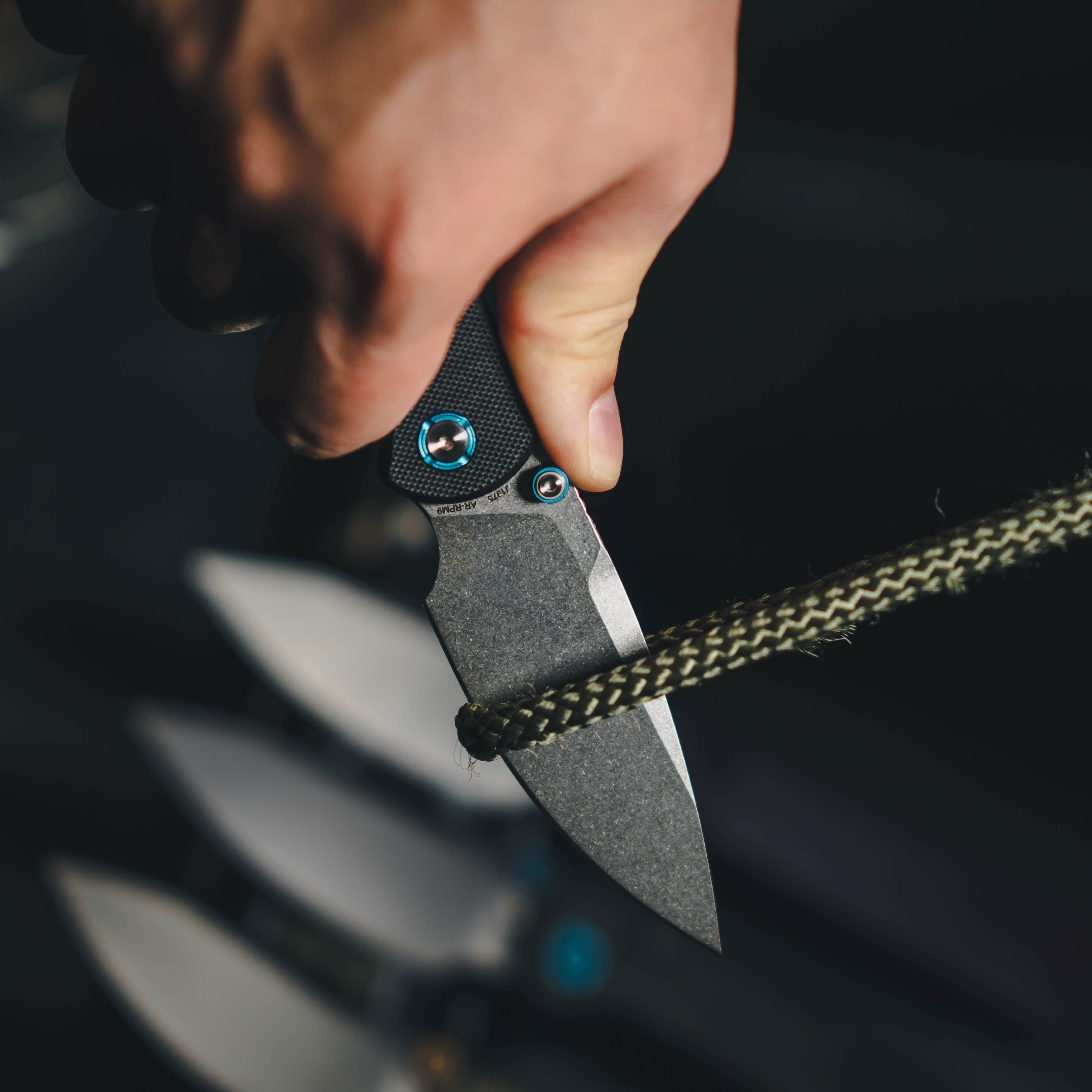
CJRB's own site lists three core steels with hardness ranges: AR-RPM9 at 59-61 HRC described as its proprietary workhorse steel, D2 at 58-60 HRC as a semi-stainless tool steel with high wear resistance, and Sandvik 12C27 at 57-59 HRC as the budget option. Those three cover the bulk of the line, with premium alloys appearing on specific models.
| Steel | CJRB listings that name it | Where it appears |
|---|---|---|
| AR-RPM9 | 179 | The default steel across the line, from the $29.99 Pyrite-Light to titanium models |
| D2 | 36 | Tool-steel versions of Crag, Gobi, Feldspar, Tundra, Doubletap |
| S90V | 28 | Premium editions of Pyrite, Bolt, Lanky, Maximal |
| CPM S35VN | 10 | Upgraded editions including the Latitude J1975-CF and Tundra |
| Damascus | 10 | Pattern-welded editions of Pyrite and Feldspar |
| 12C27 / 20CV | 2 / 2 | Sandvik budget blades and 20CV premium editions |
The practical reading of that table: if a CJRB listing does not name a steel, assume AR-RPM9, because it accounts for roughly seven out of every ten CJRB knives on the store. If you are choosing between AR-RPM9 and D2, the trade-off is wear resistance against corrosion resistance — our budget tool steel comparison runs the numbers, and the AR-RPM9 explainer covers the powder process behind the default steel.
Locks, Deployment, and Where CJRB Spends Its Money
CJRB does not build its line around one lock. Four families are in active use, and the counts below are how many of the 255 active CJRB listings name each one:
| Lock family | CJRB listings | Representative models |
|---|---|---|
| Button lock | 104 | Pyrite, Ekko, Mica, Maximal line siblings, Chord |
| Liner lock | 101 | Latitude (top liner), Rodayo, Maileah, Crag, Anansi |
| Crossbar lock | 27 | Hectare, Maximal, Prado, Lyrid |
| Recoil lock V2 | 17 | Doubletap, Bolt, Crag R variants |
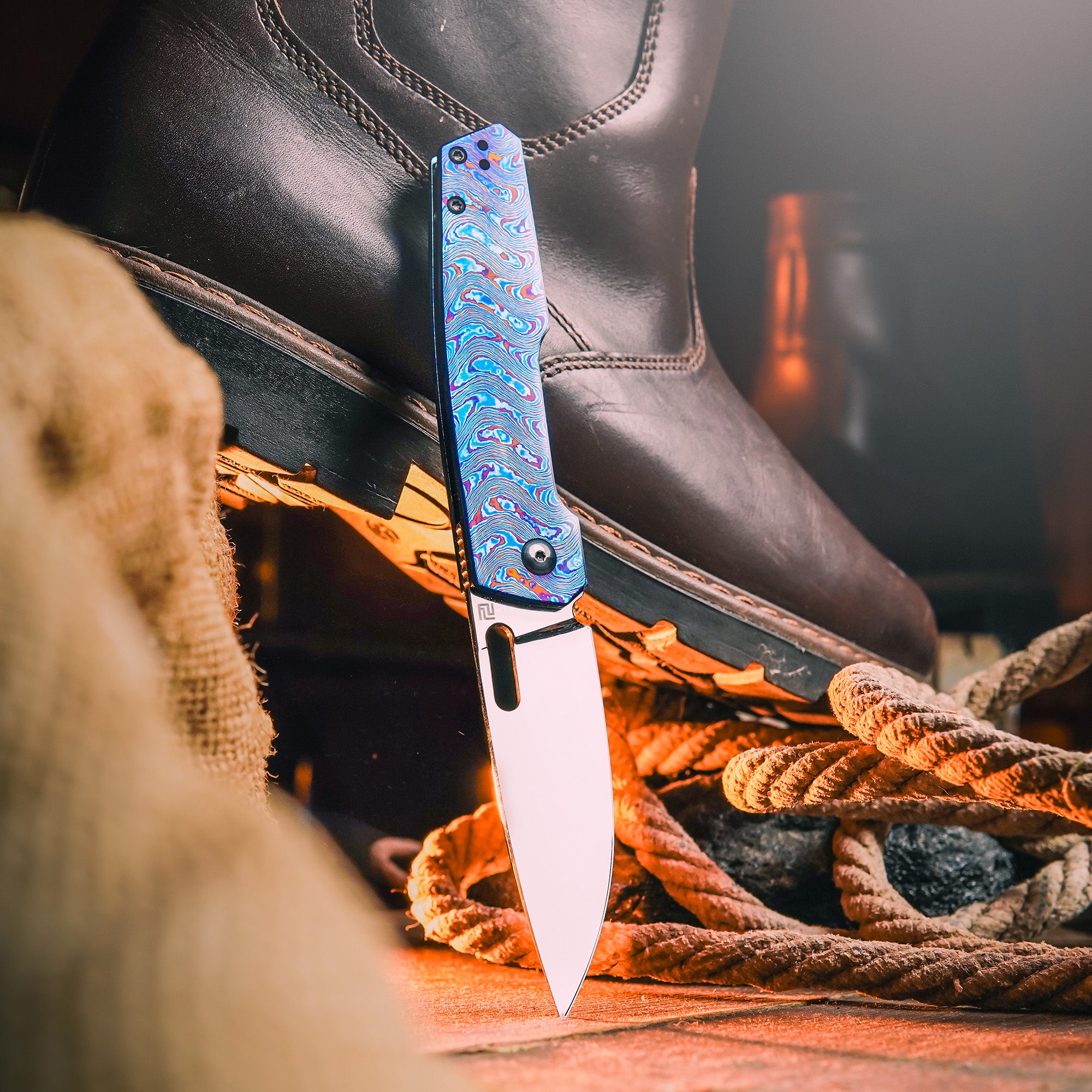
Only four CJRB listings name a frame lock — the titanium and premium editions — which is the clearest sign of where the brand's price ladder sits. Alongside the locks, deployment methods are mixed deliberately: thumb studs on the Latitude, thumb holes on the Frack and Ruffian, front flippers on the Nanner and Ekko, and flipper tabs on the Rodayo and Tundra. If you are still choosing a deployment method, our deployment methods comparison covers the trade-offs.
The Models Worth Knowing
| Model | Code | Blade | Steel | Lock | Price from |
|---|---|---|---|---|---|
| Pyrite-Light | J1945 | 3.34 in wharncliffe | AR-RPM9 | Button lock | $29.99 |
| Maileah | J1918 | 2.39 in wharncliffe | AR-RPM9 | Liner lock | $30.99 |
| Ria | J1917 | 2.95 in drop point | 12C27 | Liner lock | $32.98 |
| Anansi | J1964 | 1.61 in hawksbill | AR-RPM9 | Liner lock | $34.99 |
| Crag | J1904 | 3.43 in cleaver | D2 | Liner lock | $35.99 |
| Mica | J1934 | 2.36 in drop point | AR-RPM9 | Button lock | $36.79 |
| Gobi | J1906 | 3.5 in upswept | AR-RPM9 | Liner lock | $39.95 |
| Frack | J1931 | 3.9 in drop point | AR-RPM9 | Button lock | $42.99 |
| Pyrite Wharncliffe | J1925A | 3.11 in wharncliffe | AR-RPM9 | Button lock | $43.32 |
| Maximal | J1954 | 2.95 in drop point | AR-RPM9 | Crossbar lock | $49.99 |
| Ekko | J1929 | 3.23 in wharncliffe | AR-RPM9 | Button lock | $49.99 |
| Kestrel | J1962 | 3.31 in wharncliffe | AR-RPM9 | Liner lock | $49.99 |
| Latitude | J1975 | 3.47 in drop point | AR-RPM9 | Top liner lock | $54.99 |
| Rodayo | J1972 | 3.78 in drop point | AR-RPM9 | Liner lock | $54.99 |
| Prado | J1936 | 3.76 in clip point | AR-RPM9 | Crossbar lock | $57.00 |
| Tundra | J1966 | 3.78 in drop point | D2 | Liner lock | $69.99 |
| Doubletap | J1970 | 3.86 in drop point | D2 | Recoil lock V2 | $69.99 |
Prices are the lowest in-stock configuration of each model at the time of writing; several models also come in titanium, premium-steel, or Damascus editions that cost more. The Ekko is a Ray Laconico collaboration and the Kestrel and Prado are his designs too, which is a useful reminder that CJRB is not a house-brand exercise — the company works with named designers and pays for the designs, then builds them in its own facility.
How to Choose Your First CJRB
The catalogue splits almost cleanly into three bands, based on the lowest in-stock price of each model:
- Under $40 (57 listings in stock): Pyrite-Light, Maileah, Ria, Anansi, Crag, Mica, Gobi, Boxer. Small blades, liner and button locks, G10 or FRN or aluminium handles.
- $40 to $60 (the largest band, 98 listings in stock): Frack, Pyrite Wharncliffe, Maximal, Ekko, Kestrel, Latitude, Rodayo, Prado. This is where crossbar locks, micarta, and the 3.5-inch blade sizes live.
- $60 and up (45 listings in stock): Tundra and Doubletap at the entry to this band, and the titanium, S90V, and Damascus editions above them.
That last band is where CJRB stops being a budget-only proposition. The line includes limited editions with titanium handles and premium blades — the Pyrite J1925T-GCF in CPM S90V and titanium, the Feldspar J1912Ti in S35VN and titanium, and Damascus Pyrite and Feldspar editions — so the catalogue covers the same arc as the Artisan Cutlery line, just starting lower.
The shortcut version: buy the steel you want first, then the lock, then the handle. A $43.32 Pyrite Wharncliffe already delivers AR-RPM9 and a button lock, which is the same core specification as knives costing twice as much — the money above that line buys handle material, blade length, and premium alloys.
CJRB Knives FAQ
Are CJRB knives made in the same factory as Artisan Cutlery?
Yes. CJRB states that its models are manufactured in the same facility as the Artisan Cutlery line and machined and assembled by the same team.
What does CJRB stand for?
The brand uses the four letters without publishing an expansion in its own material. The documented naming system is the model code: J followed by four digits, with a suffix for the configuration.
Is CJRB a budget brand or a real knife company?
It is a separate brand with its own designers, its own model numbering, and its own material specification — 255 of the 558 active products on this store are CJRB models, and the line spans $29.99 budget folders to titanium editions.
See the full CJRB Cutlery collection to browse every model in one place, or start with the newest arrivals in the CJRB new arrivals range.

Leave a comment
This site is protected by hCaptcha and the hCaptcha Privacy Policy and Terms of Service apply.