

Ask five knife people what a spring knife is and you may get five different answers. The Wikipedia entry on the switchblade lists it as one of the many names for an automatic knife: a pocketknife with a sliding or pivoting blade contained in the handle, extended automatically by a spring when a button, lever or switch on the handle or bolster is activated. Yet the same two words appear in listings for spring-assisted folders, where the spring only finishes an opening you started by hand. And in older catalogues, a spring knife was simply a traditional pocketknife whose blade is held open by a backspring, with no button and no lock at all.
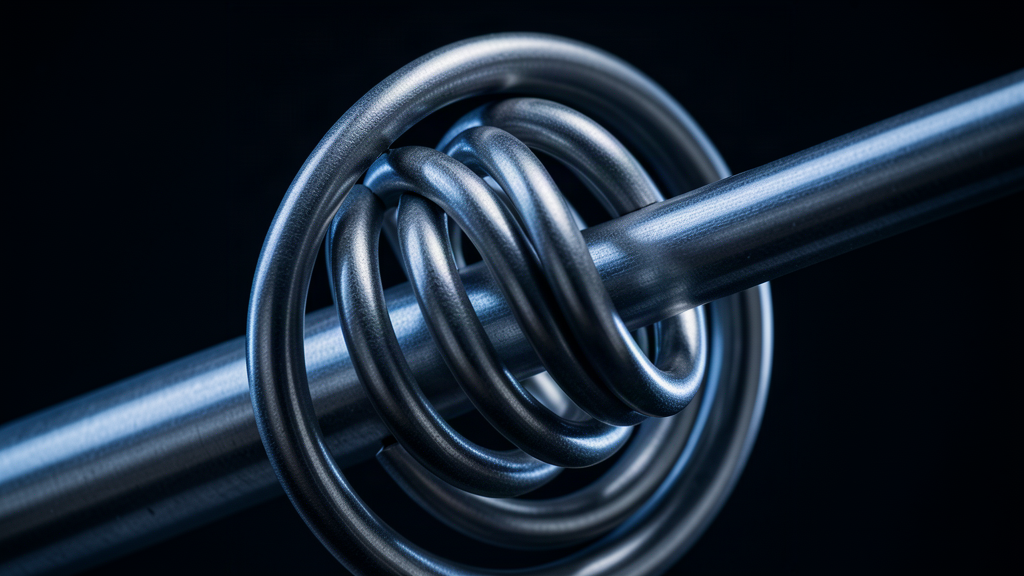
A torsion spring stores energy by twisting about its axis — the same principle behind the assist in a spring-assisted folder.
All three are spring knives in some sense, and all three behave very differently in the pocket, at the workbench and in front of a state statute. This guide pulls the three meanings apart, explains what each spring actually does, and shows why most modern everyday-carry folders are built without one.
What Does 'Spring Knife' Actually Mean?
The phrase is a shop-worn umbrella term covering three distinct mechanisms:
- Automatic (switchblade): the spring does all the work. Press a button, lever or bolster switch and the blade swings or slides out under spring pressure, then locks open.
- Spring-assisted: the spring does part of the work. You push the blade partway with a flipper tab or thumb stud, and an internal spring snaps it the rest of the way into the locked position.
- Backspring folder (slip joint): the spring does no opening work at all. It puts tension on the blade tang so the blade stays open while you cut, and the blade folds under firm spine pressure because there is no lock.
If you are shopping, reading a review or checking a statute, work out which of the three is meant before acting on it. The legal treatment, the maintenance schedule and the feel in hand are all different.
The Three Springs Inside a Folding Knife
| Spring type | Where it sits | What it does | Typical knives |
|---|---|---|---|
| Backspring (leaf spring) | Along the spine, bearing on the blade tang | Holds the blade open and closed by tension alone; many classics add a half-stop | Traditional slip joints, lockbacks |
| Torsion bar | In the liner beside the pivot | Stores torque and swings the blade through the last part of its travel after your manual start | Spring-assisted folders |
| Coil spring, often a pair | Inside the handle, behind the blade channel | Drives the blade straight out along a track, and on double-action designs pulls it back in | Out-the-front automatics |
Not every knife spring is coiled. A torsion spring stores mechanical energy by being twisted about its axis, and a torsion bar is nothing more exotic than a straight bar loaded that way. A coil spring stores its energy in a helix that returns to its natural length when the load comes off. Designers pick whichever geometry fits the space inside the handle.
Meaning 1: the Automatic Knife, the Literal Spring Knife
The automatic is the original spring knife. The blade lives inside the handle and a spring throws it open the instant you hit the release. Virtually all of them also have a locking blade, so the knife cannot fold on your fingers while open, and an unlocking mechanism you must deliberately operate to close it. Side-opening automatics use a coil or leaf spring acting on the blade, and most add a safety that blocks accidental activation. Out-the-front knives send the blade straight out through the front of the handle instead.
Double-action out-the-front knives are worth understanding because they are the most spring-dependent folders made. A schematic of the type shows a main spring stretched across the handle, two spring carriers riding in a slide, and small restraining pins that drop into notches in the blade to lock it open and closed. Push the thumb stud forward and you stretch the main spring past a ramp, the pin leaves its notch, and the blade travels out; pull back and the same spring returns it. Because the spring is charged by your thumb, the opening force is roughly the force you put in, which is why a double-action out-the-front knife cuts nothing you did not ask it to. The trade-off is mechanical: on that design a single small restraining pin is the only thing holding the blade open, and it is the part that suffers first if the knife is abused.
One vocabulary warning. Switchblade, flick knife, pushbutton knife and gravity knife all appear as loose synonyms, but a true gravity knife relies on inertia or centrifugal force rather than a spring. Courts and legislators treat the two mechanisms separately, which is why the wording of a statute matters more than the nickname. We break the mechanisms down further in our guide to automatic and out-the-front knives.
Meaning 2: the Spring-Assisted Knife
A spring-assisted knife is a folding knife that uses an internal mechanism to finish the opening once the user has partially opened it with a flipper or thumb stud. In the closed position the blade is held by torsion springs, with a blade lock optional. Apply manual pressure to the stud or flipper, and a mechanism such as a torsion spring travels along a track in the liner and rapidly rotates the blade into the open, locked position.
Two details matter to owners. First, the assist is a wear item on a track, so the mechanism responds well to being kept clean; pocket lint and dried lubricant in that channel are the usual cause of a sluggish assist. Second, an assist is not a substitute for using the knife properly. The blade still needs a deliberate push to start, which is the whole reason the category exists in jurisdictions that distinguish assisted opening from automatic opening. If you are weighing the two, our comparison of assisted-opening and manual folding knives covers the practical differences.
Meaning 3: the Backspring Folder
Here the spring is a retention device, not an opening device. A backspring is a leaf spring running along the spine that presses down on a flat on the blade tang. Open the blade and the spring rides onto the tang flat, holding the blade extended by tension. There is no lock, so firm pressure on the spine will cam the blade closed, and many classic patterns add a half-stop, a detent position partway through the travel that makes the knife easier to close deliberately.
The feel of a backspring is its whole character. A firm spring keeps the blade positively seated for normal cutting; a light one feels vague. That is also why traditional slip joints are trusted around light tasks and not around hard, sustained work. The full argument sits in our article on slip joints versus locking folders.
Why Most Modern EDC Folders Have No Spring at All
Today's mainstream folding knife removed the spring entirely and replaced it with two other bits of hardware. The first is the detent, which a technical definition describes simply as a mechanical or magnetic means to resist or arrest the movement of a device. In a folder, that is the small ball or pin that pops into a hole in the blade tang and holds the blade closed until you flick it open. The second is the pivot bearing. A ball bearing reduces rotational friction by letting the races roll over balls instead of sliding against each other, so a blade on caged bearings swings with far less effort than a plain washer pivot.
Put a detent and a good bearing pivot together with a flipper tab and you get an action that opens as fast as any assist without a single spring to fatigue. Across the Artisan Cutlery and CJRB catalogue the pattern is consistent: pivot bearings appear in the great majority of active listings, the locking systems are liner, frame, button and recoil rather than spring-driven, blades open on a flipper tab or thumb stud, and no active listing describes a spring assist. The knives are manual by design, and the reward is fewer wear parts, no spring to replace and an action you can tune.
Do Springs Wear Out?
Yes, and the failure mode is predictable. In materials science, fatigue is the initiation and propagation of cracks in a material under cyclic loading; a crack starts, grows a little with each cycle, and eventually the part fractures. Spring steel is chosen precisely because it tolerates an enormous number of cycles, but a knife spring cycles every time the blade opens, and it can also be degraded by corrosion, grit or a bad bend during a clumsy reassembly.
What to watch for:
- Slower or weaker opening on an automatic or assist is the classic first symptom of a tired spring or a dirty track.
- Never stretch a spring to fix it. Over-extending spring steel is how you turn a working part into a broken one.
- Keep the mechanism dry and lightly lubricated. A drop of knife oil on the track and pivot, not a flood, and wipe off the excess.
- Clean the track, not just the blade. Lint, sand and dried oil are the enemies of any spring-driven action.
- Treat springs as service parts. When one weakens, replace it rather than nursing it, and let a warranty service handle an automatic.
How the Law Classifies Spring Knives
Federal law in the United States approaches this through the Switchblade Act, 15 U.S.C. §§1241 to 1244. Section 1241(b) defines the prohibited class with two alternative limbs: a knife with a blade that opens automatically by hand pressure applied to a button or other device in the handle, or a knife with a blade that opens or falls into position by inertia, gravity or both. Section 1242 sets the criminal penalty for introducing such knives into interstate commerce, and section 1244 lists the exceptions, including the 2009 amendment that carved out knives with a bias toward closure and an assisted-opening mechanism that requires manual effort to overcome.
The practical scope is narrower than the nickname suggests. The American Knife and Tool Institute's summary of the Federal Switchblade Act stresses that it is a commerce statute: it regulates manufacture, sale and transport across state lines, not ownership or carry inside a state, and its mailing restriction applies to the postal service rather than to private carriers. State law is where carry rules actually live, and states differ sharply on assisted openers, automatic knives and blade length. Our own coverage of folder types and the legality write-ups elsewhere in this blog are starting points, not legal advice. Check your state statute and any local ordinance before you carry.
Before You Buy: Five Questions to Ask
- Does the spring open the blade, or only finish the job? That single answer decides which category the knife falls into for most state laws.
- Is there a button, lever or bolster release? A visible release strongly suggests an automatic; a flipper tab and thumb stud suggest a manual or an assist.
- What holds it closed? A crisp detent is the sign of a well-tuned manual folder; a soft one on an assist means the knife relies on the spring.
- Can you service it? Assisted and automatic knives have tracks, springs and pins inside. Ask what happens in year three.
- Does it fit how you use a knife? For daily cutting tasks, a manual flipper on bearings with a liner or frame lock gives you the fastest action with the fewest moving parts.
Frequently Asked Questions About Spring Knives
Is a spring-assisted knife a switchblade?
Not mechanically. An assist requires you to start the blade moving before the spring takes over, while a switchblade blade is thrown open by the spring alone when the release is pressed. Some jurisdictions blur the line anyway, so read the wording of your local law rather than the product description.
What is the spring in a pocket knife called?
It depends on the knife. Traditional folders use a backspring, a leaf spring along the spine. Assisted folders typically use a torsion spring or torsion bar in the liner. Out-the-front automatics use one or two coil springs driving a slide along a track.
Do I need a spring knife for everyday carry?
No. A manual flipper on a bearing pivot with a clean detent opens as quickly for most hands and has fewer parts to wear. Springs are a preference, not a requirement.
Looking for an action with nothing to fatigue? Browse the Artisan Cutlery collection for manual flippers in D2, AR-RPM9, S35VN and M390, built on bearing pivots with liner, frame and button locks.



Leave a comment
This site is protected by hCaptcha and the hCaptcha Privacy Policy and Terms of Service apply.