

When knife enthusiasts talk about the different types of daggers, most modern lists stop at tactical folders and double-edged EDC blades. But the dagger family is far older and far more varied — and three historical types in particular shaped everything that came after: the stiletto, the rondel, and the dirk. Understanding where these designs came from explains a lot about how modern daggers are built, carried, and used.
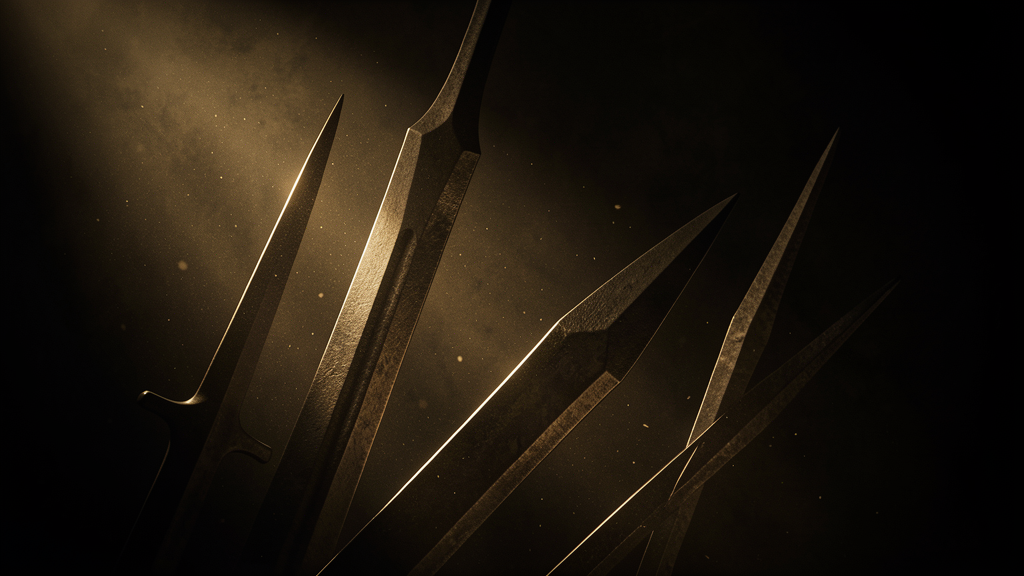
Dark, dramatic abstraction inspired by historical blade craftsmanship
What Makes a Dagger a Dagger
A dagger is a double-edged knife designed primarily for thrusting, usually with a symmetrical blade and a pointed tip. Unlike a single-edged knife, which excels at slicing, a dagger concentrates its energy on the point. That core design goal — penetration — drove the evolution of every historical type covered in this guide to dagger types.
The Stiletto: Precision Over Power
The stiletto emerged in late medieval Italy as a civilian and dueling weapon. Its defining feature is a long, slender, needle-like blade with almost no cutting edge — sometimes triangular in cross-section, sometimes a narrow flat. Because it carries no edge, a stiletto is not a slashing tool at all; it is a dedicated thrusting instrument built to slip between armor plates, mail links, or ribs with minimal resistance. Learn more about the stiletto on Wikipedia.
- Long, narrow blade profile with a stiff point
- Minimal or absent cutting edge — thrusting only
- Favored by civilians, duelists, and as a discreet self-defense piece
The stiletto's logic survives today in needle-point and stiletto-profile dagger blades on modern folders — a narrow tip that penetrates cleanly and resists snapping because it is backed by a thick spine.
The Rondel: Armor-Piercing Specialist
The rondel dagger took its name from the round disc-shaped guards and pommel that protected the hand. Popular across Europe in the 14th and 15th centuries, the rondel had a stiff, diamond-cross-section blade and was the tool of choice for delivering a decisive blow through gaps in plate armor. Its round guards also made it a reliable utility instrument that would not rotate in the hand during a hard thrust. See the rondel dagger entry on Wikipedia for its full history.
The rondel's rigid, diamond-ground blade is the direct ancestor of many modern spear-point and needle-point dagger profiles, and the round guard concept still appears on contemporary fixed-blade daggers.
The Dirk: Highland Versatility
The dirk developed in Scotland as a long companion knife to the basket-hilted broadsword. Unlike the stiletto and rondel, the dirk was a genuine multi-purpose tool: a heavy blade with a clipped point, capable of both slicing and thrusting. Highland dirks served as eating utensils, camp tools, and weapons all in one — a philosophy that maps neatly onto the modern idea of a versatile everyday-carry knife.
- Longer, broader blade than a typical dagger
- Often single-edged with a false edge on the back
- Combined utility and fighting roles in one tool
How Historical Daggers Connect to Modern EDC
Every modern dagger profile owes something to these three ancestors:
- Needle-point folders and stiletto profiles descend from the stiletto's thrust-first geometry
- Spear-point and diamond-cross-section blades borrow the rondel's rigidity and penetration
- Clip-point and single-edge-plus-false-edge designs echo the dirk's dual-use versatility
If you carry a dagger-style folder, recognizing which historical type your blade follows helps you match the knife to the job — a stiletto-derived needle point for precise piercing, a dirk-style clip point for general utility.
Stiletto vs Rondel vs Dirk: Quick Comparison
| Type | Origin | Blade Character | Primary Role | Modern Echo |
|---|---|---|---|---|
| Stiletto | Medieval Italy | Long, narrow, needle-like | Thrusting through gaps | Needle-point folders |
| Rondel | 14th–15th century Europe | Stiff, diamond cross-section | Armor-gap penetration | Spear-point daggers |
| Dirk | Highland Scotland | Broad, clipped point | Utility plus combat | Clip-point EDC blades |
Choosing Your Dagger Type
There is no universally 'best' type of dagger — only the type that fits your intended use. Want a specialized piercing tool that disappears in the pocket? A stiletto-profile needle point. Want rigidity and armor-piercing heritage? A spear-point or diamond-ground blade. Want a do-everything edge that still nods to dagger history? A dirk-style clip point. Understanding the three great historical families makes every future dagger purchase a more informed one.
Dagger-inspired designs live alongside modern everyday folders — explore the Artisan Cutlery folding knife collection to find a blade built for reliable everyday carry.


Leave a comment
This site is protected by hCaptcha and the hCaptcha Privacy Policy and Terms of Service apply.