

Why Dagger Typology Matters
Ask a knife enthusiast how many types of daggers exist and you will get a different answer every time. That is because the dagger is one of the oldest and most widely adapted blade forms in human history. Every culture that worked metal produced its own interpretation: some optimized for armor, some for ceremony, and some for everyday protection. Understanding the major families is useful even today, because the same logic still shapes modern folders: blade profile, edge geometry, and handle construction all trace back to these historical designs.
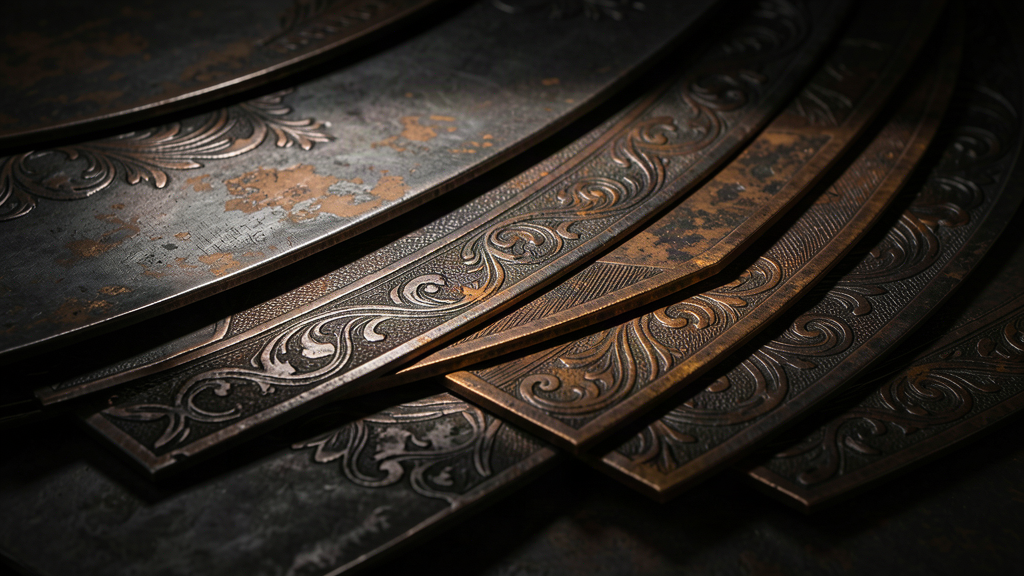
Forged metal and leather textures evoke the workshops where historical daggers were made.
The European Classics
Europe produced the most varied dagger family tree, driven by centuries of close-quarters combat and civilian carry laws.
- Dirk — Scotland's long-bladed thrusting dagger, carried at the belt as both weapon and utility tool. Its extended reach sets it apart from shorter European daggers.
- Stiletto — Italy's narrow, needle-pointed dagger with a triangular or square cross-section. It was built to pierce gaps in armor and mail rather than slash.
- Rondel — A 14th and 15th century European favorite with round disc guards at both ends. The disc guard protected the hand while the stiff blade punched through mail and plate gaps.
- Baselard — A Swiss and German civilian dagger of the 13th to 16th centuries, recognized by its I-shaped hilt. It was openly worn as a status accessory as well as a weapon.
- Poniard — A general French term for a small, slender, double-edged thrusting dagger. The word survives today as a generic label for compact double-edge knives.
- Cinquedea — Renaissance Italy's wide, short-bladed dress dagger, named for its blade roughly five fingers wide. It was more about status than combat efficiency.
- Misericorde — A narrow European dagger used to deliver the mercy stroke to a fallen armored knight, slipping through visor and armpit gaps.
The Middle Eastern and Asian Traditions
East of Europe, dagger design took very different paths, shaped by armor types, carrying customs, and deep cultural symbolism.
- Pesh-kabz — Persia's deeply curved dagger with a reinforced T-shaped spine, designed to defeat mail armor. The rat-tail tang extends through the entire grip for extra strength.
- Jambiya — Yemen and the Arabian Peninsula's short, curved, double-edged dagger worn prominently at the waist. It is a symbol of honor and identity as much as a blade.
- Khanjar — The curved ceremonial dagger of the Ottoman and Arab world, often richly decorated and worn as part of formal dress.
- Katar — India's push dagger, with an H-shaped grip that keeps the blade in line with the forearm. The katar delivered fast punching thrusts and was a signature weapon of Rajput warriors.
- Kris — The wavy-bladed dagger of Indonesia, Malaysia, and the Philippines. Beyond its distinctive undulating profile, the kris carries deep spiritual and ceremonial meaning in its culture of origin.
Dagger Types at a Glance
| Type | Region | Blade Profile | Primary Purpose |
|---|---|---|---|
| Dirk | Scotland | Long, straight | Belt weapon and utility |
| Stiletto | Italy | Narrow needle point | Thrusting through armor gaps |
| Rondel | Europe | Stiff, tapered | Armored combat |
| Baselard | Switzerland/Germany | Straight, I-shaped hilt | Civilian carry and status |
| Poniard | France | Slender, double-edge | Thrusting |
| Cinquedea | Italy | Wide, short | Dress and ceremony |
| Misericorde | Europe | Very narrow | Mercy stroke in armor |
| Pesh-kabz | Persia | Curved, T-spine | Mail penetration |
| Jambiya | Yemen/Arabia | Short, curved | Honor and self-defense |
| Khanjar | Ottoman world | Curved, decorated | Ceremonial |
| Katar | India | Straight, push grip | Fast punching thrusts |
| Kris | Southeast Asia | Wavy, asymmetric | Spiritual and ceremonial |
From History to Your Pocket
Few of us need to pierce mail armor today, but the dagger's DNA lives on in modern folding knives: needle-point and spear-point blade shapes, reinforced spines, and extended tangs all descend from these historical solutions. If you want to see how the classic profiles translate into contemporary carry, browse the Artisan Cutlery folding knife collection and compare the blade shapes against the table above.



Leave a comment
This site is protected by hCaptcha and the hCaptcha Privacy Policy and Terms of Service apply.