

Ask anyone who has carried a Ray Laconico design and they will usually say the same thing: the man understands ergonomics better than almost anyone working today. The Artisan Cutlery Centauri, his front-flipper folder for the ATZ-1839 line, is a compact 3.46-inch drop point that packs a surprising amount of knife into a thin, light frame. What most buyers do not realize is that the Centauri is not one knife — it is a small family of builds spanning S35VN, acid-etched Damascus, and even a fat carbon Damasteel edition. This guide maps every configuration so you can pick the Centauri that matches your carry.
The Centauri: a Laconico front flipper across S35VN, Damascus, and Damasteel
The Centauri design: a Laconico front flipper
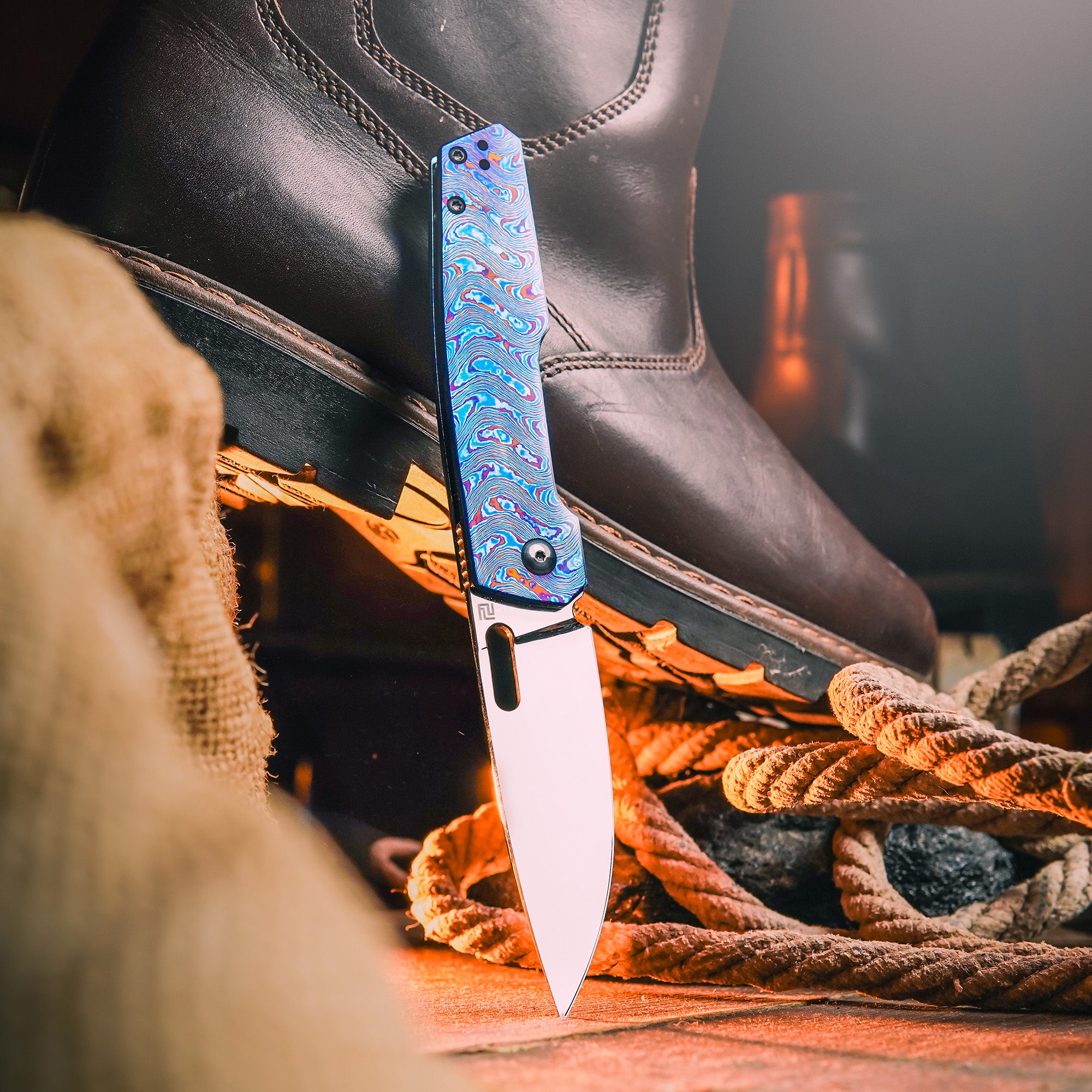
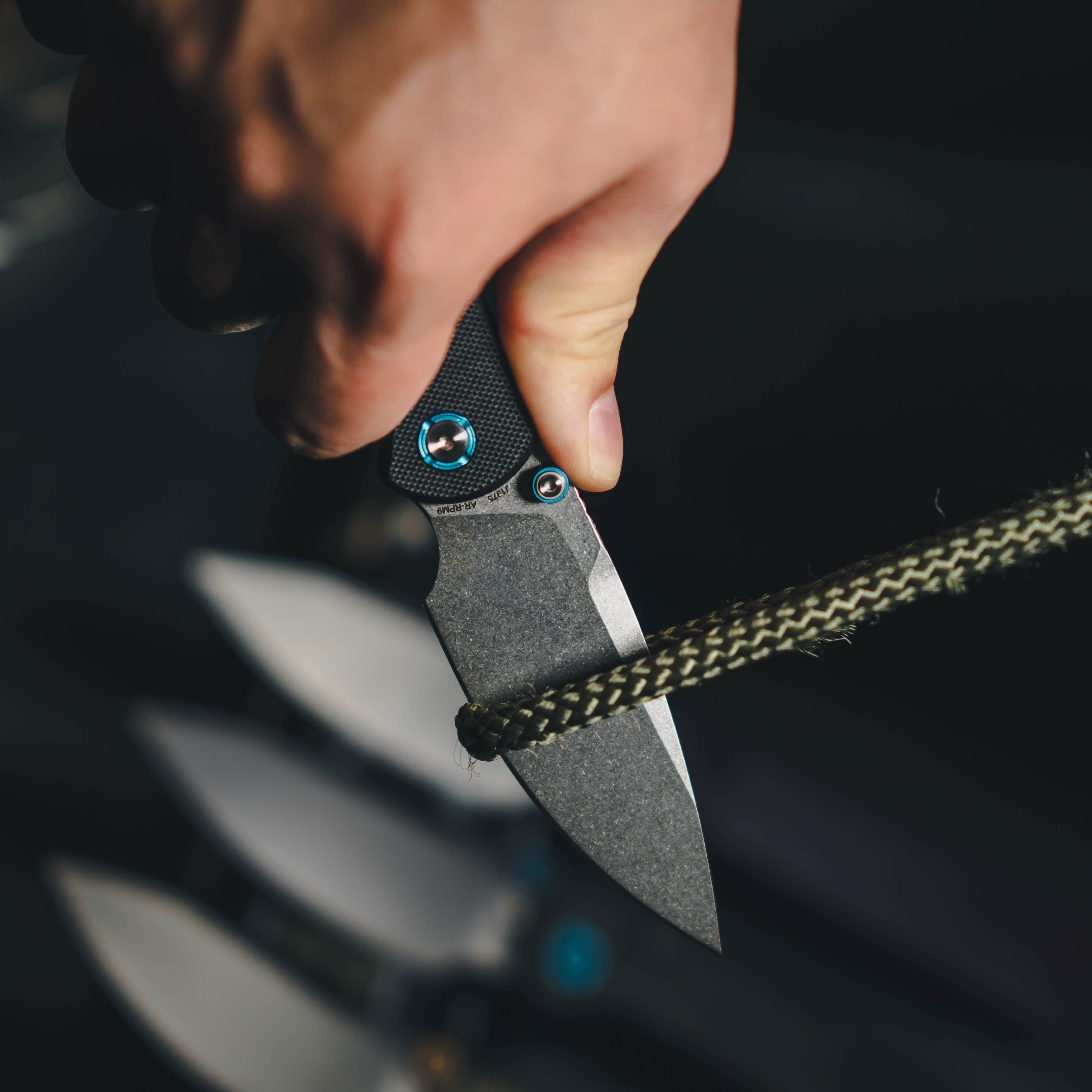
The Centauri is a front-flipper frame lock designed by Ray Laconico. Artisan describes the design as simple yet highly versatile, with clean lines and sophisticated ergonomics, and notes that you can really bear down on the knife in several different grips without discomfort. The drop point blade carries a very sharp tip for piercing work plus a modest belly for slicing, and the thin handle keeps the whole package pocket-friendly. Two subtle details stand out: a jimping cut into the thumb ramp and a hidden lanyard post tucked into the rear of the handle.
Deployment is the party trick. Instead of a conventional flipper tab that sits in the blade path when closed, a front flipper hides a small tab on the spine of the blade near the pivot; you push down on it to roll the blade out. The Centauri rides on ceramic ball bearings, and the front flipper gives you a crisp, deliberate opening motion that stays out of the way in the pocket.
Front flipper basics: why the Centauri opens the way it does
Front flippers are the quiet segment of the opening-mechanism world. A standard flipper tab projects backward out of the handle when the knife is closed, which gives your index finger a big target but also adds a bump to the knife's outline. A front flipper tucks its tab onto the spine of the blade at the pivot end, so the closed knife keeps a clean, straight profile — nothing sticking out to catch on pocket fabric. The trade-off is technique: instead of a straight backward pull, you push down and slightly forward on the tab, rolling the blade out of the handle. It takes a few days of practice to make front-flipper deployment instinctive, and once it clicks it is one of the most satisfying actions in folding knives.
On the Centauri, that clean profile is the whole point. The design brief, as Artisan describes it, is a thin handle with clean lines and surprisingly sophisticated ergonomics, and the hidden deployment keeps the silhouette uncluttered. If you are new to front flippers, the 3.7-ounce Centauri is a forgiving teacher: the blade is light enough that the bearings do most of the work, and the flipper geometry is well within reach of the index finger in a normal grip.
Centauri dimensions and ergonomics
- Blade: 3.46 in (88 mm) drop point, flat grind
- Blade stock: 0.13 in (3.2 mm)
- Overall length: 8.15 in (207 mm)
- Closed length: 4.69 in (119 mm)
- Weight: 3.7 oz (105 g)
- Pivot: ceramic ball bearing
- Clip: titanium, and every configuration uses a titanium clip
- Lock: frame lock across the family
At 3.7 oz and with a closed length under 4.7 inches, the Centauri is a middleweight that disappears in a front pocket. The 3.46-inch blade is long enough for real cutting tasks while staying under common 3.5-inch blade limits in many regions, and the flat grind keeps it a capable slicer.
Steel options across the Centauri range
The current Centauri catalog is built around three blade specifications, and the price ladder tracks them cleanly.
S35VN (satin, HRC 60-62)
The entry point of the family is Crucible's CPM S35VN in a satin finish. S35VN is a powder stainless with vanadium and niobium additions, tuned to balance edge retention, toughness, and corrosion resistance — a genuine one-knife answer for everyday carry. Most S35VN Centauri listings specify HRC 60-62, while the slim-line GS carbon fiber build is listed at 59-61. For a full breakdown, see our S35VN steel explainer and the Crucible Industries background.
Damascus (acid etch, HRC 60-62)
The mid-range Centauri builds switch the blade to pattern-welded Damascus with an acid-etched finish that brings the layered pattern to life. Mechanically identical to the S35VN versions, these are the ones you buy when the blade itself is part of the look. The Damascus steel overview explains how pattern welding works, and our Damascus folding knives guide covers what to expect from a pattern-welded folder in daily use.
Damasteel on fat carbon (the top edition)
At the top of the range, the fat carbon Centauri is offered with either an S35VN or a Damasteel pattern-welded blade. Damasteel is a well-known maker of stainless pattern-welded steel, so this edition combines a premium damascus-style blade with a sculpted fat carbon handle — the most collectible configuration in the family, and the only one that lets you choose your blade steel.
Every current Centauri configuration compared
| Configuration | Blade steel | Handle | Finish | Price |
|---|---|---|---|---|
| 1839GS | S35VN | Titanium + carbon fiber | Satin | $178.56 |
| 1839G | S35VN | Titanium + ODG micarta | Satin | $199.99 |
| 1839G | S35VN | Titanium + carbon fiber | Satin | $199.99 |
| 1839GD | Damascus | Titanium + carbon fiber | Acid etch | $199.99 |
| 1839GD | Damascus | Titanium + ODG micarta | Acid etch | $199.99 |
| 1839GSD | Damascus | Titanium + ODG micarta | Listed config | $178.56 |
| 1839G/1839GD-FCG | S35VN or Damasteel | Titanium + fat carbon | Satin / pattern | $237.49 |
Every configuration shares the same 3.46-inch blade platform, frame lock, titanium clip, and ceramic bearing pivot, so the choice is really about blade steel and handle material — not geometry. Note that the Damascus builds are priced identically to the S35VN builds at $199.99, which makes the pattern-welded versions unusually accessible for a production folder.
Reading the model codes: G, GS, GD, GSD, and FCG
Artisan's ATZ-1839 naming looks dense at first, but the suffix letters follow a pattern once you see them side by side. Plain G marks the standard Centauri builds, all S35VN satin folders. The GS prefix appears on the secondary runs — the carbon fiber GS at $178.56 is the cheapest way into the family, and the burlap micarta GS sits at $199.99. GD marks the Damascus blade versions, GSD is the additional Damascus configuration on micarta, and the FCG suffix on the fat carbon listing stands for the fat carbon build, offered with your choice of S35VN or Damasteel blade. When you see a price gap between two otherwise identical-looking Centauri listings, the suffix is almost always the explanation.
Handle materials on the Centauri
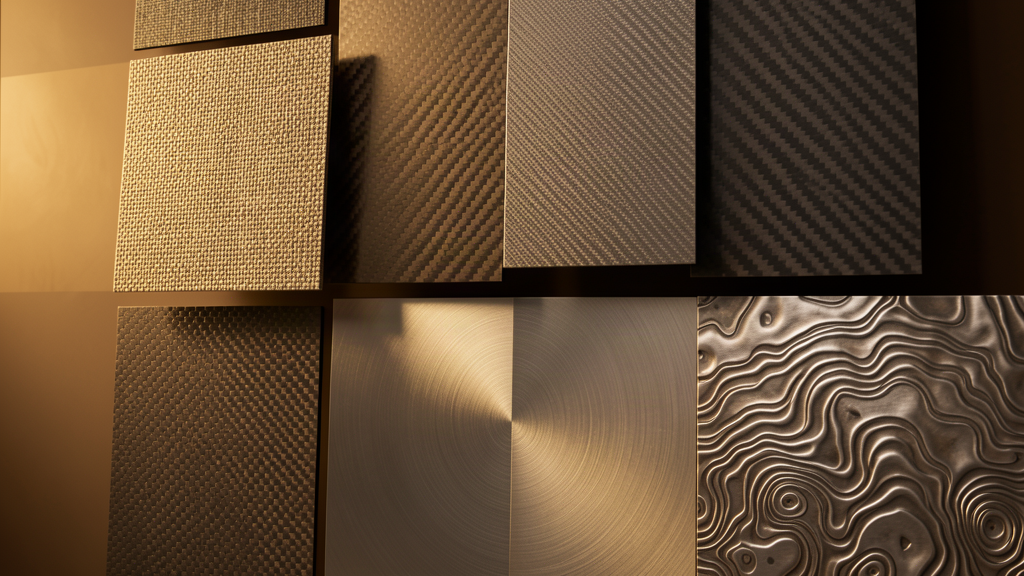
The handle is where the Centauri family shows its range, with three very different materials paired against a titanium frame.
- ODG micarta: olive drab micarta overlays give the Centauri a warm, grippy, outdoorsy character. Micarta is a resin-impregnated fabric composite that ages gracefully and grips well in the hand — our micarta handle guide covers how it patinas over time.
- Carbon fiber: the carbon fiber overlay version is lighter-feeling and more formal, with a twill look that suits office carry. See our carbon fiber handle guide for durability and care notes.
- Fat carbon: the top edition uses sculpted fat carbon, a layered composite with a distinctive three-dimensional flow pattern. It is the showpiece handle of the lineup — our fat carbon guide explains why it is heavier than standard carbon fiber but visually unmatched.
Which Centauri should you pick?
- Best value: the GS carbon fiber at $178.56 delivers the full Laconico platform for under $180.
- Best all-rounder: the S35VN ODG micarta at $199.99 is the classic pick — grippy, neutral, and ready for anything.
- Showpiece blade: the Damascus carbon fiber at $199.99 gives you an acid-etched pattern blade at the same price as the plain steel version.
- Collector edition: the fat carbon Damasteel at $237.49 is the one that will be hardest to find in a few years.
One honest note on expectations: pattern-welded Damascus blades do not outperform a good stainless on edge retention, and the acid-etched finish needs a little more care than a plain satin blade. Buy the Damascus Centauri because you want the look and the uniqueness — if you want maximum steel performance per dollar, the S35VN builds are the rational choice, and the family makes that easy by pricing both at the same $199.99.
Caring for a Centauri
Care is straightforward and material-driven. Satin S35VN is a low-maintenance stainless: wipe it down after use and it will look the same in ten years. The acid-etched Damascus versions should be kept clean and lightly oiled so the etched pattern stays crisp — the deeper layers are more exposed than on a solid blade. On the handle side, micarta ages handsomely and picks up a natural patina with use (see our micarta care guide), carbon fiber is effectively maintenance-free, and fat carbon is best treated like any other composite: clean, dry, and out of direct solvents. The titanium frame and clip will pick up light surface scratches over years of carry, which most owners accept as character.
If you want to read a hands-on take on the base knife, our earlier Centauri S35VN review covers the front-flipper action and daily-carry behavior in depth. The Centauri is one of the most approachable Laconico designs on the market: smart ergonomics, a genuinely useful 3.46-inch blade, and a family lineup that lets you move from stainless value all the way to a Damasteel showpiece without changing the knife in your hand.
Find your ideal everyday carry configuration — explore the Artisan Cutlery folding knife collection for premium EDC folders built for reliable everyday carry.


Leave a comment
This site is protected by hCaptcha and the hCaptcha Privacy Policy and Terms of Service apply.