

A dagger asks a knife steel to do something a normal pocket knife never has to do. Two cutting edges mean the blade is ground thin and symmetric, with no flat spine behind the edge to back it up. That geometry changes which steel properties matter: toughness and grindability climb in importance, while raw wear resistance loses some of its appeal.
A double edge leaves no spine behind the apex, so toughness and grindability matter more than raw wear resistance.
This guide walks through the steel families you will actually find in modern daggers and dagger-style blades — carbon steel, pattern-welded Damascus, mid-range stainless like 12C27 and AR-RPM9, tool steels like D2, and premium powder steels like S35VN, S90V and M390 — and explains which ones suit a display piece, a collector's blade, or a tool you actually use.
What Makes a Dagger Different
A dagger is a double-edged blade with a symmetric cross-section, built around a point rather than a belly. Both edges taper to a thin apex, and the blade has no blunt spine. Compared with a single-edge knife of the same length and stock thickness, a dagger's grind removes more steel near the tip and leaves less material to support each edge.
Two practical consequences follow for steel selection:
- Thin edges are less forgiving. A steel that chips or rolls at a hard contact angle shows the damage on a dagger more quickly than on a sturdy single-edge work knife.
- Two edges need symmetric maintenance. A steel that sharpens evenly and quickly makes double-edge upkeep far less tedious, especially at the low edge angles daggers are usually ground to.
If you are new to the shape itself, the difference between a needle point and a spear point is covered in our guide to dagger blade geometry.
The Four Steel Properties That Decide Performance
Every knife steel is a trade among four properties, and a dagger shifts the weighting. Our full breakdown of the underlying metallurgy is in edge retention vs toughness vs sharpenability; here is the short version as it applies to a double edge.
- Toughness — resistance to chipping and cracking. Critical on a dagger, because the edge is thin and often used in a thrusting motion where the blade meets hard material with little support behind it.
- Edge retention — how long the apex survives before it needs attention. Valuable, but on a dagger it is usually the second priority behind toughness: an edge that chips is worse than one that dulls predictably.
- Corrosion resistance — how well the steel resists rust. Daggers are frequently stored long-term and often sit in a sheath, which is exactly the environment that punishes non-stainless steel.
- Sharpenability — how easily the steel takes a fresh apex. A dagger has twice as much edge to maintain, so a steel that fights the stone costs double the time.
These four are balanced against hardness, measured on the Rockwell C scale (HRC). Harder steel holds an edge longer but becomes more brittle, which matters more on thin dagger geometry than on a thick work blade.
Steel Families Found in Modern Daggers
The table below groups the steels that show up most often in double-edge and dagger-style blades. Hardness figures are the typical working ranges quoted for production knives of that family, not a guarantee for any single blade.
| Steel | Class | Typical hardness | Strengths | Trade-off |
|---|---|---|---|---|
| 1095-class carbon | Non-stainless carbon | HRC 56-60 | Tough, takes a very keen edge, easy to sharpen | Rusts readily; needs oil and dry storage |
| Pattern-welded (Damascus) | Layered carbon/alloy | Varies by billet | Visual pattern, traditional character | Corrosion-prone, performance varies by maker |
| 12C27 | Stainless (Alleima) | HRC 54-61 | Fine grain, tough for its hardness, easy to sharpen | Moderate edge retention |
| 14C28N | Stainless (nitrogen-alloyed) | HRC 58-60 | Very fine grain, excellent toughness for a stainless, easy sharpening | Lower wear resistance than powder steels |
| AR-RPM9 | Powder-metallurgy stainless | HRC 59-61 in Artisan Cutlery blades | Uniform carbide structure, balanced edge retention, resists rust without coating | Not a high-vanadium super steel |
| 154CM / ATS-34 class | Stainless | HRC 58-61 | Proven all-round balance of edge holding and toughness | Dated versus modern powder steels |
| D2 | Semi-stainless tool steel | HRC 59-61 in Artisan fixed blades | Strong edge retention, wear resistant, affordable | Only semi-stainless, more chipping-prone at thin geometry |
| S35VN | Powder-metallurgy stainless | HRC 60-62 in Artisan blades | High toughness for a premium stainless, fine carbide structure | Cost |
| M390 / 20CV / S90V | High-alloy powder steels | HRC 59-62 | Top-tier wear resistance and corrosion resistance | Harder to sharpen, lower toughness than S35VN-class steel |
Carbon Steel and Pattern-Welded Blades
Historical daggers were forged from plain carbon steel, and modern reproductions often follow. Non-stainless carbon steel such as the 1095 class is simple iron-and-carbon steel with very little chromium, which is why it takes a keen edge easily and stays tough at high hardness — and why it rusts if you look at it wrong. A carbon-steel dagger is a fine display and collection piece if you keep it oiled and out of its leather sheath for long-term storage.
Pattern-welded Damascus sits in the same corrosion category. Its appeal is visual: layers of contrasting steel forge-welded together and etched to reveal the pattern. Performance depends entirely on the alloys used in the billet and on the maker's heat treatment, so treat a Damascus dagger as a steel to be researched per piece rather than a specification you can assume.
Mid-Range Stainless: The Practical Sweet Spot
Most usable daggers and dagger-style fixed blades use a mid-range stainless, because it balances the four properties without costing a fortune. Three good examples:
- 12C27 — a fine-grained chromium stainless that Alleima positions as a well-rounded knife steel. Tough, stainless, and easy to bring back to a sharp apex.
- 14C28N — nitrogen-alloyed and very fine-grained, which is why it is unusually tough for a stainless steel at HRC 58-60. Our 14C28N explainer covers its properties in depth.
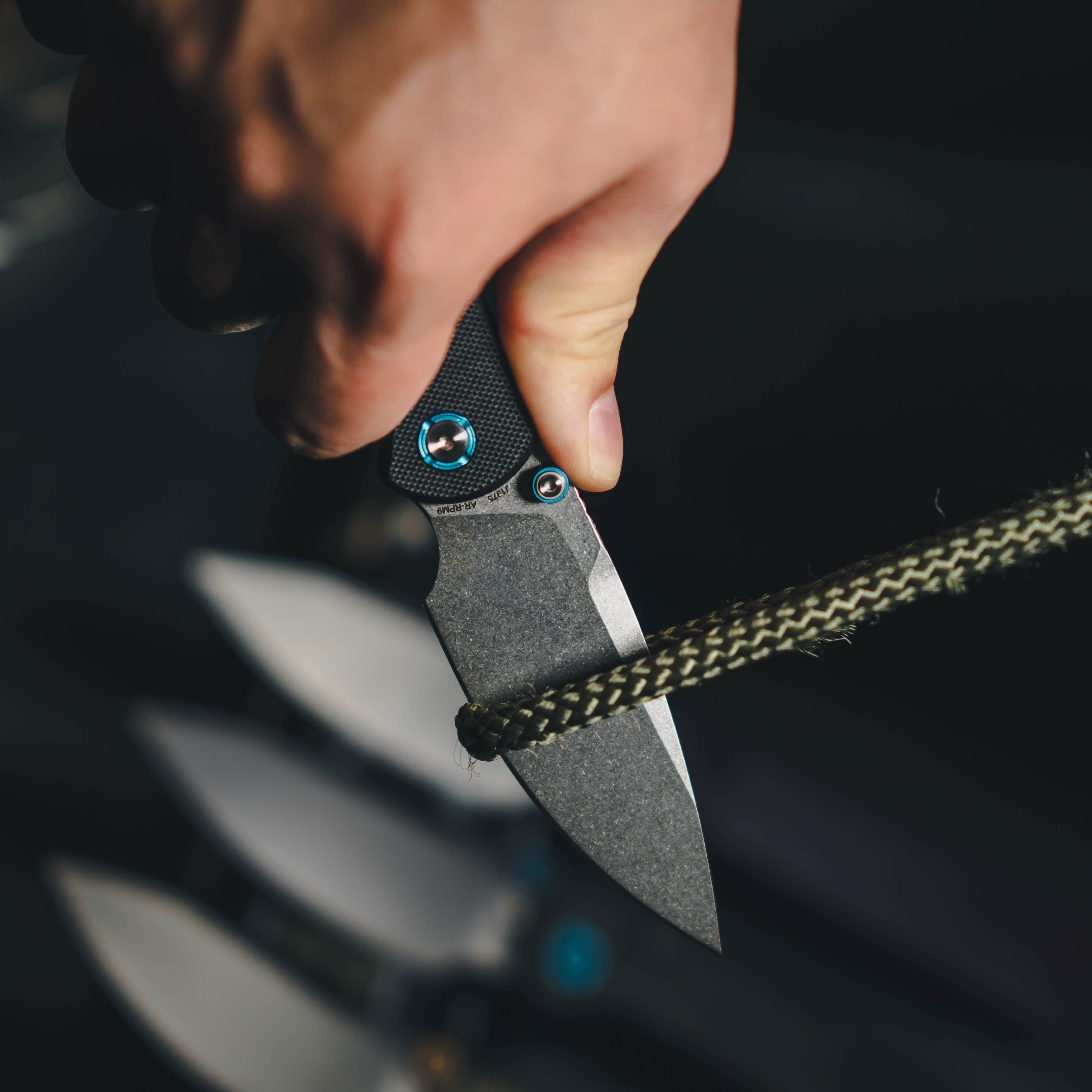
- AR-RPM9 — a powder-metallurgy stainless that Artisan Cutlery heat treats to HRC 59-61 across a wide slice of its fixed and folding lineup. It is described as a powder version of the 9Cr18MoV family with added vanadium, which produces a finer, more uniform carbide structure than conventional ingot steel. See our AR-RPM9 steel explainer for the full breakdown.
For a dagger that will be carried and used rather than displayed, this tier is the pragmatic answer: tough enough for thin geometry, stainless enough to survive a damp climate, and cheap enough that sharpening it twice as often as a single-edge knife is not a burden.
Tool Steels: D2 and the Semi-Stainless Middle
D2 is a tool steel with enough chromium to resist staining but not enough to be called stainless. It offers excellent wear resistance for the money, and it is common in tactical and outdoor fixed blades. On a dagger, the caveat is toughness: D2 holds a thin edge well but is more likely to chip than 14C28N or S35VN when it meets something hard at a steep angle. If your blade lives outdoors and gets wet, D2 also wants more attention than a true stainless — the same issue we cover in our D2 care guide.
Premium Powder Steels: S35VN, S90V, M390, 20CV
Powder metallurgy is what separates the top tier. Molten steel is atomized into fine powder and consolidated under heat and pressure, producing a far more uniform carbide distribution than casting allows. The result is a steel that can hold more alloying elements without becoming brittle or unpredictable.
- S35VN — niobium-alloyed stainless with a reputation for combining toughness with strong edge retention; commonly run HRC 60-62 in production knives.
- S90V, M390, 20CV — high-vanadium and high-chromium powder steels built for maximum wear resistance and corrosion resistance. They hold an edge remarkably well, but they sharpen more slowly and are less tolerant of thin, low-angle geometry than S35VN.
On a dagger, the premium tier makes the most sense for a collector's piece or a knife that sees light, clean cutting. For a blade that will be pushed hard, a tougher steel at slightly lower wear resistance usually serves the geometry better. Our steel properties guide walks through that trade in detail.
How Hard Should a Dagger Be?
Hardness is the number people quote first and understand last. On double-edge geometry, the useful framing is:
- HRC 56-59 — tougher, more forgiving of thin edges and hard contact, but requires more frequent sharpening.
- HRC 59-61 — the production sweet spot for stainless and tool steels used in fixed blades; this is where Artisan Cutlery runs AR-RPM9 and D2.
- HRC 61-62 — maximum edge holding, appropriate for premium powder steels in light-duty roles, less tolerant of abuse on a thin dagger grind.
Heat treatment matters as much as the number on the spec sheet. The same steel at the same nominal hardness behaves differently depending on how it was austenitized and tempered — see Wikipedia's overview of heat treating for the process behind that.
Corrosion: The Property Daggers Get Judged On
Daggers spend more of their life in a sheath or a display case than most knives, and that is exactly where corrosion starts. Leather holds moisture and can release tannins, so a non-stainless blade stored long-term in a leather sheath is the classic path to pitting. Practical rules:
- Stainless families (12C27, 14C28N, AR-RPM9, S35VN, M390) tolerate humid storage far better than carbon or D2-class steel.
- Carbon and pattern-welded blades want a thin film of oil and a dry, ventilated storage spot.
- PVD and DLC coatings add corrosion resistance and hide scratches, but they are surface treatments, not steel properties — the edge bevel itself stays bare.
Sharpening a Double Edge With Different Steels
Two edges at a low angle change the sharpening workflow more than the steel does, but steel choice sets the pace. Fine-grained stainless like 14C28N and AR-RPM9 respond quickly to a standard stone and respond well to stropping between sessions. High-vanadium powder steels such as S90V and M390 need more patience and reward a guided system that holds a consistent angle. D2 sits in the middle and can be worked with conventional stones if you keep the pressure light.
Our complete guide to sharpening a dagger covers the technique for both edges; the steel-specific angle choices are in how to sharpen different knife steels.
Matching Steel to the Job
| If the dagger is for | Steel family to look for | Why |
|---|---|---|
| Display, collection, historical interest | Carbon steel, pattern-welded Damascus | Traditional character and appearance; corrosion control is part of ownership |
| Light everyday carry of a fixed blade | 12C27, 14C28N, AR-RPM9 | Tough enough for thin edges, stainless, easy to maintain |
| Outdoor and hard-use utility | S35VN, 14C28N | Toughness plus edge retention at thin geometry |
| Maximum edge holding, clean cutting | S90V, M390, 20CV | Highest wear resistance; expects careful sharpening |
| Working on a budget | D2, AR-RPM9 | Strong performance per dollar; D2 needs more rust care |
What Artisan Cutlery Runs in Its Blades
Artisan Cutlery does not publish a double-edge fighting dagger, but the steels it uses across its fixed blades are the same families discussed above — and the double-edge reasoning applies to any thin, point-forward grind. The Wreckhart 1855B, for instance, has a fullered spear point profile the maker describes as dagger-like, in AR-RPM9 at HRC 59-61 with a PVD coating. The Sea Snake runs AR-RPM9 on the standard versions and S35VN at HRC 60-62 on the limited micarta edition. The Tomahawk ATZ-1815B fixed blade uses D2 at HRC 59-61.
That spread maps neatly onto the recommendations above: a powder-metallurgy stainless for general use, a premium powder stainless for the top tier, and D2 when wear resistance per dollar is the priority. Browse the full fixed-blade range in the Artisan Cutlery fixed blade collection.
FAQ
What steel is best for a dagger?
For a usable blade, a fine-grained stainless such as 14C28N or AR-RPM9, or a balanced premium powder steel such as S35VN. All three combine the toughness a thin double edge needs with enough corrosion resistance for sheath storage. High-wear steels like M390 and S90V are excellent choices for a collector's piece used lightly.
Is D2 good for a double-edge blade?
D2 works, and it holds an edge well, but it is only semi-stainless and is more prone to chipping on thin geometry than 14C28N or S35VN. If you choose D2, expect to oil the blade and keep it out of damp sheaths.
Does Damascus steel perform better than modern stainless?
Not inherently. Pattern-welded steel is a construction method, and performance depends on the alloys in the billet and the heat treatment. Treat Damascus as an aesthetic and traditional choice rather than a performance upgrade over a modern powder steel.
Can I store a carbon steel dagger in its leather sheath?
Not for long periods. Leather holds moisture and can release tannins, both of which encourage rust. Store non-stainless blades dry, lightly oiled, and out of the sheath if the storage is long-term.
Choosing steel is the first decision and geometry is the second. Explore the Artisan Cutlery catalog to see these steel families across the full folding and fixed blade range, built for reliable everyday carry.


Leave a comment
This site is protected by hCaptcha and the hCaptcha Privacy Policy and Terms of Service apply.