

Two blades can carry the same word on the listing and be entirely different materials. One is a forge-welded billet with hundreds of layer boundaries running through the steel; the other is a single sheet of steel with a pattern applied to the surface. Both may be sold as damascus. The difference is visible with your eyes and a light, and it is worth knowing before you spend premium money on a damascus folding knife.
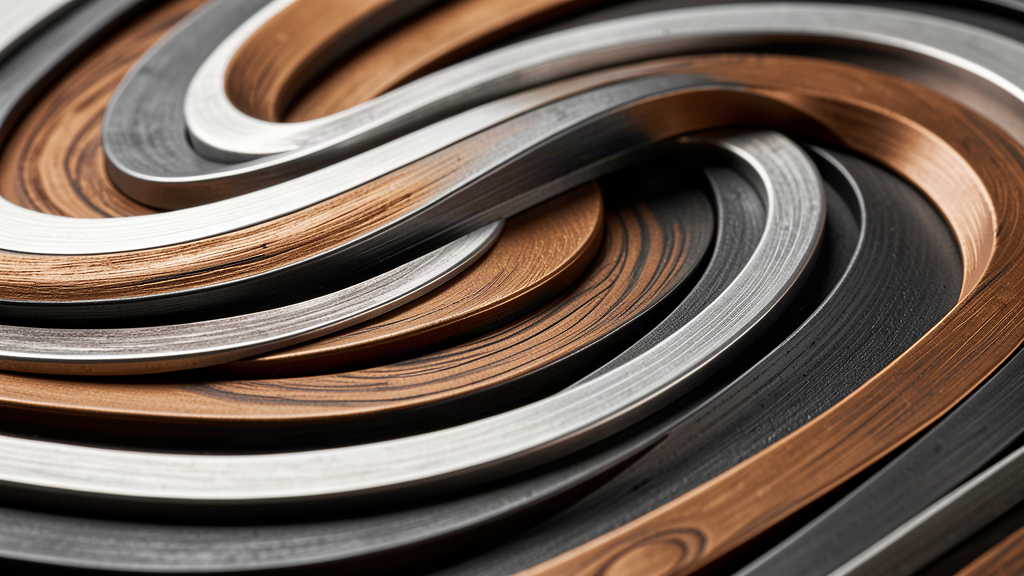
Layer boundaries run through the whole billet, which is what separates pattern-welded steel from a surface pattern.
What Damascus Means on a Modern Knife
On a modern folding knife, damascus almost always means pattern-welded steel: two or more different steels forge-welded into one billet, then folded, stacked, or twisted so that the layers multiply, and finally ground and acid-etched so the layers show as contrasting bands. The name is inherited from the historical Damascus steel of the Middle East, but the two materials are not the same thing. Historical wootz blades were a crucible steel with a carbide banding structure; modern pattern-welded blades are built by welding and deformation. That is not a downgrade, it is simply a different material — and because the pattern is structural, it cannot be applied to a finished blade afterwards.
How Real Pattern-Welded Steel Is Made
- Stack and weld. Two or more steels with different alloy content are stacked and forge-welded into one solid billet. Contrast comes from the difference: a simple high-carbon steel next to a nickel-bearing steel is the classic pairing, because the two react differently to acid.
- Multiply the layers. The billet is drawn out, cut, stacked and welded again — or twisted, punched, or ground in steps — until the stack becomes dozens or hundreds of layers. The manipulation is what makes a ladder, twist, raindrop, or random figure rather than straight stripes.
- Forge and grind the blade. The patterned billet is forged to a blade profile, then ground and finished like any other blade steel.
- Etch. An acid dip removes material from the less corrosion-resistant layers faster than the resistant ones, so the pattern is revealed as a shallow relief with tonal contrast, not a printed image.
Step four is the part that matters when you are inspecting a knife in your hand. Etching is a subtractive process on a material that is layered all the way through, so the pattern exists in three dimensions — not just on the flat.
Four Things Sold as Damascus
| What the listing says | What it usually is | How it behaves |
|---|---|---|
| Damascus / damascus steel, maker names the billet steels | True forge-welded pattern-welded billet | Layer contrast is part of the material; pattern survives regrinding and shows at the spine and plunge line |
| Rose damascus, coloured damascus | A pattern-welded billet, or a blade with a tinted etch — depends on the maker | Same questions apply: ask what is in the billet, and check the pattern at the edges of the steel |
| Stainless damascus, powder-metallurgy damascus | Pattern-welded stainless produced from stainless powders by specialist makers | Keeps the figure with far less corrosion anxiety than a carbon billet — the material is only as good as the name behind it |
| Damascus pattern, damascus-style finish | A single steel with an engraved, laser-marked, or otherwise surface-applied pattern | A finish, not a material. It will not show layering at the spine, and it does not come back if the blade is refinished |
None of those four is automatically dishonest — descriptions like 'damascus pattern' are how honest sellers flag a surface finish. The problem is when a surface finish is priced and described as a forge-welded billet.
Five Checks Before You Buy a Damascus Folding Knife
- Look at the spine and the plunge line. On a pattern-welded blade the layers run through the thickness of the stock, so the pattern continues onto the spine and into the cut where the bevel begins. A surface-applied pattern has nothing to show on those edge-on surfaces — they read as plain steel.
- Tilt the blade under a light. A real etch leaves a shallow relief because the alloys etch at different rates. Raking light should catch slight depth in the pattern rather than a perfectly flat printed layer.
- Compare both faces. Pattern-welded blades are figure on each side of the same billet, related but not identical, and the pattern follows the grind lines through the bevel. A pattern that repeats mechanically, or that stops cleanly at a masking edge, is worth questioning.
- Ask what is in the billet and how many layers. A maker selling genuine pattern-welded steel can answer that. Should the answer be vague, weigh that in the price. On this site, for example, the damascus listings name the blade as damascus without publishing a layer count or the billet steels — so the honest position is that the material claim rests on the maker's reputation and the visible pattern, not on a published recipe.
- Check the vocabulary of the listing. 'Damascus blade', 'rose damascus', 'damascus pattern', and 'damascus-style finish' are four different claims. Matching the claim to the price is the whole exercise, and it is why a photo cannot do this work for you.
Titanium Damascus Is a Handle Material, Not a Blade Steel
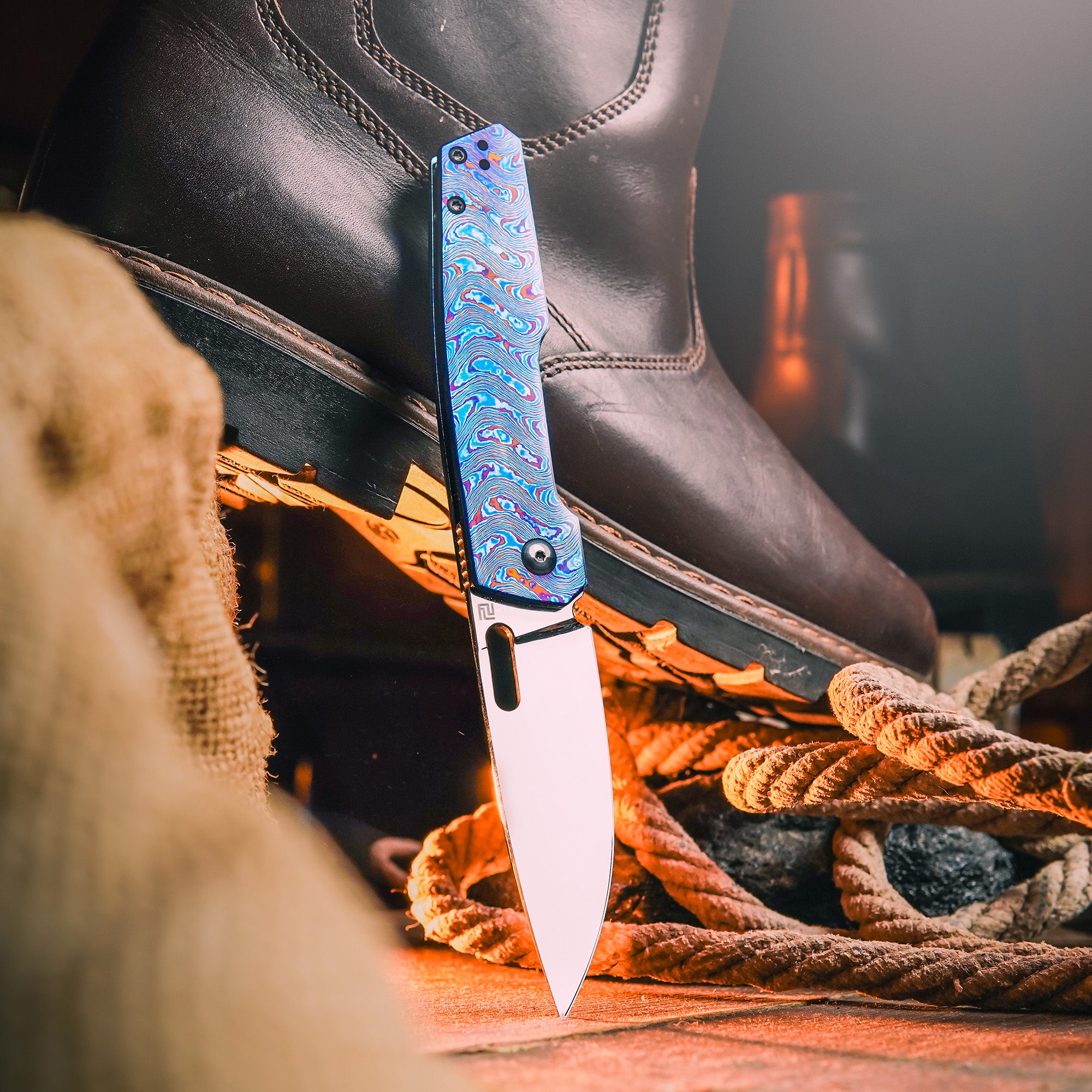
One of the most confusing labels in the category has nothing to do with edges. Titanium damascus is a layered titanium material — different titanium alloys stacked and welded so that anodising brings out colour and figure. It is used for handles, inlays, clips, and backspacers, where its job is to look extraordinary. It cannot hold an edge.
This catalogue uses it well, and the listings are clear about where it goes:
| Model | Where the titanium damascus sits | Blade | In-stock price |
|---|---|---|---|
| Building the Feldspar: Titanium Damascus Top-Framelock Deluxe | Inlaid into the titanium frame | S90V, HRC 60-62 | $749.25 |
| Building the Feldspar: Titanium Damascus Top-Framelock | Inlaid into the titanium frame | S90V | $534.00 |
| ArtisanCutlery Crusoe ATZ-1869G | Full handle over a frame lock | S90V, HRC 60-62 | $609.00 |
| CJRB Lanky J1965G-TDB | Full handle with a steel clip | CPM S90V, mirror polish | $459.99 |
| CJRB Galactic Pyrite J1925G | Titanium damascus inlay in a titanium handle | S90V, HRC 60-62 | $452.00 |
Notice the pattern in that table: every one of those knives pairs a cosmetic titanium-damascus handle with a conventional premium blade steel. That is the correct way round. If you ever see a listing that implies the titanium damascus is the cutting steel, the listing is confused.
What Damascus Does and Does Not Do for Performance
A pattern-welded blade is a real blade, and a well-made one cuts. But damascus is not a shortcut to better cutting, and it is fair to say so plainly:
- Buy it for the material, not the numbers. A modern powder-metallurgy monosteel such as S35VN, M390, or S90V is engineered for edge retention and toughness in a way that a cosmetic multi-steel billet is not. Damascus earns its place on character.
- Carbon billets ask more of you. Classic pattern-welded recipes pair high-carbon steels, which means the etch that reveals the pattern is also a visible map of the layers most likely to react to moisture and acids.
- Stainless pattern-welded steel narrows the gap. Powder-metallurgy stainless damascus gives you a figure with the corrosion behaviour you expect from a stainless blade.
- Sharpening is normal, with one caveat. You sharpen the edge, not the pattern, and the steel at the apex is a blend of the billet's layers. Keep your angles consistent and the material handles the rest.
In-Stock Damascus Folding Knives at Artisan Cutlery
The current line-up spans a $70 button-lock CJRB to a $199 titanium frame lock, which is a useful range for comparing the same material across construction types. Prices below are in-stock variant prices at the time of writing.
| Model | Blade | Handle | Lock | In-stock price |
|---|---|---|---|---|
| CJRB Pyrite-Light J1945 | Rose damascus, 3.34 in | FRN | Button lock | $69.99 |
| CJRB Crag J1904 | Rose damascus, 3.43 in | Carbon fiber | Liner lock | $89.99 |
| CJRB Feldspar J1912 | Damascus, 3.53 in | Steel | Button lock | $89.99 |
| Artisan Cutlery Arion ATZ-1843GD | Damascus, 3.81 in | Carbon fiber | Liner lock | $129.99 |
| CJRB Pyrite J1925 | Damascus, 3.11 in | Titanium | Button lock | $139.99 |
| Artisan Cutlery Orthodox ATZ-1817GSD | Damascus, 2.95 in, tanto | Titanium | Frame lock | $171.74 |
| Artisan Cutlery Hyperion ATZ-1834GSD | Damascus, 3.0 in, clip point | Titanium and carbon fiber | Frame lock | $183.30 |
| Artisan Cutlery Osprey ATZ-1803GD | Damascus, 3.74 in | Titanium TC4 | Frame lock | $187.49 |
| Artisan Cutlery Tacit ATZ-1838GD | Damascus, 3.42 in, tanto | Titanium | Frame lock | $186.41 |
Caring for a Damascus Blade
Damascus is not fragile, but it does reward a wipe. Acidic food, fingerprints, and humidity all show first on the layers that etch darkest, so a quick wipe after use and a light film of oil on the blade keeps the contrast clean. Keep the pivot dry and properly lubricated rather than over-oiled, and store the knife out of a damp sheath or case. The site's damascus maintenance guide covers the routine in detail, and the lubrication guide explains what belongs on the pivot.
The Bottom Line
Real damascus is a material, and the honest test is physical: layers that run through the steel and show at its edges, a pattern with slight relief under raking light, and a maker who will tell you what is in the billet. If the pattern lives only on the surface, you are buying a finish — which is fine, as long as it is priced like one. Choose damascus for the look and the craft, pair it with a blade steel you trust if performance is the priority, and inspect before you commit.
Browse every pattern-welded blade and titanium-damascus handle piece in the Artisan Cutlery damascus collection, or start from the full folding knife range and read the buyer's guide to pattern welding for the manufacturing side of the story.

Leave a comment
This site is protected by hCaptcha and the hCaptcha Privacy Policy and Terms of Service apply.