

Artisan Cutlery is best known for folding EDC knives, but the catalog also carries something most knife buyers never notice: a small kitchen line sold under the Butterfork name. Two models live there today — the Butterfork Classic and the Butterfork Purest — and both are 8-inch chef's knives in AR-RPM9 stainless steel, priced at $49.99 and $44.99.
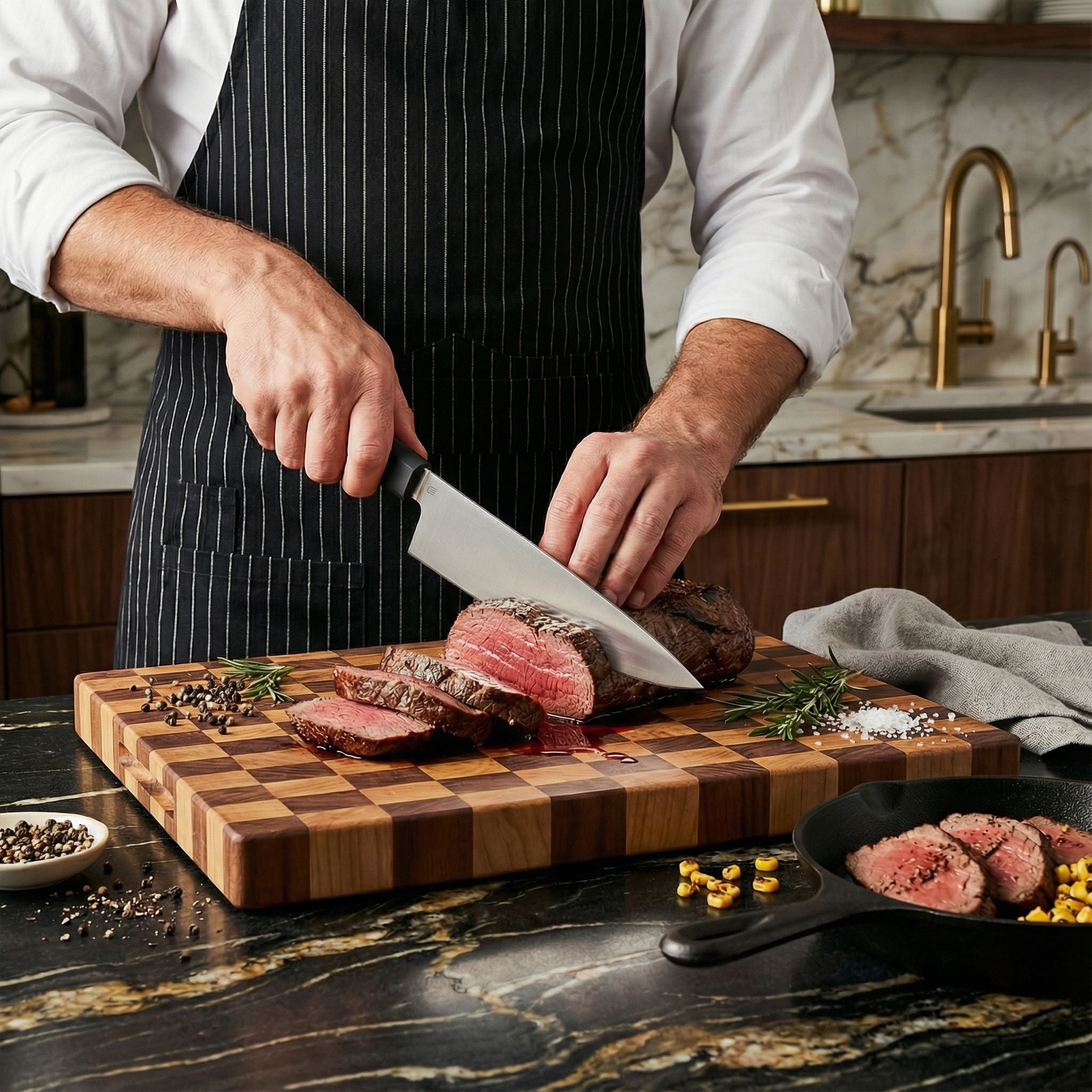
Two handles, one blade: the Butterfork Classic in pakkawood and the Butterfork Purest with its replaceable ABS handle.
That is a deliberate pairing worth understanding. Rather than scattering a dozen kitchen shapes across the catalog, Artisan has kept the Butterfork line to one blade format and one steel, and made the handle the decision. The result is simple to shop: pick your finish, pick your handle, done. Here is how the two models differ, how AR-RPM9 behaves when it spends its life near water and onions instead of cardboard, and how to keep an 8-inch chef's knife working the way it should.
The Butterfork Line at a Glance
| Model | Blade | Steel | Handle | SKU prefix | Price |
|---|---|---|---|---|---|
| Butterfork Classic 8-inch Chef's Knife | 8 in | AR-RPM9 stainless | Ergonomic pakkawood | BF02-CK | $49.99 |
| Butterfork Purest 8-inch Chef's Knife | 8 in | AR-RPM9 stainless | Replaceable ABS | BF01-CK | $44.99 |
The Purest is the broader line of the two, because the replaceable handle is offered in six colourways: Dark Grey, Light Grey, Mist Violet, Pale Yellow, Turquoise Green and Ultramarine. Each colour has its own SKU — BF01-CK-DGNS, BF01-CK-LGNS, BF01-CK-PPNS, BF01-CK-YLNS, BF01-CK-MTNS and BF01-CK-BUNS — and every one of them is the same knife underneath. That is the whole point of the design: the handle is a replaceable part, so a chipped or stained handle does not end the knife's working life.
The Classic takes the traditional route instead, with a pakkawood handle and the words ergonomic and all-around food preparation doing the describing in its own listing. Both knives are grouped under Chef's Knives in the Artisan catalog, and the Classic's listing carries both a with-sheath and a without-sheath tag, so check which option you are selecting before you order. The Purest listing is the simpler of the two on that front.
Why a Folding Knife Brand Made an 8-Inch Chef's Knife
The pairing is less strange than it first looks. Artisan already runs AR-RPM9 across a large part of its folding line — the Ahab, Arroyo, Beest, Cazador and several others — and a brand that has already solved stainless steel sourcing and factory edge geometry has most of what it needs to build a kitchen blade. What changes is the format: an 8-inch chef's knife is the single most-used cutting tool in a home kitchen, and the shape is standardised enough that a maker only has to get one thing right.
That one thing is geometry. An 8-inch chef's knife is a slicing and rocking tool: a long, gently curved edge that lets you push-cut herbs and rock through onions without lifting the tip off the board. It is a different job from the short, thick, flat-ground blades on most folding knives, and it is the format where a thin, keen edge matters more than a lock, a pivot or a pocket clip.
It is also worth being honest about scale. Two models is a focused offering, not a full kitchen range — no paring knife, no bread knife, no santoku. If you want the rest of the cutting jobs covered, you keep your current knives and put the Butterfork where it earns its place: the main board knife. For the wider picture of how Artisan builds across tiers, the Artisan Cutlery full lineup guide walks the folding side of the catalog from entry level to premium.
AR-RPM9 in the Kitchen
Both Butterforks use AR-RPM9, and if you have only met the steel on Artisan's folders you already know most of what matters here. AR-RPM9 is a powder-metallurgy stainless steel — molten steel is atomised into fine powder and then consolidated under heat and pressure, the same family of manufacturing used for premium steels. Artisan heat treats its AR-RPM9 blades to roughly HRC 59–61, and the fine, uniform carbide structure gives it a reputation for taking a keen edge, holding it well for the price class, and sharpening without drama.
The steel is often described as a powder-metallurgy take on the 9Cr18MoV stainless family with added vanadium for wear resistance. The detail that matters in a kitchen is the stainless part. Kitchen knives live in a wet, mildly acidic environment: onion, tomato, lemon, a damp board, a sink. A stainless blade tolerates all of that without the spotting and patina management that a non-stainless carbon or tool steel demands. If you want the full metallurgical background on this family of steel — carbide structure, powder metallurgy, how it compares to D2-class tool steels — it is covered in our AR-RPM9 steel explainer and in Wikipedia's article on powder metallurgy. The general properties of stainless steel and the Rockwell scale behind those HRC numbers are also worth a look if hardness ratings are new to you.
Two practical consequences follow. First, you can sharpen AR-RPM9 on ordinary equipment — a medium stone to set the edge and a fine stone or a rod to finish it — which matters far more on a knife you use daily than on a knife you carry weekly. Second, because the carbide structure is fine, the edge tends to fail by rolling or dulling rather than by chipping out, which is the behaviour you want from a knife that meets a cutting board every night.
Classic vs Purest: The Handle Is the Real Decision
With blade length and steel fixed across the line, the handle carries the whole decision — and the two handles represent genuinely different philosophies.
Pakkawood (Butterfork Classic, $49.99) is a resin-impregnated wood laminate. It looks and feels like wood, warms up in the hand, and hides the small marks and cutlery-rash that accumulate on a working kitchen knife. The trade is that a laminated wood handle is a finished component: if it is damaged badly enough, the knife is damaged. If the traditional look of a wooden kitchen knife is why you own one, this is the model that delivers it.
Replaceable ABS (Butterfork Purest, $44.99) is the more modern answer, and it is the more interesting design. ABS is a tough, water-tolerant thermoplastic, and making the handle a replaceable part changes the service life of the knife: wear, impact and staining are handle problems rather than knife problems. It also makes the colourways meaningful, because six options mean you can match a Purest to a kitchen, a knife roll or a gift without buying anything else.
The price difference is trivial — $5 — so this is not a budget choice. Pick the Classic if you want wood in your hand and a traditional kitchen aesthetic. Pick the Purest if you want a lower-maintenance handle, a colour choice, and a knife whose weakest serviceable part is designed to be replaced. Both sizes are the same 8-inch format, so board feel and cutting technique do not change between them.
8 Inches: Getting the Format Right
The 8-inch chef's knife is the standard main-board size for good reason: it is long enough to handle a full onion, a head of cabbage or a pile of herbs in one motion, and short enough to control on a smaller board. It is also the format most cooks learn on, which means replacement knives in the category are judged against the shape people already know — a gently curved edge for rocking, a spine that stays clear of the knuckles, and enough length to slice rather than saw.
If you are weighing formats, Wikipedia's overview of the chef's knife covers the classic proportions, and the broader kitchen knife article sets the chef's knife alongside the paring knife and the bread knife it is expected to complement. A knife's blade geometry — how thin the stock is behind the edge, and how the grind tapers — decides how it moves through food, and that is the variable an 8-inch chef's knife gets right when it is built for slicing rather than for chopping through bone.
Keeping an 8-Inch Chef's Knife Sharp
A chef's knife is used often and roughly, so its edge degrades faster than a carried folder's. The routine that works is not complicated: a fine rod or a strop for maintenance between sharpenings, and a stone session when the knife stops biting into a tomato.
For the full treatment of edge angles and how they differ between steels, our guides to sharpening different knife steels and to blade grind types cover the reasoning. For the maintenance habit itself, a honing steel or a fine sharpening stone used lightly and often will keep a working edge alive far longer than an occasional aggressive sharpening session. Kitchen knives reward frequency over force: a dozen light passes a week beats a heavy grind twice a year.
Care and Cleaning
Nothing about the Butterfork line requires special handling, but a few habits are what separate a knife that lasts a decade from one that looks tired in two years.
- Wash by hand and dry immediately. Even a stainless blade is happier when it is not left wet on a draining board, and the handle — wood laminate or ABS — is not improved by prolonged soaking.
- Skip the dishwasher. Heat, prolonged moisture and contact with other cutlery are hard on edges, handles and fasteners alike.
- Clean the transition between blade and handle. Food residue collects there, and it is the first place a kitchen knife gets grim. Our guide to cleaning and sanitising a knife covers the routine in detail.
- Store it dry and separate. A magnetic strip, a knife block or a sheath all beat a crowded drawer where edges meet other edges.
- Check which sheath option you bought. The Classic listing carries both with-sheath and without-sheath tags, so the storage solution may already be in the box.
Handle materials follow the same logic as on folding knives: impervious composites and laminates need no oil or feeding, but they do reward a wipe-down rather than a scrub. If you want the deeper material comparison, our knife handle materials guide covers how G10, Micarta, titanium and carbon fibre differ in grip, weight and long-term wear — the same properties that make ABS a sensible choice for a kitchen handle. Wikipedia's article on ABS covers why that polymer is tough and water-tolerant in the first place.
How the Butterfork Fits the Artisan Lineup
Think of the Butterfork line as the kitchen end of a catalog that is otherwise built around carry. The same brand thinking applies: a sensible working steel, a handle that matches its job, and a price that stays in the range of a serious tool rather than a display piece. If you already carry an AR-RPM9 Artisan folder, the AR-RPM9 collection is where that steel family lives, and the best sellers collection shows what the rest of the brand's customers actually buy.
If you are buying your first serious kitchen knife and you are used to shopping EDC specs, this is the moment the habits transfer usefully. Blade steel should be stainless for a wet environment, the handle should tolerate water and impact, and the format should match the board you actually use.
Classic or Purest: The Short Answer
- Buy the Butterfork Classic at $49.99 if you want a traditional pakkawood handle, a warm wood-in-hand feel, and the classic look of a wooden kitchen knife.
- Buy the Butterfork Purest at $44.99 if you want a replaceable ABS handle, a choice of six colourways, and a knife designed so the most wear-prone part can be swapped rather than endured.
Either way you get the same 8-inch chef's knife format and the same AR-RPM9 stainless steel blade, which means the decision really is about the handle — and about whether replaceable sounds like a feature or a compromise to you.
Explore the full Artisan Cutlery collection — kitchen blades and premium folding knives built for reliable everyday carry.


Leave a comment
This site is protected by hCaptcha and the hCaptcha Privacy Policy and Terms of Service apply.