


Most conversations about folding knives are about blades: the steel, the shape, the grind. But the parts that decide how a knife actually behaves day to day are the smallest ones on it. A pivot screw that has backed out a quarter turn gives you blade play. A clip screw that works loose drops the clip into a pocket lint trap. A body screw tightened past its limit strips its head and turns a five-minute job into an afternoon.
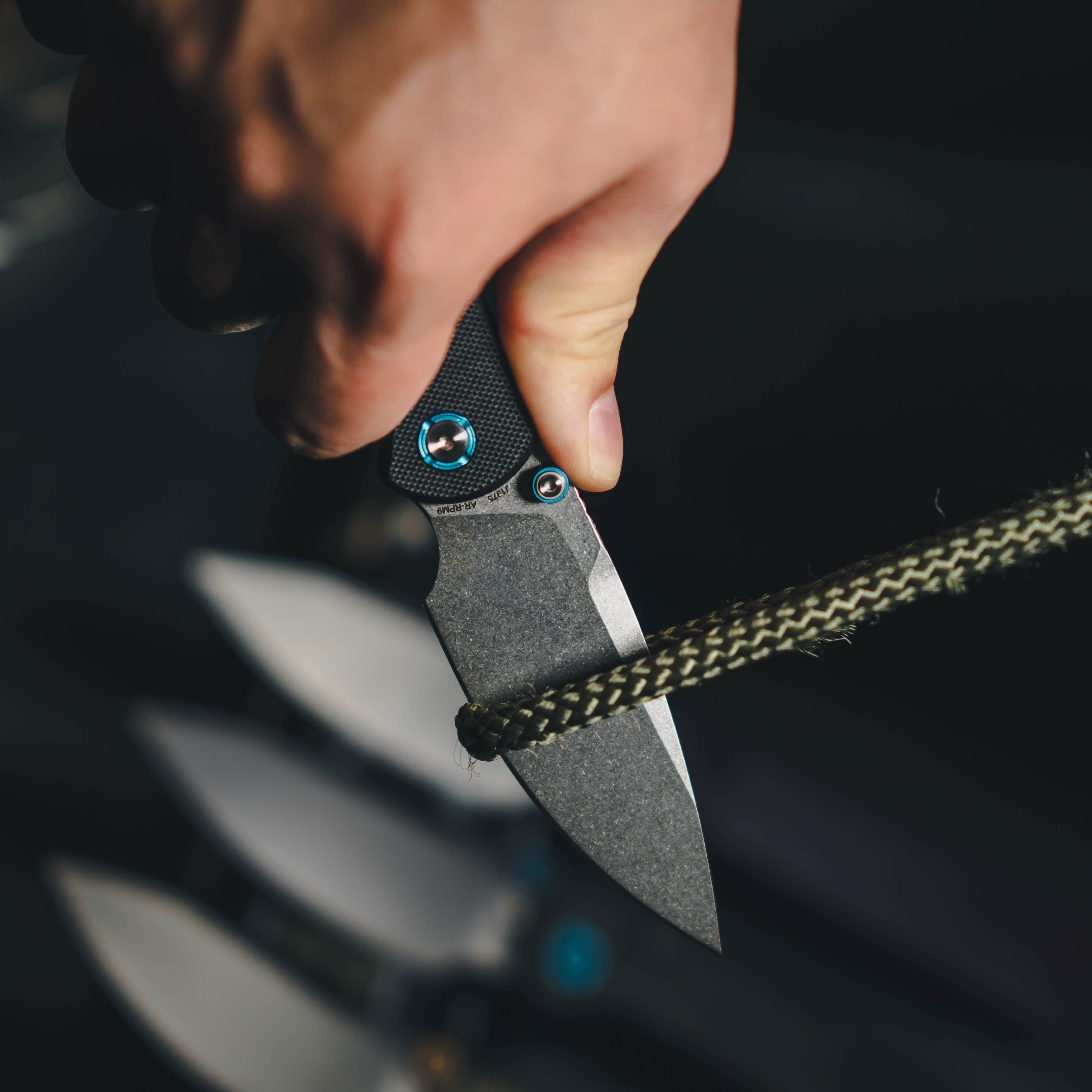
Pivot and body hardware: the fit of the drive decides whether a screw comes out or rounds off.
Knife hardware is the least glamorous part of the hobby and the one that most often determines whether a knife stays in a pocket for ten years or gets retired early. This guide covers what the fasteners on a modern folding knife are, what sizes are typical, how threadlocker and torque really work, what to do when a screw strips, and where replacement hardware honestly comes from. For the step-by-step teardown itself, our folding knife disassembly guide covers the sequence — this article is about the parts you are handling while you do it.
The Hardware on a Modern Folding Knife
A typical folding knife has between six and a dozen fasteners, and they fall into a few clear jobs. Sizes vary by maker and model, so treat the ranges below as the common case rather than a specification for any single knife — the right move on any unfamiliar knife is to test-fit a bit before applying torque.
| Part | What it does | Typical drive | Common size |
|---|---|---|---|
| Pivot screw (pivot pin) | Sets blade pivot tension and blade centring | Torx | T8–T10 |
| Body or scale screws | Hold the handle scales and liners together | Torx | T6–T8 |
| Pocket clip screws | Retain the clip, usually into a liner or standoff | Torx or Phillips | T6, or a small Phillips |
| Backspacer / standoff screws | Space the handle slabs and set handle rigidity | Torx | T6–T8 |
| Pivot barrel (sex bolt) | The mating half the pivot screw threads into | Torx or slotted | Matched to the pivot screw |
| Stop pin | Limits blade travel against the tang | Often pressed, not threaded | — |
The one universal rule is that the pivot is not like the others. Body screws and clip screws are fasteners: they are meant to be tight and to stay tight. The pivot screw is a tension adjustment, and its correct setting is whatever gives you a clean, centred blade with the action you want — not maximum torque. Our explainer on pivot systems, bearings and washers covers what changes inside the joint, and the guide to blade play covers what a loose pivot actually feels like.
Why Torx, and Why Bits Matter More Than the Knife
Torx — the six-pointed star drive — has been the default on quality folding knives for years, and the reason is mechanical. At the tiny sizes used on a knife, a slot or Phillips head has very little engagement between driver and screw. Torx puts six flat contact surfaces to work and tolerates far more torque before the head cams out, which is exactly what you need on a screw that was installed by a factory and may have threadlocker on it.
That is also why the driver is the part worth investing in. A cheap Torx bit that has been machined slightly undersize will round over the screw head instead of turning it, and a rounded pivot screw is the single most common way a routine cleaning turns into a real problem. The disassembly routine on this site recommends a quality driver set with T5, T6, T8 and T10 Torx bits, and that range covers the overwhelming majority of modern folders. A set of small hex keys is worth keeping nearby for the odd model that mixes drive types, and a set of slotted drivers covers older or budget designs.
The background is worth a few minutes if you have never looked at it: Wikipedia's articles on Torx and the wider list of screw drives explain why star drives resist cam-out better than cross-heads, and the screw and screw thread articles cover what pitch and thread form actually mean. If you want a shorter version: a driver that fits properly is worth more than any single accessory you can buy.
Torque, Feel, and the Art of Stopping Early
Knife hardware fails in one direction — over-tightening — and the fix is a habit, not a tool. Small screws in thin metal have very little margin, and the tightening that feels reassuring on a door hinge is destructive at T6 scale.
- Tighten until the part stops moving, then stop. Body screws need to hold a scale flat against a liner, not to compress anything.
- Work in a diagonal pattern on a handle with four or more body screws. Alternating corners keeps the scale from binding on one side and pulling the blade off centre.
- Never force a screw that resists. Resistance usually means threadlocker, cross-threading or debris in the threads. Heat, patience and a properly seated bit are the answers; leverage is not.
- Check the pivot last. Set body screws, then tune the pivot, then re-check centring with the blade closed.
If the blade sits off centre or will not hold its tension, the fault is usually the pivot adjustment rather than the screws, and the sequence for correcting it is covered in our blade play guide and in the buying checklist on lockup and centring.
Threadlocker: Which Strength, and Where It Goes
Almost every complaint about a pivot screw that keeps backing out ends with threadlocker, and almost every horror story about a screw that will not come out starts there too. The middle ground is well understood.
Use low-strength, removable threadlocker — the blue grades. They hold a fastener against vibration but release with ordinary hand-tool torque, which is exactly the behaviour a pivot screw needs. Avoid high-strength, permanent grades — the red ones — on anything you intend to service. They are designed to need heat and force to break, which is the opposite of what you want on a knife you clean twice a year. Wikipedia's article on thread-locking fluid covers how the anaerobic chemistry works.
Application matters as much as the grade. Apply a small amount to the threads of the screw, not to the pivot barrel or the blade's pivot hole, and use far less than feels satisfying — one small drop on the first two or three threads is enough. If threadlocker reaches the pivot surfaces it acts like a weak adhesive on the rotation itself, and the action goes from smooth to sluggish. Clean the old residue off both threads before applying fresh product; hardened debris is what causes false tightness.
Threadlocker is also the answer to the most annoying small failure in knife ownership: a pocket clip that will not stay put. Clip screws see more vibration than any other fastener on the knife, and a low-strength threadlocker on those threads is the standard fix.
When a Screw Strips: The Recovery Order
A stripped screw head is demoralising, but there is a sensible order of operations, and it starts with stopping.
- Stop turning. Every additional slip makes the next attempt harder. Most stripped heads are recoverable; a fully rounded one usually is not.
- Re-seat the bit. Debris, a shallow bit or a slight angle is often all that is wrong. Press down firmly — real downward pressure, not just rotation — and try again slowly.
- Try the next size up or a slightly different profile. A T8 where a T7 was needed can sometimes get a bite. A thin rubber band laid over the head has rescued many marginal screws by filling the gap between bit and recess.
- Soften the threadlocker. Gentle, controlled warmth from a hairdryer or a soldering-iron tip applied away from heat-sensitive parts will break down most removable threadlockers. A drop of penetrating oil left to sit overnight works on corrosion and debris.
- Know when to hand it over. A screw that has already lost its recess, especially a pivot screw embedded in a titanium or aluminium scale, is a job for a workshop with the right extractors — or for the maker's service department. Damage caused by drilling usually costs more than the screw was ever worth.
One prevention note: stripped screws are almost always a driver problem, not a knife problem. A worn or undersized bit concentrates force on the corners of the recess rather than the flats, and it takes only a couple of those slips to ruin a head.
Where Replacement Hardware Actually Comes From
This is the part of the subject where the internet is least honest, so here is the reality. Knife hardware is not standardised across brands. Pivot diameters, barrel lengths, thread pitches, head diameters and screw lengths are all model-specific, which means a bag of generic replacement screws bought online is unlikely to fit your knife properly — and a pivot screw that is 0.05 mm off can change lockup and centring.
In practice, spare hardware comes from three places:
- The maker's service channel. This is the correct source and the one most people skip. Screws, clips and pivots are usually available on request, and asking costs nothing. If you already have a knife from a brand with a support channel, that is the first email to send before you consider anything else.
- Dealer and accessory stock. A handful of makers and their dealers list clips, screws and hardware kits directly, and those parts are model-matched. If the part number is not published for your knife, assume the part does not exist yet.
- Aftermarket upgrade hardware. Titanium clips, anodised screw sets and replacement standoffs are a genuine sub-hobby, and they can transform the look of a knife. Treat them as cosmetic and structural upgrades for models with documented fitment, not as universal spares — and check first whether swapping hardware affects your warranty.
Two material notes worth knowing when you shop. Titanium hardware is light, corrosion-proof and can be anodised into a range of colours, which is why it dominates the upgrade market — Wikipedia's titanium and anodising articles explain the properties behind that. In practice titanium threads also gall more readily than steel, which is a reason to keep titanium-to-titanium threads clean and lightly lubricated. Stainless hardware is stronger per unit of size, which is why it still dominates pivots and load-bearing fasteners; the trade is weight and the fact that stainless is corrosion-resistant, not immune, particularly in salt air. For the broader picture of how steel choice affects a knife, Knife Steel Nerds is the reference to read.
Where hardware attaches to another material, the joint matters more than the screw. Threaded inserts pressed or bonded into a handle scale, rather than exposed barrel threads, are what allow repeated disassembly without the handle giving up its grip on the fastener. Wikipedia's article on threaded inserts covers the concept. If a scale's threading has failed, the fix is a new scale or a repaired insert, not a bigger screw.
A Five-Minute Hardware Audit
Given how many complaints trace back to loose or over-tightened fasteners, a periodic check is the highest-value maintenance you can do. Once a season, or after any weekend of hard use:
- Test every screw for movement with a properly seated driver, without adding torque. A screw that turns a fraction of a turn is a screw that was backing out.
- Check the pivot for play with the blade open: side-to-side wobble means tension, not a failed part.
- Test the clip by pushing it sideways. Clip screws work loose more than any others.
- Look into the screw recesses for lint and grit. Packed recesses stop the driver seating fully and are a leading cause of stripped heads.
- Wipe the hardware, then re-lubricate the pivot sparingly. Our knife lubrication guide covers which oils and greases suit which job.
- Re-check centring with the blade closed, and re-tune the pivot if it has moved.
This is also the moment to decide whether a knife needs more than an audit. A blade that has developed play at the tang, a lockbar that no longer reaches its full engagement point, or a handle scale that will not sit flat all point to something other than hardware, and those cases are worth a proper look rather than another round of tightening. Our knife maintenance 101 guide sets out the wider cleaning and lubrication routine, and the folding knife anatomy guide explains what each of those parts is supposed to be doing in the first place. If the terminology is unfamiliar, the knife terms glossary is the fastest way to get aligned.
Hardware Is a Cost Centre, Not a Club Member
The pragmatic summary is short. Buy drivers that fit properly, keep the sizes you actually need, use low-strength threadlocker and use it sparingly, treat the pivot as a tuning screw rather than a bolt, stop turning before you round a head, and go to the maker first for spares. Do those five things and hardware stops being a source of problems and becomes what it should be: the quiet mechanism that lets you forget about everything except the blade.
Finally, resist the urge to disassemble a knife simply because you can. A new knife with a firm detent and a tight pivot needs break-in rather than a teardown, and the right sequence for that is in our guide to breaking in a new folding knife. Hardware work earns its place when something is actually wrong — grit, play, or a screw that will not stay put.
Explore the full Artisan Cutlery collection — titanium, G10 and carbon fibre folding knives built for reliable everyday carry.


Leave a comment
This site is protected by hCaptcha and the hCaptcha Privacy Policy and Terms of Service apply.