

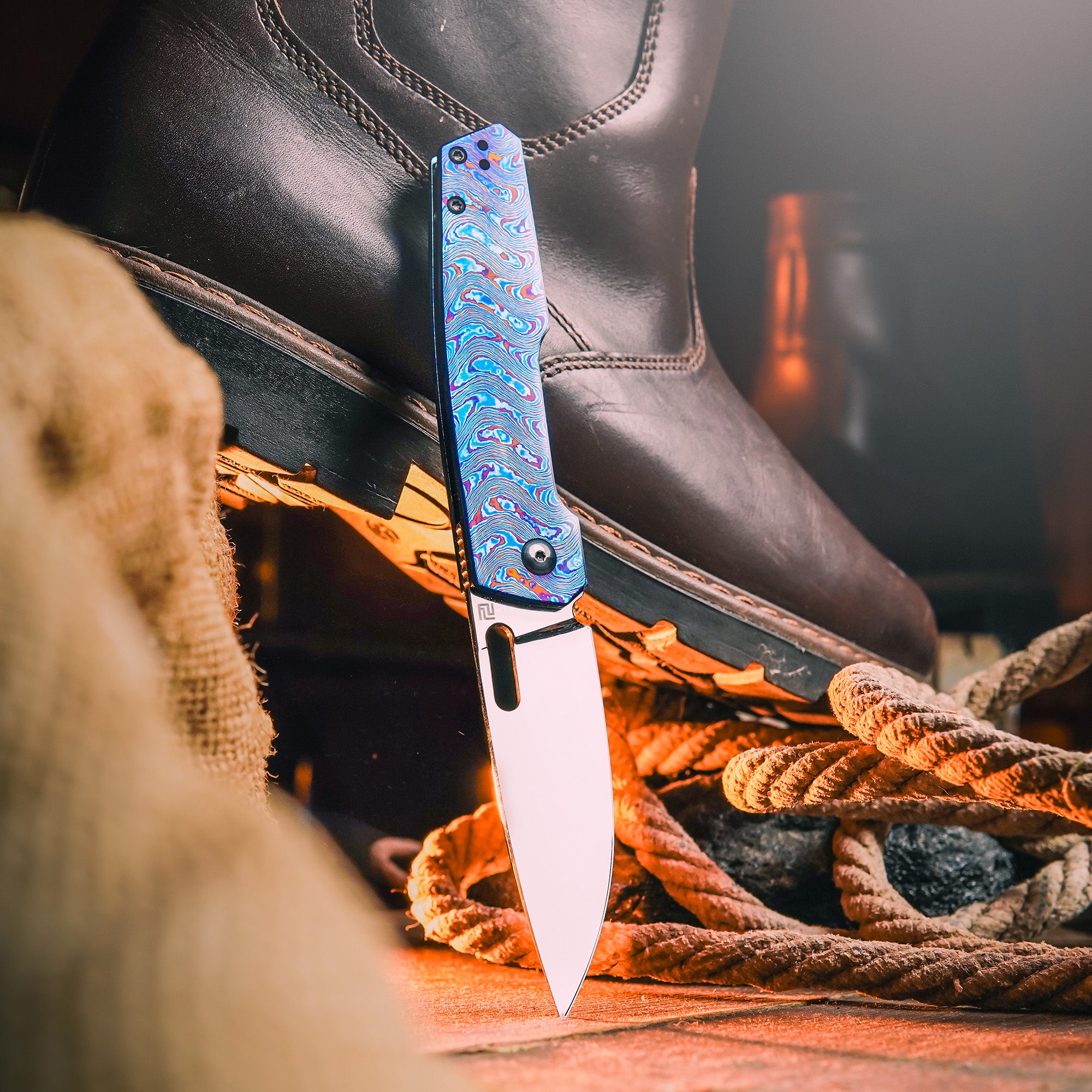
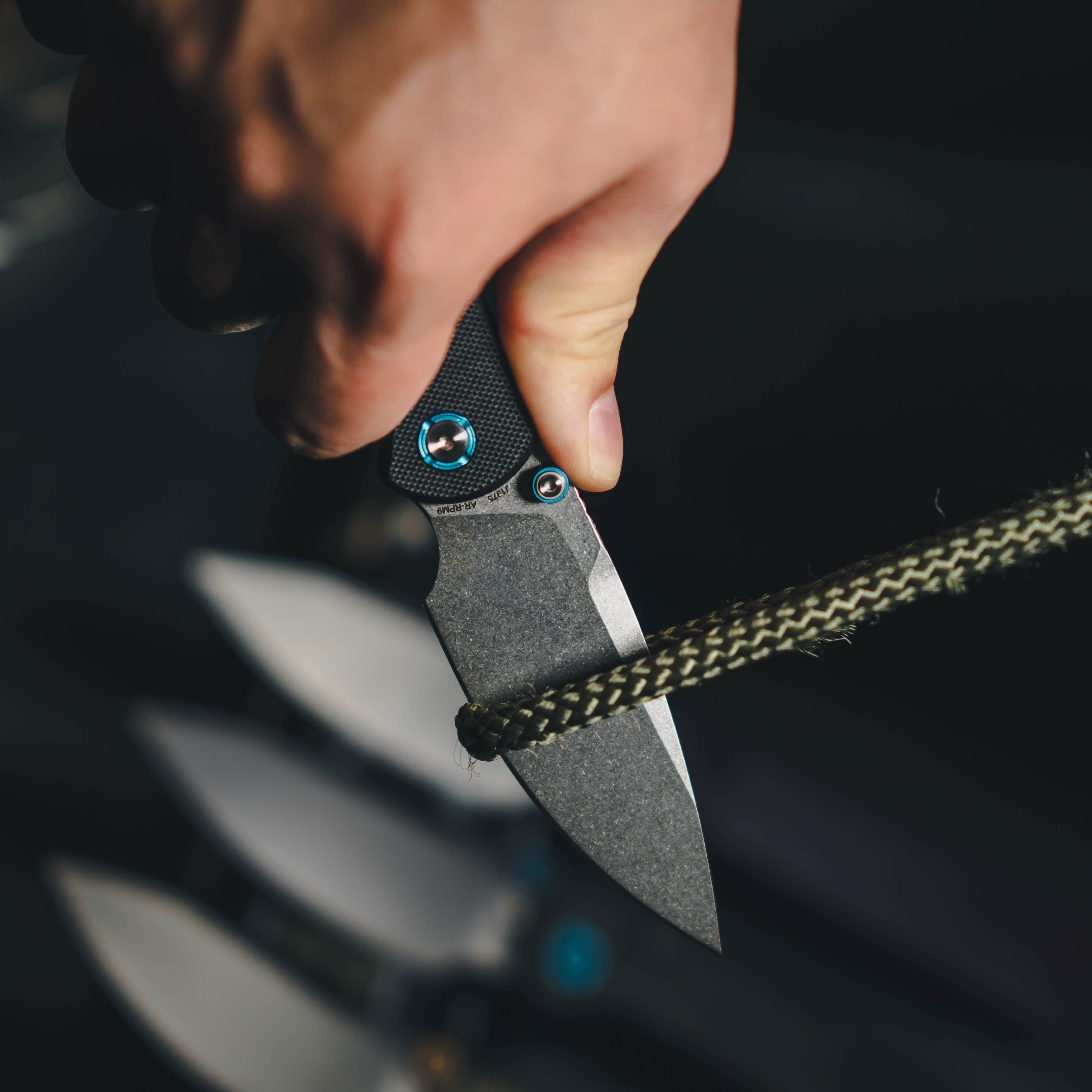
The CJRB Latitude is the clearest example of what a J-code tells you. One model number, J1975, covers seven knives that share a single blade, lock, and pivot — and differ only in handle material and blade finish. Six of the seven are in stock today, from a $54.99 black G10 workhorse to a $69.99 glow-in-the-dark edition, with a carbon fiber and CPM S35VN tier at the top of the line.
Every Latitude configuration shares the same 3.47-inch drop point and top liner lock — only the handle and blade finish change.
This guide covers every CJRB Latitude configuration on the store, the top liner lock that holds it open, the AR-RPM9 steel in the standard versions, and how the Latitude's 3.47-inch blade compares to the rest of the CJRB catalogue. Every specification below is read from the live product listings.
The CJRB Latitude Spec Sheet
| Spec | CJRB Latitude J1975 |
|---|---|
| Blade length | 3.47 in (88 mm) |
| Blade thickness | 0.15 in (3.7 mm) |
| Blade steel | AR-RPM9 (CPM S35VN on the J1975-CF) |
| Blade hardness | HRC 59-61 (HRC 60-62 on the S35VN version) |
| Blade style | Drop point |
| Blade grind | Flat |
| Blade finish | Stone wash or black PVD coating |
| Handle material | G10, CNC-textured G10, glow-in-the-dark micarta, glow G10, or carbon fiber |
| Lock type | Top liner lock |
| Pivot | Ceramic ball bearings |
| Clip | Steel |
| Overall length | 7.99 in (203 mm) |
| Closed length | 4.53 in (115 mm) |
| Weight | 112-120 g (3.95-4.23 oz) depending on handle material |
That is a mid-size folder: enough blade for real work at 3.47 inches, still short enough to disappear into a jeans pocket at 4.53 inches closed. At 120 g in the standard G10 build it is lighter than either the Doubletap (241 g) or the Tundra (226 g), and heavier than the compact end of the line.
What a Top Liner Lock Means on the Latitude
The Latitude's listing names its lock type as a top liner lock, which places it in the liner lock family. A liner lock uses a leaf spring cut directly out of one of the handle liners; when the blade opens, that spring travels across the tang and blocks it from closing, and releasing it means pushing the bar sideways out of the tang's path. Because the spring is part of the liner rather than a separate part, the mechanism adds almost no thickness to the knife.
Seventeen active listings across the store carry the same top liner lock designation, and they are not all the same model: the Latitude line uses it on a G10 handle, while titanium designs such as the Mousebird use the same lock type on a metal frame. CJRB does not use the two labels interchangeably either — its standard liner-lock models and its top liner lock models are listed as separate designs, so the distinction is one the brand treats as meaningful rather than decorative.
Two supporting details come straight off the Latitude spec sheet. The pivot runs on ceramic ball bearings, the same bearing-assisted action described in our pivot systems guide, and the blade is held closed by detent tension — the small spring-loaded interface between blade and liner that decides how hard you have to push the thumb stud before the knife fires. Ball bearings, detent, and liner lock are the three parts of the action you will feel every time you open the Latitude. If you want the wider picture of how these locks compare for durability, the lock type comparison sets the liner lock against button and crossbar designs.
AR-RPM9: The Steel in Every Standard Latitude
Six of the seven Latitude SKUs run AR-RPM9 hardened to HRC 59-61. That hardness figure is the one on the product listing, and it lines up with the way the brand's own materials describe the steel: CJRB lists AR-RPM9 at 59-61 HRC as its proprietary workhorse steel, chosen for edge retention that still sharpens easily in the field.
AR-RPM9 is the same steel used across the majority of the CJRB line — it appears in the copy of 179 of the 255 active CJRB listings on this store. Our AR-RPM9 steel explained article covers what the powder process does for the carbide structure, and the head-to-head numbers against the other budget steels are in D2 vs 12C27 vs AR-RPM9.
The exception is J1975-CF, the carbon fiber model, which upgrades the blade to CPM S35VN at HRC 60-62. Same geometry, same thickness, higher-alloy steel.
Every Latitude Configuration in the Line
| SKU | Handle | Blade finish | Price | Availability |
|---|---|---|---|---|
| J1975-BK | Black G10 | Stone wash | $54.99 | In stock |
| J1975-PU | Purple CNC-textured G10 | Stone wash | $54.99 | In stock |
| J1975-BGN | Green G10 | Black PVD coating | $54.99 | In stock |
| J1975-BBK | Black CNC-textured G10 | Black PVD coating | $54.99 | In stock |
| J1975-GD | Glow-in-the-dark G10 | Stone wash | $69.99 | In stock (Exclusive) |
| J1975-GDBN | Glow-in-the-dark micarta | Black PVD coating | $69.99 | In stock (Exclusive) |
| J1975-CF | Carbon fiber | Stone wash, CPM S35VN blade | $89.99 | Sold out at the time of writing |
Reading that table is the fastest way to understand how CJRB prices a knife. The four standard G10 versions all land at $54.99 and differ only in colour and blade finish. Moving to a glow handle adds $15 and gets you an Exclusive label. The steel upgrade to S35VN adds another $20.
Handle Materials: G10, Glow Micarta, and Carbon Fiber
G10 is the default. It is a glass-fibre laminate — the same family of material as FR-4 circuit board stock — built up in layers and cured under pressure, which makes it dimensionally stable, unaffected by moisture, and grippy when machined with a texture. Two of the four $54.99 versions use a CNC-textured pattern rather than smooth scales, which changes the feel in hand without changing the weight class meaningfully. Our G10 handle guide covers how the material ages.
The glow options are the interesting ones for a Latitude buyer. J1975-GD keeps the G10 construction with glow-in-the-dark resin and comes in at 116 g (4.09 oz). J1975-GDBN swaps to micarta — layers of fabric bonded in resin, which ages and darkens with handling — and is the lightest Latitude at 112 g (3.95 oz). Micarta's patina behaviour is the subject of its own care and aging guide.
J1975-CF is the outlier on every axis: carbon fiber scales, an S35VN blade, and the same 120 g as the baseline G10 knife. Carbon fiber handles and what to expect from them over time are covered in our carbon fiber handle guide.
Blade Finish: Stone Wash vs Black PVD
The Latitude is offered in two finishes, and the listing makes the choice explicit per SKU. Stone wash tumbles the blade in abrasive media, producing a dull, evenly scratched surface that hides the small marks a working knife collects. Black PVD is a coating applied by physical vapour deposition, which deposits a hard thin film over the steel.
Which one you want depends on how the knife will be used. A stone-washed blade shows wear more gracefully; a PVD-coated blade resists staining on the surface but will show bright metal if it is scratched deeply. The differences between these finishes and the rest of the family — satin, bead blast, DLC — are laid out in the knife finish guide.
Size, Weight, and Carry
The Latitude sits in the middle of the CJRB size range, and the numbers make the positioning obvious. It carries a 3.47-inch blade in a 7.99-inch overall package, 4.53 inches closed. For reference, here is how it lines up against the models that are closest to it in the catalogue:
| Model | Blade length | Weight | Price from |
|---|---|---|---|
| Anansi J1964 | 1.61 in (41 mm) | 52 g (1.83 oz) | $34.99 |
| Maileah J1918 | 2.39 in (60.8 mm) | 65 g (2.29 oz) | $30.99 |
| Maximal J1954 | 2.95 in (75 mm) | 80 g (2.82 oz) | $49.99 |
| Ekko J1929 | 3.23 in (82 mm) | 124 g (4.37 oz) | $49.99 |
| Pyrite-Light J1945 | 3.34 in (85 mm) | 80 g (2.82 oz) | $29.99 |
| Latitude J1975 | 3.47 in (88 mm) | 120 g (4.23 oz) | $54.99 |
| Prado J1936 | 3.76 in (95.5 mm) | 90 g (3.17 oz) | $57.00 |
| Tundra J1966 | 3.78 in (96 mm) | 226 g (7.97 oz) | $69.99 |
| Doubletap J1970 | 3.86 in (98 mm) | 241 g (8.5 oz) | $69.99 |
Two patterns are worth noting. First, blade length and weight do not move together in this catalogue: the Prado carries a longer blade than the Latitude at 30 g less, because it uses a lighter build, while the Tundra and Doubletap add the better part of 100 g for their extra length. Second, the Latitude's weight is concentrated in a steel-lined G10 handle, which is why the glow micarta version shaves 8 g off the same platform.
Carry is conventional: a steel pocket clip, positioned for right-hand tip-up carry, on a knife under 5 inches closed. If you are deciding what to expect from the clip and how deep it sits, the pocket clip guide walks through the options, and the weight vs size guide explains why 120 g is the sweet spot for a knife this size.
Who the CJRB Latitude Is For
- First real EDC folder. A drop point blade, a simple lock, a thumb stud, and a sub-$60 entry point. Nothing about the knife requires instruction.
- Anyone who wants one knife in several colours. The four $54.99 SKUs are the same knife in different clothes, so you can pick finish without re-evaluating specs.
- Buyers who value the steel upgrade. The S35VN carbon fiber version is the highest-spec Latitude, and the only one whose blade differs from the rest of the line.
- Not the right call for hard-use chopping. At 0.15-inch stock and 120 g it is an EDC knife, not a camp tool — that is what the Tundra and Doubletap are for.
CJRB Latitude FAQ
What is the difference between the J1975 SKUs?
Handle material and blade finish. J1975-BK, -PU, -BGN, and -BBK are the four $54.99 G10 versions; J1975-GD and J1975-GDBN are glow-handled exclusives at $69.99; J1975-CF is the carbon fiber knife with an S35VN blade at $89.99.
Is AR-RPM9 good enough for daily carry?
At HRC 59-61 with the edge retention and resharpening balance the brand specifies, yes — it is the steel the majority of the CJRB catalogue is built on, including 179 of the 255 active listings.
Is the Latitude a button lock or a liner lock?
It is a liner lock. CJRB's listing specifies a top liner lock, the variant the company lists separately from its standard liner-lock models.
Browse every configuration in the CJRB Latitude collection, or see the full range of CJRB Cutlery folding knives for the rest of the line.

Leave a comment
This site is protected by hCaptcha and the hCaptcha Privacy Policy and Terms of Service apply.