

The Artisan Cutlery Fragarach 1879G is the newest chapter in one of the brand's most talked-about names. The original Fragarach was a premium limited flipper; the new ATZ-1879G platform takes a different path entirely, pairing a thumb-hole opening system with a titanium frame lock, a fat carbon inlay, and an S90V blade at a serious HRC 60-62. If the name is familiar from earlier comparisons but the knife in front of you is not, that is the point: this is a new design, and it deserves a fresh look.
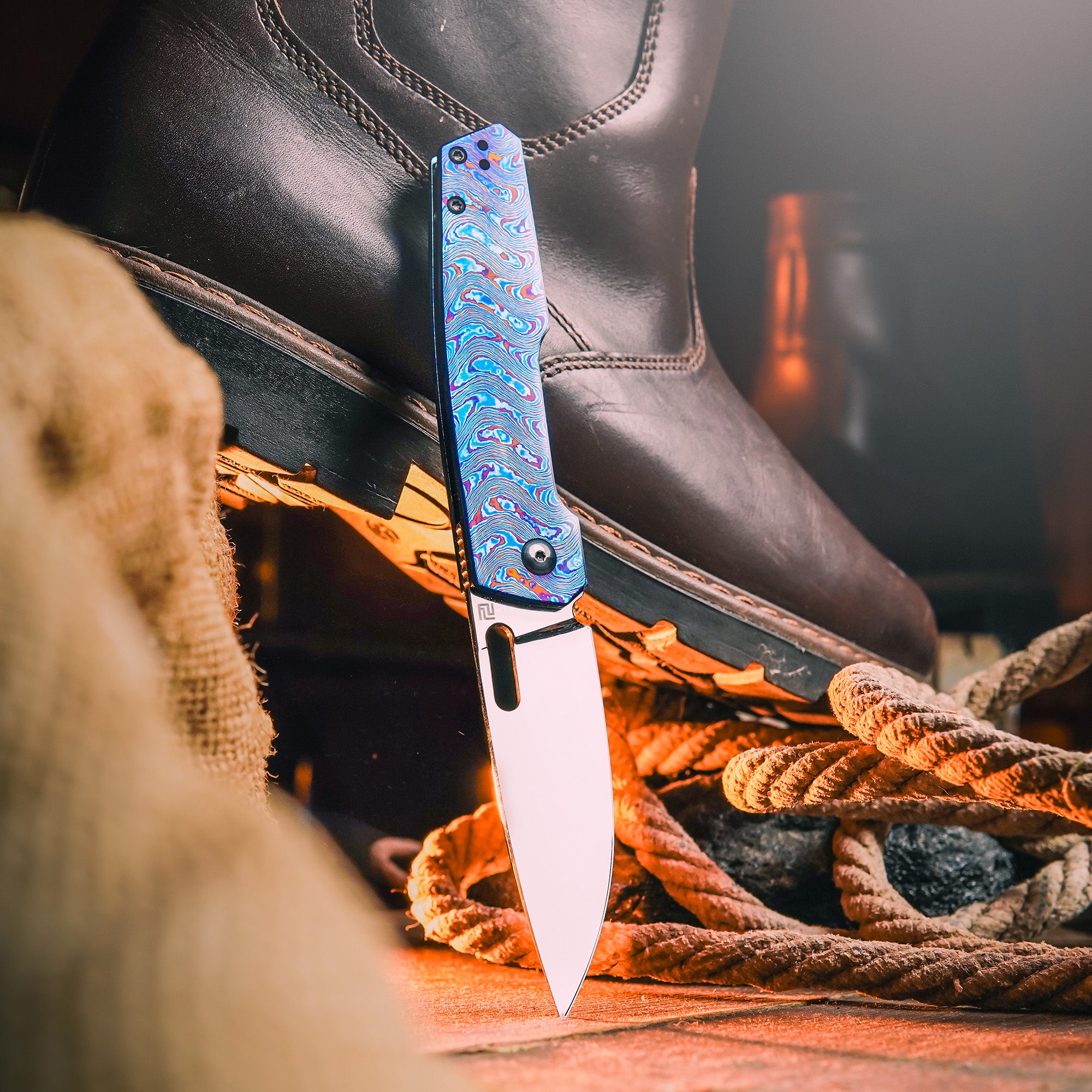
The 1879G combines a titanium frame lock with flowing fat carbon inlays across every production colorway.
This review covers every live Fragarach 1879G configuration on Artisan Cutlery's site, with every specification taken from the product listings, so you can decide between the two prototype builds and the three production colorways with real numbers in front of you.
A New Collaboration: Wayne Walter's Fragarach
The 1879G is Artisan Cutlery's collaboration with designer Wayne Walter, and the listing carries his own description of the brief: he wanted to create something 'authoritative and powerful for an EDC knife'. The result is a 3.72-inch drop point riding in a full titanium frame lock, wrapped in a handle that combines titanium with fat carbon on the production models.
It is also the first time the Fragarach name has been attached to a thumb-hole design. Where earlier Fragarach coverage centered on a flipper-tab opening, the 1879G moves deployment to a large thumb hole in the blade, which favors a slow, deliberate open or a quick flick, and gives left-handed users the same access as right-handed ones.
Fragarach 1879G Specifications at a Glance
| Specification | Value |
|---|---|
| Blade length | 3.72 in (94.5 mm), drop point, flat grind |
| Blade thickness | 0.13 in (3.2 mm) |
| Blade steel | S90V, HRC 60-62 |
| Overall length | 8.56 in (217.5 mm) |
| Closed length | 4.84 in (123 mm) |
| Handle | Titanium, or titanium with fat carbon inlay |
| Clip | Titanium |
| Pivot | Ceramic ball bearing |
| Lock type | Frame lock |
| Weight | 5.29 oz (150 g) |
That 150-gram weight tells you this is a substantial, full-size folder rather than a featherweight dress knife. The drop-point blade with a flat grind is a practical cutter first, and the frame lock keeps the build slim while providing the rock-solid lockup that premium EDC knives are known for.
Every Fragarach 1879G Configuration, Compared
Artisan currently lists the 1879G in two prototype builds and three production colorways. All five share the same platform, steel, and dimensions; what changes is the finish of the blade and the character of the handle.
| Model | Blade finish | Handle | Price |
|---|---|---|---|
| 1879G-GY-P / 1879G-BBU-P (prototype) | Stonewash / black PVD | Titanium, fat carbon on selected builds | $266.65 |
| 1879G-BBK | Black PVD, sidecut detail | Black titanium with fat carbon | $199.99 |
| 1879G-DM | Sand polish | Titanium with fat carbon (Dark Matter Polar) | $199.99 |
| 1879G-BDM | Black PVD | Black titanium with fat carbon (Dark Matter Polar) | $199.99 |
The prototype pair carries a premium price of $266.65 and is offered in grey and black colorways, finished in stonewash or black PVD. The three production configurations sit at a friendlier $199.99 and split the difference between two looks: the sand-polished Dark Matter Polar build for carriers who want a brighter blade, and the black PVD builds (1879G-BBK with its sidecut detail, and 1879G-BDM) for the fully darkened, low-reflectivity look.
S90V: The Edge-Retention Champion Behind the Blade
S90V is a powder-metallurgy stainless steel from Crucible Industries, and it is one of the highest-edge-retention blade steels in production. The Fragarach runs it at HRC 60-62, which is exactly where this steel wants to be: hard enough to hold a working edge through long stretches of cutting, with enough vanadium carbides in the mix to resist abrasive wear.
The tradeoff is real and worth knowing before you buy. S90V holds its edge longer than almost any mainstream stainless, but it is noticeably more difficult to sharpen than a steel like D2 or 14C28N once that edge finally dulls. A guided sharpening system or fine stones are the practical answer, and our S90V steel guide walks through the full behavior. For the maker behind the steel, Crucible Industries has the company history, and the knife steel overview on Wikipedia is a good primer on what edge retention means in practice.
Thumb Hole Deployment and the Frame Lock
Two design decisions define how the Fragarach 1879G feels in the hand: how it opens, and how it locks.
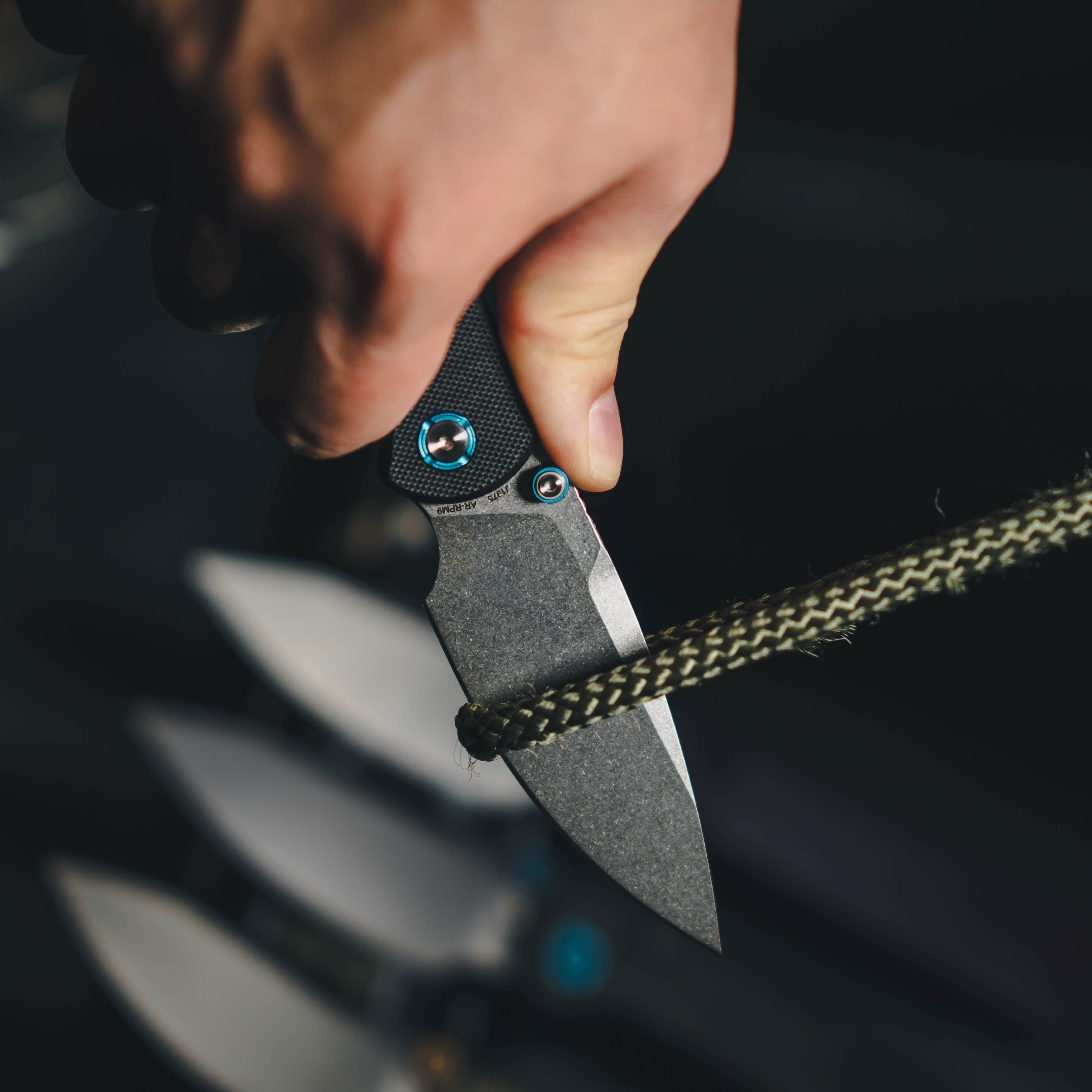
The thumb hole sits in the blade ahead of the pivot, giving you a purchase point that works the same way for either hand. It is a deployment style that rewards a clean flick and makes the knife genuinely ambidextrous, without adding a flipper tab to the profile. If you are weighing opening mechanisms, our thumb hole vs thumb stud vs flipper comparison lays out the differences.
The frame lock is the premium folder standard: one titanium handle scale flexes inward behind the blade tang to lock the knife open, then releases with a thumb press. It contributes to the slim handle profile and delivers the confidence of a solid lockup on a hard-use blade. For the mechanics, Wikipedia's frame lock article is a reliable reference, and if you are comparing lock types for durability, our lock strength comparison covers the broader picture.
Underneath all of it, the pivot runs on a ceramic ball bearing, the same pivot system Artisan uses across its premium lines. Bearings reduce friction at the pivot so the blade swings smoothly whether you open it slowly or flick it fast; the mechanics of bearings versus washers are covered in our knife pivot guide.
Titanium and Fat Carbon Handles
Every production Fragarach 1879G pairs titanium with a fat carbon inlay, and the result is a handle that is simultaneously premium and light in character. Titanium brings the strength-to-weight ratio and corrosion resistance that make it the default material for high-end EDC; titanium is the same aerospace material Artisan uses across its flagship G-series knives, and our best Artisan titanium folders guide shows where the Fragarach sits in that lineup.
Fat carbon is a molded composite made from layered carbon fiber sheets, pressed into flowing, marbled patterns. Because the layers are randomized during molding, no two fat carbon handles look exactly alike, which is a large part of why collectors chase them. The Dark Matter Polar builds take that to an extreme with a black-and-white flowing pattern. Our fat carbon handle guide explains the material in depth, and carbon fiber is the base material behind it.
Prototype vs Production: Which Fragarach to Choose
The $66.65 gap between the prototype pair and the production colorways is the whole decision, so it helps to understand what a prototype build means at Artisan. Prototype releases are early, limited batches that carry the design before or alongside full production, and they often become the pieces collectors track hardest. The two 1879G prototypes are grey and black builds at $266.65 with stonewash or black PVD finishes.
The production trio at $199.99 is the practical recommendation for most buyers: same S90V blade, same frame lock, same dimensions, and the same fat carbon character, at a price that sits comfortably in the premium-but-reasonable range. Between the three, choose the finish first:
- 1879G-DM (sand polish): the brightest blade of the production group, with the Dark Matter Polar fat carbon for contrast. Best all-rounder look.
- 1879G-BBK (black PVD, sidecut): a fully darkened blade with an extra sidecut detail on the handle. The most aggressive visual.
- 1879G-BDM (black PVD, Dark Matter Polar): black blade with the black-and-white polar fat carbon. The most dramatic handle.
Collectors who want the earliest, lowest-numbered builds of the platform should look at the prototype pair; everyone else should pick a production colorway and save the difference.
Caring for a Black PVD or Sand-Polished S90V Blade
Finishes and steel both affect your care routine. Black PVD coating is tough and corrosion-resistant, but it will show wear at the edge over time as sharpening exposes bare steel; the sand-polish build shows scratches more readily but is trivial to maintain. Either way, the standard rules apply: wipe the blade after use, keep the pivot clean, and touch up the edge before it gets dull rather than after. S90V at HRC 60-62 responds best to fine abrasives, and Science of Sharp has detailed studies of how high-hardness powder steels behave at the edge. For finish-specific care, our knife finish guide covers stonewash, satin, and PVD coatings.
Quick Fragarach 1879G Questions
- Is the 1879G a flipper? No. The new Fragarach opens through a thumb hole in the blade, not a flipper tab, and locks with a frame lock.
- What steel does it use? S90V at HRC 60-62 across every configuration, prototype and production alike.
- Why are the prototypes more expensive? The two prototype builds are listed at $266.65 versus $199.99 for production colorways, reflecting their limited, early-release status.
- How heavy is it? 5.29 oz (150 g), with a 3.72-inch blade and an 8.56-inch overall length.
- Is it ambidextrous? The thumb hole and the frame lock both work from either side, which makes the 1879G unusually left-hand-friendly.
Should You Buy the Fragarach 1879G?
- Collectors and early adopters: the grey and black prototype builds at $266.65 are the ones to track.
- Premium everyday carry: any production colorway at $199.99, with the sand-polish Dark Matter Polar build as the pick for daily carry.
- Fans of dark, low-reflectivity knives: the black PVD builds, 1879G-BBK or 1879G-BDM.
- Left-handed carriers: the thumb-hole deployment makes this one of the most accessible premium frame locks in the catalog.
Start with the 1879G-BBK production Fragarach, compare the Dark Matter Polar 1879G-BDM, or go straight for the limited prototype pair.
Find your ideal everyday carry configuration — explore the Artisan Cutlery folding knife collection for premium EDC folders built for reliable everyday carry.

Leave a comment
This site is protected by hCaptcha and the hCaptcha Privacy Policy and Terms of Service apply.